What Is the Average Settlement for a Lyft Accident in Texas?


Every article on this site is researched by our internal team, reviewed for legal accuracy against current Texas law, and held to State Bar of Texas advertising standards before publication. We do not publish content that overstates outcomes or makes promises about results.
Learn more about our
editorial standards .
Key Takeaways
- Lyft carries a $1 million liability policy in Texas during periods 2 and 3 of a ride.
- Texas bars recovery if you are found more than 50 percent at fault under the proportionate responsibility rule.
- CPRC § 16.003 gives you two years from the crash date to file a Lyft injury lawsuit.
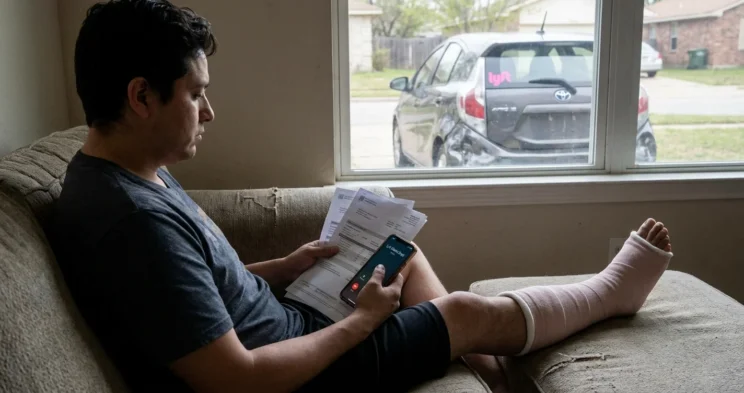
You were riding home in a Lyft after a long shift, scrolling through your phone, when the driver ran a stop sign and got T-boned at an intersection. Now, along with physical pain, you’ve got the financial kind, thanks to that enormous emergency room bill, plus the stress over missing days from work. The Lyft claims rep you speak with floats an offer that barely covers your co-pay, making you question what your case is really worth.
Lyft Accident Settlement Ranges in Texas
Lyft accident settlements in Texas typically fall into three categories, based on injury severity. Minor soft tissue injuries often range from a few thousand dollars up to about $25,000. Moderate injuries like fractures and disc damage can land victims $50,000 to $200,000. Catastrophic injuries and wrongful death claims can run from $500,000 into the millions, capped by Lyft’s $1 million policy.
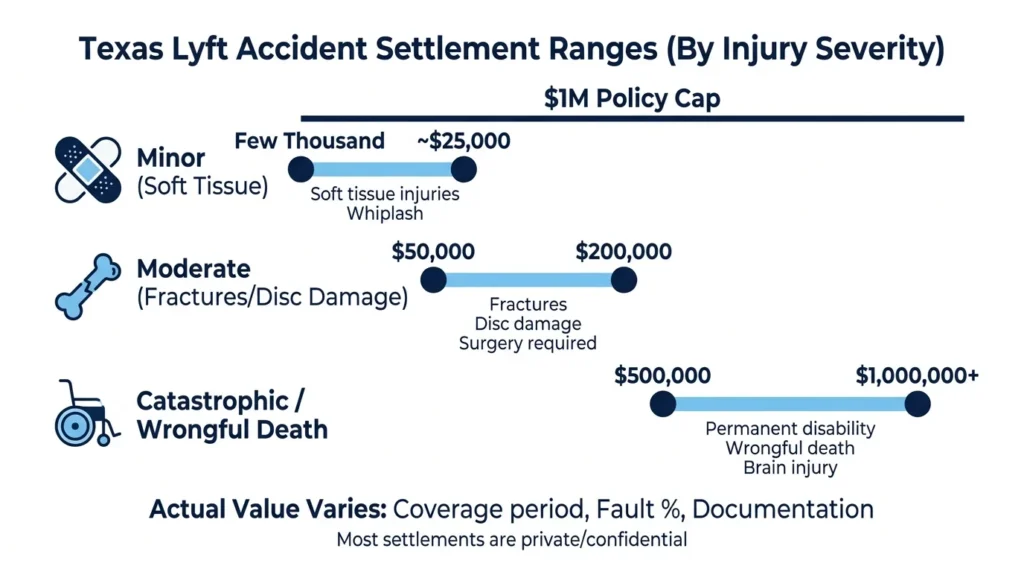
These are ranges, not promises. Two cases in which the injured parties received the same medical diagnosis can settle for very different amounts, depending on coverage period, fault allocation, and how well medical records are documented.
Rideshare companies prefer to resolve cases privately, often with confidentiality terms attached. That suppresses public data and makes precise averages hard to pin down. National figures from non-Texas sources should not be treated as a benchmark for what your claim is worth.
For broader context on injury claim values, see our analysis of average car accident settlements in Texas.
Lyft’s Insurance Periods & Texas Coverage Rules
Texas law sets the minimum insurance requirements for rideshare companies. Lyft uses a tiered insurance structure, and the driver’s status in the app at the time of your accident corresponds to a period that determines the coverage limit for your claim. The biggest jump in coverage happens the moment a driver accepts a ride request, which is why driver app status is often the most important factor.

Period 1: App On, No Ride Accepted
Period 1 covers the time when the driver has the Lyft app open but has not been matched with a passenger. During this window, Lyft provides contingent liability coverage of $50,000 per person, $100,000 per incident, and $25,000 for property damage.
“Contingent” matters here. Lyft’s Period 1 coverage is primary and does not require the driver’s personal auto insurer to deny the claim first (though most personal policies exclude commercial ride activity under a separate provision). Period 1 claims are the most likely to involve coverage gaps and disputes, and settlement values at this tier tend to be lower and more contested.
The rules governing insurance coverage for transportation network company drivers can be found in Texas Insurance Code Chapter 1954.
Periods 2 & 3: Ride Accepted Through Drop-Off
Period 2 begins when the driver accepts a ride. Period 3 covers the trip itself through passenger drop-off. During both periods, Lyft’s primary $1 million liability policy applies.
Texas Insurance Code § 1954.053 requires the rideshare company to carry an aggregate liability coverage minimum of $1 million for prearranged rides. Uninsured and underinsured motorist coverage is also available during this window, along with contingent comprehensive and collision coverage, subject to a $2,500 deductible.
If you were a passenger during Period 2 or 3, you are in the strongest position for a rideshare claim. The $1 million minimum policy is what makes serious-injury and catastrophic-injury claims financially viable. Pedestrians and people in other vehicles hit by a Lyft driver are covered under the same policy.
For a deeper look at how these claims work, see our overview of Texas rideshare-accident claims.
How Lyft’s Coverage Differs from Uber’s in Texas
According to state law, both companies must carry $1 million in liability insurance during periods 2 and 3. Neither offers a higher mandatory minimum.
Lyft’s contingent comprehensive and collision coverage carries a $2,500 deductible. Uber’s is also $2,500 for most drivers, with a lower $1,000 deductible only for Uber Marketplace rental vehicles. For most claimants, that distinction is minor.
Where the companies actually differ is in the claims-handling process. Lyft and Uber have different insurance carriers, with different adjuster timelines, documentation requests, and initial-offer patterns. Your experience working through each system will feel different, even though the insurance coverage requirement is the same.
Our Uber accident settlement guide clearly explains the claims process. An attorney familiar with both rideshare companies’ policies can quickly identify which coverage period applies to your accident.
Factors That Change What a Lyft Claim Is Worth
Several variables push a settlement number up or down from the ranges above. Injury severity and documented medical treatment form the basis for the claim amount. Total medical costs, both incurred and projected, anchor the calculation. If you have gaps in treatment, the rideshare company’s insurer will likely argue that your injuries were not as serious as you claim.
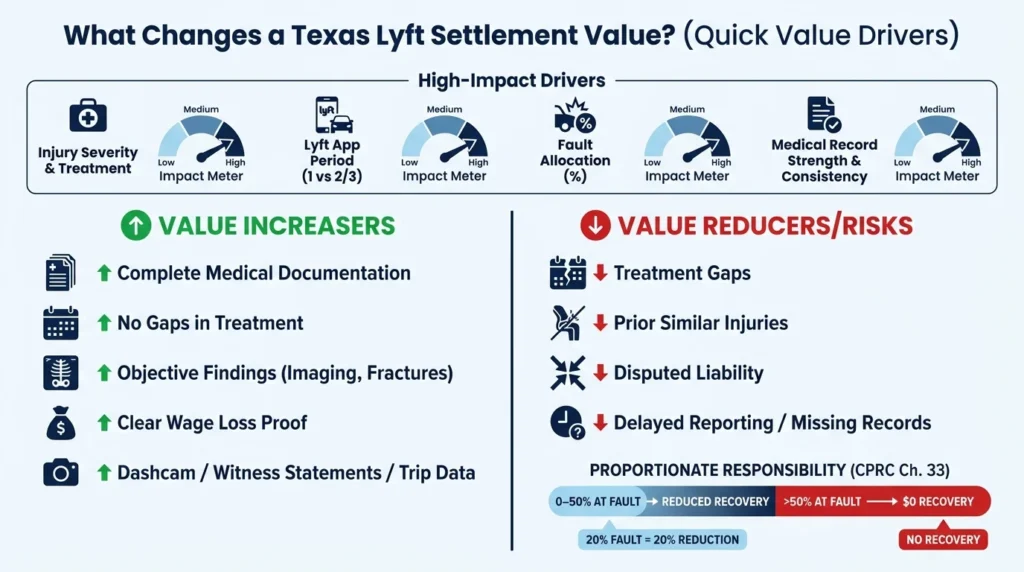
Lost wages and earning capacity matter, too. Current lost income is easy to prove. Future diminished earning capacity, however, requires expert testimony and becomes a major driver in serious-injury cases.
Texas uses a modified comparative fault rule called proportionate responsibility under Texas Civil Practice and Remedies Code Chapter 33. If you are found more than 50 percent at fault, you recover nothing. Even a 20 percent fault finding cuts your recovery by 20 percent. That’s why claims adjusters try to drive down the number by routinely contesting the fault allocation.
Driver app status is the single most consequential factor for claim value. A Period 1 claim may settle for a fraction of what a Period 2 or 3 claim would under injury facts that are the same. Evidence quality also matters: Dashcam footage, Lyft’s internal trip data, medical records, and witness statements all affect how aggressively an adjuster can push back.
Early low offers, slow medical records requests, and fault disputes are typical patterns of rideshare company insurers. An initial offer should never be treated as the best a company can do.
Filing Deadlines for Lyft Injury Claims in Texas
Under CPRC § 16.003, you have two years from the date of injury to file a personal injury lawsuit. Miss that window and your claim is barred, regardless of how strong it was.
The clock typically starts running from the crash date. (Tolling rules can apply for minors or when an injury was not immediately discoverable.) Two years sounds like plenty of time, but claim investigation, medical treatment, and pre-lawsuit demand timelines compress the practical window quickly.
The Texas Department of Licensing and Regulation governs transportation and delivery network companies’ operations, including driver history and trip logs. Early preservation of this evidence matters because retention periods are not indefinite. Once those records are gone, rebuilding the timeline becomes much harder.
Speaking with a rideshare-injury attorney before the deadline approaches protects your right to recover and gives you time to build your case properly. Our client reviews reflect how taking action early can positively change a case’s outcome.
Talk to a Texas Lyft Accident Attorney
Lyft claims are technical, and the difference between a fair settlement and a lowball offer often comes down to who is handling the negotiation. Angel Reyes & Associates has over 30 years of experience handling rideshare and car accident claims across Texas. We work on contingency (meaning we receive no fee unless we win) and offer free consultations 24/7. Contact us today to discuss your Lyft accident claim.
Past results do not guarantee future outcomes.
Lyft Claim FAQs
Can I file a Lyft injury claim if the driver was an independent contractor, not a Lyft employee?
Yes. Lyft classifies its drivers as independent contractors, but that does not prevent you from claiming against Lyft’s insurance policy. Texas law requires Lyft to carry coverage that applies during the ride, regardless of the driver’s employment classification.
Does Lyft's $1 million policy cover my medical bills directly, or does it pay only if I sue?
The policy is liability coverage, so it pays the injured party’s damages as part of a settlement or court judgment. You do not need to file a lawsuit to receive payment, but you must submit a formal claim and negotiate with the insurer.
Can I still recover damages if I did not have health insurance at the time of the Lyft crash?
Yes. Lacking health insurance does not disqualify you from pursuing a Lyft injury claim. Medical bills paid out of pocket are documented economic damages, and providers may agree to defer payment until your claim resolves through a medical lien arrangement.
What happens if the Lyft driver who hit me had a suspended license?
A suspended license does not void Lyft’s coverage during an active ride period. Lyft’s insurer may attempt to recover costs from the driver separately, but that dispute is between Lyft and the driver and does not reduce your right to compensation.
Are punitive damages available in a Texas Lyft accident case?
Texas law allows punitive damages, called exemplary damages, under Texas Civil Practice and Remedies Code Chapter 41 when the defendant acted with malice or gross negligence. They are rare in standard crash cases but can apply if evidence shows that the driver acted with conscious disregard for others’ safety.
About the Authors

Angel Reyes
Writer
Angel L. Reyes, III is the Founder and Managing Partner of Angel Reyes & Associates. A nationally recognized trial attorney and business leader, Angel has helped over 70,000 injury victims recover more than $1 billion since founding the firm in 1993. Named to the Texas Super Lawyers list annually since 2008, Angel brings Wall Street experience, Ivy League education, and a deep commitment to client advocacy. He is a frequent legal commentator and published author with extensive contributions to legal scholarship, trial strategy, and consumer protection.

Kyle Nicolas
Editor
Kyle Nicolas is the Web Content & SEO Manager at Angel Reyes & Associates. He has more than 10 years of experience as a marketing co...

Angel Reyes
Reviewer
Angel L. Reyes, III is the Founder and Managing Partner of Angel Reyes & Associates. A nationally recognized trial attorney and business...