Can a Truck Driver’s Electronic Logs Be Falsified?


Every article on this site is researched by our internal team, reviewed for legal accuracy against current Texas law, and held to State Bar of Texas advertising standards before publication. We do not publish content that overstates outcomes or makes promises about results.
Learn more about our
editorial standards .
Key Takeaways
- ELD records can be falsified, but federal rules preserve the original data.
- Every ELD edit carries a code showing who requested the change, when, and why.
- Unassigned driving time and convenient malfunctions are audit-trail red flags.

An 18-wheeler drifted across the lane line on I-35, and weeks later the carrier’s records say the driver was rested and well inside his hours; however, what you saw does not match the paperwork.
Yes, Electronic Logging Devices (ELD) Can Be Falsified, But the Regulation Builds In an Audit Trail
Electronic logging device records can be falsified or tampered with, and 49 CFR 395.8(e) bars both. The rule that requires the device also requires it to preserve evidence of anyone who alters what it recorded.
Federal law treats falsification and tampering as two separate problems.
- Falsification is a content problem: the record says something untrue.
- Tampering is a device problem: someone disabled or reengineered the hardware so it could not record accurately at all.
49 CFR 395.8 prohibits both, and the distinction matters when an attorney reviews the data. A falsified entry usually leaves fingerprints in the edit history, while a tampered device leaves gaps where data should exist.
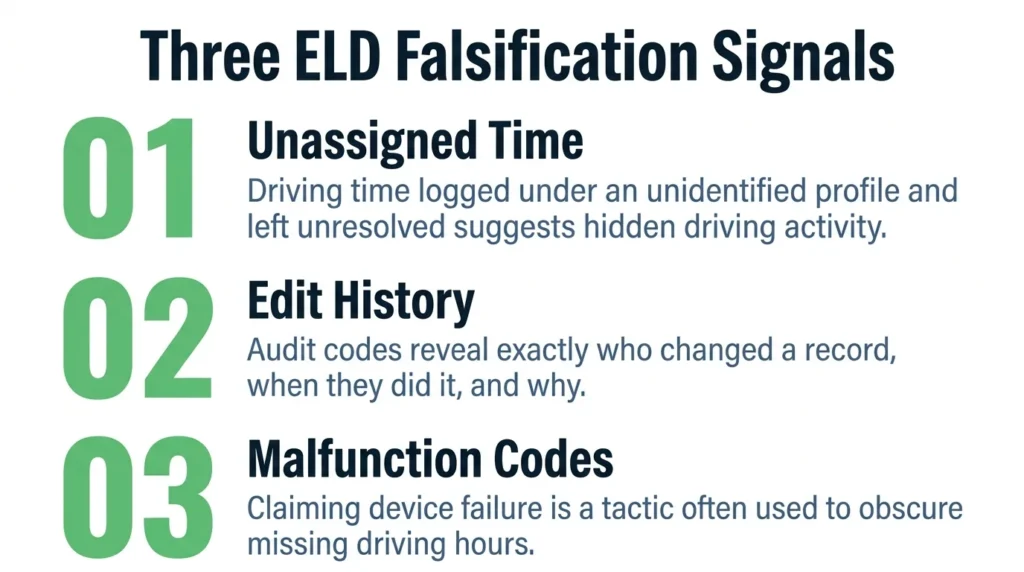
Electronic logs are harder to falsify than the paper logbooks they replaced, but they are not immune. Three signals do most of the work in Texas truck accident cases:
- unassigned driving time
- the edit history showing who changed what and when
- malfunction codes used to explain away missing hours
The ELD Mandate & the Rules Against False Reports and Tampering
Most commercial drivers who keep records of duty status have been required to use an electronic logging device since December 18, 2017. The mandate carries limited exceptions and two explicit prohibitions.
- Carriers must require ELD use for most drivers subject to records-of-duty-status rules. Exceptions are limited: short-haul drivers who use those records 8 or fewer days in any 30-day period, driveaway-towaway operations, and pre-2000 model year engines.
- Drivers record four duty statuses: Off duty, Sleeper berth, Driving, and On-duty not driving.
- Drivers must submit their records to the motor carrier within 13 days.
- Under 395.8(e)(1), no driver or motor carrier may make a false report in connection with a duty status.
- Under 395.8(e)(2) and (e)(3), no driver or carrier may disable, deactivate, jam, block, degrade, reengineer, reprogram, or otherwise tamper with an ELD so it fails to accurately record and retain required data, and no one may permit or require another person to do so.
Those two prohibitions are the foundation for everything that follows. The rest of the regulation makes violations visible.
The Carrier’s Administrative Duties That Make the Audit Trail Possible
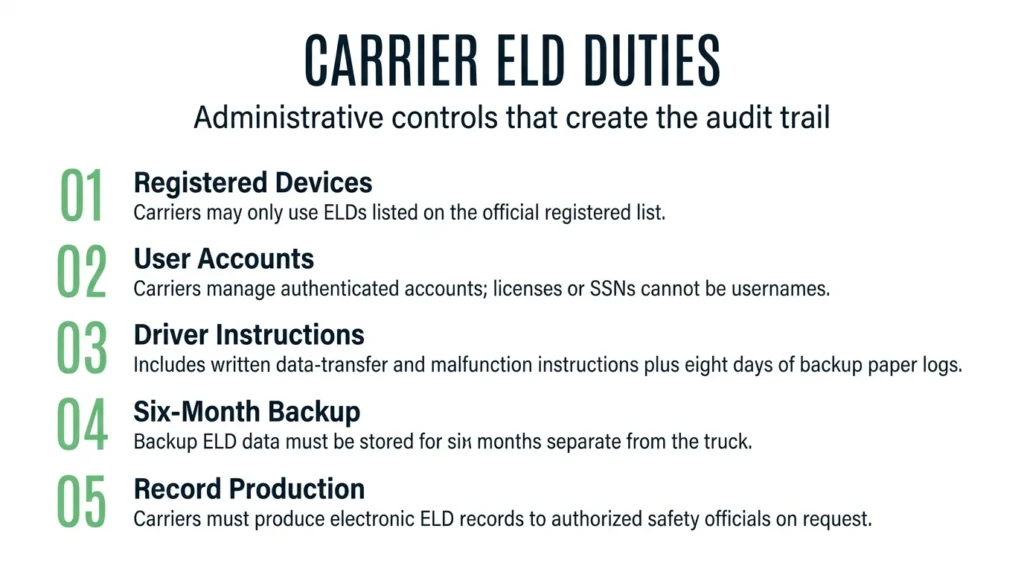
Detecting electronic logging device tampering depends on carrier-side controls, because they determine who could have touched a record and whether a copy still exists. 49 CFR 395.22 sets out those duties.
- Carriers may use only an ELD listed on the FMCSA registered ELD list.
- Carriers must create, deactivate, and update ELD user accounts and ensure that properly authenticated individuals hold accounts with appropriate rights. A driver’s license number or Social Security number cannot be used as or within a username.
- Carriers must give drivers written instruction sheets covering data transfer and malfunction reporting, plus blank records-of-duty-status forms for at least 8 days as a manual backup.
- Carriers must keep backup copies of ELD data for 6 months on a device separate from the truck.
- Carriers must produce ELD records electronically to authorized safety officials on request.
The six-month backup requirement carries real weight after a crash. It is often why a complete data set still exists when an attorney sends a preservation letter.
Account controls matter too. If only three people at a Dallas carrier could request an edit, the list of suspects is short.
Edits, Annotations, & Certification: Who Changed What and When
An electronic log is not a fixed document. It is a running record with a certification step and a permanent change history, governed by 49 CFR 395.30.
A driver must review, edit, correct, and certify each 24-hour record, affirming that the entries and record of duty status for that period are true and correct. Any edit after certification requires the driver to certify again.
Drivers and carriers do not hold equal authority here. A driver may edit, annotate, and enter missing information directly through the device prompts.
A carrier may only request an edit after the driver submits the record. Any edit requested by a system or by anyone other than the driver requires the driver’s electronic confirmation or rejection, so a carrier cannot quietly rewrite what a driver logged.
Every change or addition must be annotated with a stated reason, so a changed number without an explanation is itself a compliance problem.
Carriers must also not alter or erase the original hours-of-service information or the source data streams underlying it. The original has to survive alongside the edit.
The technical standard in Appendix A to Subpart B of Part 395 makes that history readable. Each event record carries an Event Record Status code (1 for active, 2 for inactive-changed, 3 for inactive-change requested, 4 for inactive-change rejected) and an Event Record Origin code (1 for automatically recorded, 2 for driver-edited, 3 for an edit requested by another authenticated user, 4 for time assumed from an unidentified driver profile).
The device retains the original records even after allowed edits. A reviewer can reconstruct what the ELD generated on its own, what a human changed, who asked for the change, whether the driver accepted or rejected it, and the reason given.
Two Falsification-Adjacent Patterns: Unassigned Driving Time & Malfunction Codes Used as Cover
Direct false entries are only one form of ELD log falsification. Two other patterns show up often enough that investigators and attorneys look for them by default.
Unassigned Driving Time That Nobody Resolves
Unidentified driving time accumulates when a driver operates the truck without logging in and ignores the device’s visual and audible prompts. The ELD records that time under an “Unidentified Driver” profile instead of dropping it.
After 30 minutes of unidentified driving in 24 hours, the device triggers a data-diagnostic flag that appears across all driver profiles for that day and the following 7 days. The FMCSA ELD guidance on unidentified driving time sets out what happens next.
The carrier must either annotate the record with an explanation or assign the time to the correct driver. A carrier may propose an assignment, but the driver has to accept it, so unidentified hours cannot be moved onto someone unilaterally.
Carriers must keep unidentified driving records for at least 6 months, and rejected unidentified-time events must stay viewable at roadside for 8 days. Large or recurring blocks of unassigned time left unexplained are one of the clearest audit-trail signals, because this is the one category a carrier must affirmatively resolve rather than passively store.
A Malfunction That Conveniently Covers a Gap
A genuine malfunction excuses missing ELD data for a bounded window. That is why a reported malfunction deserves a close look when it covers hours that are otherwise hard to explain. 49 CFR 395.34 and the FMCSA guidance on malfunctions and data diagnostic events define the categories and the response timeline.
The recognized categories are power, engine synchronization, timing, positioning, data recording, and data transfer. Each has a defined trigger, such as:
- losing ELD power for 30 or more minutes of aggregated driving time in 24 hours
- losing engine control module connectivity for 30 or more minutes in 24 hours
- an internal clock that deviates 10 or more minutes from true time

When a malfunction occurs, the regulation sets a specific sequence.
- The driver must note the malfunction and give the carrier written notice within 24 hours.
- The driver must reconstruct the current day’s duty status and the prior 7 days on paper unless those records are already available, then keep logging manually until the device is repaired.
- The carrier must correct, repair, or replace the device within 8 days of discovery or notification.
- If the carrier needs longer, it must notify its FMCSA Division Administrator within 5 days with the malfunction details and evidence of its repair efforts.
That timeline makes a claimed malfunction testable. If no written notice exists, no paper reconstruction was produced, and no repair record appears within the eight-day window, the malfunction looks less like a hardware failure and more like an explanation built afterward.
Civil penalties and out-of-service consequences can follow false reports and device tampering. For an injured Texan, the more immediate point is evidentiary: the rules that punish falsification also generate the records that expose it.
Talk to a Texas Truck Accident Attorney About ELD Evidence
Electronic logging data is perishable, and the carrier controls it. Edit histories, unassigned-time records, malfunction notices, and the six-month backup file are evidence a Texas truck accident case can turn on, and they are easier to secure early than to reconstruct later.
If you were hurt in a crash with a commercial truck in Texas and the driver’s hours do not add up, Angel Reyes & Associates can review what happened and work to preserve the log data before it ages out. The firm has guided injured Texans through the legal process for over 30 years from over 20 locations across the state; its team includes investigators and accident reconstruction professionals, and over $1 billion has been recovered on behalf of its clients.
Contact Angel Reyes & Associates for a free consultation to review your options; clients don’t pay any legal fees unless we win.
Past results do not guarantee future outcomes.
How Electronic Logs Get Falsified FAQs
Can a Truck Driver Refuse to Certify or Recertify an ELD Record?
Yes, certifying a 24-hour ELD record is the driver’s own act, not the carrier’s, and any edit made after certification requires the driver to certify the record again before it stands. When a carrier or another authenticated user requests a change to a log, the driver can accept or reject it. A rejected request is coded as an inactive, rejected change, and the driver’s original entry stays the active record.
Can a Motor Carrier Change a Driver's ELD Log Without the Driver's Permission?
No. A carrier may only request an edit after the driver has submitted the record, and any edit requested by a system or by anyone other than the driver requires the driver’s electronic confirmation or rejection before it takes effect. The device also keeps the original, pre-edit data alongside any accepted change, so a carrier cannot quietly rewrite what a driver logged.
What Penalties Can a Driver or Carrier Face for ELD Falsification or Tampering?
A false duty-status report or ELD tampering can carry civil penalties for the driver or carrier responsible. The exact penalty amount is not fixed and adjusts over time, so this is not a set dollar figure. The legal exposure is real, though, and it sits alongside the audit trail (edit history, unassigned-time records, and malfunction notices) that can show whether a violation actually happened.
What Must a Driver Do if the ELD Malfunctions Mid-Trip?
If the ELD malfunctions, the driver must note the malfunction and give the carrier written notice within 24 hours, then reconstruct the current day’s duty status and the prior 7 days on paper (unless those records are already available) and keep logging manually until the device is repaired. During a roadside inspection while the malfunction is unresolved, the driver must show those manually kept records. The carrier must correct, repair, or replace the device within 8 days of discovery or notice, or notify FMCSA within 5 days if it needs more time.
About the Authors

Angel Reyes
Writer
Angel L. Reyes, III is the Founder and Managing Partner of Angel Reyes & Associates. A nationally recognized trial attorney and business leader, Angel has helped over 70,000 injury victims recover more than $1 billion since founding the firm in 1993. Named to the Texas Super Lawyers list annually since 2008, Angel brings Wall Street experience, Ivy League education, and a deep commitment to client advocacy. He is a frequent legal commentator and published author with extensive contributions to legal scholarship, trial strategy, and consumer protection.

Kyle Nicolas
Editor
Kyle Nicolas is the Web Content & SEO Manager at Angel Reyes & Associates. He has more than 10 years of experience as a marketing co...

Angel Reyes
Reviewer
Angel L. Reyes, III is the Founder and Managing Partner of Angel Reyes & Associates. A nationally recognized trial attorney and business...