What to Do After a Motorcycle Accident in Texas


Every article on this site is researched by our internal team, reviewed for legal accuracy against current Texas law, and held to State Bar of Texas advertising standards before publication. We do not publish content that overstates outcomes or makes promises about results.
Learn more about our
editorial standards .
Key Takeaways
- Texas law requires you to stop, render aid, and notify police after a crash with injuries.
- Riders 21 and older may skip a helmet only with qualifying insurance or proof of a safety course.
- CPRC § 16.003 gives you two years from the crash date to file a Texas personal injury lawsuit.
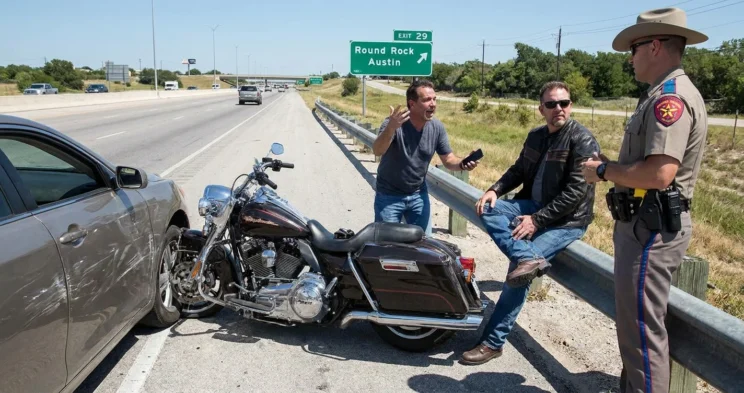
You were heading home on I-35 through Round Rock when a driver drifted into your lane and clipped your bike. You’re on the shoulder, with a hurt leg, and the other driver is already talking fast. You’re not sure what to do first.
What happens in the next few minutes and the next few days will determine the compensation you can get later. Here’s what to do in this critical time.
Motorcycle Crashes in Texas: The Stakes Are High
Motorcycle crashes in Texas carry huge risk. While motorcycles represent a small share of vehicles on the road, they account for a much larger share of serious injuries and deaths. The decisions you make at the scene and during the first 72 hours after the accident often affect the outcome of your insurance claim and whether fault gets unfairly pinned on you.
Texas has seen a rise in motorcyclist deaths in recent years, according to TxDOT motorcyclist fatality data. Insurers know this, and they are often quick to put the fault on the bikers.
Here we cover what to do at the crash scene and in the first 72 hours. For longer-term planning, see our guide on legal strategies after a Texas motorcycle accident.
Your Legal Duties at the Crash Scene
Under Texas law, every driver and rider involved in a crash has specific duties. You must stop, stay at the scene, determine whether anyone needs aid and provide it, and report the incident to the police if it results in injury, death, or damage that prevents a vehicle from being safely driven. Skipping these steps can be a criminal offense and will damage any future claim you make.
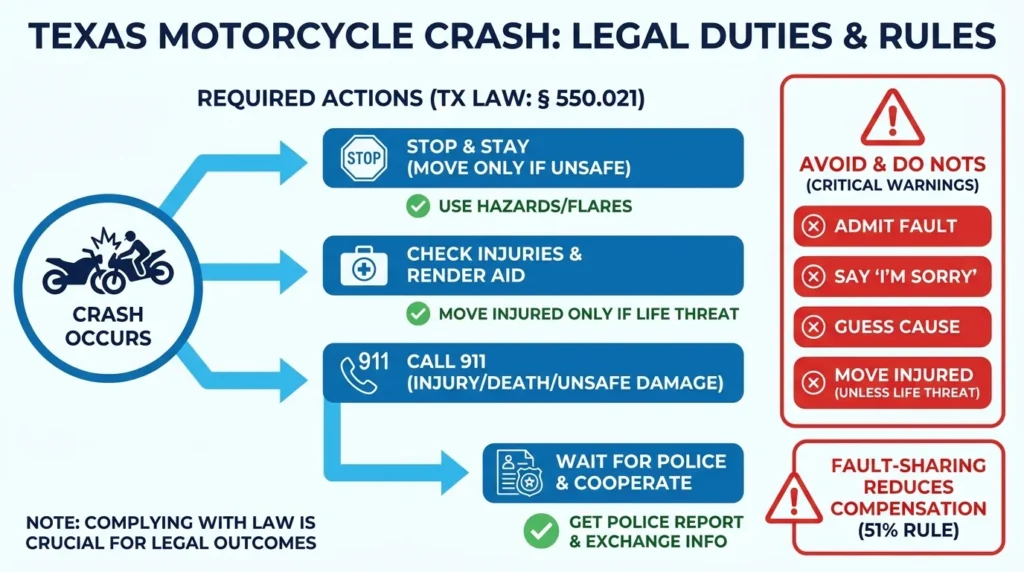
The duty to stop and render aid comes from Texas Transportation Code § 550.021. Failing to comply is treated as a serious crime, not a paperwork problem.
Call 911 even if the other driver wants to settle the matter privately—a remedy that rarely ends well for the biker. You want to have a police report, as this becomes the essential document that supports your insurance claim.
While you wait for officers:
- Move only if staying in place puts you in more danger.
- Do not move injured people unless there is an immediate life threat.
- Turn on hazard lights or set out flares or markers if you have them.
Do not apologize, admit fault, or make guesses about the cause of the crash. A simple “I’m sorry” can be twisted into an admission later. Texas has a fault-sharing rule that can cut your compensation if you are blamed for part of the crash. See our explanation of Texas comparative negligence and the 51% rule for more details.
Document the Scene & Exchange Information
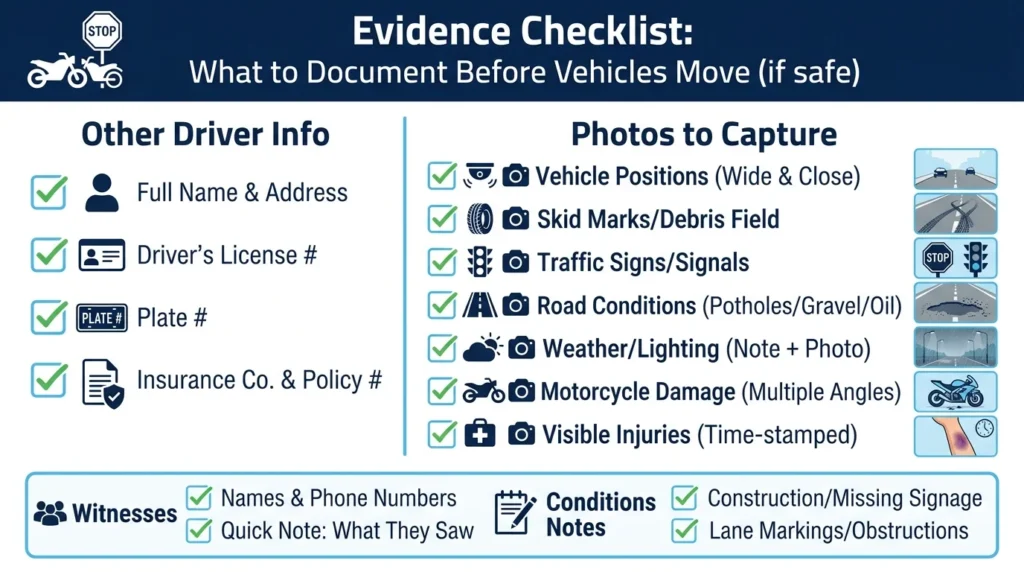
Before vehicles are moved, collect as much information as you can. Get the other driver’s full name, address, driver’s license number, license plate, insurance carrier, and policy number. Take photos of vehicle positions, skid marks, traffic signs, road conditions, your motorcycle’s damage, and any visible injuries.
Talk with witnesses and get their phone numbers. Witness accounts carry real weight in motorcycle cases, since insurers often assume the rider was at fault. Note the weather, lighting, road surface, and any construction or missing signage that played a role in the crash.
Then get medical care, even if you feel OK. Keep in mind that adrenaline masks pain. Plus, if you avoid treatment, insurance adjusters can argue that your injuries were minor. Many common injuries in motorcycle accidents take hours or days to fully surface.
If you aren’t sure you collected all the evidence you need, a Texas motorcycle accident attorney can review your documentation and flag gaps before they hurt your claim.
Texas Helmet Law & How It Affects Your Claim
Texas helmet rules are not all-or-nothing. Riders under 21 must wear a helmet. Those who are 21 and older can legally ride without one if they carry qualifying health insurance or have completed an approved safety course, as stated in Texas Transportation Code § 661.003.
Insurers are aware of this rule, and so they push back on claims from riders who don’t wear protective headgear. They may argue that the lack of a helmet made head or neck injuries worse, which can reduce the damages you can collect under Texas proportionate responsibility rules, covered in Texas Civil Practice and Remedies Code (CPRC) Chapter 33.
If you qualify for the exemption, prove it. Keep proof of qualifying insurance or your safety course certificate with your gear. If you wore a helmet, photograph it. A cracked or scuffed helmet is strong evidence of crash severity.
One key point: Whether you wore a helmet does not decide who caused the crash—it only affects damages tied to head and neck injuries. Liability for the crash itself is judged separately.
Steps to Take Within 72 Hours of the Crash
You’ll have a lot to do after the accident, because the first three days can make or break your case. You’ll need to notify your insurer, seek medical care, obtain the police report, and meet the deadline to file that report with your carrier.
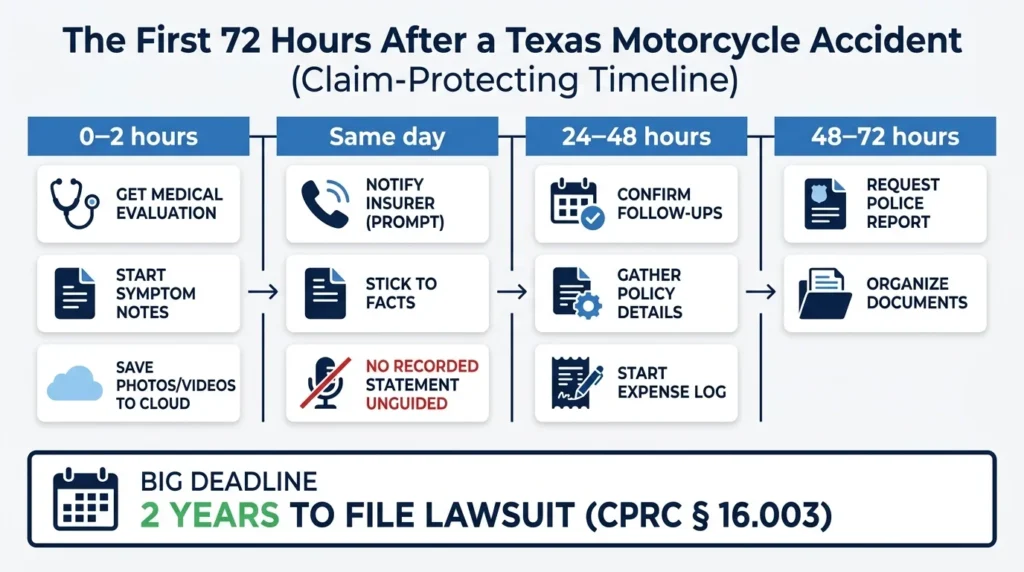
It’s essential that you inform your insurance carrier within the time your policy requires. Most Texas policies demand prompt notice. Stick to facts: date, location, parties involved. Do not give a recorded statement without legal guidance.
Look closely at your uninsured and underinsured motorist coverage. If the at-fault driver has no insurance or thin limits, your UM/UIM policy may be your main source of payment for your medical bills. Our uninsured motorist accident guide outlines how this coverage works in Texas.
Keep every medical appointment. Follow the treatment plan. Missed doctor visits become arguments that you healed faster than you really did.
Request the police report from the investigating agency once it is filed. If Department of Public Safety troopers were at the scene, you can request their report through TxDOT’s crash-records process.
Keep an eye on the calendar. Under Texas Civil Practice and Remedies Code § 16.003, you generally have two years from the crash date to file a personal injury lawsuit. Miss that deadline and your case will likely be over before it starts.
Reviewing your policy with an attorney costs nothing and can clarify your options before you respond to any claims adjuster.
Talk to a Texas Motorcycle Accident Attorney
Angel Reyes & Associates has over 30 years of experience handling Texas motorcycle accident cases statewide and has recovered more than $1 billion for clients. We offer free consultations and work on contingency, meaning we don’t get paid unless we win, and that matters when you are worried about lost wages and medical bills.
Our team is available 24/7 and can handle most of your case remotely. Contact us today to discuss your situation.
Past results do not guarantee future outcomes.
Motorcycle Accident FAQs
Can I file a Texas motorcycle accident claim if the crash happened partly on private property?
Texas law generally allows personal injury claims regardless of where a crash occurs, including parking lots and private roads. The key factors are who was at fault and whether the injured rider can document the circumstances.
What happens if I was a passenger on the motorcycle, rather than the rider?
As a passenger, you generally have a strong claim because you had no control over the bike. You may be able to pursue compensation from the at-fault driver, the motorcycle operator, or both, depending on how the crash happened.
Does Texas require motorcycle riders to carry liability insurance?
Yes. Texas requires all motor vehicle operators, including motorcyclists, to carry minimum liability coverage of $30,000 per injured person, $60,000 per crash, and $25,000 for property damage. Riding without it can result in fines and complicates a biker’s recovery after a crash.
Can a road in poor condition be the basis for a Texas motorcycle accident claim?
Yes, but claims against a Texas government entity follow a different process and have shorter notice deadlines than standard injury lawsuits. The Texas Tort Claims Act governs these cases and limits how and when you can sue a city, county, or state agency.
Will a prior traffic violation affect my motorcycle accident claim in Texas?
A prior violation on its own will not bar your claim, but if it is recent and related to the crash circumstances, an insurer may try to use it to argue you were a higher risk. Texas proportionate responsibility rules focus on fault for the specific crash, not your general driving history.
About the Authors

Alex Ivanov
Writer
Alex Ivanov is a personal injury attorney at Angel Reyes & Associates, focused on car, truck, and motorcycle accident cases. Licensed in Texas and multiple federal districts, Alex brings international legal experience and a global education to his practice. He earned his LL.M. from Texas A&M University School of Law after graduating from Belarussian State University in 2016. Alex is fluent in Russian, English, Ukrainian, and Belarussian, and is recognized by multiple national trial lawyer associations for his results and leadership under 40.

Kyle Nicolas
Editor
Kyle Nicolas is the Web Content & SEO Manager at Angel Reyes & Associates. He has more than 10 years of experience as a marketing co...

Angel Reyes
Reviewer
Angel L. Reyes, III is the Founder and Managing Partner of Angel Reyes & Associates. A nationally recognized trial attorney and business...