Texas Motorcycle Helmet Laws and How They Affect Your Claim


Every article on this site is researched by our internal team, reviewed for legal accuracy against current Texas law, and held to State Bar of Texas advertising standards before publication. We do not publish content that overstates outcomes or makes promises about results.
Learn more about our
editorial standards .
Key Takeaways
- Texas riders under 21 must always wear a DOT-compliant helmet under Transportation Code § 661.003.
- Riders 21+ need a TDLR training certificate or a health insurance plan that covers motorcycle accident injuries to skip a helmet.
- No helmet does not bar recovery in Texas, but fault over 50% under CPRC Chapter 33 ends the claim.
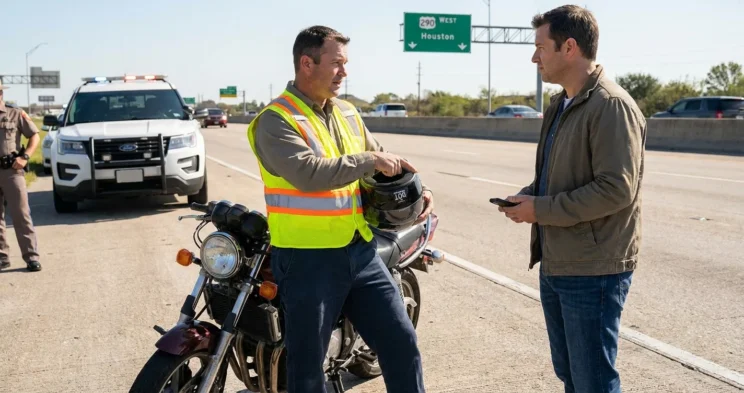
You were heading west on US-290 outside Houston when a driver drifted into your lane and clipped your bike. You went down hard, and the first thing the other driver’s insurance adjuster asked you about was your helmet. That single question can shape how the entire claim plays out.
Texas Motorcycle Helmet Laws: Who Must Wear One
Texas requires every motorcycle operator and passenger to wear a DOT-compliant helmet, with a narrow exemption for riders 21 and older who meet specific conditions. The rule is set by Texas Transportation Code § 661.003. Riders under 21 have no exemption and must always wear protective headgear.
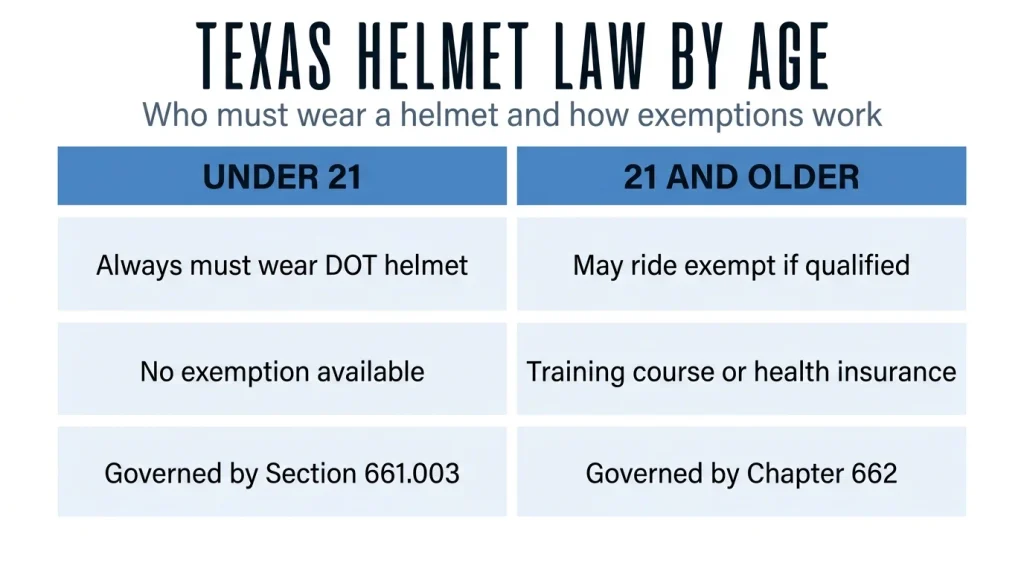
The helmet itself must meet Federal Motor Vehicle Safety Standard 218, the federal DOT standard. A novelty helmet or a non-certified shell does not satisfy the law. If you do not qualify for the age-21 exemption, a DOT-certified helmet is mandatory equipment, not optional.
The rule applies equally to operators and passengers. The operator is on the hook for making sure any passenger under 21 wears a compliant helmet, regardless of who owns the bike.
The safety reasoning behind the rule is well documented. NHTSA motorcycle safety data shows helmets sharply reduce the risk of fatal head injuries and traumatic brain injuries in crashes. That backdrop is important because the law conditions any exemption on a rider showing some form of safety preparation or financial coverage.
Texas Helmet Exemption Requirements for Riders 21 & Older
Riders 21 and older may legally ride without a helmet only if they meet one of two conditions. They must either have completed an approved motorcycle operator training course, or they must carry qualifying health insurance. Texas Transportation Code Chapter 662 provides the statutory framework, and current course approval authority rests with the Texas Department of Licensing and Regulation under 37 Tex. Admin. Code § 21.6.
The training course exemption requires a course administered under TDLR authority. Older guidance often points to the Department of Public Safety, but TDLR is now the correct agency. Hold on to your course completion certificate. That document becomes important if exemption status is questioned after a crash.
The health insurance exemption requires coverage that actually pays benefits for motorcycle accident injuries. A general health plan that excludes motorcycle-related injuries does not qualify. If you plan to rely on this exemption, read your policy and confirm the scope before you ride without a helmet.
The passenger rule follows the same logic. The operator is responsible for any passenger who does not independently qualify for the exemption. A passenger 21 or older with their own training certificate or qualifying coverage meets the exemption on their own.
There is also a rider-rights point worth knowing. Under § 661.003(c-1), an officer may not stop or detain you solely to check your exemption status. A traffic stop has to be based on some other lawful reason. To learn more about how these rules play out in injury cases, see our overview of Texas motorcycle accident claims.
Helmet Status & Comparative Fault in Texas Claims
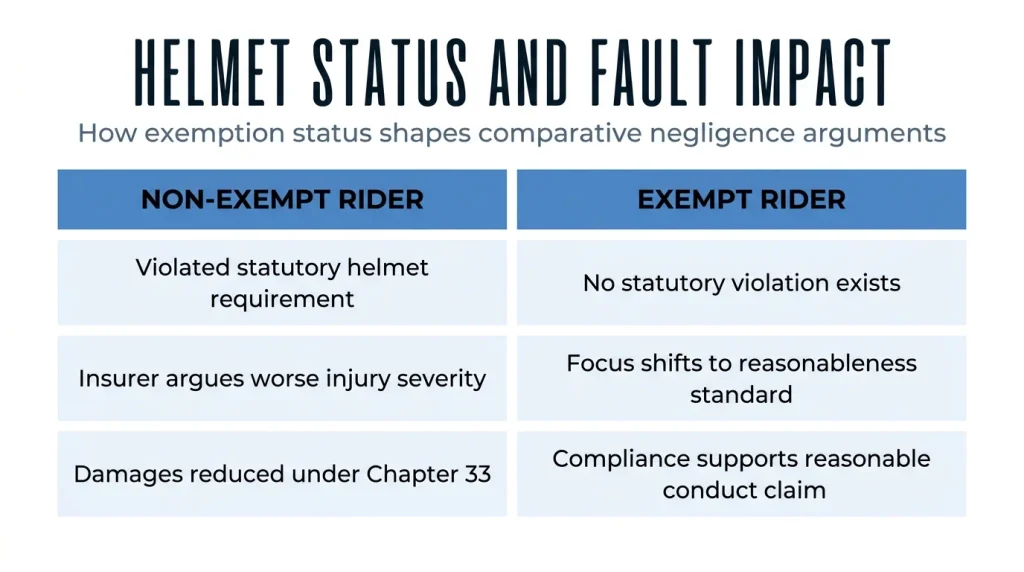
Helmet use rarely decides liability for the crash itself. Instead, it usually shows up as a severity argument inside Texas’s proportionate responsibility system. Whether you were legally required to wear a helmet, or were exempt and chose not to, changes how that argument is framed and how strong it is.
Non-Exempt Riders Who Were Not Wearing a Helmet
When a rider was legally required to wear a helmet and did not, the insurer has a stronger basis to argue that the rider’s choice worsened the injuries. Under Texas Civil Practice and Remedies Code (CPRC) Chapter 33, your percentage of responsibility reduces your recoverable damages. A finding of 51% or more bars recovery entirely.
The defense usually does not claim the helmet caused the crash. The argument is that the head and brain injuries would have been less severe with a compliant helmet, so damages should be cut. Insurers often lean on IIHS motorcycle fatality and injury data to support the severity framing.
That math is where claims get reduced or lost. Our breakdown of the Texas 51 percent bar rule for comparative negligence explains how the threshold works in practice. An attorney can challenge severity arguments early, before they harden into a low settlement position.
Legally Exempt Riders Who Were Not Wearing a Helmet
A rider who met the exemption conditions still faces a comparative fault argument, but the shape of it changes. The defense cannot point to a statutory violation. The question becomes whether a reasonable rider in the same circumstances would have worn a helmet anyway.
Courts evaluate comparative fault on reasonableness, not just legal compliance. Following the law is strong evidence of reasonable conduct, but it does not automatically end a severity-of-injury argument. For more on how these percentages get applied, see our explainer on how Texas modified comparative negligence works.
The distinction between exempt and non-exempt status is a major factual variable in negotiations. Solid exemption documentation can shut down insurer assumptions that you violated the law. The medical picture is also important, and our guide to common motorcycle accident injuries shows why crash mechanism, not helmet status, often drives the most serious harm.
Protecting Your Claim After a No-Helmet Crash
Texas law does not erase your right to recover damages just because you were not wearing a helmet. Fault is apportioned, not eliminated. The specific facts of the crash, your injuries, and your exemption status drive the outcome far more than the helmet question alone.
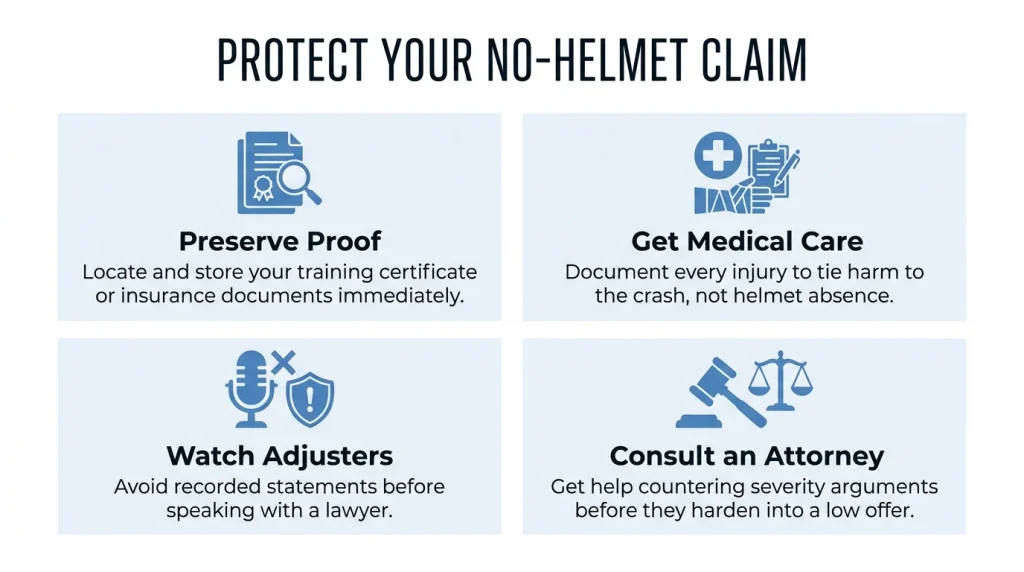
Preserve your exemption proof immediately. If you held a TDLR training certificate or qualifying health coverage at the time of the crash, locate the documents and store copies in a safe place before any claim activity begins.
Get a full medical evaluation that documents every injury. Records that tie specific injuries to the crash mechanism, not to helmet absence, are the foundation for countering severity-reduction arguments later.
Be careful with insurance adjusters. Avoid recorded statements before talking to a lawyer. Adjusters may ask about helmet use in ways designed to pin down compliance or admissions about exemption status. Riders facing pressure over helmet use should have their case reviewed before accepting any offer.
Talk to an Attorney Today
Helmet status adds real complexity to a Texas motorcycle claim, but it is rarely the whole story. Angel Reyes & Associates has represented injured motorcyclists across Texas for over 30 years and has recovered more than $1 billion for clients.
We offer free consultations, work on contingency with no fee unless we win, and you can read our client reviews and testimonials to see how we work. Contact us today to discuss your crash and what helmet status may mean for your claim.
Past results do not guarantee future outcomes.
Motorcycle Helmet Law FAQs
Does wearing a DOT-certified helmet affect how much my health insurance pays after a motorcycle crash in Texas?
Your health insurer pays based on your policy terms, not on whether you wore a helmet. However, if your health plan only qualifies for the helmet exemption when it covers motorcycle injuries, a plan with high out-of-pocket costs could leave you with significant unpaid medical bills regardless of helmet use.
Can a passenger sue the motorcycle operator if the passenger was not wearing a helmet and got hurt?
A passenger injured in a Texas crash can bring a claim, and the operator’s legal duty to make sure an unqualified passenger wears a helmet may factor into how fault is assigned. The passenger’s own failure to wear a helmet could also reduce their recoverable damages under Texas proportionate responsibility rules.
Does Texas recognize helmets that are not DOT-certified, such as novelty helmets, as legally compliant?
No. Texas law requires headgear that meets Federal Motor Vehicle Safety Standard 218, and novelty helmets typically do not carry a valid DOT certification. Wearing one would not satisfy the helmet requirement for a rider who does not qualify for the age-21 exemption.
If a child is a passenger on a motorcycle in Texas, are there additional legal requirements beyond the helmet rule?
Texas Transportation Code § 661.003 applies to all passengers, so a child must wear a DOT-compliant helmet. Texas law also restricts motorcycle passengers to seats designed for that purpose, which has practical implications when carrying young children on a bike.
How does helmet use affect a wrongful death claim in Texas if the rider died in the crash?
Texas wrongful death claims are governed by the same proportionate responsibility rules that apply to injury claims. If the decedent was not wearing a required helmet, the defense may argue that head injuries contributed to the death and seek a fault reduction, which would lower the damages the surviving family can recover.
About the Authors

Alex Ivanov
Writer
Alex Ivanov is a personal injury attorney at Angel Reyes & Associates, focused on car, truck, and motorcycle accident cases. Licensed in Texas and multiple federal districts, Alex brings international legal experience and a global education to his practice. He earned his LL.M. from Texas A&M University School of Law after graduating from Belarussian State University in 2016. Alex is fluent in Russian, English, Ukrainian, and Belarussian, and is recognized by multiple national trial lawyer associations for his results and leadership under 40.

Kyle Nicolas
Editor
Kyle Nicolas is the Web Content & SEO Manager at Angel Reyes & Associates. He has more than 10 years of experience as a marketing co...

Angel Reyes
Reviewer
Angel L. Reyes, III is the Founder and Managing Partner of Angel Reyes & Associates. A nationally recognized trial attorney and business...