Crash When Your Driver Was on Two Apps


Every article on this site is researched by our internal team, reviewed for legal accuracy against current Texas law, and held to State Bar of Texas advertising standards before publication. We do not publish content that overstates outcomes or makes promises about results.
Learn more about our
editorial standards .
Key Takeaways
- Two open apps can mean two policies, but coverage and a double recovery are not automatic.
- Texas requires $1 million in liability coverage during an accepted passenger ride.
- Match both apps' logs, both policies, and ride and order records to the collision time.

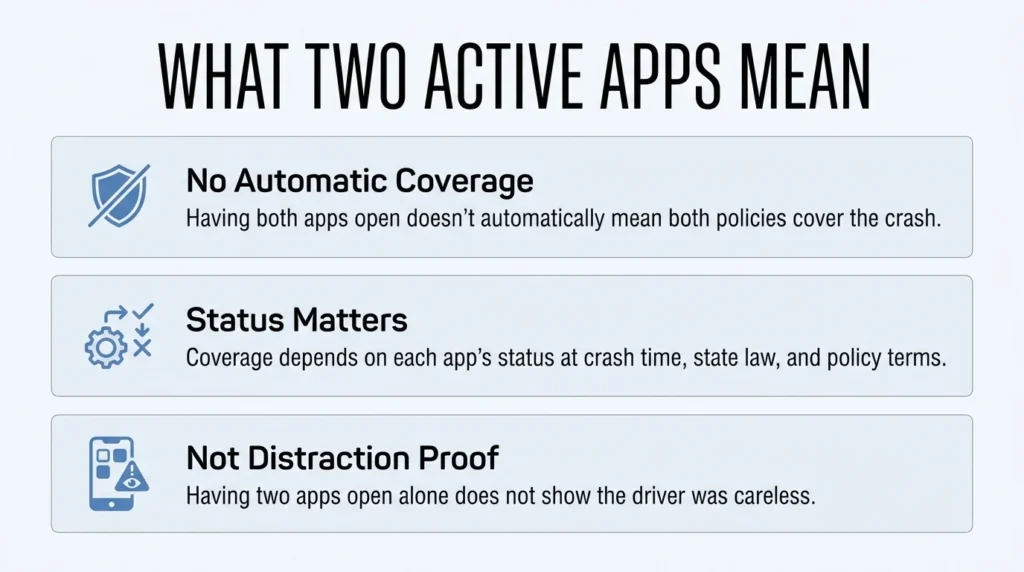
If your Uber driver was using a delivery app when the crash happened, you may need to review two insurance policies. Having both apps open does not automatically mean both policies cover the crash or that you can collect twice.
Coverage depends on each app’s status at the time of the crash, Texas law, and the policy terms. Matching both platforms’ records to the crash time can help you respond when one insurer points to the other.
What Two Active Apps Mean for a Texas Crash Claim
The Texas Department of Insurance’s rideshare guidance explains that coverage changes based on the driver’s activity and whether the claim involves injuries or property damage. A passenger’s injury claim may involve different coverage than damage to the driver’s car. Passengers may also want to check their own auto policy alongside the rideshare company’s coverage.
For example, a passenger ride could still be underway when the driver accepts a delivery order. An adjuster may review the timing, vehicle use, exclusions, and policy provisions addressing other insurance.
Having two apps installed or open does not, by itself, show the driver was distracted or careless. A timeline of both activities helps identify which coverage may apply.
How the Ride Stage Affects Texas Rideshare Coverage
Texas sets rideshare liability insurance minimums by the driver’s activity. §§ 1954.052 and 1954.053 of Texas Insurance Code Chapter 1954 establish two main periods:
- Logged on and available, outside a prearranged ride (§ 1954.052). At least $50,000 per injured person, $100,000 per incident for bodily injury or death, and $25,000 for property damage.
- During a prearranged ride (§ 1954.053). At least $1 million in aggregate liability coverage per incident.

These amounts do not guarantee what an injured person will receive.
A prearranged ride starts when the driver accepts the request and ends when the last requesting rider exits the vehicle. Coverage for this period therefore begins before pickup. Login, acceptance, pickup, and exit records help establish the ride stage at the time of the crash.
§§ 1954.054 and 1954.055 address situations where the driver’s required coverage is missing or insufficient. The rideshare company’s coverage does not depend on the personal insurer denying the claim first. Applying these rules requires the policies and activity records in effect when the crash happened.
How Delivery Activity Can Affect Coverage
Delivery activity requires a separate review of insurance coverage. House Bill 4215 expanded Texas’s delivery network rules effective September 1, 2025. The Texas Department of Licensing and Regulation’s permit guidance says transportation and delivery network companies must maintain proof of coverage required by Chapter 1954.
HB 4215 expanded Texas Occupations Code Chapter 2402 to cover delivery network permits, screening, safety policies, and recordkeeping. It distinguishes prearranged deliveries from passenger rides and did not amend Insurance Code Chapter 1954.
The permit guidance alone does not explain how every passenger-ride coverage requirement applies to delivery work or which policy pays when the activities overlap. Review the delivery policy in effect on the crash date alongside the applicable law and order records.
The delivery timeline should show when the driver went online, accepted an order, picked it up, and completed the delivery. Include any cancellation or reassignment.
For example, DoorDash’s insurance overview describes liability coverage during an accepted delivery in its section for other U.S. states. It identifies the driver’s own insurance as primary while online without an accepted order. Texas is not listed separately, so the summary needs to be checked against the policy and applicable Texas requirements.
Older TDI guidance on delivery insurance explains that policies may treat carrying goods differently from pickup travel or side trips. It predates HB 4215 and helps explain policy-reading issues rather than settle current delivery requirements.
What Records Help Resolve Disputes Between Insurers?
Preserve both platforms’ logs, the policies in effect on the crash date, and the ride and order records. Match them to the collision time and give each potentially relevant insurer the same account of what happened.
For a Texas car accident claim involving two apps, these records can help establish the driver’s activity and the coverage that may apply.
1. Save what you already have. Keep receipts, booking details, screenshots, driver and vehicle information, crash photos, witness contacts, and police report information. Report the crash through the platform’s appropriate channel.
2. Request preservation from both platforms. Ask them to preserve trip and app records, including login and logout events, availability changes, acceptance, cancellation, pickup, completion, and retained route or location information. Some records may not exist or be immediately available to a passenger.
3. Build one timeline. Separate ride acceptance from pickup and ride completion from delivery completion. Check timestamps and time zones before drawing conclusions.
4. Obtain both policies in full. Request the crash-date policies, declarations, endorsements, exclusions, coverage-period definitions, and other-insurance provisions, plus relevant personal or commercial insurance.
5. Ask each insurer for its position in writing. Keep claim numbers, reservation-of-rights letters, and denials. If an insurer denies your rideshare accident claim, ask it to identify the policy language and disputed facts supporting its decision.
6. Respond when one insurer points to another. Use the timeline and policy terms to address its stated reason.
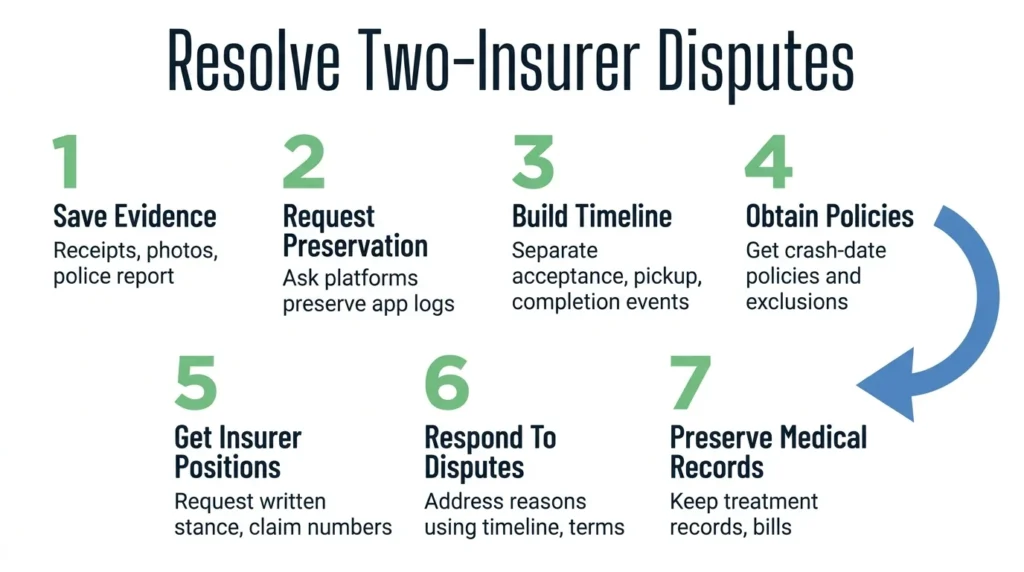
Keep treatment records, bills, and proof of missed work too. Do not delay needed medical care while insurers review coverage.
§ 1954.154 of Chapter 1954 requires the transportation network company and insurers providing Subchapter B coverage to help with the investigation. This includes precise TNC login and logout times for the 12 hours before and 12 hours after the crash, plus descriptions of coverage, exclusions, and limits. Do not assume that duty extends to every delivery platform or every requested record.
§ 1954.153(b) also allows an insurer to seek a contribution from another insurer in limited circumstances. It applies when an auto insurer defends or pays a claim that its policy excludes under Subchapter D, and another insurer covers the driver under § 1954.052 or § 1954.053.
A dispute between two insurers alone does not trigger this provision. It does not require equal sharing, automatic payment from a delivery insurer, or direct payment to an injured person. A lawyer can assess whether it applies.
Talk With Angel Reyes & Associates About Your Rideshare Crash
Sorting out two apps and two policies can feel overwhelming while you recover.
Angel Reyes & Associates can help. Gather any ride receipts, order details, screenshots, insurer letters, crash photos, and injury records you have, then contact Angel Reyes & Associates for a free consultation to review your situation and discuss your options.
Past results do not guarantee future outcomes.
Two-App Rideshare Crash FAQs
Can an Uber driver be held liable for a crash while making a DoorDash delivery?
Yes. An Uber driver may be personally liable if their negligence causes a crash, even while completing a DoorDash delivery. Liability depends on the driver’s conduct and the circumstances of the collision, not simply which apps were active.
Does using two rideshare or delivery apps at once violate Texas law?
Texas law generally does not prohibit drivers from using multiple rideshare or delivery platforms at the same time. However, drivers must still follow traffic laws, including restrictions on using electronic devices while driving.
Can a passenger sue a delivery company after an accident involving an Uber driver?
A passenger may pursue a claim against a delivery company if the facts establish a legal basis for holding that company responsible. The driver’s use of the delivery platform alone does not establish company liability.
What happens if an Uber driver causes a crash while looking at a delivery notification?
Looking at a delivery notification may support a negligence claim if the distraction contributed to the collision. Phone records, witness statements, and other evidence may help establish whether the driver was distracted.
How long do I have to file a lawsuit after a rideshare accident in Texas?
Under Texas Civil Practice and Remedies Code § 16.003, you must file most personal injury lawsuits within two years of the accident. Certain exceptions may change that deadline, and claims involving government entities can have additional notice requirements.
About the Authors

Angel Reyes
Writer
Angel L. Reyes, III is the Founder and Managing Partner of Angel Reyes & Associates. A nationally recognized trial attorney and business leader, Angel founded the firm in 1993, which has gone on to help over 70,000 injury victims recover more than $1 billion. Named to the Texas Super Lawyers list annually since 2008, Angel brings Wall Street experience, Ivy League education, and a deep commitment to client advocacy. He is a frequent legal commentator and published author with extensive contributions to legal scholarship, trial strategy, and consumer protection.

Kyle Nicolas
Editor
Kyle Nicolas is the Web Content & SEO Manager at Angel Reyes & Associates. He has more than 10 years of experience as a marketing co...

Angel Reyes
Reviewer
Angel L. Reyes, III is the Founder and Managing Partner of Angel Reyes & Associates. A nationally recognized trial attorney and business...