Can Uber or Lyft Deny Your Accident Claim?


Every article on this site is researched by our internal team, reviewed for legal accuracy against current Texas law, and held to State Bar of Texas advertising standards before publication. We do not publish content that overstates outcomes or makes promises about results.
Learn more about our
editorial standards .
Key Takeaways
- A rideshare denial comes from the insurer, not Uber or Lyft, and you can challenge it.
- A written appeal, app records, and a TDI complaint can reverse a wrongful denial.
- Texas gives you two years from the crash date to sue, and a denial does not pause it.
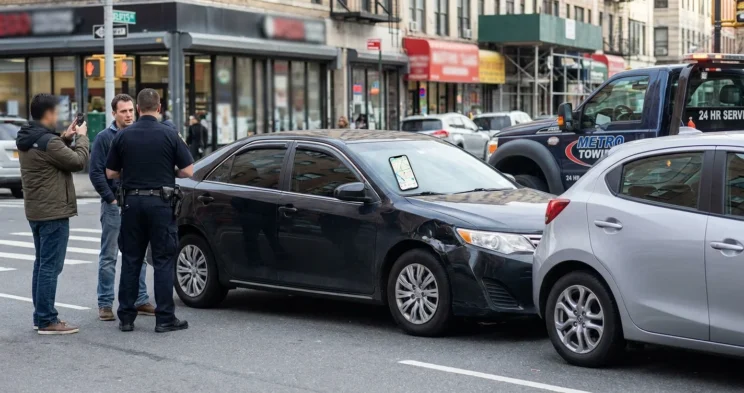
You were riding home from a late shift on Congress Ave in Austin when another car slammed into your Uber. Now a letter from the insurer says your claim is denied, and the medical bills are already stacking up. You did nothing wrong, so how can they refuse to pay?
Yes, Your Claim Can Be Denied
Yes, your rideshare accident claim can be denied. The denial does not come from Uber or Lyft directly. It comes from the third-party insurer each platform contracts with to handle these claims.
You are not fighting a tech company. You are dealing with an insurance carrier that has specific, contestable reasons for saying no.
A denial is also not the end of the road. It is the insurer’s opening position, and you can challenge it with the right evidence and a clear response.
Timing is where many people get hurt. Texas gives you two years from the date of the crash to file a personal injury lawsuit under Texas Civil Practice and Remedies Code (CPRC) § 16.003. That clock does not pause while you appeal a denial.
So if Uber or Lyft denies your claim, it’s important to respond to the insurer and keep the lawsuit deadline in view. Texas also requires insurers to act on claims within set timelines, and bad-faith delays carry penalties under Texas Insurance Code Chapter 542.
Common Reasons Rideshare Claims Get Denied
Most rideshare denials trace back to one of a few specific reasons. Identifying which one applies to you is the first step toward overturning it.
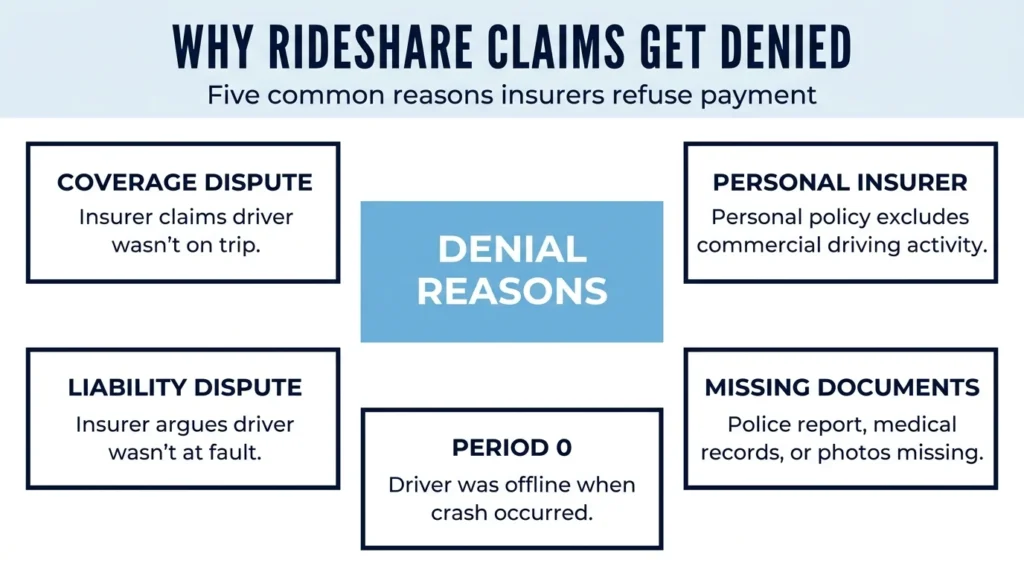
The most common is a coverage period dispute. The insurer argues the driver was not actively on a trip when the crash happened. What rideshare accident coverage applies depends on whether the app was off, the driver was waiting for a request, was on the way to a pickup, or had you in the car.
A second scenario involves the driver’s personal insurer. Most personal auto policies exclude commercial activity, so the personal carrier denies the claim because the driver was working when the crash occurred.
A third reason your claim may be denied is a liability dispute. The insurer argues the rideshare driver was not at fault, or that fault is shared in a way that shrinks or wipes out your claim.
Or, the insurer might argue that there’s insufficient documentation. They deny your claim because something required was missing: the police report, medical records, accident photos, or app records.
Then there is Period 0. If the driver was not logged into the platform at the time of the crash, neither Uber’s nor Lyft’s commercial policy responds, and you are left looking at the driver’s personal coverage under Texas Insurance Code Chapter 1954. An attorney can pull the driver’s app records and match the timestamp to the correct coverage period, which often reverses a Period 0 denial.
How To Appeal a Denied Rideshare Claim
You can appeal a denied rideshare claim, and the strongest appeals follow a clear order.
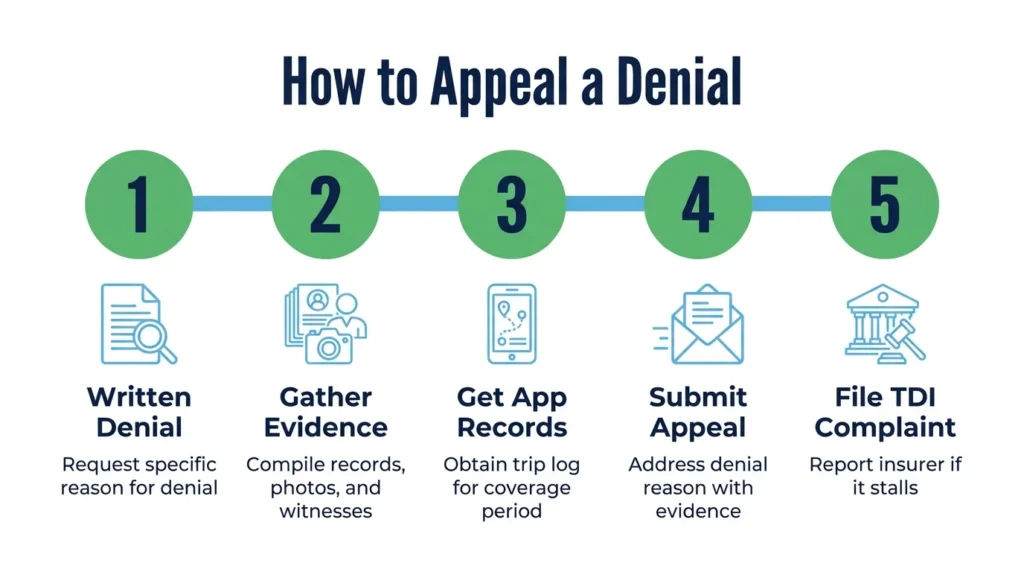
Step 1: Get the denial in writing. Request a written explanation that states the exact reason for the denial. A vague denial is often a sign the insurer does not have a solid basis for it.
Step 2: Gather and organize your evidence. Compile the police report, your medical records, photos of the scene and your injuries, any dashcam or surveillance footage, witness contact information, and screenshots of the app showing the trip in progress.
Step 3: Request the driver’s app records. The platform’s internal trip log is the definitive record of which coverage period was active. An attorney can get this through discovery if the insurer refuses to hand it over.
Step 4: Submit a formal appeal with your evidence. Address the specific denial reason point by point. Don’t let the denial stand without a direct, documented response.
Step 5: File a complaint with the state if the insurer stalls. You can report the carrier through the Texas Department of Insurance complaint process when it misses statutory deadlines or keeps denying a covered claim without a valid reason.
When To Escalate with a Lawsuit or Regulatory Complaint
When an internal appeal fails, you have two escalation paths. You can file a lawsuit, file a complaint with the state, or pursue both at once.
Filing a Lawsuit
A lawsuit moves the dispute into a formal process the insurer cannot stonewall. The carrier must disclose its full claim file, the driver’s app records become obtainable through subpoena, and the insurer faces the real cost of litigation. That pressure often produces a better result than months of back-and-forth.
The two-year deadline under CPRC § 16.003 runs from the date of the accident. A denial, an appeal, or an open negotiation does not extend it.
A lawsuit can name the at-fault driver and, depending on the facts, the platform itself for negligent entrustment or its own negligence.
Filing a Regulatory Complaint with TDI
A complaint with the Texas Department of Insurance is a parallel track, not a replacement for a lawsuit. It creates an official record of the insurer’s conduct, can force a faster response, and can put regulatory pressure on the carrier.
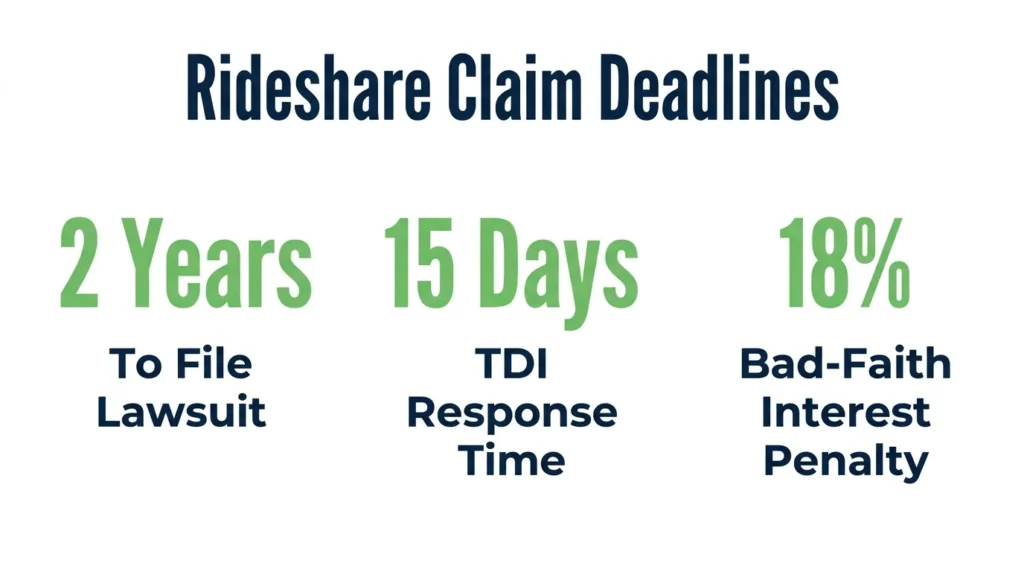
You file through the state’s online complaint portal, and the agency then contacts the insurer and requires a response within 15 days.
An insurer that delays a valid payment without justification may owe you 18% annual interest on the unpaid amount plus attorney’s fees under Chapter 542. The complaint and the lawsuit can run at the same time, since neither one forecloses the other.
Talk to a Rideshare Accident Attorney About Your Denied Claim
A denied rideshare claim is a starting point, not a verdict. The right evidence, a documented appeal, and a firm deadline in view can change the outcome.
Angel Reyes & Associates has guided injured Texans through denied rideshare accident claims for over 30 years. We work on contingency, so there is no fee unless we win, and your initial consultation is free.
Our team has more than $1 billion recovered for clients across Texas, and we can review your denial and tell you which path fits your situation. Contact us for a free consultation to discuss the facts of your case.
Past results do not guarantee future outcomes.
Denied Rideshare Claim FAQs
Can I use my own insurance if the rideshare insurer denies my claim?
Yes. If you carry uninsured or underinsured motorist coverage on your personal auto policy, that coverage can step in when the rideshare insurer refuses to pay or the available coverage falls short of your losses.
What if two drivers share fault for the crash that injured me as a passenger?
Texas follows a modified comparative fault rule, so you can pursue claims against both at-fault drivers at the same time. As a passenger, you are almost never assigned any share of fault, which puts you in a stronger position to recover your full losses.
Does filing a TDI complaint hurt my chances in a personal injury lawsuit?
No. A Texas Department of Insurance complaint and a lawsuit are separate processes, and filing one does not affect the other. The complaint creates an official record of the insurer’s conduct and can move things faster, while the lawsuit pursues the underlying damages.
What if the Uber or Lyft driver had no personal insurance at all?
Uber and Lyft are required under Texas Insurance Code Chapter 1954 to maintain commercial coverage that applies when the driver is logged into the platform, so the absence of the driver’s personal policy does not leave you without recourse during an active trip.
About the Authors

Angel Reyes
Writer
Angel L. Reyes, III is the Founder and Managing Partner of Angel Reyes & Associates. A nationally recognized trial attorney and business leader, Angel has helped over 70,000 injury victims recover more than $1 billion since founding the firm in 1993. Named to the Texas Super Lawyers list annually since 2008, Angel brings Wall Street experience, Ivy League education, and a deep commitment to client advocacy. He is a frequent legal commentator and published author with extensive contributions to legal scholarship, trial strategy, and consumer protection.

Graham Griffin
Editor
Graham Griffin is the Web & Content Manager at Angel Reyes & Associates, where he oversees content strategy, AI-powered workflows, a...

Angel Reyes
Reviewer
Angel L. Reyes, III is the Founder and Managing Partner of Angel Reyes & Associates. A nationally recognized trial attorney and business...