Dallas Invests Millions to Put Pedestrian Safety First


Every article on this site is researched by our internal team, reviewed for legal accuracy against current Texas law, and held to State Bar of Texas advertising standards before publication. We do not publish content that overstates outcomes or makes promises about results.
Learn more about our
editorial standards .
Key Takeaways
- Dallas received $9.24 million from the federal SS4A program on September 5, 2024.
- Five corridors, including Ferguson Road and Lake June Road, gain new safety upgrades.
- Dallas Vision Zero aims to end traffic deaths and halve injuries by 2030.
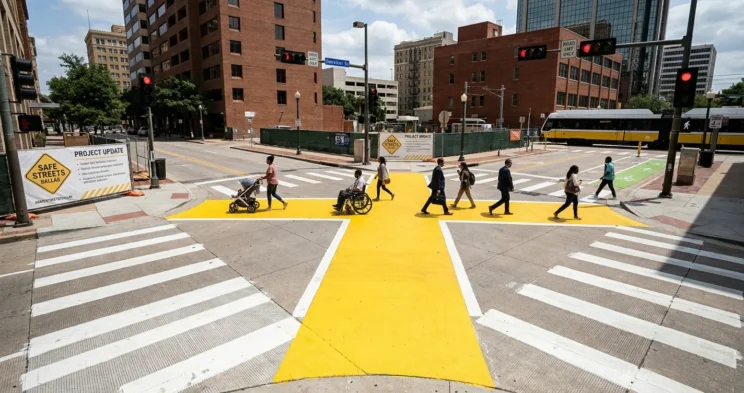
You cross Ferguson Road on your way to work, dodging cars because the nearest crosswalk is too far away. That gap helped push Dallas toward millions of dollars in new pedestrian safety funding. The money is now official, with clear numbers attached.
Dallas Pedestrian Safety Grant Funding
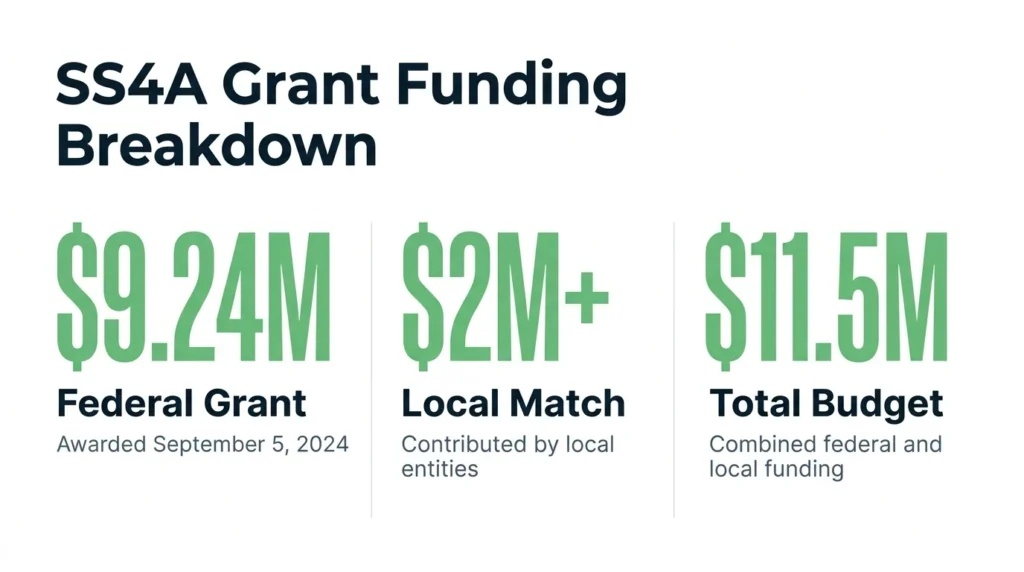
The U.S. Department of Transportation awarded the City of Dallas and Dallas Area Rapid Transit (DART) $9.24 million on September 5, 2024, through the Safe Streets and Roads for All (SS4A) program.
The city’s grant announcement confirms the award. Dallas and DART added more than $2 million in local matching funds, bringing the total project budget to $11.5 million. Dallas Morning News reporting dated October 7, 2024, independently confirmed these figures against the city’s FY24 memo.
This SS4A grant is separate from the city’s ongoing MLK Jr./Cedar Crest Boulevard project. The two should not be confused, since each targets different corridors under Dallas’s broader push to reduce pedestrian accidents.
Dallas High Injury Network Corridors
Dallas has targeted five High Injury Network corridors for these safety upgrades: Ferguson Road, Lake June Road, Saint Augustine, Camp Wisdom Road, and Maple Avenue.
Up to 15 pedestrian safety zones are planned along these corridors.
Planned Pedestrian Safety Improvements
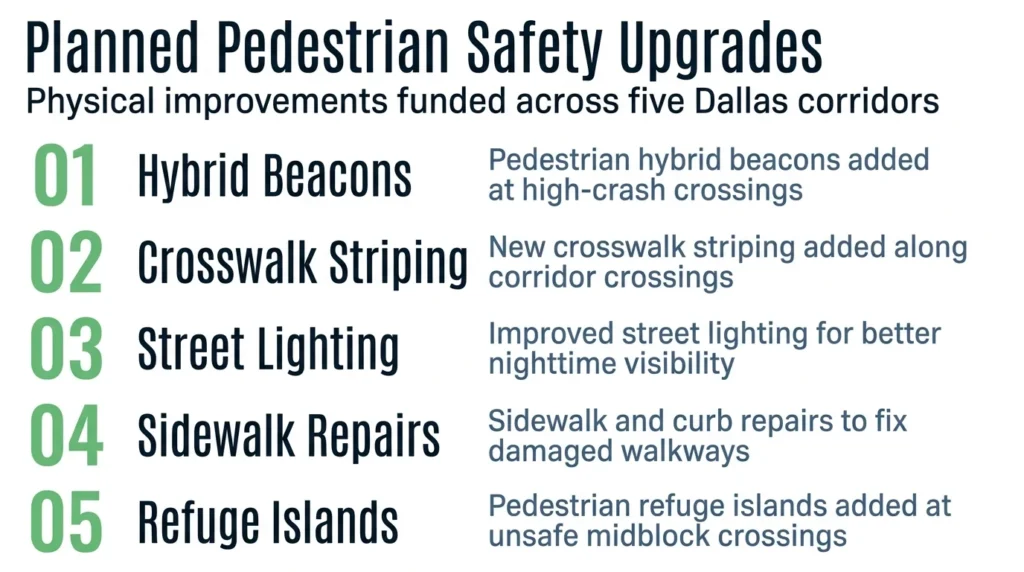
Dallas’s $11.5 million investment funds several categories of physical upgrades along the five corridors, according to the city’s grant announcement. Improvements include:
- Pedestrian hybrid beacons at high-crash crossings
- New crosswalk striping
- Improved street lighting
- Sidewalk and curb repairs
- Pedestrian refuge islands
- Possible relocation of a DART bus stop to improve pedestrian access
Each upgrade targets a specific hazard, from poor nighttime visibility to unsafe midblock crossings. Together, they form the physical backbone of the SS4A-funded corridor work.
Dallas Vision Zero Timeline
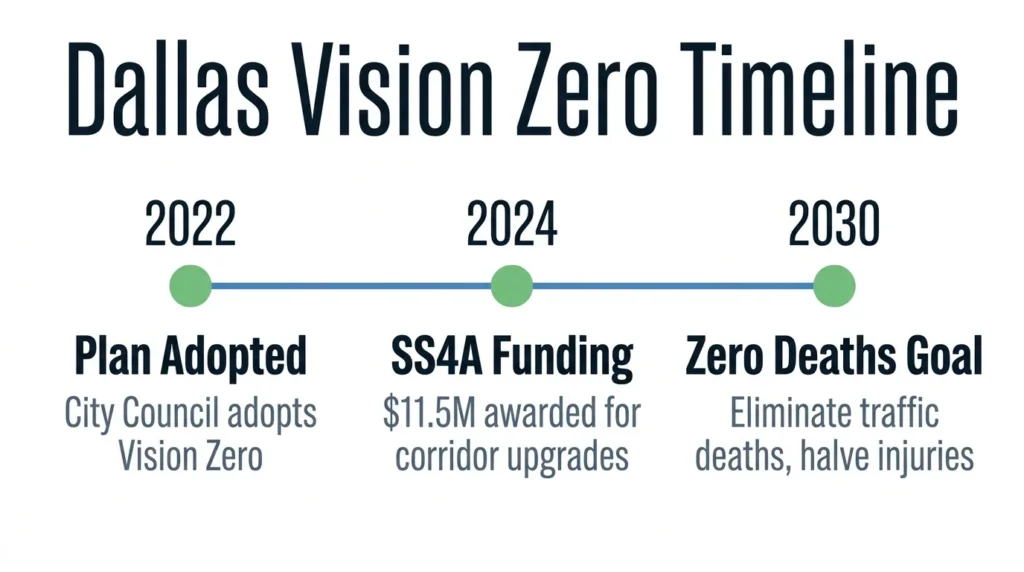
The Dallas City Council adopted the Vision Zero Action Plan on June 8, 2022. Its stated goal is to eliminate all traffic deaths and cut severe injuries in half by 2030.
The five-corridor pedestrian project follows a five-year implementation window tied to that 2030 target. Exact completion dates for individual zones have not been published.
Recent pedestrian fatality data from the Governor’s Highway Safety Association shows why cities pursue investments like this one. Texas has also seen a broader rise in pedestrian deaths in recent years.
More Dallas Pedestrian Safety Resources
Angel Reyes & Associates follows Dallas pedestrian safety developments like this one as part of our ongoing coverage of local infrastructure and safety issues. We invite you to review our case results and learn more about us and our dedication to our clients.
If you have questions about pedestrian safety in Dallas, visit our contact page to reach our team.
Past results do not guarantee future outcomes.
Dallas Pedestrian Safety FAQs
What is a High Injury Network?
A High Injury Network is a map that city planners build from crash data to find the small share of streets where most severe and fatal crashes happen. Cities like Dallas use this method to decide where limited safety funding should go first.
What is a pedestrian hybrid beacon?
A pedestrian hybrid beacon is a traffic signal that stays dark until a person walking activates it, then flashes and turns solid red to stop traffic so they can cross. It is sometimes called a HAWK signal, short for High-Intensity Activated crossWalK.
What is a Vision Zero traffic safety plan?
Vision Zero is a traffic safety strategy that began in Sweden in the 1990s and aims to eliminate all traffic deaths through better street design, enforcement, and education. Dozens of U.S. cities, including Dallas, have since adopted their own local versions of the plan.
Does a federal Safe Streets and Roads for All grant only pay for planning, or does it fund actual construction?
The Safe Streets and Roads for All program offers separate grants for planning studies and for building physical safety projects. Awards used to build upgrades like new signals or sidewalks fall under the program’s construction focused implementation grant category.
About the Authors

Spencer Browne
Writer
Spencer Browne is a partner at Angel Reyes & Associates and a Board Certified personal injury trial lawyer with nearly 100 jury trials across Texas. He focuses on car, truck, and wrongful death cases, with notable verdicts including a landmark win in the Choctaw Casino bus crash case. A recognized speaker and legal educator, Spencer is a member of the American Board of Trial Advocates and has been honored as a Texas Super Lawyer and one of D Magazine’s Best Lawyers in Dallas. He brings deep trial experience and relentless advocacy to every client he represents.

Graham Griffin
Editor
Graham Griffin is the Web & Content Manager at Angel Reyes & Associates, where he oversees content strategy, AI-powered workflows, a...

Angel Reyes
Reviewer
Angel L. Reyes, III is the Founder and Managing Partner of Angel Reyes & Associates. A nationally recognized trial attorney and business...