When Is an Employer Liable for Hiring a Dangerous Employee?


Every article on this site is researched by our internal team, reviewed for legal accuracy against current Texas law, and held to State Bar of Texas advertising standards before publication. We do not publish content that overstates outcomes or makes promises about results.
Learn more about our
editorial standards .
Key Takeaways
- Texas employers can be liable for their own hiring, training, supervision, and retention choices.
- Liability turns on what the employer knew or a reasonable pre-hire inquiry would have revealed.
- The personnel file, background inquiry, and complaint records carry the knowledge proof.

You were hurt by someone who was on the job, and the more you learn about that person, the worse it looks. The company had reasons to know better and put them in that role anyway.
Texas law gives you a way to hold the business accountable for its own decision, separate from any claim over what its employee did to you. Those are direct negligence claims: negligent hiring, negligent training, negligent supervision, and negligent retention.
An employer can be liable when it knew or should have known an employee was unfit or peculiarly likely to cause the kind of harm that happened, and that unfitness helped cause your injury.
The Four Direct Negligence Claims Against a Texas Employer
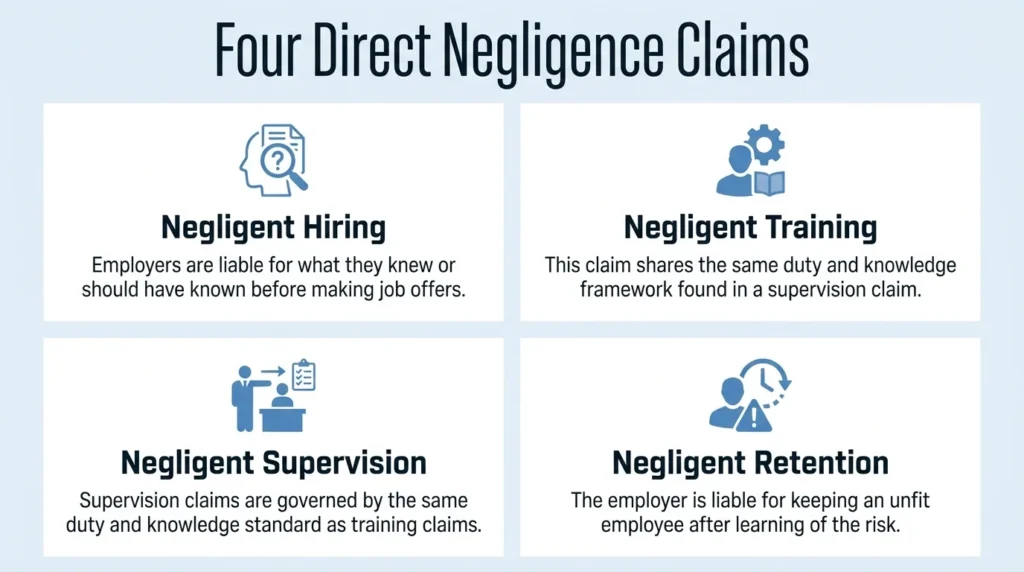
Texas recognizes four direct negligence theories against an employer, and each one looks at the company’s own conduct rather than the employee’s. A claim for negligent hiring, training, supervision, or retention requires a duty to hire and keep competent employees, a breach of that duty, and proof that the breach proximately caused your injury.
These claims do not stand alone. The Texas Supreme Court has also required proof that the employee committed an actionable tort that caused the harm, so the employer’s bad hiring decision has to connect to real wrongful conduct by the person it hired.
Whether the employer owed a duty at all is analyzed under Texas’s general common-law factors. Courts weigh the risk, the foreseeability, and the likelihood of injury against the social utility of the conduct, the burden of guarding against the harm, and the consequences of placing that burden on the defendant, with foreseeability carrying the most weight.
Negligent hiring and negligent retention share the same elements and differ only in timing. Hiring looks at what the employer knew or should have known before it made the offer. Retention looks at what the employer learned afterward and whether it kept the person in that role anyway.
Negligent training sits under the same duty and knowledge framework as a negligent supervision claim. Many of these cases begin with an employee who assaults or injures a customer, tenant, or visitor on company property, which is why they often travel alongside premises liability claims.
Why These Claims Count Even When the Employer Is Already Vicariously Liable
A direct negligence claim is not a substitute for respondeat superior, which reaches an employee’s tortious act only when it happened within the course and scope of employment. A direct negligence theory attacks the employer’s own hiring, training, supervision, or retention decision, which can be unreasonable no matter when or where the resulting harm occurred.
The damages picture is different too. Exemplary damages in Texas generally require clear and convincing evidence of fraud, malice, or gross negligence under Texas Civil Practice and Remedies Code § 41.003.
There is a specific provision for harm caused by someone else’s criminal act. Exemplary damages are ordinarily barred in that situation, with listed exceptions, one of which applies where “the agent was unfit and the principal acted with malice in employing or retaining him.” Texas Civil Practice & Remedies Code § 41.005(b)(2). What opens that door is the employer’s own malice in the hiring or retention decision, not the employee’s underlying act.
How far this independence runs is an unresolved question in Texas. In Werner Enterprises, Inc. v. Blake, No. 23-0493 (Tex. June 27, 2025), the Texas Supreme Court majority said it has not recognized negligent training or supervision as an independent theory of tort liability, and on the facts before it treated those claims as derivative of the employee’s own negligence.
A concurring justice raised an “admission rule,” under which an employer’s admission that its employee acted within the course and scope could make direct claims largely beside the point for compensatory damages. The majority expressly declined to adopt or resolve that rule.
So the honest statement of Texas law is a careful one. Texas courts have recognized these theories as doctrinally distinct from vicarious liability, and they remain the route to exemplary damages based on the employer’s own conduct. Whether they survive an employer’s admission of vicarious liability in a given court is still open after Werner.
That uncertainty is worth discussing early with a lawyer, especially when a family is also pursuing a wrongful death claim arising from the same conduct.
What the Employer Knew or Should Have Known
Everything turns on knowledge. The employer is liable when it knew or should have known that the employee was incompetent, unfit, or peculiarly likely to commit the kind of harmful act that occurred, and placed that person in a position where the risk could land on someone like you. Akins frames the standard that way.
At the hiring stage, “should have known” is measured against what a reasonable investigation appropriate to that position would have turned up. An employer is charged with the knowledge that inquiry would have produced, even if nobody at the company actually looked.
Skipping a background check is not automatic negligence. The question is what a reasonable inquiry for that job and those risks would have revealed, and whether the employer acted reasonably in light of it. A cashier position and a job driving a company truck through Dallas traffic do not call for the same level of screening, which is one reason commercial driver hiring sits at the center of so many truck accident claims.
After the hire, the same standard governs retention. Once complaints, discipline, or incident reports reach the employer and point to unfitness, continuing to keep that person in a role where the danger can materialize is what turns ordinary employment into negligent retention.
When Unfitness Is Based on a Prior Criminal Conviction
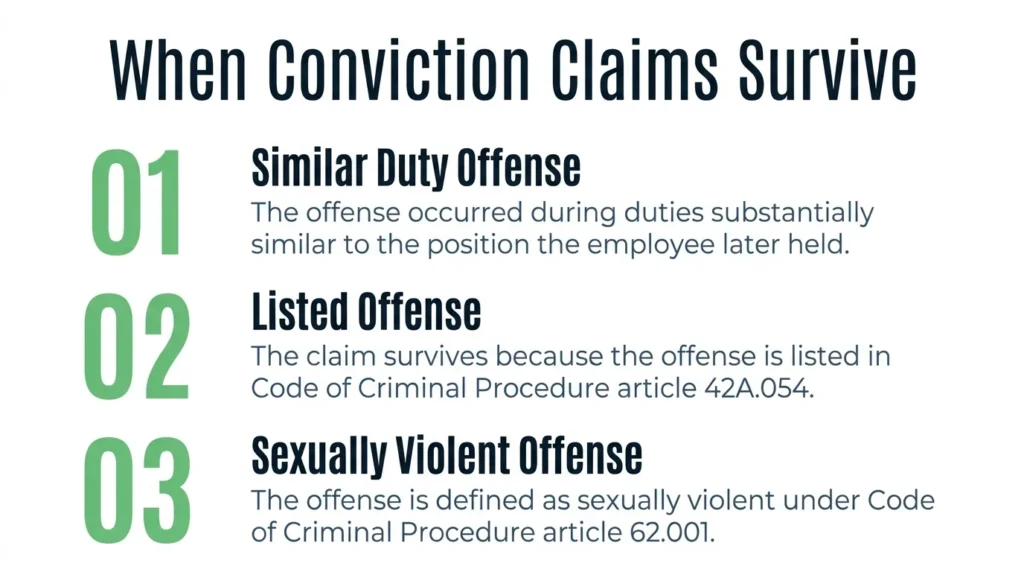
Texas added a statutory limit for claims built on a criminal record. A negligent hiring or supervision claim resting solely on evidence that the employee was convicted of an offense is barred, unless the employer knew or should have known of the conviction and one of the statutory exceptions applies, as per Texas Civil Practice & Remedies Code §§ 142.001 and 142.002.
The claim survives when the conviction was for:
- An offense committed while performing duties substantially similar to those of the position the employee later held
- An offense listed in Code of Criminal Procedure article 42A.054
- A sexually violent offense as defined in Code of Criminal Procedure article 62.001
A separate carve-out preserves claims involving misuse of funds or property where the employee had a fraud-type conviction and the position was one a reasonable person would expect to carry a fiduciary responsibility.
This statute narrows those claims. It does not eliminate them, and it does not touch claims built on non-conviction warning signs such as documented complaints, written discipline, or a prior termination. Those are still governed by the ordinary knew-or-should-have-known standard.
How the Personnel File & Background Inquiry Prove the Case

Three categories of employer records carry most of the weight, because each one maps onto the knowledge element:
- The pre-hire background inquiry, including its absence or its gaps, shows what a reasonable investigation would have revealed at the moment of hire
- The personnel file shows what the company actually knew about this employee and when it knew it
- Records of prior complaints, discipline, and incidents build the retention timeline, showing what warnings arrived and what the employer did next
These are ordinary business records, and there is no special shortcut to them. Getting them means asking for them early in discovery, before a file gets thinner. The value is in the dates as much as the content, since a complaint logged months before your injury is what separates an unfortunate hire from a negligent one.
Talk to a Lawyer About Your Claim
If the person who hurt you was working for someone, the company’s own decisions belong in the case. Angel Reyes & Associates has guided injured Texans through situations like this for over 30 years, and evaluating a claim like yours starts with the personnel file, the background inquiry, and the complaint and discipline history.
These claims can still matter when an employer is already answering for its employee’s conduct, and they are often where an employer’s own gross negligence comes into view. Contact Angel Reyes & Associates for a free consultation and a straight answer about your options.
Past results do not guarantee future outcomes.
Dangerous Employee Liability FAQs
Can I still sue an employer for negligent hiring if it admits its employee acted within the course of employment?
Possibly, though this point is not fully settled under Texas law. Texas courts have treated negligent hiring, supervision, and retention as distinct from vicarious liability because they target the employer’s own decision, but a 2025 Texas Supreme Court decision left open whether an employer’s admission can moot a direct claim for compensatory damages.
How long do I have to bring a negligent hiring claim in Texas?
The deadline depends on the underlying claim and circumstances of the injury, and different rules can apply to particular types of cases. Because missing an applicable limitations deadline can bar a claim, the specific facts should be reviewed promptly.
Can a customer sue an employer for an employee's misconduct outside the workplace?
The location of the misconduct does not by itself determine whether a direct negligence claim exists. The key questions include whether the employer had a relevant duty, what it knew about the employee, and whether the employer’s conduct was sufficiently connected to the injury.
About the Authors

Angel Reyes
Writer
Angel L. Reyes, III is the Founder and Managing Partner of Angel Reyes & Associates. A nationally recognized trial attorney and business leader, Angel founded the firm in 1993, which has gone on to help over 70,000 injury victims recover more than $1 billion. Named to the Texas Super Lawyers list annually since 2008, Angel brings Wall Street experience, Ivy League education, and a deep commitment to client advocacy. He is a frequent legal commentator and published author with extensive contributions to legal scholarship, trial strategy, and consumer protection.

Kyle Nicolas
Editor
Kyle Nicolas is the Web Content & SEO Manager at Angel Reyes & Associates. He has more than 10 years of experience as a marketing co...

Angel Reyes
Reviewer
Angel L. Reyes, III is the Founder and Managing Partner of Angel Reyes & Associates. A nationally recognized trial attorney and business...