What Should You Tell Police After a Crash?


Every article on this site is researched by our internal team, reviewed for legal accuracy against current Texas law, and held to State Bar of Texas advertising standards before publication. We do not publish content that overstates outcomes or makes promises about results.
Learn more about our
editorial standards .
Key Takeaways
- Provide required identification and insurance details to the proper people after a crash.
- Describe what you saw, and acknowledge uncertainty instead of guessing about speed or fault.
- Your statements may appear in the crash report or footage and matter in a later claim.
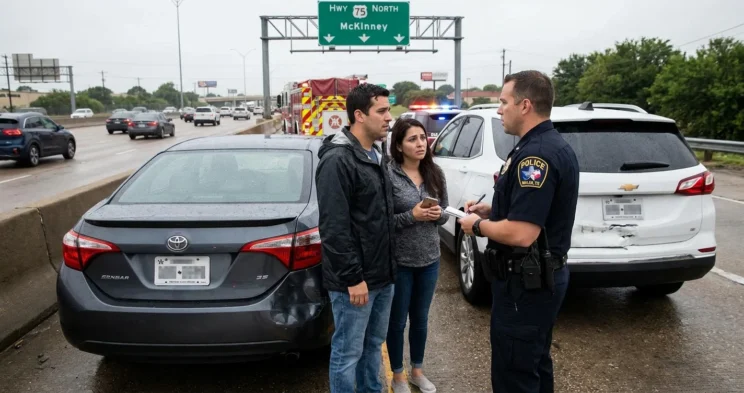
After a car crash, knowing what to do next is challenging. You’re disoriented, possibly hurt, and looking for answers. So, what do you need to tell the police?
Give the identification and insurance information Texas law requires, describe what you actually saw, and say plainly when you don’t know a detail. After a crash on I-35, answering an officer’s questions while your hands are still shaking can be difficult. You do not need to fill gaps in your memory with guesses.
Your words may appear in the crash report, on body-camera footage, and later in an insurance claim. Knowing what to say to police after a car accident, and what not to say after a car accident, starts with separating facts from assumptions.
What Information Must You Give After a Texas Crash?
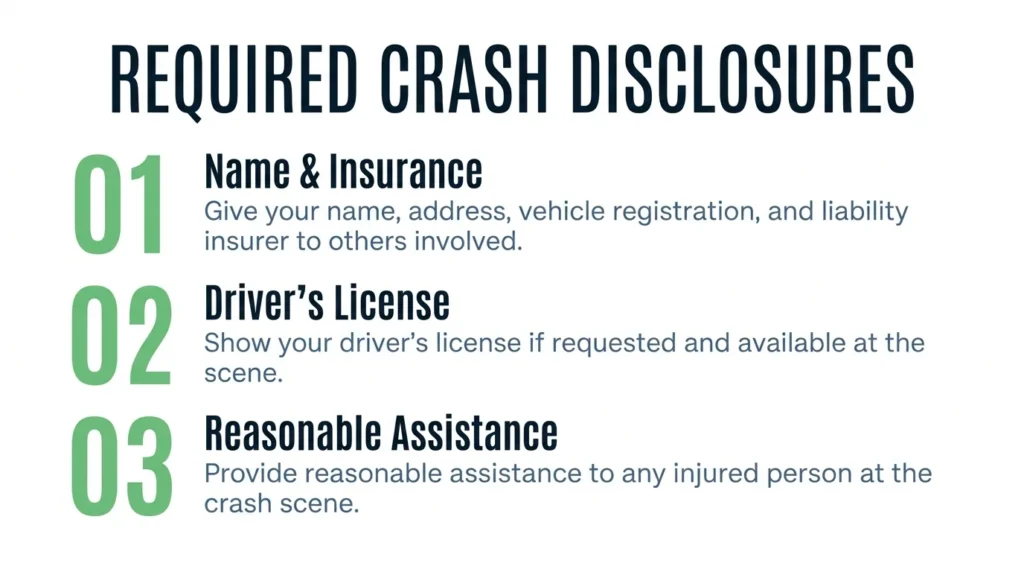
Texas law imposes duties to stop, assist injured people, and exchange information. Some duties run to other crash participants; others apply when an officer asks.
Under Texas Transportation Code §550.023, a driver in a collision involving injury, death, or damage to an occupied or attended vehicle must:
- Give their name and address, vehicle registration number, and liability insurer’s name to the specified people involved.
- Show their driver’s license if requested and available.
- Provide reasonable assistance to an injured person.
The same chapter sets out stop-and-remain duties. It requires immediate notice to the appropriate law enforcement agency when someone is injured or killed, or a vehicle cannot be normally and safely driven.
Separate duties apply when an officer requests documents:
- Driver’s license. If you must hold a license, Transportation Code §521.025 requires you to carry it while driving and display it on a peace officer’s request.
- Proof of financial responsibility. Under Transportation Code §601.053, the operator of a covered vehicle must show this evidence when an officer or a person involved in the collision requests it. An insurer-provided image on your phone is one permitted format.
Section 550.023 governs information exchanged with crash participants. It is not a checklist of every question an officer may ask.
Identification duties toward police also depend on your situation. Under Texas Penal Code §38.02, a lawfully arrested person must give their name, residence address, and date of birth when asked.
If a driver lawfully detained for an alleged violation fails to provide or display a requested license, that driver must not intentionally refuse requested identifying information: name, license number, residence address, or date of birth.
The statute also prohibits false identifying information in specified arrest, detention, and witness situations. Never give a false name, and follow lawful commands.
How Should You Describe What Happened to the Officer?
Tell the officer what you personally saw and recall, in the order it happened. When a detail is unclear, acknowledge that instead of guessing.
Start with your direction of travel and lane. Describe what you could see, including traffic signals and road conditions, then explain the sequence you recall. Identify witnesses and available photographs, and tell responders about current pain, symptoms, or a need for medical help.
Keep your observations separate from what others told you. If a passenger says the other driver ran the light, identify the passenger as the person who may have seen it. Don’t present their account as your memory or assume the other driver was texting or speeding.
“I don’t know” and “I don’t remember clearly” are appropriate when true. Acknowledging uncertainty is different from refusing required identification. Be equally accurate about your condition: don’t hide symptoms or claim you’re uninjured if you aren’t sure.
Ask the officer to repeat or clarify a confusing question so you can answer accurately. That request does not give you a right to pause the investigation or skip information the law requires.
What Should You Avoid Guessing or Admitting at the Scene?
Avoid inventing a speed estimate or assigning fault without personal knowledge. A statement you volunteer may later be offered against you.
Why a Speed Guess Can Come Back Later
Under Texas Rule of Evidence 801(e)(2), a party’s own statement falls outside the definition of hearsay when offered against that party. It need not be a formal confession or have seemed harmful when spoken.
A casual speed estimate or “It was my fault” may therefore count in a later claim. It does not automatically decide liability. Other evidence rules still apply: a report repeating someone’s words can raise multiple hearsay layers under Rule 805, and recordings require authentication under Rule 901.
If you didn’t check your speedometer immediately before impact, say that only if true. Don’t supply a number you don’t know.
How an Apology Differs From Admitting Fault
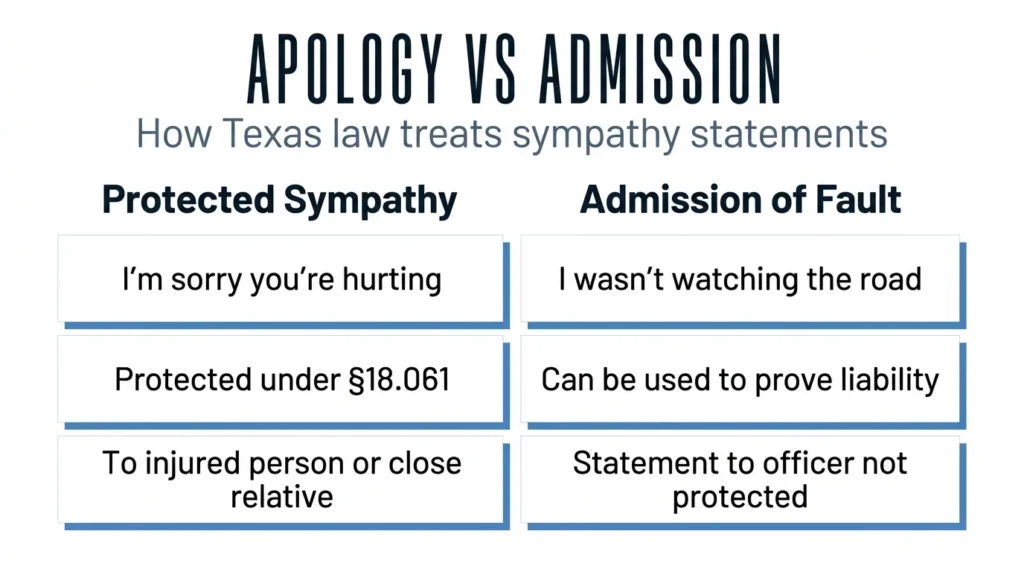
Texas law distinguishes sympathy from statements about negligent conduct. Under Texas Civil Practice and Remedies Code §18.061, certain expressions of sympathy to an affected person or specified close relatives cannot be used in a civil action to prove the speaker’s liability.
That protection does not cover a communication that also includes statements about negligent or culpable conduct related to the accident. Such a communication can be offered to prove liability.
Consider two hypothetical statements. “I’m sorry you’re hurting. Can I call someone for you?” expresses concern. “I’m sorry; I wasn’t watching the road” adds a statement about your driving that the word “sorry” does not shield.
The recipient also matters. A remark to an officer is not automatically covered by the sympathy protection.
Where Might Your Statement Appear Later?
Your words may appear in the officer’s crash-report narrative or on body-camera footage, if a camera captured the conversation. Neither record is guaranteed to contain everything you said.
What the Officer’s Narrative Records
TxDOT’s crash-report forms page identifies the CR-3 report and applicable CR-100 instructions. Under CR-100 §4.7, the officer prepares a narrative and diagram describing the crash’s principal events, pertinent facts, and contributing factors.
The narrative is the investigator’s account, not necessarily a word-for-word transcript. A summary of your statement may leave out context.
What Body-Camera Footage May Show
If a responding officer’s camera captured your conversation, footage may preserve your words and their context. Not every conversation is recorded, and footage does not necessarily show the collision.
The Texas Attorney General’s body-camera request guidance identifies Article 2B.0112 as the request provision. A written request needs the date or approximate time, specific location, and name of at least one known subject. Confidentiality restrictions may limit release, so requesting footage does not guarantee access.
Steps to Preserve & Review Your Account
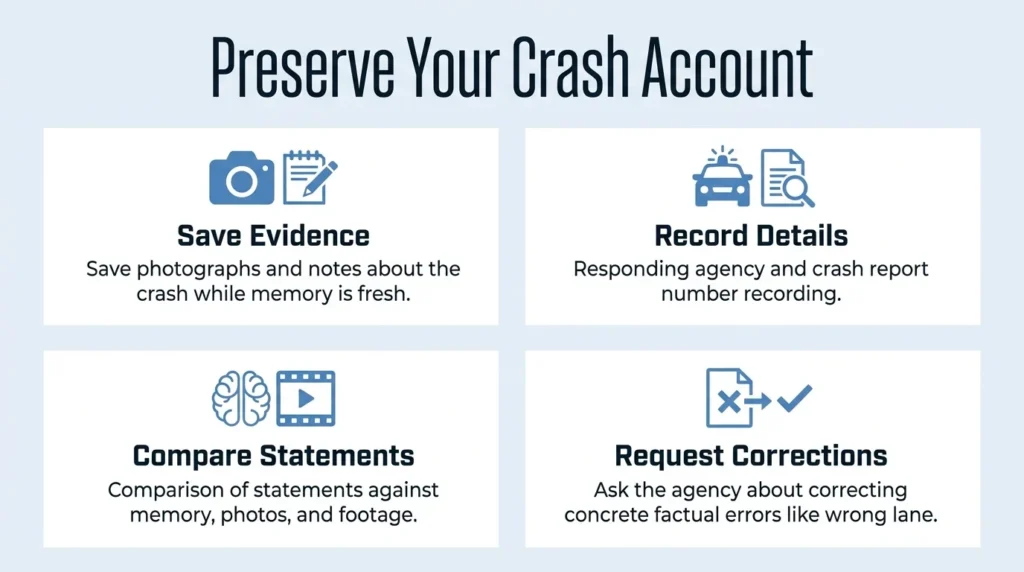
After a crash on the LBJ Freeway or a Dallas side street, these steps can help you review the records:
- Save your photographs and write notes about the crash and officer conversation while your memory is fresh.
- Record the responding agency and crash report number.
- Compare reported statements with your memory, photographs, and available footage.
- Ask the agency about correcting concrete factual errors, such as the wrong lane or direction of travel.
An officer may decline to revise a disputed narrative, and a correction does not erase an earlier statement. Texas car accident legal help can include reviewing available records and assessing appropriate preservation or access steps.
Talk With Angel Reyes & Associates About Your Crash
If you’re worried about something you said or how the report describes it, Angel Reyes & Associates can review your statements and available records with you. The firm has guided injured Texans for over 30 years and can walk you through your options.
Contact Angel Reyes & Associates for a free consultation.
Past results do not guarantee future outcomes.
Talking to Police After a Crash FAQs
Can you refuse to give a recorded statement to the other driver's insurance company after a Texas car accident?
You generally do not have the same legal obligations to the other driver’s insurer that you have to law enforcement, although your own insurance policy may require cooperation with your insurer. Before providing a recorded statement, review your policy obligations and consider getting legal advice if fault or the extent of your injuries is disputed.
What happens if the other driver gives police a false or misleading account of the crash?
You can provide the investigating officer with relevant evidence, such as photographs, witness contact information, dashcam footage, or nearby surveillance-camera locations, to help clarify disputed facts. Keep your own account factual and avoid confronting the other driver or making unsupported accusations.
Can a passenger or witness give police a statement after a Texas car accident?
Yes, passengers and other witnesses can share what they personally observed, including traffic signals, vehicle movements, and events immediately before impact. Witnesses should distinguish firsthand observations from information they heard from someone else so investigators can assess the account accurately.
About the Authors

Angel Reyes
Writer
Angel L. Reyes, III is the Founder and Managing Partner of Angel Reyes & Associates. A nationally recognized trial attorney and business leader, Angel founded the firm in 1993, which has gone on to help over 70,000 injury victims recover more than $1 billion. Named to the Texas Super Lawyers list annually since 2008, Angel brings Wall Street experience, Ivy League education, and a deep commitment to client advocacy. He is a frequent legal commentator and published author with extensive contributions to legal scholarship, trial strategy, and consumer protection.

Kyle Nicolas
Editor
Kyle Nicolas is the Web Content & SEO Manager at Angel Reyes & Associates. He has more than 10 years of experience as a marketing co...

Angel Reyes
Reviewer
Angel L. Reyes, III is the Founder and Managing Partner of Angel Reyes & Associates. A nationally recognized trial attorney and business...