How to File a Claim Against a Self-Driving Car Company in Texas


Every article on this site is researched by our internal team, reviewed for legal accuracy against current Texas law, and held to State Bar of Texas advertising standards before publication. We do not publish content that overstates outcomes or makes promises about results.
Learn more about our
editorial standards .
Key Takeaways
- Multiple parties may share liability in a self-driving car accident, including operators, manufacturers, software developers, and other drivers.
- Preserving event data recorder (EDR) and automated driving system (ADS) data immediately after a crash is critical because this evidence can be overwritten or lost.
- Texas generally allows two years to file a personal injury lawsuit, but some cities may require a Formal Notice of Claim within 45 to 60 days.
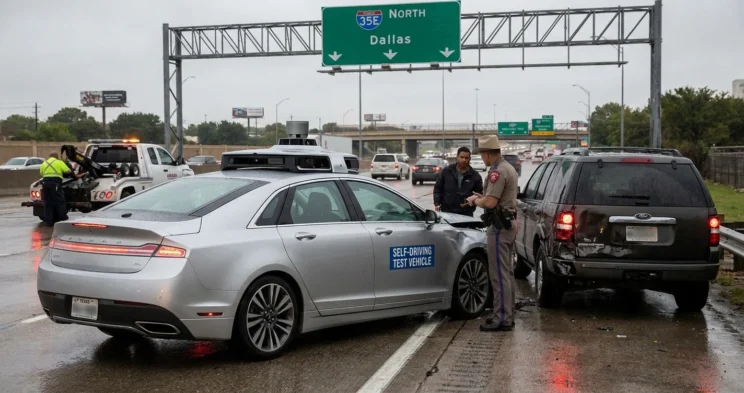
You were heading home on I-35E through Dallas when a vehicle with no one behind the wheel drifted into your lane. The collision happened before you could react. Now you’re dealing with injuries, vehicle damage, and a confusing question: who exactly was responsible when the other car was driving itself?
Self-driving car accidents raise liability questions that traditional crashes don’t. The good news is that Texas law still provides a path to compensation. The challenge is knowing where to look for answers and how to document the evidence that matters most.
What Makes Self-Driving Car Accident Claims Different
In self-driving car accidents, the same legal rules and regulations apply as in any Texas car accident claim. You still need to prove someone (or something) was at fault and that the negligence caused your injuries. The difference here is that “someone” might include a software developer, a vehicle manufacturer, a fleet operator, or a combination of all three.
Texas Transportation Code § 545.454 treats an engaged automated driving system (ADS) in the vehicle as the “operator” for traffic-law compliance purposes. This matters for regulatory questions, but it doesn’t automatically determine who pays for your injuries in a civil claim.
Who Is Liable in a Texas Self-Driving Car Accident?
Liability in self-driving vehicle crashes rarely falls on just one party. Your claim may involve multiple defendants with different insurance coverage and legal duties.
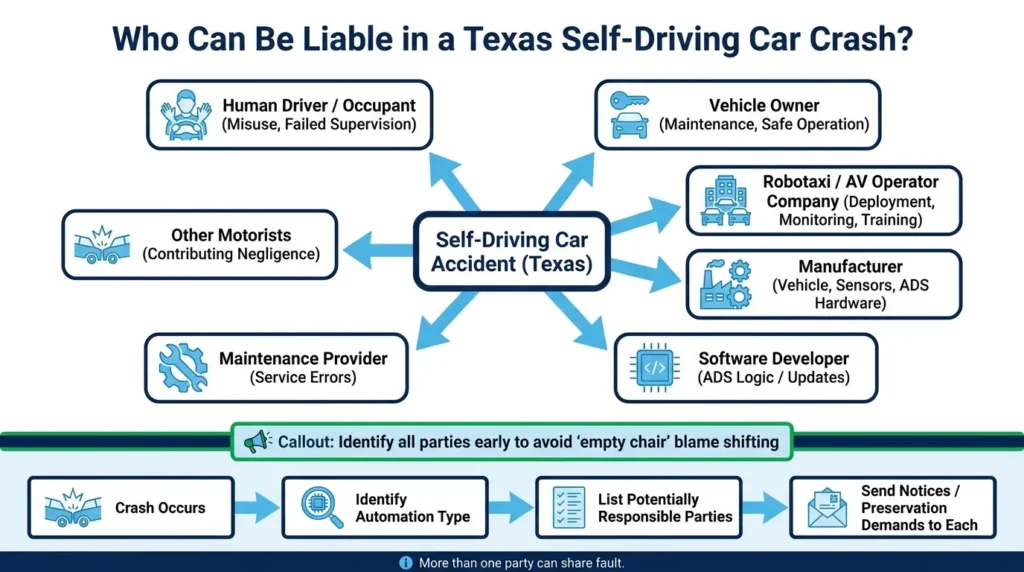
Potentially responsible parties include:
- Human drivers or occupants who failed to supervise driver-assist systems.
- Vehicle owners who are responsible for maintenance and safe operation.
- Robotaxi or AV operator companies that deployed the vehicle.
- Manufacturers of the vehicle, software, or sensor systems.
- Maintenance providers who serviced the vehicle.
- Other motorists whose negligence contributed to the crash.
Early identification of all parties matters. It ensures proper insurance notice, allows for preservation demands, and prevents defendants from shifting blame to an “empty chair” (a party not included in the lawsuit).
Owner & Operator Liability
Even when a vehicle operates independently, the owners and operators responsible for the vehicle still have duties. Fleet operators must maintain vehicles properly, train safety drivers, choose safe deployment routes, and monitor operations.
For crashes involving rideshare or robotaxi services, the operating company’s policies, incident response logs, and driver communications become important evidence. Negligent maintenance, inadequate training, or unsafe dispatch decisions can all support liability claims.
Manufacturer & Software Liability
If a defect in the ADS contributed to your crash, you may have a product liability claim against the manufacturer.
Texas recognizes three types of product defects:
- Design defects: The product was inherently unsafe as designed.
- Manufacturing defects: Something went wrong during production.
- Warning defects: Inadequate instructions or safety warnings.
For self-driving vehicles, this might involve perception errors (the system failed to detect your car), decision failures (the system chose an unsafe action), or sensor malfunctions.
Driver-Assist vs. Self-Driving
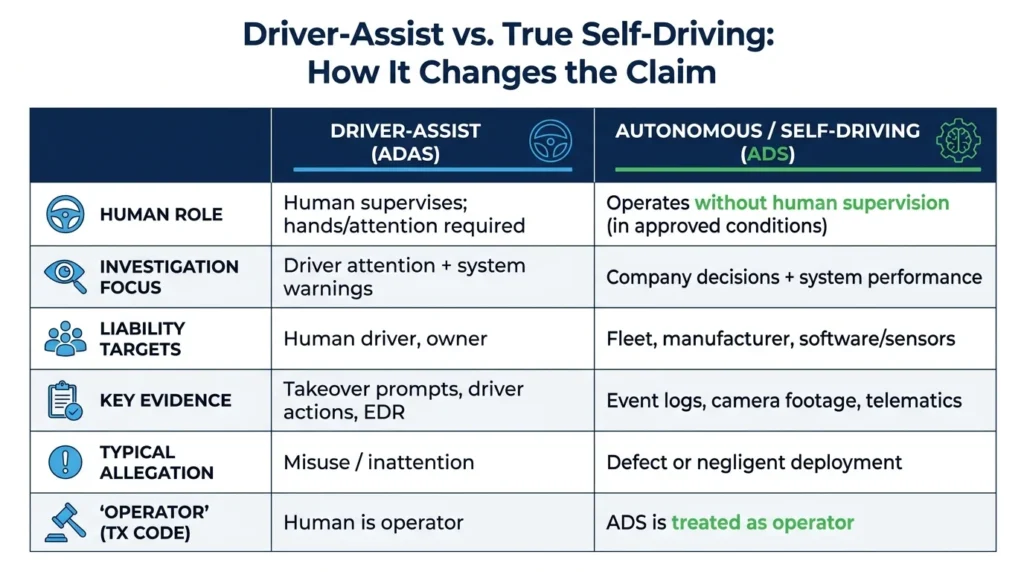
Many crashes involving “self-driving” technology actually involve driver-assist systems. These systems require a human driver to remain attentive with hands on the wheel. True autonomous vehicles can operate without human supervision in certain conditions.
This distinction changes everything about your claim. With driver-assist, the investigation focuses on whether the human driver was paying attention and whether the system performed as designed. With self-driving vehicles, the focus shifts to the company operating the vehicle and whether the technology itself failed.
Legal Theories Your Claim May Rely On
Because self-driving technology involves both human oversight and machine logic, your claim will likely follow one of two legal paths, or both simultaneously.
These include:
- Traditional negligence (the human error path): This applies when a person or company makes a careless mistake. In Texas, you must prove that they had a duty to act safely and failed to do so.
- Product liability (the technology failure path): This is often the core of a self-driving vehicle claim. You do not have to prove a specific person was at fault – you only need to prove that the product itself was defective.
In both scenarios, the ADS logs act as the ultimate witness. They tell us if the human was warned to take over (negligence) or if the software misidentified an object (product liability).
Key Claim Deadlines
The legal clock starts running immediately after your crash. Self-driving vehicle cases often take longer to investigate, but you still must adhere to local deadlines.
Here are some key deadlines to be aware of:
- Under Texas Civil Practice and Remedies Code § 16.003, personal injury lawsuits in Texas must be filed within 2 (two) years of the accident.
- Local North Texas cities, such as Dallas, often require a formal Notice of Claim within 90 days (and some require as little as 45 to 60 days).
- If a city vehicle, public transit, or road design contributed to your crash, the Texas Tort Claims Act may require notice within six months.
Investigate early to determine when your claim should be filed.
What Compensation Can You Pursue
Texas law allows recovery for both economic and non-economic damages after a self-driving car accident.
Economic damages include medical bills (current and future), lost wages, reduced earning capacity, and out-of-pocket costs like transportation to appointments and medical equipment. Keep all receipts, bills, and employer documentation.
Non-economic damages cover pain, mental anguish, physical impairment, disfigurement, and loss of enjoyment of life. These damages are harder to quantify but often represent significant portions of serious injury claims.
What to Do After a Self-Driving Car Accident in DFW
The first 72 hours after a crash involving an autonomous vehicle are critical. The steps you take protect your legal options.
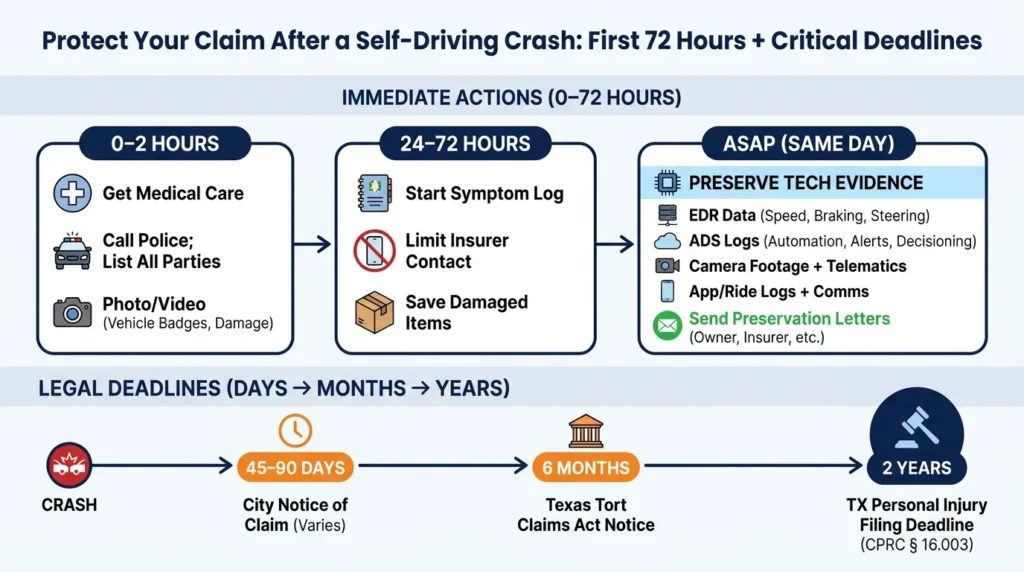
Here’s what to do after you are involved in a self-driving car accident:
- Get medical attention immediately, even if injuries seem minor. Emergency rooms and urgent care facilities create documentation that connects your injuries to the crash.
- Keep a symptom log in the days that follow. Delayed symptoms like headaches, neck pain, or cognitive issues are common after collisions.
- Call the police and make sure the report identifies all involved parties. This includes the vehicle owner, any ride or app company operating the vehicle, safety drivers, and remote operators.
- Take photos and videos of the vehicle’s badges and trim levels. These details indicate whether the car has driver-assist or full autonomous capability.
- Be careful with insurance communications. Adjusters may call quickly with questions and offers. Avoid recorded statements until you understand how fault allocation and potential product defects affect your claim. Insurance companies are businesses focused on resolving claims for the lowest possible payout.
Preserve Tech Evidence Immediately
Modern vehicles, especially those with autonomous features, store data that can prove exactly what happened. This evidence doesn’t last forever.
The National Highway Traffic Safety Administration explains that Event Data Recorders (EDR) capture information like speed, braking, steering inputs, and system status in the seconds before a crash. Autonomous vehicles may also store camera footage, telematics data, app and ride logs, and detailed ADS event logs showing when automation was engaged.
Send preservation letters immediately to vehicle owners, insurers, fleet operators, and manufacturers. These letters formally request that no data be overwritten or destroyed. Without this step, critical evidence can disappear during routine maintenance or system updates.
How Angel Reyes & Associates Can Help
Self-driving car accident claims require quick action, technical knowledge, and experience handling complex liability questions. At Angel Reyes & Associates, we’ve spent over 30 years helping injured Texans navigate difficult claims.
We understand the urgency of preserving EDR and ADS data before it disappears. We know how to identify all potentially responsible parties and hold them accountable. Our firm has recovered more than $1 billion for clients, and we handle cases on a contingency basis; that means no fees unless we win.
We offer free consultations and are available 24/7. With more than 20 locations across Texas, we can meet you where you are. We also offer service in Spanish.
If you’ve been injured in a crash involving a self-driving or driver-assist vehicle, contact us today to discuss your options. The evidence that matters most won’t wait.
Self-Driving Accident Claim FAQs
Can I get the self-driving car’s data myself after a crash?
Usually not on your own. Access to EDR downloads, company logs, camera footage, or app records often depends on vehicle ownership, consent, or formal legal requests.
What if the self-driving vehicle is part of a company fleet?
A commercial vehicle may bring in additional records, insurance policies, and company procedures that do not exist in a private-car claim. That can include dispatch records, maintenance files, remote-operator communications, and trip data.
Does Texas require a human to sit behind the wheel of a self-driving car?
Not always. Texas law allows certain automated vehicles to operate without a human driver if the vehicle meets legal requirements for registration, insurance, and safe operation.
What happens if I was partly at fault in a Texas autonomous vehicle crash?
You may still recover damages if you were 50% or less responsible, but your recovery can be reduced by your share of fault. If you are more than 50% at fault, Texas law generally bars recovery.
Should I keep the damaged car and personal items after the crash?
If possible, yes. The vehicle, child seats, helmets, phones, and other damaged items can become important evidence about impact force, system warnings, or how the crash happened.
About the Authors

Angel Reyes
Writer
Angel L. Reyes, III is the Founder and Managing Partner of Angel Reyes & Associates. A nationally recognized trial attorney and business leader, Angel has helped over 70,000 injury victims recover more than $1 billion since founding the firm in 1993. Named to the Texas Super Lawyers list annually since 2008, Angel brings Wall Street experience, Ivy League education, and a deep commitment to client advocacy. He is a frequent legal commentator and published author with extensive contributions to legal scholarship, trial strategy, and consumer protection.

Kyle Nicolas
Editor
Kyle Nicolas is the Web Content & SEO Manager at Angel Reyes & Associates. He has more than 10 years of experience as a marketing co...

Angel Reyes
Reviewer
Angel L. Reyes, III is the Founder and Managing Partner of Angel Reyes & Associates. A nationally recognized trial attorney and business...