How Guardrails & Road Infrastructure Can Injure Motorcyclists in Texas


Every article on this site is researched by our internal team, reviewed for legal accuracy against current Texas law, and held to State Bar of Texas advertising standards before publication. We do not publish content that overstates outcomes or makes promises about results.
Learn more about our
editorial standards .
Key Takeaways
- Texas Tort Claims Act claims require written government notice within six months of the crash.
- Defective end terminals and private contractors are not protected by sovereign immunity.
- TxDOT confirmed in 2024 that standard W-beam guardrails are not designed to protect motorcycle riders.
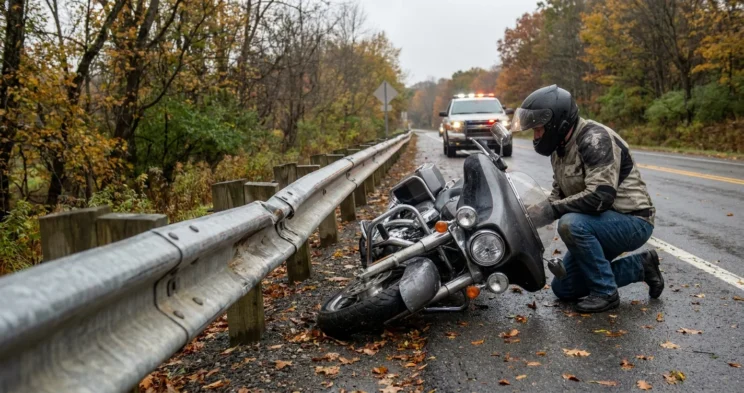
You were riding home on a curve outside San Antonio when your front wheel caught loose gravel along the shoulder. In a fraction of a second, you were sliding toward the guardrail. You expected it to stop you, but instead, the steel edge sliced through your leg before you even understood what had happened.
Most people assume guardrails are designed to protect everyone on the road, but they are not. The engineering behind standard W-beam guardrail systems was built around car occupants, and what protects a driver can become a fatal hazard for a rider.
Why Guardrails Hurt Motorcyclists Differently
Standard W-beam guardrails sit at a height and angle designed to catch the body of a car, and a motorcycle rider’s body is positioned differently. When a rider goes down, the body slides toward the barrier at a lower height, often passing under the beam and directly into the steel posts embedded in the ground.
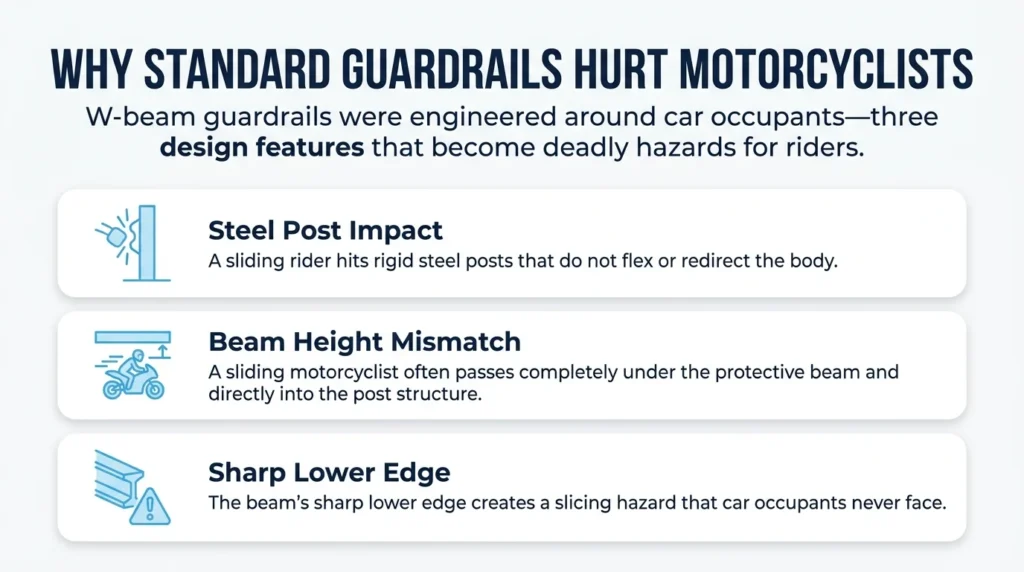
The posts are the deadliest element for riders because they do not flex or redirect a sliding body. Impact with a post at highway speed causes severe blunt force trauma; fractures; and, in documented cases, amputation. The beam’s sharp lower edge also creates a slicing hazard that car doors never encounter.
TxDOT acknowledged this in a May 2024 announcement, following a five-year partnership with the Texas A&M Transportation Institute. The agency confirmed that current guardrail designs are not optimized for motorcyclists and began developing a retrofit rub rail and cap rail system to reduce post-impact injuries. That standard was still in development at the time of the announcement.
Texas law allows injured riders to pursue claims for motorcycle accidents caused by road infrastructure that fails to meet reasonable safety standards. The first step is understanding which type of claim applies.
Product Liability for Defective Guardrail End Terminals
The guardrail beam itself is only part of the problem. The end terminal, which is the flared entry section at the beginning of every guardrail run, is where many of the most catastrophic injuries occur.
End terminals are engineered to cushion the impact of a vehicle that strikes the guardrail head-on. When they work correctly, the beam extrudes through a feeder chute and bends away from the vehicle. When they fail, the chute jams and the beam folds into a rigid metal spear that can penetrate a vehicle or a rider.
The Trinity Industries ET-Plus end terminal became the center of federal litigation after it was discovered that, in 2005, the company quietly changed the dimensions of the feeder chute without notifying the Federal Highway Administration as required. A federal jury in the Eastern District of Texas initially found Trinity liable and returned a verdict that grew to over $680 million. The Fifth Circuit later reversed the judgment on appeal, but the litigation produced a documented record of the 2005 design change and the injury pattern it created.
The FHWA’s own safety analysis of extruding W-beam guardrail terminal crashes documented the scope of the performance failures.
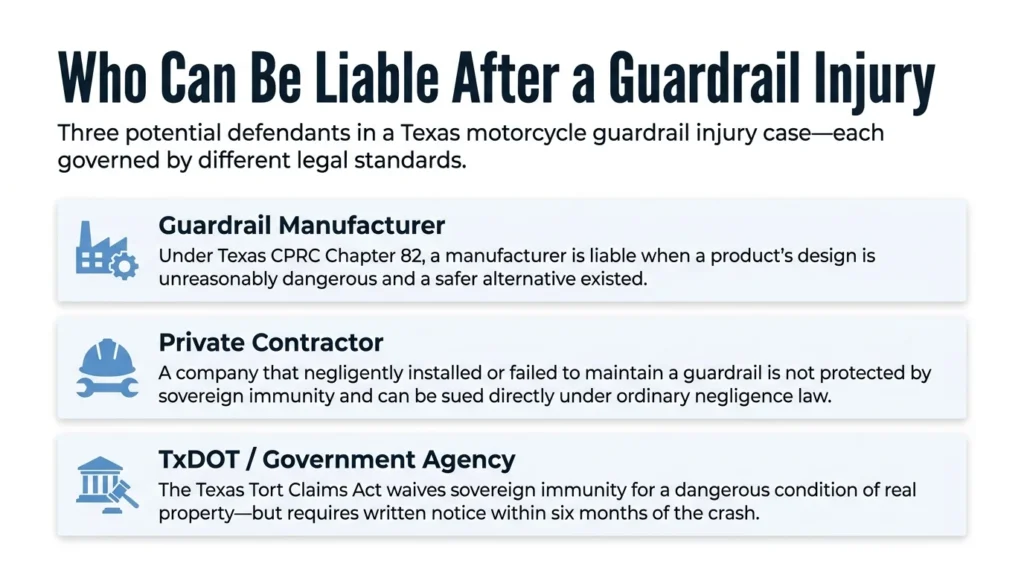
Under the Texas Civil Practice and Remedies Code (CPRC) Chapter 82, a manufacturer is liable when a product’s design makes it unreasonably dangerous and a safer alternative design existed. The ET-Plus design change meets that standard. For motorcycle riders, the geometry of standard W-beam systems may also support a design defect argument independent of the end terminal.
Pursuing a defective product claim against a manufacturer requires identifying the specific hardware model, tracing the installation history, and verifying whether it matches a recalled or litigated product line. An attorney can pull those records through discovery.
Private installation contractors face separate exposure. Because the Texas Tort Claims Act’s (codified at Texas CPRC Chapter 101) definition of employee excludes independent contractors, a private company that negligently installed or failed to maintain an end terminal can be sued directly under negligence theories, without the sovereign immunity shield that protects government agencies.
Government Liability Under the Texas Tort Claims Act
Government entities are not automatically off limits when a public road’s hardware causes injury. The Texas Tort Claims Act waives sovereign immunity for personal injury caused by a condition of tangible personal or real property.
A guardrail that fails to meet applicable safety standards can qualify as a dangerous condition of real property under that provision. TxDOT and county road authorities have a duty to maintain barriers on public roads to a standard that reflects foreseeable risk. When a known hazard exists and goes unaddressed, that inaction can form the basis of a claim.
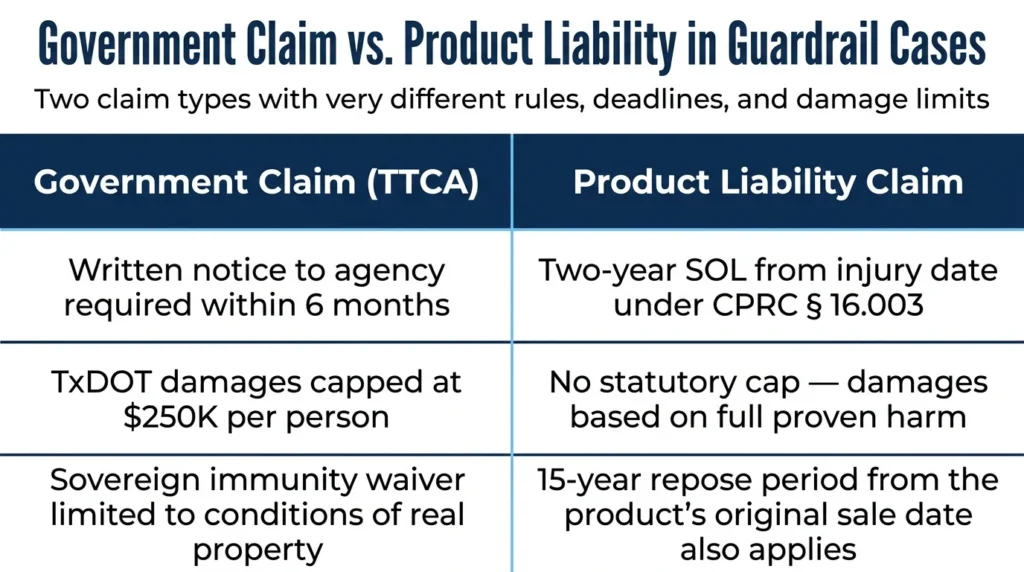
The procedure for suing a government entity is strict. You must provide formal written notice to the agency within six months of the incident. The notice must reasonably describe:
- the injury
- the time and place
- the facts of the incident
Missing this deadline can bar the claim entirely, regardless of how strong the underlying facts are. The six-month requirement runs independently of the two-year statute of limitations under CPRC § 16.003, which governs the deadline for filing the actual lawsuit.
Damage caps also apply, meaning claims against the state of Texas are limited to $250,000 per person and $500,000 per occurrence for bodily injury or death, while local government caps are lower. These limits do not apply to claims against private contractors, which is one reason identifying every responsible party at the outset of a case matters. If a private entity’s negligence contributed to the hazardous guardrail or maintenance, your recovery options may change significantly.
After a guardrail crash, gathering evidence quickly gives your claim the strongest foundation. A review of legal strategies after a Texas motorcycle accident can help you understand what documentation to collect before returning to the crash site.
What TxDOT’s 2024 Standard Means for Your Claim
TxDOT’s motorcycle rub rail announcement is not just an engineering story; it is an official acknowledgment by the state’s own road authority that current guardrail hardware creates foreseeable risk for riders. When a crash occurs on a road where that risk was known, and no upgrade was installed, the knowledge gap becomes part of the liability analysis.
The 2024 guidance targets high-risk corridors: tight curves, roads with histories of roadside departure crashes, and areas with higher-than-normal motorcycle traffic. If your crash happened in one of those locations without the new standard applied, the absence of the retrofit is relevant evidence.
A review of how Texas motorcycle accident settlements are calculated shows that the facts around road maintenance and known defects directly affect settlement value. Documented prior crashes at the same barrier location, maintenance records showing delayed repairs, and inspection logs showing no response to known hazards all carry weight in a guardrail injury case.
Where a private contractor was responsible for installation or maintenance, deviation from TxDOT standards is evidence of negligence. Those contractors are not protected by sovereign immunity even when performing government-funded work. An attorney reviewing your crash can subpoena the maintenance and inspection records tied to the specific barrier section.
Work with an Injury Attorney After a Guardrail Crash
Guardrail injury claims are among the more technically complex personal injury cases. They often require identifying multiple defendants, tracing the installation and maintenance history of specific hardware, and meeting procedural deadlines that differ for government and private party claims.
Angel Reyes & Associates has over 30 years of experience, helping injured Texans recover over $1 billion in damages, including riders facing the hard question of who is responsible when the road itself caused the injury. To review what we have recovered for clients in similar injury cases, see our case results. We work on a contingency basis, so you pay no fee unless we win.
Our team can investigate the specific end terminal and barrier records involved in your crash, identify whether the manufacturer, a contractor, or a government entity bears responsibility, and pursue the claim on your behalf.
Every guardrail crash is different. We can help you understand your options, so contact us for a free consultation.
Past results do not guarantee future outcomes.
Guardrail Motorcycle Injury Claims FAQs
Does not wearing a helmet affect my guardrail injury claim in Texas?
Texas law allows riders over 21 to ride without a helmet under certain conditions, and the absence of a helmet does not bar a claim. However, if you sustained head injuries, an insurer may argue that not using a helmet increased the severity of those injuries and seek to raise your percentage of fault under Texas’s modified comparative fault rules.
What evidence should I gather at the crash site after hitting a guardrail?
Photograph the guardrail and end terminal from multiple angles before any repairs are made, and capture the road surface, skid marks, and surrounding conditions. Guardrails are often repaired or replaced within days of a serious crash, so documentation gathered at the scene is frequently the only record of the barrier’s pre-crash condition.
Is there a time limit for filing a product liability claim against a guardrail manufacturer in Texas?
Texas product liability claims are governed by a two-year statute of limitations from the date of injury and a 15-year statute of repose from the date the product was first sold, meaning guardrails installed more than 15 years before your crash may fall outside the product liability window even if a defect contributed to your injuries.
Can I request TxDOT's maintenance records for the guardrail that injured me?
Yes. Texas Public Information Act requests allow you to obtain maintenance, inspection, and repair records for specific road sections from TxDOT or the relevant county road authority. These records can reveal prior damage reports, delayed repairs, or a history of crashes at the same location.
Do the same rules cover county road guardrails as TxDOT guardrails?
County road authorities fall under the Texas Tort Claims Act, but the damage caps are lower than those for state-level claims. Claims against a local government are limited to $100,000 per person and $300,000 per occurrence for bodily injury or death, and the six-month written notice requirement still applies.
About the Authors

Alex Ivanov
Writer
Alex Ivanov is a personal injury attorney at Angel Reyes & Associates, focused on car, truck, and motorcycle accident cases. Licensed in Texas and multiple federal districts, Alex brings international legal experience and a global education to his practice. He earned his LL.M. from Texas A&M University School of Law after graduating from Belarussian State University in 2016. Alex is fluent in Russian, English, Ukrainian, and Belarussian, and is recognized by multiple national trial lawyer associations for his results and leadership under 40.

Kyle Nicolas
Editor
Kyle Nicolas is the Web Content & SEO Manager at Angel Reyes & Associates. He has more than 10 years of experience as a marketing co...

Angel Reyes
Reviewer
Angel L. Reyes, III is the Founder and Managing Partner of Angel Reyes & Associates. A nationally recognized trial attorney and business...