Has a Waymo Self-Driving Car Ever Caused a Fatal Crash?


Every article on this site is researched by our internal team, reviewed for legal accuracy against current Texas law, and held to State Bar of Texas advertising standards before publication. We do not publish content that overstates outcomes or makes promises about results.
Learn more about our
editorial standards .
Key Takeaways
- As of current reporting, no fatal crash has been documented in which a Waymo vehicle was determined to have caused the death.
- Texas law treats an engaged automated driving system as the "operator" for traffic-law compliance, which affects how fault is analyzed but doesn't automatically determine civil liability.
- Texas's proportionate responsibility system means that fault in multi-vehicle crashes can be divided among multiple parties, which makes evidence preservation and thorough investigation essential.
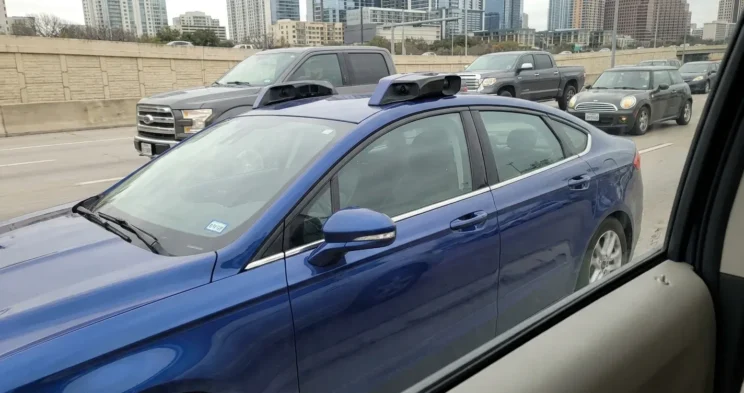
You were driving on I-35 through Austin when a self-driving vehicle merged into the lane beside you. The sight of an empty driver’s seat made you wonder: what happens if one of these cars causes a serious crash?
After reading headlines about a fatal collision involving a Waymo robotaxi, you want to know whether autonomous vehicles have actually caused deaths and who would be responsible if you were hurt in a crash involving a robotaxi in Texas.
To answer this, you need to understand a critical distinction that news headlines often get wrong.
“Involved in a Fatal Crash” Is Not the Same as “Caused a Fatal Crash”
When you search for information about Waymo and fatal accidents, you’ll find headlines that can be misleading if you don’t read carefully. The phrase “fatal crash involving Waymo” sounds alarming. It does not, however, mean Waymo caused someone’s death.
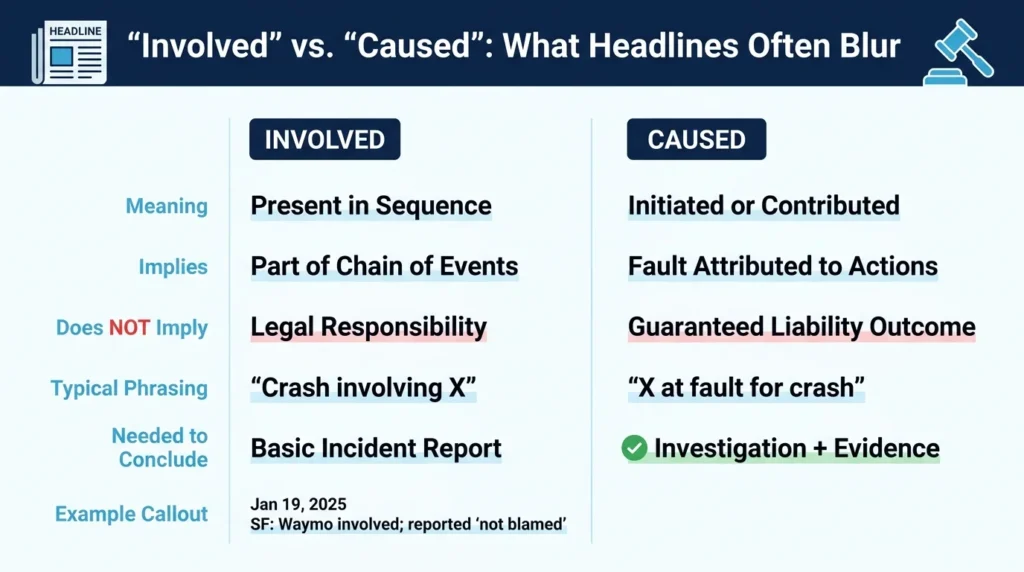
On January 19, 2025, a multi-vehicle collision in San Francisco resulted in one fatality and multiple injuries. A Waymo robotaxi was among the vehicles in the crash. NBC Bay Area reported this was the first fatal crash involving a driverless car. The same report stated that Waymo was not blamed for the collision.
This distinction is important. A vehicle can be “involved” in a crash simply by being present in the chain of events. For example, if you are struck by another car, you are involved in a crash. However, it does not make you responsible for the crash.
According to publicly available reports, no fatal crash has been documented in which a Waymo vehicle was determined to have caused the death. Early fault statements can change as investigations progress, but the current evidence does not support any claims that Waymo has killed someone through its own error.
What Happened in the January 2025 San Francisco Collision
The January 19, 2025 crash occurred in San Francisco and involved multiple vehicles in a chain-reaction collision. The San Francisco Standard reported specific details about the incident, including that a Waymo robotaxi was among the vehicles struck during the sequence of collisions.
Chain-reaction crashes work like dominoes. One vehicle initiates contact, which pushes other vehicles into subsequent collisions. A car at the end of that chain can sustain significant damage without having done anything wrong.
The reporting language is important here. Journalists noted that Waymo “was not blamed” based on information available at the time of publication. This phrasing reflects what first responders and early investigators communicated. It does not represent a final legal determination, but it does indicate that available evidence did not implicate Waymo as the initiating cause.
For readers searching whether Waymo was “at fault” in a fatal crash, the honest answer based on current reporting is no.
How Investigators Determine Who Caused a Multi-Vehicle Crash
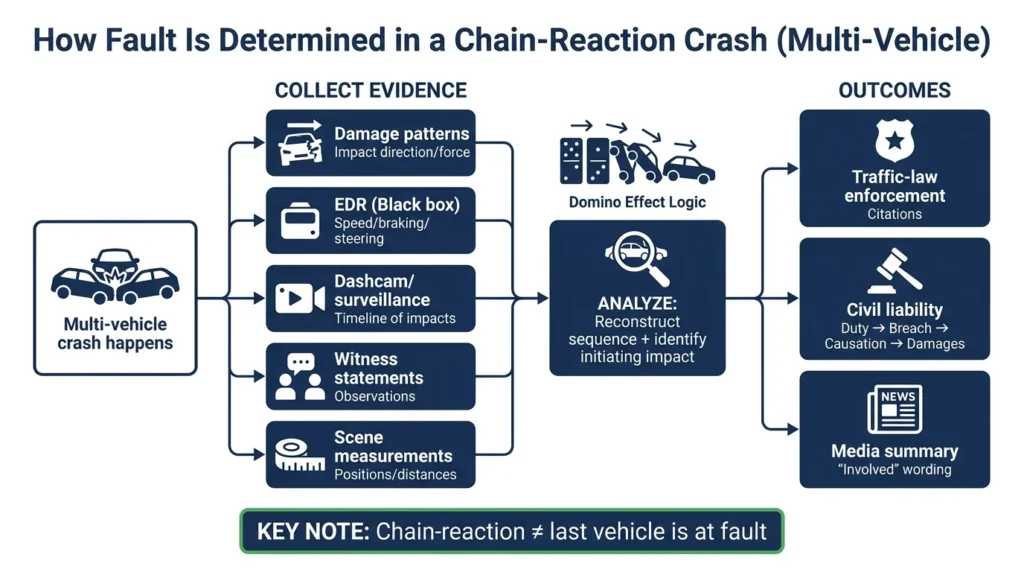
When multiple vehicles collide, determining responsibility requires examining specific evidence, such as:
- Damage patterns showing the direction and force of impacts
- Event data recorders capturing speed, braking, and steering inputs
- Dashcam or surveillance footage documenting the sequence of events
- Witness statements describing what each vehicle was doing
- Scene measurements establishing positions and distances
Traffic-law fault, civil liability, and media shorthand are three different things. A police report might assign a citation. A civil lawsuit applies different standards. A headline might simplify everything into language such as “there was a crash involving,” which obscures who did what.
In chain-reaction crashes, responsibility is frequently shared. The driver who rear-ended the first car may be primarily responsible. A driver following too closely in the middle of the chain might share some responsibility. The analysis depends entirely on the specific facts of the collision.
Why NHTSA Crash Reports Don’t Prove Fault
Many claims about autonomous vehicle safety reference data from the National Highway Traffic Safety Administration. Understanding what this data actually shows can help prevent misinterpretation.
NHTSA’s Standing General Order requires that companies operating automated driving systems must report crashes that meet certain criteria. This criteria includes fatalities, injuries requiring hospitalization, and crashes in which the vehicle had to be towed.
A report filed under this system indicates that a crash occurred. It does not establish who was legally at fault.
The reporting framework exists to collect data for safety analysis. It was not designed to decide who is at fault. When you see statistics about “Waymo crashes reported to NHTSA,” those numbers reflect incidents that meet reporting criteria. They do not represent findings that Waymo caused those incidents.
How Texas Law Treats Automated Driving Systems
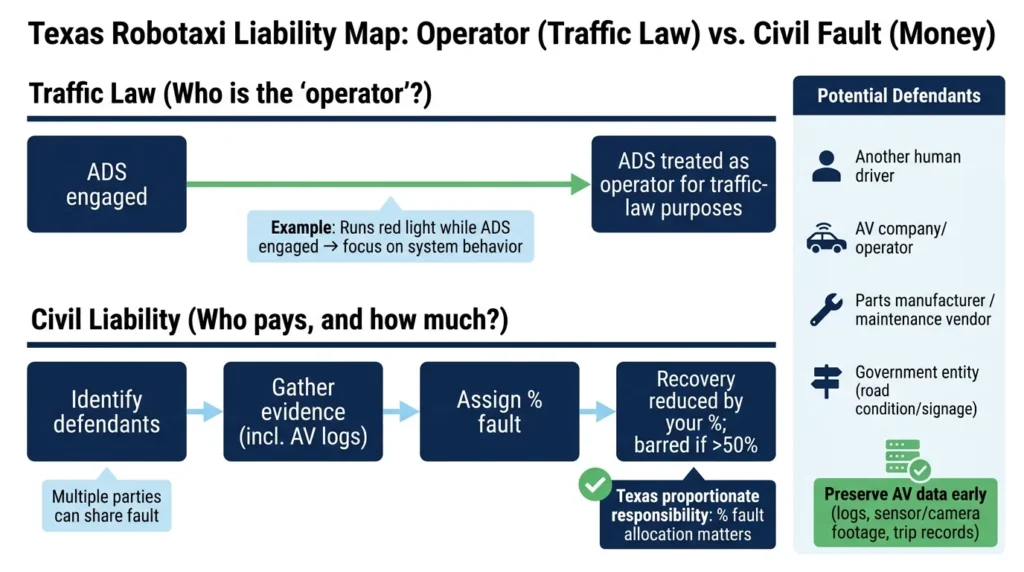
Texas has addressed autonomous vehicles in its transportation code. Under Texas Transportation Code Chapter 545, when an automated driving system is engaged, the ADS is considered to be the “operator” for traffic-law compliance purposes.
This means that when evaluating whether traffic laws were followed, the system itself, not a human passenger, is treated as the driver. If a robotaxi runs a red light while the ADS is engaged, the analysis focuses on the system’s behavior, rather than looking for a human driver to blame.
This concept shapes how people think about crashes involving autonomous vehicles. Instead of focusing on “driver error,” the analysis examines system behavior, company protocols, and technological performance.
However, the “operator” designation does not automatically resolve civil liability questions. A Texas injury lawsuit still requires that you prove duty, breach, causation, and damages. The traffic-law framework provides only one piece of the analysis, not the complete answer.
Potential Defendants When a Robotaxi Is Involved
If you’re hurt in a crash involving an autonomous vehicle in Texas, several parties might be responsible, depending on the evidence:
Another human driver often remains the primary focus. Speeding, impairment, distracted driving, unsafe lane changes, and tailgating cause most car accidents regardless of whether an AV is present.
The AV company could face scrutiny if there is evidence to suggest that the automated system made an unsafe decision, the vehicle was improperly maintained, or company protocols contributed to the crash.
Other entities (including parts manufacturers, maintenance vendors, or even government agencies responsible for road conditions) might share responsibility if the evidence supports it.
Texas Comparative Fault in Multi-Vehicle Crashes
Texas uses a proportionate responsibility system under Texas Civil Practice and Remedies Code Chapter 33. This means fault can be divided among multiple parties, and what you recover will depend on how responsibility is allocated.
Consider three hypothetical scenarios:
Scenario A: A robotaxi is stopped at a red light in the Mueller neighborhood. A speeding driver rear-ends it, pushing it into the intersection. In this case, the primary fault likely rests with the speeding driver.
Scenario B: A robotaxi makes an abrupt lane change on Loop 1 while its ADS is engaged, cutting off another vehicle and causing a collision. In this case, the company’s system behavior becomes the central focus.
Scenario C: Multiple human drivers and a robotaxi are all involved in a chain-reaction crash on I-35. In this case, proportionate responsibility analysis will examine each party’s conduct to allocate specific fault percentages.
Small shifts in fault allocation can significantly affect your compensation. For example, if you’re found 20% responsible versus 40% responsible, your recovery will change substantially.
Steps to Take After a Crash Involving a Self-Driving Vehicle
If you’re involved in a collision with an autonomous vehicle in Texas, certain steps become especially important:
- Call 911 and request police documentation of the scene.
- Get a medical evaluation even if your injuries seem minor.
- Photograph everything including all vehicles, damage patterns, the surrounding area, and any visible company branding or vehicle identification.
- Identify all parties including the AV company, any human drivers, and witnesses.
- Preserve communications from any company representatives who contact you.
Evidence preservation is more important in AV cases because vehicle logs and system data can be time-sensitive. An attorney can send a formal preservation letter requiring the company to retain this information before it can get overwritten or lost.
Finally, don’t assume a single insurance policy covers everything. Multi-vehicle crashes involving commercial robotaxis may involve multiple policies and corporate entities.
When to Contact a Texas Car Accident Attorney
The following are indications that you may need professional legal guidance:
- Serious injuries or fatalities in the crash
- Multiple vehicles with unclear fault allocation
- Commercial or robotaxi involvement which adds corporate complexity
- Conflicting statements from different parties or insurers
- Pressure to settle quickly before the full picture is clear
An experienced attorney can coordinate investigation efforts, ensure evidence is preserved, identify all potentially responsible parties, handle communications with multiple insurers, and document damages thoroughly.
At Angel Reyes & Associates, we’ve spent over 30 years helping Texans injured in complex crashes. Our team has recovered more than $1 billion for clients across the state. We offer free consultations and work on contingency, meaning you pay nothing unless we win your case.
If you’ve been hurt in a crash involving an autonomous vehicle or any multi-vehicle collision, contact us today to discuss your situation.
Waymo Accident FAQs
Can a passenger in a Waymo be personally sued after a crash in Texas?
Usually, a passenger is not liable just for riding in the vehicle, but liability questions can become more complicated if the person owned the vehicle, interfered with its operation, or had some other direct role in what happened.
Are self-driving car companies required to report fatal crashes to the government?
Yes. NHTSA’s crash-reporting rules require reporting certain crashes involving automated driving systems, including crashes with a fatality, but the report is for safety oversight and does not decide legal fault.
What kind of evidence is unique in a crash involving a robotaxi?
In addition to the usual photos, witness names, and police report, these cases may involve trip records, sensor data, camera footage, and system logs that can help show what the vehicle was “seeing” and doing before impact.
Could a defective part-maker be responsible for a Waymo crash in Texas?
Possibly. If evidence shows a bad sensor, brake component, tire, or other part contributed to the crash, a manufacturer or maintenance-related party could share liability, along with other drivers or companies.
Does it matter whether the Waymo was carrying a rider at the time of the crash?
It can. Whether the vehicle was transporting a passenger, repositioning itself, or stopped between trips may affect which records, contracts, and insurance policies become important in a claim.
About the Authors

Angel Reyes
Writer
Angel L. Reyes, III is the Founder and Managing Partner of Angel Reyes & Associates. A nationally recognized trial attorney and business leader, Angel has helped over 70,000 injury victims recover more than $1 billion since founding the firm in 1993. Named to the Texas Super Lawyers list annually since 2008, Angel brings Wall Street experience, Ivy League education, and a deep commitment to client advocacy. He is a frequent legal commentator and published author with extensive contributions to legal scholarship, trial strategy, and consumer protection.

Kyle Nicolas
Editor
Kyle Nicolas is the Web Content & SEO Manager at Angel Reyes & Associates. He has more than 10 years of experience as a marketing co...

Angel Reyes
Reviewer
Angel L. Reyes, III is the Founder and Managing Partner of Angel Reyes & Associates. A nationally recognized trial attorney and business...