What Is the Average Settlement If You’re Hit by a Company Vehicle in Texas?


Every article on this site is researched by our internal team, reviewed for legal accuracy against current Texas law, and held to State Bar of Texas advertising standards before publication. We do not publish content that overstates outcomes or makes promises about results.
Learn more about our
editorial standards .
Key Takeaways
- Commercial policies often carry far higher limits than personal auto minimums.
- Vicarious liability lets injured victims pursue the employer, not just the driver.
- Exemplary damages are capped and require proof of gross negligence or fraud.
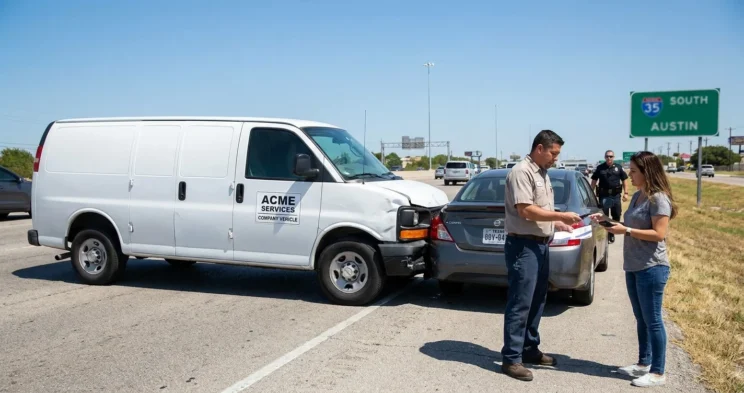
You’re waiting on a delivery in Fort Worth when a company van runs the light and hits your car. Your bumper is crushed, your neck already aches, and you have no idea yet whether this crash is worth more than an ordinary fender bender.
The number you can expect depends on a short list of facts, not on who happened to be behind the wheel.
Settlement Ranges & the Factors That Drive Them
There is no single average settlement for being hit by a company vehicle. What you can realistically expect falls into a range dicated by four factors. Because commerical accidents involve comapny-level insurance, these claims often land much higher than an ordinary driver-to-driver accident.
In Texas, every car accident claim in Texas gets evaluated the same basic way at the start: how badly you were hurt, what it cost you, and who has to pay. Minor, short-term injuries tend to settle in the low tens of thousands of dollars, while cases requiring months of treatment usually land higher. Severe or permanent injuries can reach well into six figures or more, according to general settlement data.
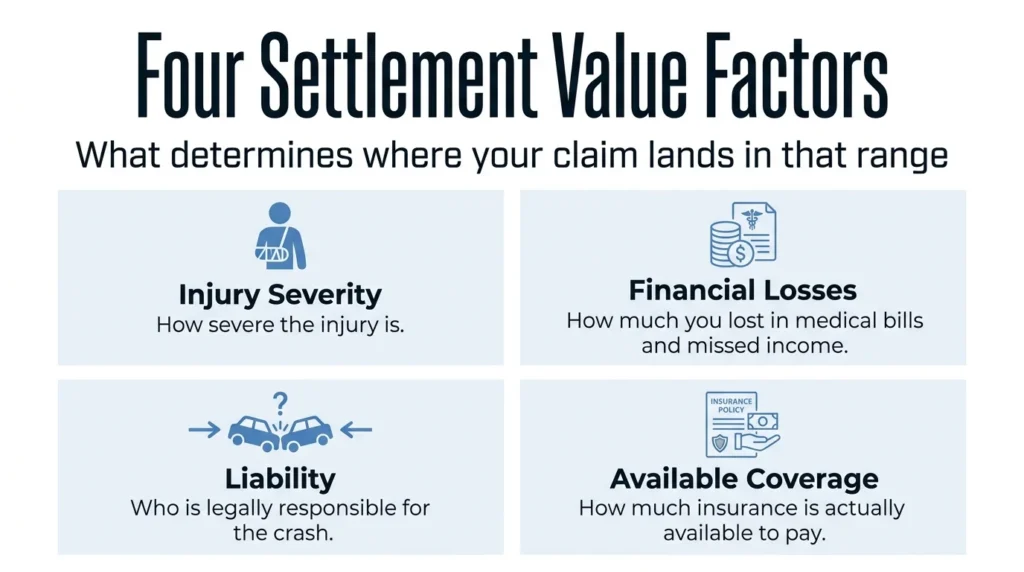
Where your claim lands within that range comes down to four specific elements. The first two factors come from you and the last two factors come from the crash itself.
- Injury Severity: How severe the injury is
- Financial Losses: How much you lost in medical bills and missed income.
- Liability: Who is legally responsible
- Available Coverage: How much insurance is actually available to pay.
A company vehicle directly impacts both liability and available coverage. These claims often land higher than an ordinary crash.
Why Company Vehicle Claims Settle Higher
Two things separate a company vehicle crash from an ordinary one: who can be held responsible, and how much insurance stands behind that responsibility.
Under respondeat superior, an employer can be held responsible for an employee’s actions if the employee was doing their job when the crash happened. That means you are not limited to the driver’s own insurance. The company itself, and the company’s insurance policy, can also be on the hook.
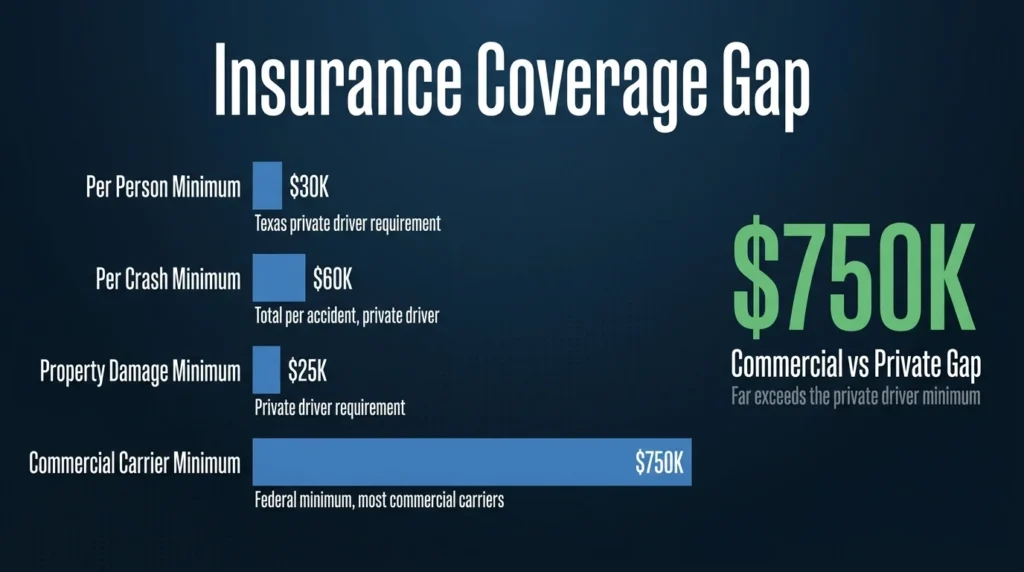
Insurance coverage is where the gap really opens up. Under Texas Transportation Code § 601.072, a private driver in Texas only has to carry $30,000 per injured person, up to $60,000 per crash, and $25,000 in property damage.
A qualifying commercial motor carrier must generally carry at least $750,000 in liability coverage under 49 CFR § 387.9. That category covers many of the trucks and vans behind truck accident claims. Some cargo types require far more coverage than that baseline.
Not every company vehicle meets that federal threshold. However, even an ordinary commercial policy usually carries higher limits than the state minimum for a personal vehicle. That gap in available coverage, not the crash itself, is usually the biggest reason a company vehicle claim settles for more.
When Employer Liability Does Not Apply
Vicarious liability applies only when the driver was doing their job at the time of the crash, not automatically every time a company vehicle is involved.
Courts look at whether the driver was performing work duties when the crash happened. That distinction, whether the driver was on the clock or off duty, sits at the center of most employer liability disputes after a crash.
Three situations commonly break the link between employer and employee:
- The driver was running a personal errand unrelated to work.
- The driver misused the vehicle in a way the job never authorized.
- The driver was actually an independent contractor, whom Texas law generally treats differently than a direct employee for vicarious liability purposes.
A company can also face separate liability for how it hired or supervised the driver, known as negligent supervision. A pattern of unsafe driving history can support that kind of claim, but Texas law limits when a prior conviction alone is enough to prove it. This angle depends heavily on the specific facts of your case.
Because more than one party, the driver, the company, or even another contractor, can end up sharing fault, understanding how liability gets divided among multiple parties in a commercial crash is worth doing before you accept any offer.
Recoverable Damages After a Company Crash
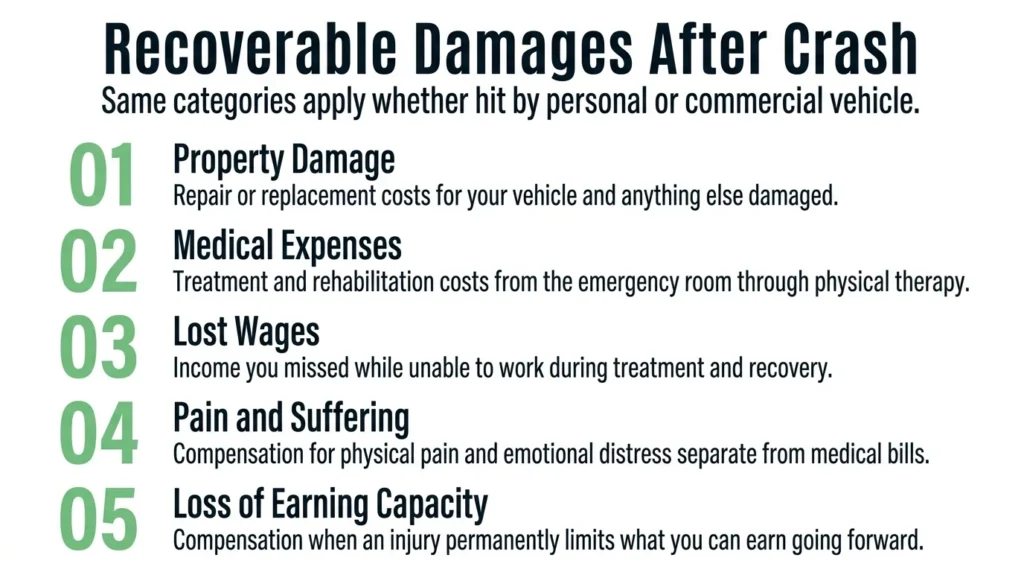
The same damage categories apply whether a personal or commercial vehicle hit you. What changes is how much of each category the available insurance can actually pay.
- Property damage: repair or replacement costs for your vehicle and anything else damaged in the crash.
- Medical expenses: treatment and rehabilitation costs tied to the injuries from the crash, from the emergency room through physical therapy.
- Lost wages: income you missed while you were unable to work during treatment and recovery.
- Pain and suffering: compensation for physical pain and emotional distress the injury caused, separate from your medical bills.
- Loss of earning capacity: compensation when an injury permanently limits what you can earn going forward, not just what you missed so far.
- Exemplary damages: available only in cases involving fraud, malice, or gross negligence, and capped by Texas Civil Practice and Remedies Code (CPRC) § 41.008 at the greater of $200,000 or twice your economic damages plus up to $750,000 in noneconomic damages.
A higher commercial policy limit does not create new categories of damages. It just means more room to actually recover what each category is worth once medical bills, lost income, and everything else are added up.
Work with a Texas Injury Attorney
Angel Reyes & Associates has represented Texas crash victims, including people hit by company and commercial vehicles, for more than 30 years. That experience means we know how to prove fault against a well-insured company, not just its driver. With more than 20 offices across Texas and a team of over 600 dedicated professionals, we have the resources needed to stand up to major commercial insurers.
We handle the investigation, the paperwork, and the negotiation, and you pay nothing unless we win. Our case results reflect more than $1 billion recovered for clients across thousands of Texas injury claims.
You pay nothing unless we win your case. Contact us for a free consultation, and let’s find out what your claim is realistically worth.
Past results do not guarantee future outcomes.
Company Vehicle Crash FAQs
How long do I have to file a claim if a company vehicle hit me?
Texas gives you two years from the crash date to file a personal injury lawsuit, the same deadline that applies to any car accident, under Texas Civil Practice and Remedies Code (CPRC) § 16.003.
Can I also sue the rental company if a rented company vehicle hit me?
Not solely for owning the vehicle. The Graves Amendment shields rental and leasing companies from liability based only on ownership, unless the rental company itself was negligent.
Will my own insurance help while a company vehicle claim is pending?
Yes, if you carry personal injury protection, since Texas requires insurers to include it on your policy unless you reject it in writing under Texas Insurance Code § 1952.152, and Personal Injury Protection pays medical bills and lost income regardless of fault.
Can I sue if a coworker driving a company vehicle hurt me on the job?
No, if your employer carries workers’ compensation coverage, since Texas Labor Code § 408.001 makes that coverage your exclusive remedy against the employer for an on-the-job injury.
Does a shorter deadline apply if a government vehicle hit me instead of a private company's?
Yes. Claims against a Texas governmental unit require written notice within six months of the crash under Texas Civil Practice and Remedies Code § 101.101, far shorter than the two-year deadline for private claims.
About the Authors

Alex Ivanov
Writer
Alex Ivanov is a personal injury attorney at Angel Reyes & Associates, focused on car, truck, and motorcycle accident cases. Licensed in Texas and multiple federal districts, Alex brings international legal experience and a global education to his practice. He earned his LL.M. from Texas A&M University School of Law after graduating from Belarussian State University in 2016. Alex is fluent in Russian, English, Ukrainian, and Belarussian, and is recognized by multiple national trial lawyer associations for his results and leadership under 40.

Kyle Nicolas
Editor
Kyle Nicolas is the Web Content & SEO Manager at Angel Reyes & Associates. He has more than 10 years of experience as a marketing co...

Angel Reyes
Reviewer
Angel L. Reyes, III is the Founder and Managing Partner of Angel Reyes & Associates. A nationally recognized trial attorney and business...