Back-to-School 2026: Record Road Construction Meets Record College Enrollment


Every article on this site is researched by our internal team, reviewed for legal accuracy against current Texas law, and held to State Bar of Texas advertising standards before publication. We do not publish content that overstates outcomes or makes promises about results.
Learn more about our
editorial standards .
Key Takeaways
- Crash rates in Texas university counties rose 27.1% in late August, against 9.4% elsewhere.
- Brazos County, home to Texas A&M, saw crash rates rise 65.1%, in all four years studied.
- The rise begins at move-in weekend, not the first day of class, and lasts into the following spring.
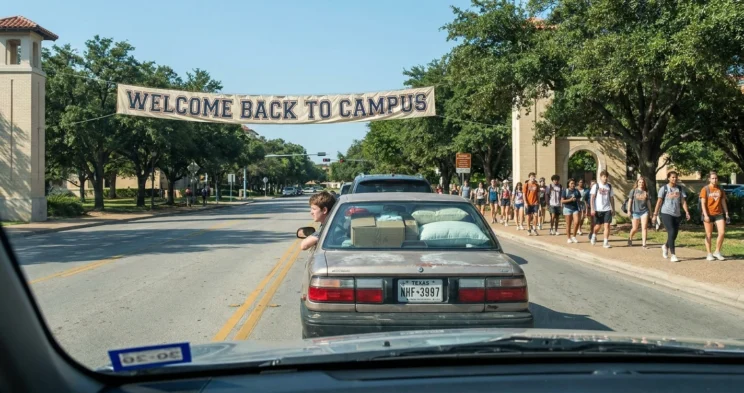
Most Texas college students commute. Four years of state crash records show what that does to the roads every August, and how long it lasts.
Texas A&M, UT Austin, Texas Tech, the University of Houston and UT Dallas all begin fall classes on Monday, August 24. Dallas College, Lone Star College, Austin Community College and dozens of other two-year schools around the state will also kick off their new semester within the same week.
For most of the students at these universities, that means getting behind the wheel, hitting the road, and driving to class. What that means across the state is that freeways, highways, and roads around these higher-education institutions are about to see the start of an annual spike in traffic that leads to a sustained increase in car accidents that doesn’t recede until the following spring.
In Brazos County, home to Texas A&M, crashes climb from about seven a day in July to more than thirteen by the end of August. The shift takes about ten days, and it happens every year.
To better understand this annual trend, we pulled four years of crash data directly from the Texas Department of Transportation’s (TxDOT) Crash Records Information System (CRIS). What we found not only added some important context to this annual increase in accidents, but also provided some great insight into what students who are heading to class this fall can expect for their commutes.
Texas Colleges Are Commuter Schools
Texas is somewhat unique in the national landscape in that several of our flagship, major universities house only a tiny fraction of the students they enroll. In fact, our research estimates* found that close to 90 percent of all college and university students throughout the state do not live on campus.
Texas A&M enrolled 81,354 students in fall 2025 and houses about 11,000 of them. The other 70,000 live somewhere else and travel into campus for class. College Station’s entire population at the 2020 census was 120,511.
That ratio is found in other schools too. More than three quarters of students at the University of Texas at Austin live off campus. This is partially due to first-year students not being required to live in university housing—a somewhat unique freedom amongst Texas four-year universities.
Ninety percent of UT Arlington students live off campus. So do 89 percent at UT San Antonio and 96 percent at UT Rio Grande Valley. The University of Houston puts its own figure at 85 percent of undergraduates. The University of Houston-Downtown has no student housing at all.
Community and junior colleges push these numbers further. These local institutions are almost entirely non-residential. When you add them to the count, the estimated total moves to roughly nine in ten Texas higher-education students commute to class.
While other states also have large contingents of commuting students, major universities of similar sizes in other states house far more of their students. The University of Georgia, for example, houses two-thirds of their student population. Michigan State houses 41 percent. Ohio State and Penn State house about a third each. By comparison, Texas A&M houses roughly one in seven.
What the Crash Records Show
A Texas university opening for the fall adds tens of thousands of cars to a mid-size city, including many driven by people who have never driven there before. To measure the impact of this influx of commuting vehicles, we compared five counties that host large universities against five counties that do not.
The university counties include:
- Brazos County (Texas A&M)
- Hays County (Texas State)
- Lubbock County (Texas Tech)
- Denton County (University of North Texas and Texas Woman’s University)
- McLennan County (Baylor University)
For comparison, we chose Ellis, Johnson, Kaufman, Guadalupe and Wichita counties. Each has a population in the same range and no large school drawing students in from outside the area.
We extracted and analyzed more than 200,000 crash records from CRIS and measured every county’s crash statistics for different periods of fall, comparing them to their own July. Historically, July is one of the quietest months on Texas roads, and the one when most students are gone for their summer break. With schools closed and classes not in session, school commuter traffic almost entirely ceases. That keeps local roads, weather and police reporting habits fairly constant.
However, we found that trend shifts quickly. In the last two weeks of August, crash rates in the university counties rose 27 percent. Brazos County, home of Texas A&M, rose 65 percent. In our comparison counties, crash rates rose just 9 percent.
| County | University | Late-August Rise | Years Rising |
| Brazos | Texas A&M | +65.1% | 4 of 4 |
| Lubbock | Texas Tech | +27.4 | 4 of 4 |
| Hays | Texas State | +23.2% | 4 of 4 |
| Denton | UNT, Texas Woman’s | +17.1% | 4 of 4 |
| McLennan | Baylor University | +6.0% | 3 of 4 |
| Comparison average | five counties | +9.4% | n/a |
Momentum Carries Throughout the Fall
By the time most students and their families arrive for move-in this weekend, the annual increase in crash rates will already be underway.
Through the first week of August, Brazos County’s daily crash count sits near its July average of 7.4. By August 13th, that count has jumped to 8.7. Historically, it reaches 9.8 by the very next day, and it does not come back down.
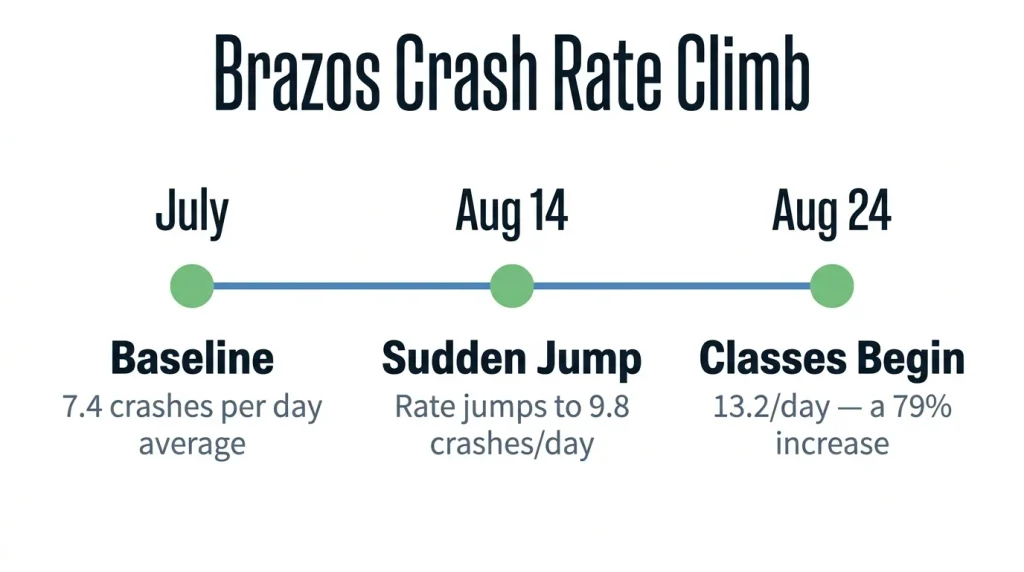
In 2026, that August 14th date is significant because it falls on Friday of the first of this year’s two biggest college move-in weekends. Several of the state’s large public universities, including Texas State, UT San Antonio, and Sam Houston State, will open their residence halls to students this weekend. Several others will open their residence halls between August 21st and 23rd.
Texas A&M, specifically, begins their move-in process next week on the 18th.
By the time August 24th rolls around, the day eight of the state’s largest institutions are scheduled to begin classes, the daily accident rate for Brazos County reaches 13.2. That’s a 79 percent increase in the number of crashes every day over the span of around two weeks.
This phenomenon is almost entirely localized to counties playing host to major universities, and our comparison counties prove it. Across those same four weeks, the five we selected combined never ran more than 16 percent above their July average.
That’s not the end of the momentum either. Historically, the rate has kept climbing well past the first day of class, peaking in October at 13.3 crashes a day, nearly double the July figure.
From there, the rate eases but never fully goes back. The count stays high through the winter and rises again with the spring semester. The monthly crash rate does not return anywhere near its July level until the following June, well after the school year has come to a close.
It should be noted that crash rate increases are not exclusive to university counties. Our comparison counties saw their own accident rates increase by 21 percent by October.
Some of what fuels this surge in crashes is a natural condition: darkness. In all ten examined counties, both university and not, the share of crashes happening after dark roughly doubles between July and November. A drive home in broad daylight during the first week of classes might be almost entirely in the dark by Halloween.
Why the Crashes Happen
People can point plenty of fingers at different theories or guesses as to why this surge in crashes happens every year. A lot of those guesses aren’t necessarily wrong, either. The truth is there are a lot of factors that contribute to this increase in daily wrecks around college campuses, including both some obvious and some that are less so.
Youth & Inexperience
Young drivers account for a growing share of these crashes, and the way the crashes happen explains why. In Brazos County, drivers aged 16 to 24 made up about 30 percent of crash-involved drivers in July. By late August that share was 39 percent. Once the semester was underway, their share reached 43 percent.
TxDOT records a “contributing factor” for every crash, which is essentially the peace officer who reports the accident’s best guess at a factor that either caused or contributed to a crash. During our study period, “failure to yield” spiked the most in Brazos County, up more than seven percentage points.
This factor category includes actions like turning across traffic, merging, and pulling onto a roadway. Each of these are common errors of a driver who does not yet know how traffic runs in a particular location. That is why inexperience carries such heavy crash risk for younger drivers.
College Football & Drunk Driving
For many Texas schools, college social life in the fall and winter weeks is centered around football. Our state is home to 22 NCAA Division 1 football programs, many of which are consistently considered among some of the best in the country. Several stadiums throughout the state are among the largest sporting venues in not just the country, but the entire world. Home games bring crowds of sometimes over 100,000 spectators to a densely-confined area on Saturday afternoons from August through December.
Generally, crashes do not notably increase from traffic around stadiums. However, these games have an indirect impact on crashes through another factor: intoxication. Tailgate culture, in-stadium consumption, and viewing parties at local bars and homes lead to an uptick in drug- and alcohol-fueled accidents that can be seen in documented data patterns.
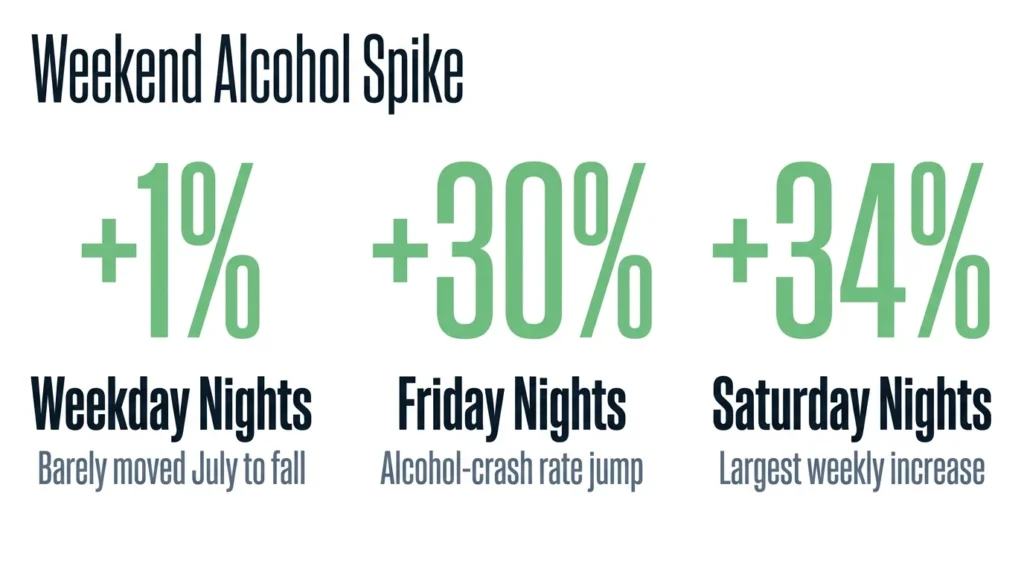
On weekday nights across our five chosen university counties, alcohol- and drug-involved crashes barely moved between July and the fall, rising just one percent. On Friday nights, they rose 30 percent. On Saturday nights they rose 34 percent.
In the fall, about two percent of weekday crashes in these counties involved alcohol or drugs. On weekend days the figure was closer to seven percent. Friday through Sunday are just three days out of seven, yet they account for nearly two-thirds of impaired-driving crashes in the fall.
Changing Roads
This year, students are also arriving back to class amidst heavy road construction. TxDOT counted more than 1,800 active work zones statewide during peak construction in 2025, and most of those projects are still ongoing. Many of those projects involve either major freeways or surface street thoroughfares through some of the state’s largest university communities.
Work zones are more dangerous for the people driving through them than for the crews. In 2024, TxDOT recorded nearly 28,000 work-zone crashes, resulting in 215 fatalities, a 12 percent increase over the year before. Vehicle drivers and passengers made up 81 percent of the victims in these crashes. The agency lists speeding, inattention and unsafe lane changes as the leading factors.
Two of the corridors in this study are in the middle of some of the most intense road construction in the state. In Denton, a $583 million rebuild of the I-35E/I-35W merge (located just outside of the University of North Texas campus) began in January 2025 and is slated to run into fall 2029.
In Waco, the My35 Waco South project is rebuilding three miles of I-35 through the center of town near Baylor until early 2029. Plans for this project include removal of the South Valley Mills Drive connection to northbound I-35. It is also adding a diverging diamond intersection, a design that briefly shifts traffic to the opposite side of the road.
This means students heading back to class may need to navigate a roadway that functions different from how it did when they left. Their preferred freeway exit to get to class may have either shifted or might not exist at all anymore. Lanes may shift or swerve to accommodate temporary lane closures or rerouting. And construction occurring off freeways may still bleed onto them in the form of backed-up exits that struggle to accommodate rush-hour capacity.
Locals may be familiar with the whims of road changes caused by construction, but for some students, these changes may feel like learning to navigate a once-familiar area all over again.
What This Means for You
The months ahead mean a return to routine, traffic, and the need for constant awareness of traffic. However, a little bit of preparation can go a long way toward a safer and happier school year, even with traffic levels continuing to steadily climb.
If you will be commuting to campus, drive your route at least once before you have to be somewhere on time. Note any construction along the way because ramps and traffic patterns have shifted in several of these cities.
If your child is heading back, having a conversation and reinforcing good decisions can go a long way. The riskiest stretch is the two weeks around move-in, and knowing where specific accident hotspots are near campus can help your young student avoid them if they can.
Also, reinforce the importance of calling a rideshare or getting a ride with friends if your student plans on drinking. That one choice could save lives, especially on Saturday nights, where accidents involving intoxicated drivers occur at a rate three times higher than on weeknights.
If you live in or near a college town, the added traffic is not confined to campus or to weekends. Friday crash volume in Brazos County rose 96 percent between July and the fall peak, the largest jump of any day of the week. Driving defensively and taking an extra look can help you avoid a potentially serious incident.
Has a Crash Changed Your Life?
At Angel Reyes & Associates, we have spent more than 30 years representing Texans injured in serious collisions. We have recovered more than $1 billion for our clients. We offer free consultations, take cases on a contingency fee basis, and are available 24 hours a day. Our attorneys work with clients across Texas, and we offer service in Spanish.
If you were hurt by another driver, contact us to talk through your options.
The information contained within this post is purely for educational and legal marketing purposes. It is not legal advice and does not constitute or imply an attorney/client relationship. Past results do not guarantee future outcomes.
The figures in this study come from crash-level records in TxDOT’s Crash Records Information System, for calendar years 2021 through 2024. That covers 143,274 crashes across the five university counties and 60,568 across the five comparison counties.
Because the periods differ in length, every comparison is expressed as crashes per day. Daily counts are five-day averages, which smooths out which weekday a given date happened to fall on. For the day-of-week figures, crashes between midnight and 5 a.m. were counted toward the previous evening.
*Federal IPEDS data for fall 2024 puts the off-campus share above 80 percent at Texas A&M, UT Austin and most large Texas public universities. Adding the state’s community colleges, which are almost entirely non-residential, raises the enrollment-weighted figure to roughly 90 percent. The figure reflects where students live rather than how they travel to campus.
About the Authors

Angel Reyes
Writer
Angel L. Reyes, III is the Founder and Managing Partner of Angel Reyes & Associates. A nationally recognized trial attorney and business leader, Angel has helped over 70,000 injury victims recover more than $1 billion since founding the firm in 1993. Named to the Texas Super Lawyers list annually since 2008, Angel brings Wall Street experience, Ivy League education, and a deep commitment to client advocacy. He is a frequent legal commentator and published author with extensive contributions to legal scholarship, trial strategy, and consumer protection.

Kyle Nicolas
Editor
Kyle Nicolas is the Web Content & SEO Manager at Angel Reyes & Associates. He has more than 10 years of experience as a marketing co...

Angel Reyes
Reviewer
Angel L. Reyes, III is the Founder and Managing Partner of Angel Reyes & Associates. A nationally recognized trial attorney and business...