How to Prove Hidden Truck Driver Fatigue in Texas


Every article on this site is researched by our internal team, reviewed for legal accuracy against current Texas law, and held to State Bar of Texas advertising standards before publication. We do not publish content that overstates outcomes or makes promises about results.
Learn more about our
editorial standards .
Key Takeaways
- The DOT 70-hour rule limits a driver's total on-duty time over a rolling 8-day period, not a fixed calendar week.
- A 34-hour restart resets the driver's regulatory hours calculation, but it does not necessarily eliminate sleep debt.
- Carriers may lawfully destroy ELD records 6 months after they receive them, which makes early preservation requests important.

You’re driving down I-35 when traffic suddenly slows to a crawl. You expect the 18-wheeler behind you to slow down, but it doesn’t. The driver reacts too late, and the impact leaves you injured. Later, you learn that the truck driver’s hours-of-service logs show no violations. The trucking company’s attorney points to the records that state the driver was within the legal limits, so fatigue could not have caused the crash.
The truth is that while federal hours-of-service rules limit how long a commercial driver can work and drive, they do not prove that a driver was rested and alert. A driver can comply with every time limit and still be too fatigued to react safely. Understanding this distinction can be critical when investigating a truck crash in which driver fatigue may have played a role.
Understanding the 60/70-Hour Truck Driver Rule
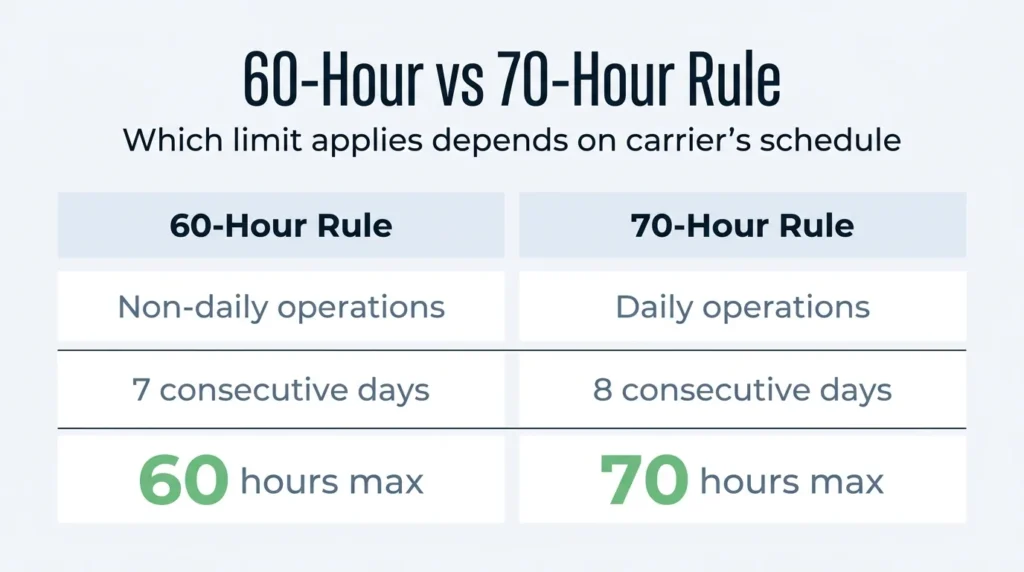
The DOT 70 hour rule limits how much on-duty time a driver can accumulate over a rolling period. Under 49 CFR 395.3(b), a property-carrying driver may not drive after being on duty for more than 60 hours in any 7 consecutive days, or 70 hours in any 8 consecutive days.
The number that applies depends on the carrier’s operating schedule:
- A company that runs commercial motor vehicles every day of the week operates on the 70-hour/8-day schedule.
- A company that does not operate every day uses the 60-hour/7-day schedule.
A driver follows one of these two limits, never both at once. These limits apply in addition to the daily driving and on-duty limits. They are designed to control a driver’s total on-duty time over an entire week to address fatigue that can build up over an extended period.
It’s important to note that the limit is based on consecutive days, not a calendar week that resets every Sunday night. As a new day begins, the oldest day in the calculation drops off, so the driver’s available hours can change from one day to the next.
Understanding the 34-Hour Restart Rule
Under 49 CFR 395.3(c), a driver can end the 7-or-8-day duty period with at least 34 consecutive hours spent off duty. This is commonly called the 34 hour restart. It allows the weekly hours calculation to start over. The 34-hour restart is optional. A driver can use it to reset the weekly hours calculation, or they can just wait for their older hours to drop off the rolling 7-or-8-day window.
However, it’s important to note that the 34-hour restart only resets the regulatory hours calculation. It does not necessarily mean that the driver is fully rested or that fatigue is no longer a concern. If you were injured in a crash involving a commercial truck, it is important to understand that distinction before accepting a carrier’s claim that the driver was fully compliant with hours-of-service rules. A truck accident attorney can look past the logbook to examine whether the available evidence points to fatigue that may have contributed to the crash.
The Link Between Hours-of-Service Rules and Truck Driver Fatigue
Compliance with hours-of-service rules is a minimum safety standard, not proof that a driver was fully rested. A driver can work close to the weekly limit, take the 34-hour restart, and legally return to driving, even if the restart did not eliminate accumulated fatigue or sleep debt.
The National Academies of Sciences reviewed federal research on commercial driver fatigue and found evidence that fatigue can build up over several days of driving. The review also noted that hours-of-service rules can have unintended effects, including schedules that push driving time close to the legal limits, rather than spreading it more evenly.
Federal crash research has also connected driver fatigue to large truck crashes. In the Large Truck Crash Causation Study conducted by FMCSA and NHTSA from 2001 and 2003, researchers investigated 963 large truck crashes in depth. Fatigue was identified as an associated factor for 13% of the truck drivers studied.
An earlier National Transportation Safety Board study examined heavy truck crashes that were fatal to the truck driver. Fatigue was identified as the most frequently cited probable cause, appearing in 31% of these crashes.
(Note that these two percentages come from different studies that examined different types of crashes. In particular, the NTSB study was limited to crashes that caused the truck driver’s death. These studies used different methods and focused on different crash populations, so these numbers should never be combined or treated as a singular estimate of truck driver fatigue.)
Why Off-Duty Hours Don’t Always Equal Rest
There is also a practical problem with treating 34 hours off duty as automatically restorative. Off-duty time does not necessarily mean a driver will spend it sleeping or recovering. A driver may instead spend part of that time waiting on a load, using the truck for a personal errand, or trying to sleep in a truck parked in conditions that are not conducive to sleep.
Irregular schedules create another concern. A driver who shifts between overnight and daytime runs may have difficulty maintaining a consistent sleep schedule, and the hours-of-service log does not capture every factor that affects their quality of rest.
How to Prove Fatigue When the Driver’s Logs Show No Violation
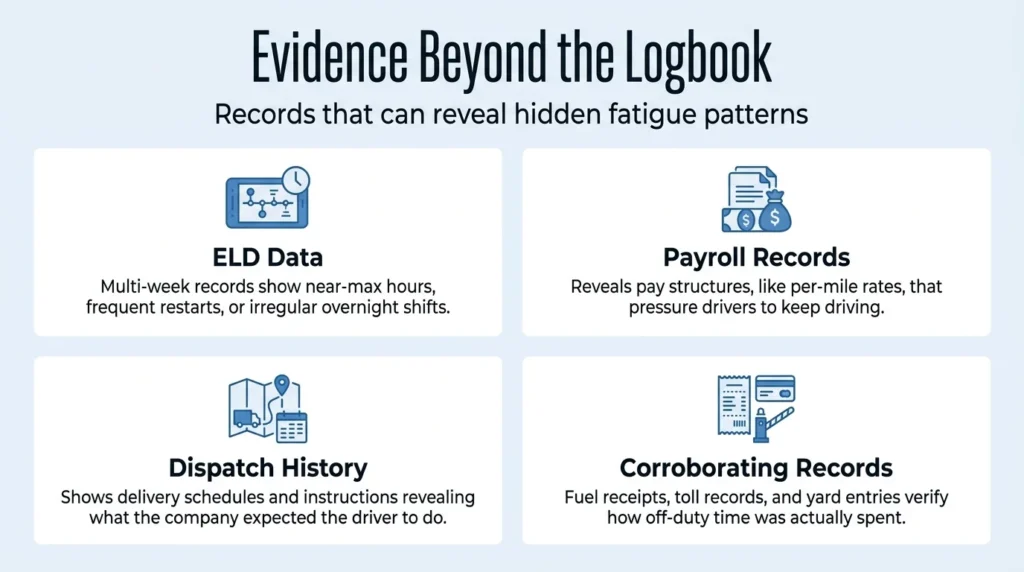
When no single day shows a violation, the focus shifts from finding one broken rule to looking at the driver’s overall work pattern in the days and weeks before the crash.
That analysis relies on records controlled by the trucking company, such as:
- Multi-week ELD data: Records covering several weeks can show whether a driver was working near the maximum allowed hours, taking frequent restarts, driving repeated overnight shifts, or driving on an irregular schedule before the crash.
- Payroll records: These can show how the driver was paid, and whether the pay structure may have encouraged working close to the legal hours limit. Per-mile and per-load pay arrangements can create pressure to keep driving close to the legal limit without technically exceeding it.
- Full trip and dispatch history: This can include delivery schedules, dispatch instructions, and communications that show what the trucking company expected the driver to do and when they expected them to do it.
- Corroborating records: Fuel receipts, toll records, and scale or yard entry times can help verify what the driver was doing during periods logged as off-duty, including whether that time was spent waiting, loading, or handling other work instead of getting meaningful rest.
How Long Can Trucking Companies Keep Crash-Related Records?
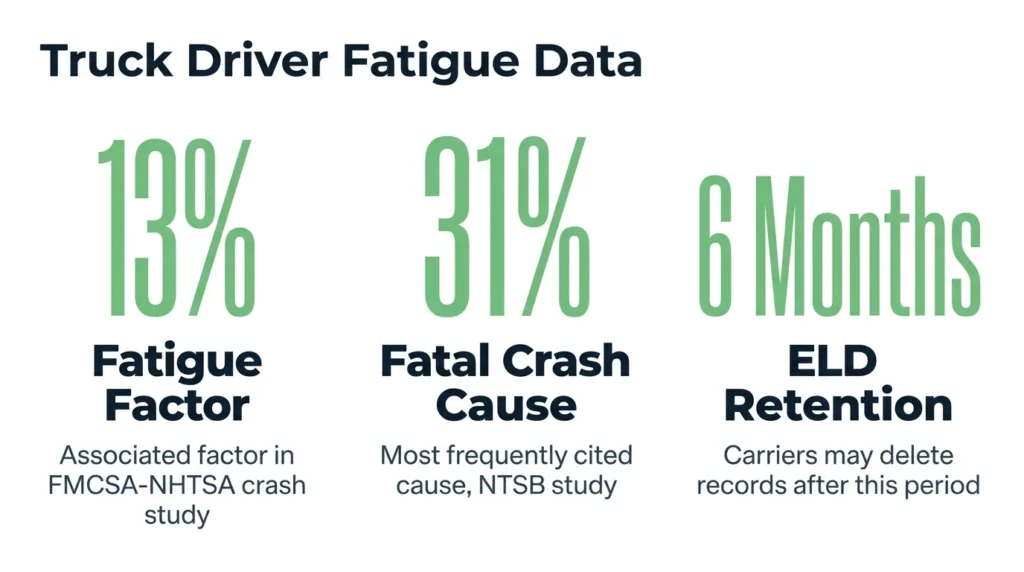
Every one of the above records has a limited retention period. Under 49 CFR 395.8(k)(1), motor carriers must keep records of duty status and supporting documents for 6 months from the date they receive them. This includes ELD records. After that 6-month retention period ends, a carrier may be allowed to delete records that it is no longer required to keep.
A prompt preservation request can help protect relevant records from being destroyed, so it should be sent as soon as possible after the crash.
Can You Sue for Truck Driver Fatigue Without a Logbook Violation?
A trucking company or driver may still be legally responsible for a crash involving driver fatigue, even if the driver did not exceed the specific limits in the federal hours-of-service rules. However, the legal liability theory must match the facts of the crash.
For example, negligence per se may not be the appropriate legal theory if the driver complied with the applicable hours-of-service limits. Negligence per se generally requires a violation of an applicable statute or regulation, so simply showing that a driver was fatigued at the time of the crash would not establish negligence per se.
In Texas, the stronger approach may be ordinary negligence, which focuses on whether the driver or trucking company acted unreasonably under the circumstances. In a negligence case, the question becomes whether the trucking company and the driver knew or should have known that the work schedule created a foreseeable risk of fatigue, even if the driver never exceeded a specific hours-of-service limit. Answering this question requires looking at ELD records, GPS data, fuel receipts, dispatch records, and payroll records to help reconstruct the driver’s work pattern in the days and weeks before the crash.
Talk to an Attorney About Driver Fatigue-Related Truck Accidents in Texas
A clean logbook does not necessarily mean a trucking company or driver is free from responsibility for a fatigue-related crash. Other records, including ELD data, payroll files, and dispatch history, may help reveal how long a driver was working before the crash, and whether the company should have recognized a fatigue risk.
Angel Reyes & Associates has guided injured Texans through the legal process for over 30 years, and we have recovered more than $1 billion for our clients. We work with our team of investigators to preserve critical evidence before it is lost or destroyed.
If you or a loved one was injured by a fatigued truck driver, contact Angel Reyes & Associates for a free consultation and a straightforward explanation of your options. We operate on contingency, so you pay no fees unless we win your case.
Past results do not guarantee future outcomes.
Driver Fatigue FAQs
Does Texas have its own hours-of-service rule for intrastate truckers, or does the federal rule always apply?
The federal hours-of-service rule generally controls the 60/70-hour weekly limit and 34-hour restart, while Texas has parallel rules for intrastate carriers. In a Texas truck accident case, Texas law generally supplies the negligence and liability rules that determine who may be responsible for a crash caused by driver fatigue.
What should I do if I suspect a truck driver was fatigued when the crash happened?
Seek medical attention for your injuries and preserve any evidence from the crash. If driver fatigue may have contributed to the crash, an attorney can investigate records that may not be available to you, including electronic logging data, dispatch records, and documents showing the driver’s schedule and activities before the crash.
Should I mention suspected driver fatigue to my attorney after a truck accident?
Yes. Even without direct evidence that the driver was fatigued, tell your attorney about anything you noticed before or during the crash. Details such as the truck drifting between lanes or repeatedly slowing down, and the driver reacting slowly or appearing drowsy, may help identify evidence of fatigue and guide the investigation.
About the Authors

Angel Reyes
Writer
Angel L. Reyes, III is the Founder and Managing Partner of Angel Reyes & Associates. A nationally recognized trial attorney and business leader, Angel has helped over 70,000 injury victims recover more than $1 billion since founding the firm in 1993. Named to the Texas Super Lawyers list annually since 2008, Angel brings Wall Street experience, Ivy League education, and a deep commitment to client advocacy. He is a frequent legal commentator and published author with extensive contributions to legal scholarship, trial strategy, and consumer protection.

Kyle Nicolas
Editor
Kyle Nicolas is the Web Content & SEO Manager at Angel Reyes & Associates. He has more than 10 years of experience as a marketing co...

Angel Reyes
Reviewer
Angel L. Reyes, III is the Founder and Managing Partner of Angel Reyes & Associates. A nationally recognized trial attorney and business...