Fixing I-635 Is Making It More Dangerous


Every article on this site is researched by our internal team, reviewed for legal accuracy against current Texas law, and held to State Bar of Texas advertising standards before publication. We do not publish content that overstates outcomes or makes promises about results.
Learn more about our
editorial standards .
Key Takeaways
- I-635 closed three times in one day on Sept. 9, and a second fatal wreck hit the same Mesquite stretch just five days earlier.
- TxDOT built I-635 for 180,000 cars a day in 1969. It now carries 230,000 and logged 13 fatal crashes in 2025 alone.
- The freeway has been under construction since 2020, an 11-mile, $1.74 billion rebuild that still is not finished.
This is an opinion piece, and is intended to provide analysis and commentary on current events and issues facing personal injury law. While resources are provided to support statements, opinion statements should not be misconstrued as fact, evidence, or argument in favor of or against any particular legislation. This is not legal advice.
Wednesday, September 9, 2026, was a rough day to be on Interstate 635.
Just after 3 a.m., a vehicle slammed into the back of a slow-moving semi-truck trailer on the northbound lanes near Gross Road in Mesquite. The driver of the car was killed. The truck driver stayed on scene and cooperated with police. All but one northbound lane stayed closed for hours while officers investigated.
Hours later, a separate crash overturned another semi-truck at the I-635/I-35E interchange near Farmers Branch. Dallas Fire-Rescue crews worked to free the driver, who was taken to the hospital with non-life-threatening injuries. TxDOT cameras showed every lane blocked for a stretch of the mid-morning commute, with traffic diverted onto the I-35E exit ramp.
Then, in the early afternoon, a vehicle hit the barrier on westbound I-635 near Miller Road in the Lake Highlands area, closing the right lanes, the shoulder, and an exit. Police said it was a single-vehicle collision; injuries weren’t immediately known.
Three separate incidents on three separate stretches of the same freeway, all in the same 24-hour period.
The Pattern People Aren’t Seeing
September 9th may have been a bad day, but it isn’t the only bad day I-635 has seen recently. In fact, it wasn’t the first fatal crash on that stretch of highway that week.
Five days earlier, on September 4, a 33-year-old woman was killed in another accident that happened just after 3 a.m., when her SUV struck the rear of a semi-truck trailer on the I-30 ramp to northbound I-635 in Mesquite. The driver of that truck now faces manslaughter charges.
The driver of the fatal crash on September 9 was also criminally charged, this time for driving while intoxicated.
Two separate accidents, both occurring in less than a week and just three miles apart. Both incidents involved a passenger vehicle meeting a slow or stopped commercial truck in the dark, alleged driver negligence, and resulted in fatalities.
Whether either charge escalates will depend on what investigators can prove about impairment and cause. But the pattern itself (two fatal, early-morning, rear-end collisions with slow-moving trucks on the same few miles of highway) is worth attention on its own.
Why I-635 Has Earned This Reputation
I-635, known to most Dallas drivers as LBJ Freeway, didn’t become one of the region’s most dangerous highways overnight.
TxDOT built the freeway in 1969 to handle about 180,000 vehicles a day. Today, it carries an estimated 230,000, roughly 50,000 vehicles a day more than it was ever designed to absorb, and enough to put it among the most congested roadways in Texas.
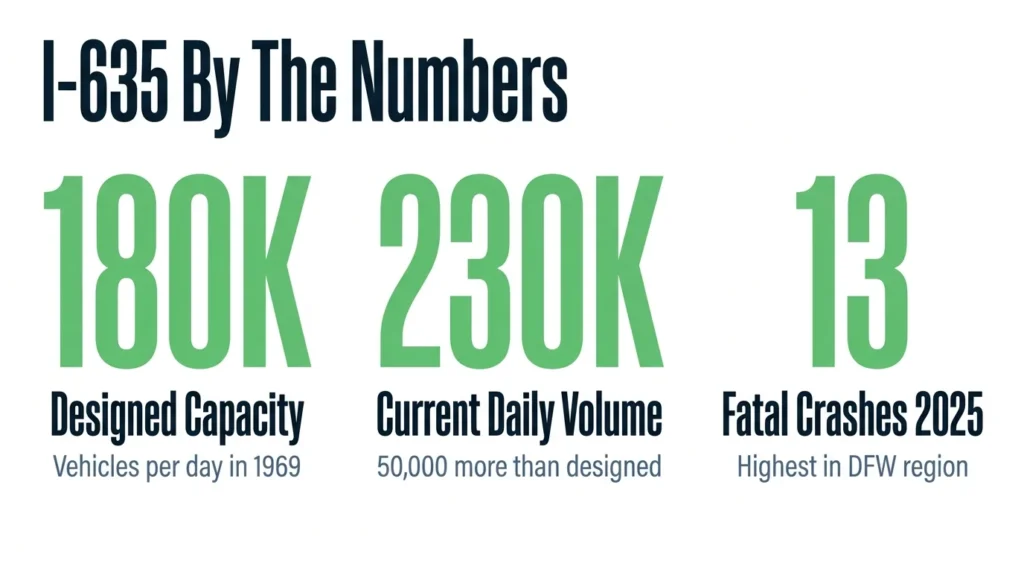
The volume shows up in the crash data. TxDOT’s 2025 Crash Records Information System (CRIS) data credits I-635 with 13 fatal crashes for the year, tying it with I-45 for the highest total of any highway in the Dallas-Fort Worth region.
That’s happening against a statewide backdrop that’s already troubling. TxDOT recorded more than 28,000 crashes in Texas work zones in 2025, resulting in 203 deaths. The vast majority of those deaths were drivers and passengers, not the roadway workers themselves. Regionally, the North Central Texas Council of Governments has tracked a steady rise in construction-zone crashes across North Texas since 2022, with more than 7,000 in 2025 alone, the highest total since 2021.
Six Years (and Counting) of Construction
Part of why I-635 feels unpredictable right now is that it has been a construction zone for most of the last decade.
The 635 East project, also called LBJ East, is an eleven-mile, $1.74 billion reconstruction running from US 75 in North Dallas through Garland and Mesquite to I-30. Work began in 2020. By the summer of 2026, most of the new general-purpose lanes had opened, but crews were still rebuilding the managed toll lanes and testing tolling equipment, with occasional overnight closures continuing through the end of the job.
Businesses along the corridor have felt it directly. Near the Jupiter Road construction zone in Garland, employees at a car dealership told the WFAA news crew they watch wrecks happen almost daily, blaming confusing detours and abrupt U-turns near the work zone.
Pushing the Riskiest Work to 3 a.m. Has a Blind Spot
TxDOT and its contractors have generally scheduled the most disruptive construction work (the kind that drops a stretch of freeway down to a single lane) for overnight hours, when traffic volume is lowest. That’s a reasonable call for keeping the daytime commute moving. Nobody has claimed it’s a safety plan, and it shouldn’t be treated as one.
Both fatal crashes this month happened in exactly the hours that overnight strategy depends on: the dead of night, on a corridor still carrying 50,000 more vehicles a day than it was built for. Whether either stretch of highway was narrowed to a single lane at the moment of either crash hasn’t been made public. That’s a question worth asking every time a fatal crash happens in an active construction corridor, not months later in a courtroom, but that week, while the facts are still fresh.
Who’s Liable When a Construction Zone Contributes to a Crash?
When a crash happens in or near a highway construction zone in Texas, liability isn’t always obvious, and more than one party can hold a portion of it. The driver who caused the immediate collision, through speeding, distraction, fatigue, or impairment, is usually the starting point. But construction zones can introduce their own hazards: unclear signage, sudden lane shifts, inadequate lighting, or barriers placed too close to a live travel lane.
TxDOT is a government entity, and government entities in Texas generally have sovereign immunity from lawsuits. The Texas Tort Claims Act waives that immunity only in narrow circumstances, including a “special defect” in the roadway itself, like an unmarked obstruction or a dangerous condition the agency knew about and failed to fix.
Private design-build contractors working under TxDOT contracts don’t have that same protection. They can typically be sued under ordinary negligence principles if their work created an unreasonably dangerous condition.
Sorting out which theory applies, and against whom, takes a real investigation. That means obtaining crash reports, TxDOT traffic camera footage, the active work zone plan for that date and time, and often the contractor’s own safety records.
What Drivers Can Do Right Now
Nothing about the corridor’s design or construction schedule is going to change overnight. Until it does: slow down through work zones, especially at night. Remember: fines double if workers are present, and law enforcement are almost always present at large roadwork sites.
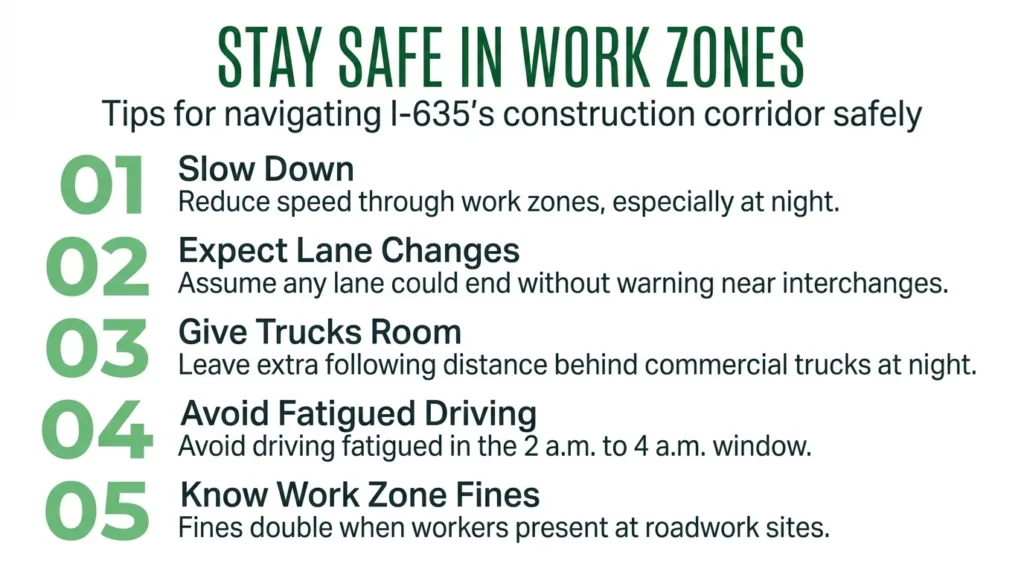
Assume any lane could end without warning near interchanges and known construction segments. Leave extra following distance behind commercial trucks, which need more room to stop and are harder to see in the dark. And avoid driving fatigued in the 2 a.m. to 4 a.m. window, when reaction time is already compromised and an unfamiliar, narrowed roadway gives the least room for error.
Driving safely and defensively isn’t just reserved for navigating freeways under heavy construction in early-morning hours, but early-morning hours are when driving safely and defensively become even more important.
About the Authors

Angel Reyes
Writer
Angel L. Reyes, III is the Founder and Managing Partner of Angel Reyes & Associates. A nationally recognized trial attorney and business leader, Angel has helped over 70,000 injury victims recover more than $1 billion since founding the firm in 1993. Named to the Texas Super Lawyers list annually since 2008, Angel brings Wall Street experience, Ivy League education, and a deep commitment to client advocacy. He is a frequent legal commentator and published author with extensive contributions to legal scholarship, trial strategy, and consumer protection.

Kyle Nicolas
Editor
Kyle Nicolas is the Web Content & SEO Manager at Angel Reyes & Associates. He has more than 10 years of experience as a marketing co...

Angel Reyes
Reviewer
Angel L. Reyes, III is the Founder and Managing Partner of Angel Reyes & Associates. A nationally recognized trial attorney and business...