Is Uber Liable for Accidents in Texas?


Every article on this site is researched by our internal team, reviewed for legal accuracy against current Texas law, and held to State Bar of Texas advertising standards before publication. We do not publish content that overstates outcomes or makes promises about results.
Learn more about our
editorial standards .
Key Takeaways
- Texas law classifies Uber drivers as independent contractors, blocking standard vicarious liability claims.
- Uber's $1 million policy applies only during active rides, from request acceptance through trip completion.
- CPRC § 16.003 gives most Texas crash victims two years from the crash date to file a claim.
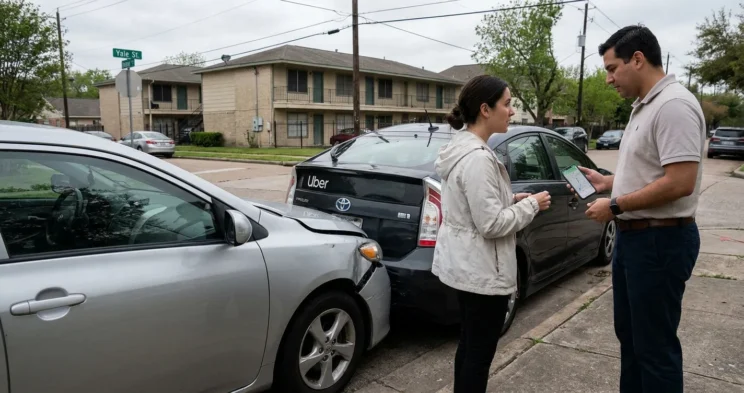
You were heading home from a late dinner near The Heights when an Uber driver ran a stop sign on Yale Street and clipped the front of your car while his app was on. His personal insurer is now telling you a rideshare exclusion applies, while Uber’s claims department is pointing liability back toward the driver. You’re wondering whether the company itself can be held responsible, or whether you’re stuck chasing one driver’s policy.
Uber’s Independent Contractor Defense
Uber’s first move in almost every Texas crash claim is to argue it isn’t responsible because the driver is an independent contractor, not an employee. This distinction blocks the standard rule that an employer is responsible for a worker’s on-the-job negligence. Texas law backs this classification by statute, which is why the defense holds up so often.
The classification matters because of a doctrine called respondeat superior. Under this rule, employers are automatically on the hook for negligent acts an employee commits while working. No employer-employee relationship means no automatic liability.
Texas codifies the rideshare classification in the Texas Occupations Code Chapter 2402, often called the Texas TNC Act. Under § 2402.114, rideshare drivers are deemed independent contractors only if there is a written independent contract agreement and the company avoids imposing key operational restrictions. That gives Uber a statutory shield against vicarious liability claims that would otherwise be straightforward.
So the standard route is closed. However, it isn’t the only option, as several alternative legal paths remain available.
Insurance Coverage Periods for Uber Drivers
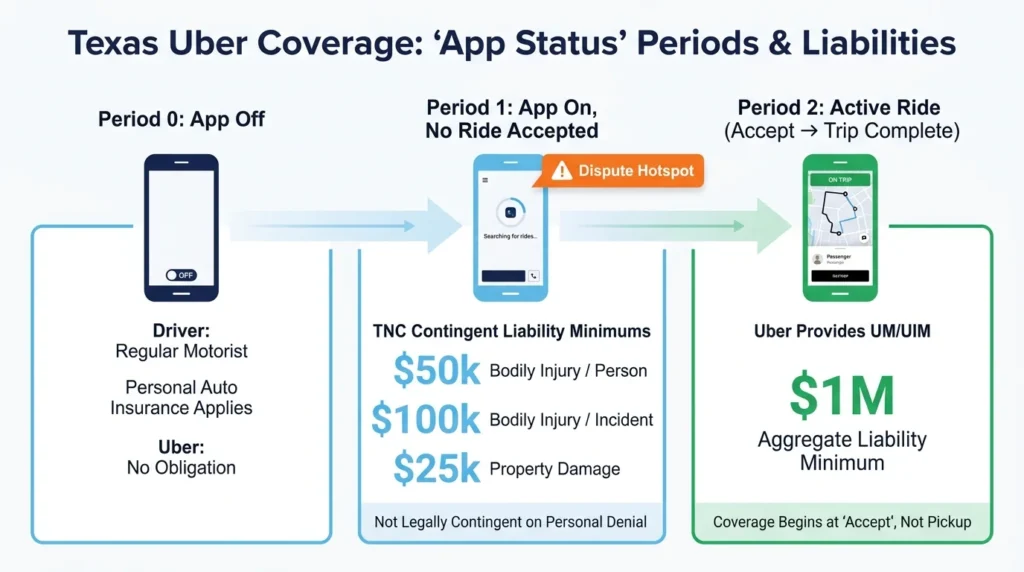
Texas law ties Uber’s insurance obligations to the driver’s app status at the moment of the crash. There are three periods, and each has different coverage rules under the Texas Insurance Code Chapter 1954. Which period applies often decides whether you recover full damages, receive only partial damages, or must fight a total coverage denial.
App Off
When the app is off, the driver is just a regular motorist. Personal auto insurance applies and Uber is under no obligation.
App On with No Ride Accepted
When the app is on but no ride has been accepted, the Insurance Code requires contingent liability coverage of at least $50,000 per person, $100,000 per incident for bodily injury, and $25,000 for property damage. This is where most disputes happen. Uber’s policy is structured as secondary coverage in practice, and typically responds after the driver’s personal insurer, but Texas Insurance Code § 1954.055 provides that TNC coverage is not legally contingent on the personal insurer first denying the claim.
The practical result is a coverage gap. Many personal auto policies exclude rideshare activity. If the personal insurer denies the claim and Uber’s contingent layer is contested, you can be left without a clear payor while bills pile up.
Active Ride: Accepted Request Through Trip Completion
Once the driver accepts a request and completes the trip, Texas requires at least $1 million in aggregate liability coverage, plus uninsured and underinsured motorist coverage where required by Texas Insurance Code § 1952.101. Uber voluntarily provides $1 million in Uninsured Motorist (UM)/Underinsured Motorist (UIM) coverage as a matter of company policy, though the statute does not mandate that the UM/UIM limit match the liability limit. This is Uber’s primary coverage during the prearranged ride period.
The $1 million coverage starts the moment the driver taps “accept,” not when a passenger climbs in, a timing detail that is critical in disputes about whether the en-route phase had begun. The Texas Department of Licensing and Regulation publishes a consolidated TNC laws and rules page that tracks the current framework.
Settlement values vary widely depending on which period applies and the severity of injuries. Reviewing average rideshare settlement ranges in Texas can help set realistic expectations before negotiating.
Sorting out which period was active at the time of your crash is fact-intensive, and reviewing Texas’s requirements for rideshare accident claims before talking with an attorney can save time.
Who Can Pursue Uber Directly in Texas?
Even with the independent contractor shield in place, three doctrines let injured parties pursue Uber directly through theories of negligent hiring, negligent entrustment, and negligent retention. While these theories overlap in logic, they target different points in the driver’s relationship with the platform.
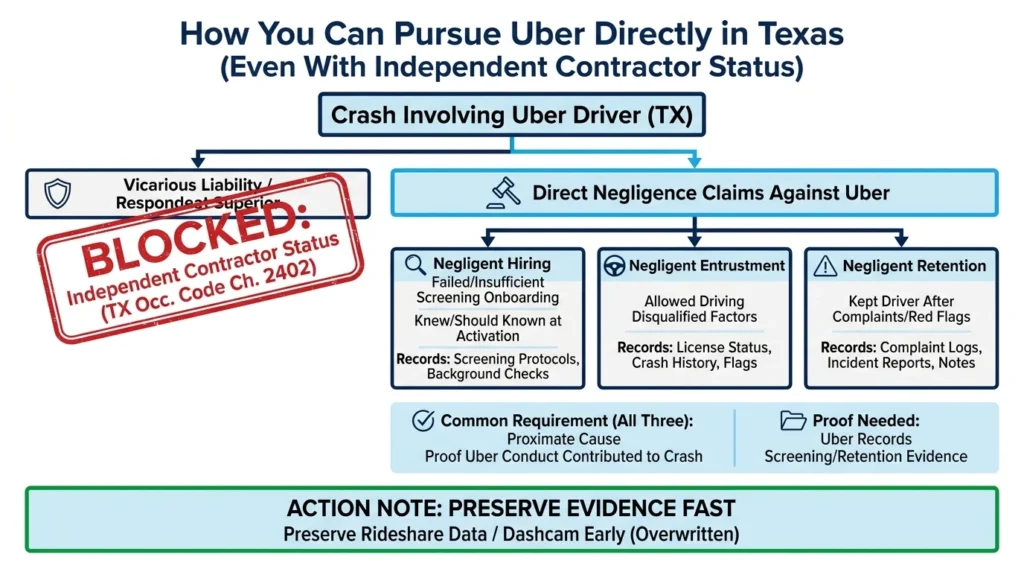
Succeeding on these claims requires digging into Uber’s internal records, which is why these claims rarely succeed without attorney-led discovery.
- Negligent hiring: Uber may be liable if it failed to run adequate background screening before onboarding a driver who later caused a crash. The claim turns on what Uber knew or should have known about the driver’s history at the time of activation.
- Negligent entrustment: Uber may be liable if it allowed a driver to keep operating despite known disqualifying factors, such as a suspended license or prior at-fault crashes. This focuses on continuing knowledge of driver fitness.
- Negligent retention: Uber may be liable if it kept a driver on the platform after complaints or post-hire records that should have prompted removal.
All three require proof that Uber’s conduct was a proximate cause of the crash. Each also requires access to documents Uber controls: screening protocols, complaint logs, driver histories, and internal communications. Reviewing our past case results gives a sense of what these investigations can uncover.
Preserving evidence quickly matters because rideshare data and dashcam footage are often overwritten on short cycles. Reviewing the steps to take after a rideshare accident in Texas can help protect a claim before litigation begins.
Fault Allocation & Filing Deadlines in Texas
Two Texas rules apply to every Uber accident claim, regardless of the theory: how fault is split among the parties, and how long you have to file. Both can end a case before the merits are ever reached.
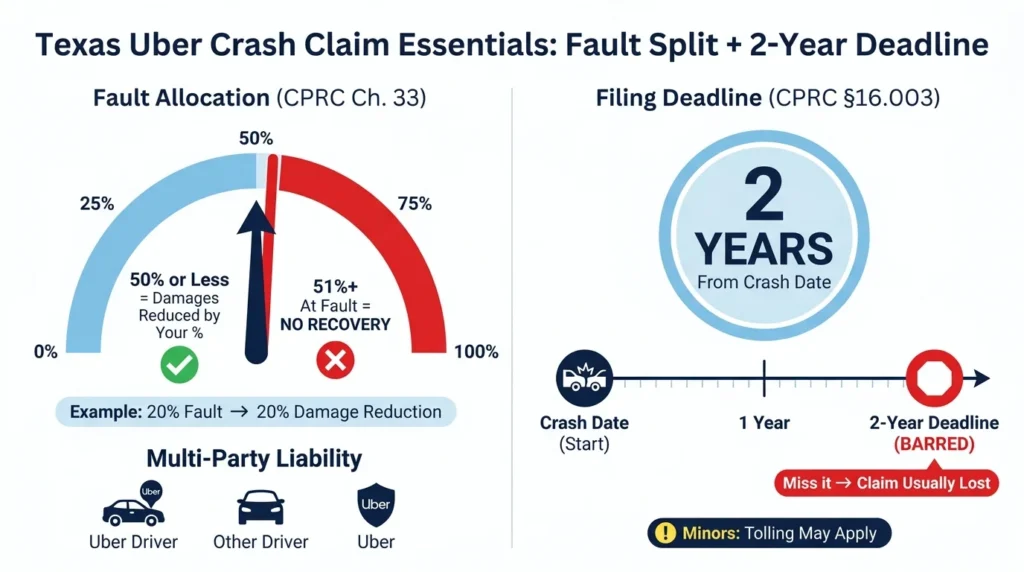
Texas uses modified comparative fault under the Texas Civil Practice and Remedies Code (CPRC) Chapter 33, meaning a claimant found 51% or more responsible for the crash recovers nothing. Below that threshold, damages are reduced by the claimant’s percentage of fault. In multi-party rideshare crashes, allocation gets complicated fast: the Uber driver, another motorist, and Uber itself may each be assigned a share.
The filing deadline comes from CPRC § 16.003, which gives most personal injury claimants two years from the date of the crash. Miss that deadline and the claim is generally lost, no matter how strong it would have been on the merits.
A few narrow tolling rules exist, including for minors. Those exceptions are limited and shouldn’t be assumed without confirming with our Texas attorneys how § 16.003 applies to your specific situation.
Talk to an Attorney with Experience in Rideshare Accidents
Uber accident claims in Texas turn on technical details: app status at the moment of impact, statutory coverage minimums, the limits of vicarious liability, and proof of Uber’s own negligence. None of that is easy to handle alone while recovering from injuries.
With more than 600 dedicated professionals available 24/7 across more than 20 offices statewide, Angel Reyes & Associates has more than 30 years of experience handling Texas rideshare and motor vehicle injury claims, with more than $1 billion recovered for clients. We work on contingency, so there’s no fee unless we win, and consultations are free. Contact us today to talk through what happened and what your options look like.
Past results do not guarantee future outcomes.
Uber Liability in Texas FAQs
Can Uber deactivate a driver after an accident, and does that affect my claim?
Yes. Uber can deactivate a driver at any time, including after a reported crash. Deactivation does not resolve your injury claim or shift Uber’s legal exposure, but records of the deactivation decision can support a negligent retention argument if Uber had earlier reason to remove the driver.
Does Uber's insurance cover passengers differently from other people injured in the crash?
No. Texas Insurance Code Chapter 1954 does not create separate coverage tiers for passengers versus pedestrians, cyclists, or occupants of other vehicles. All injured parties can access the same coverage layer that applies based on the driver’s app status at the time of the crash.
Can an injured minor file a claim against Uber after the two-year window closes?
In Texas, the two-year limitations period under CPRC § 16.003 is typically tolled while a claimant is a minor, meaning the clock does not start until the minor turns 18. A parent or guardian may still file on the child’s behalf before that point.
What happens if the Uber driver was also at fault but carried no personal auto insurance?
If the driver had no personal coverage and the crash occurred during the active-ride period, Uber’s $1 million policy serves as primary coverage. Uber also voluntarily provides $1 million in uninsured motorist coverage during that period, which can apply when the at-fault party is uninsured.
Does Texas law require Uber to run background checks on its drivers?
Texas Occupations Code Chapter 2402 requires TNCs to conduct driver background checks before allowing someone to operate on the platform. The statute sets minimum disqualifying criteria, including certain criminal convictions and driving violations, which form the baseline for what Uber must screen against.
About the Authors

Angel Reyes
Writer
Angel L. Reyes, III is the Founder and Managing Partner of Angel Reyes & Associates. A nationally recognized trial attorney and business leader, Angel has helped over 70,000 injury victims recover more than $1 billion since founding the firm in 1993. Named to the Texas Super Lawyers list annually since 2008, Angel brings Wall Street experience, Ivy League education, and a deep commitment to client advocacy. He is a frequent legal commentator and published author with extensive contributions to legal scholarship, trial strategy, and consumer protection.

Kyle Nicolas
Editor
Kyle Nicolas is the Web Content & SEO Manager at Angel Reyes & Associates. He has more than 10 years of experience as a marketing co...

Angel Reyes
Reviewer
Angel L. Reyes, III is the Founder and Managing Partner of Angel Reyes & Associates. A nationally recognized trial attorney and business...