How Much Does a Motorcycle Accident Lawyer Cost in Texas?


Every article on this site is researched by our internal team, reviewed for legal accuracy against current Texas law, and held to State Bar of Texas advertising standards before publication. We do not publish content that overstates outcomes or makes promises about results.
Learn more about our
editorial standards .
Key Takeaways
- Texas motorcycle accident lawyers work on contingency, so you pay nothing upfront.
- Fees run near one-third before a lawsuit and 40% or more after one is filed.
- You have two years from your injury date to file a Texas injury lawsuit.
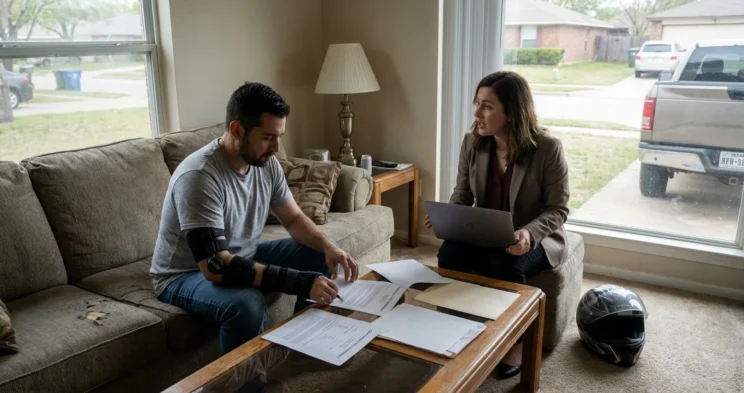
You were riding home through Deep Ellum one evening when a driver turned left across your lane on Commerce Street and put you on the pavement. Now you’re dealing with medical bills, missed paychecks, and calls from insurance adjusters. Hiring a lawyer sounds expensive, especially when you’re already worried about money.
Accident Lawyers Charge No Upfront Fees
Most motorcycle accident lawyers work on a contingency fee basis. That means you do not pay attorney fees upfront. Instead, the lawyer receives a percentage of any settlement or court award recovered on your behalf. Most Texas contingency agreements specify that the client owes no attorney’s fee if there is no recovery. This arrangement allows injured riders to pursue a claim without paying hourly legal fees while dealing with medical bills and missed work.
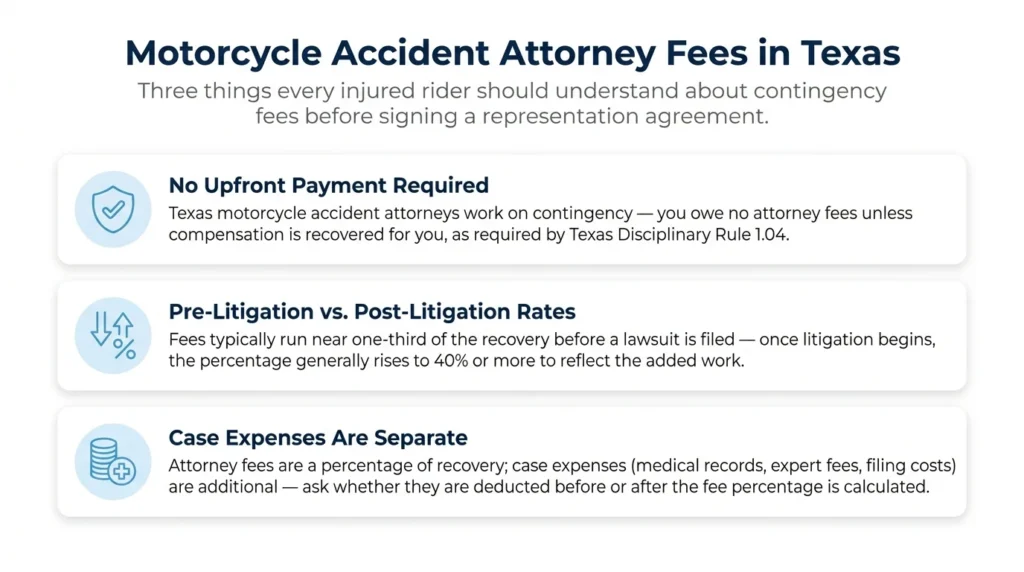
The Texas Disciplinary Rules of Professional Conduct, Rule 1.04, require contingency fee agreements to be in writing and explain the fee percentage and how case expenses will be handled. That written agreement protects you, and it is standard practice for any reputable attorney handling motorcycle accident claims.
Typical Fee Percentage & What Changes It
Most contingency fees in motorcycle accident cases are around one-third of the recovery, although the percentage may increase if the case moves into litigation. The exact fee depends on the terms of the representation agreement and the complexity of your case.
Pre-Litigation vs. Post-Litigation Fees
The fee usually rises once a lawsuit is filed. Before a lawsuit, the attorney’s fee typically amounts to about one-third of the gross recovery. After a lawsuit is filed, the attorney’s fee generally climbs to 40% or higher. The jump reflects the work involved. Trial preparation, depositions, and court proceedings demand far more attorney time and firm resources than a pre-suit settlement does.
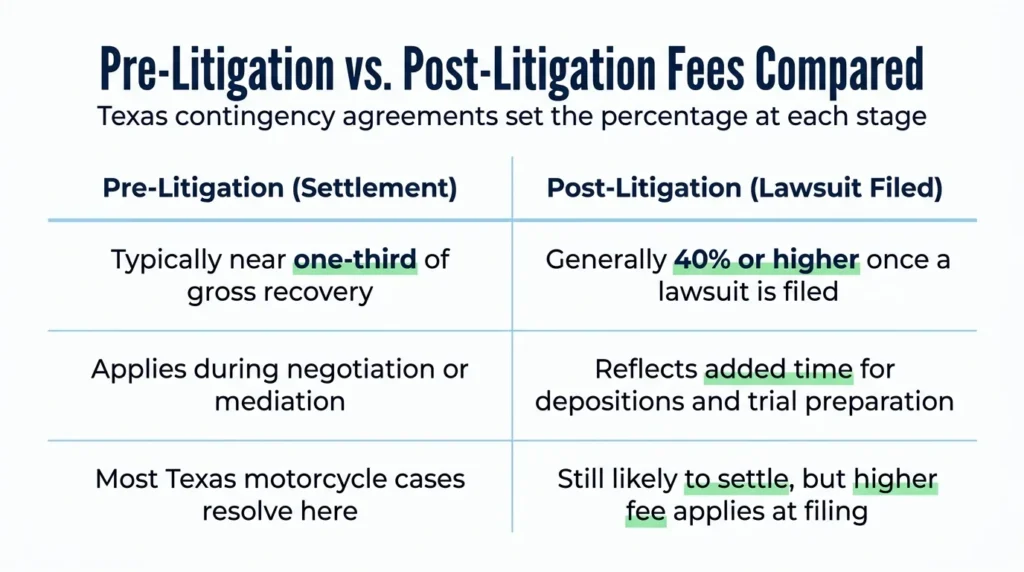
Your written contingency agreement spells out the percentage at each stage before representation begins. Ask about both tiers before you sign so you know exactly how the numbers change if your case goes to court.
Factors That Affect the Percentage
The severity of your motorcycle accident injuries is one. Texas crash data shows motorcycle wrecks frequently cause severe, life-altering injuries. Catastrophic harm like spinal cord damage, traumatic brain injury, or amputation usually means higher damages and can change the negotiating math on the percentage.
Liability complexity is another. Disputed fault, multiple at-fault drivers, or shared-blame arguments raise the risk a firm takes on, and that risk can show up in the fee tier.
Comparative fault issues can also be a factor. Texas Civil Practice and Remedies Code Chapter 33 reduces a rider’s recovery by their percentage of fault. Insurers may argue the rider was partly to blame, because if they pin enough fault on you, they pay less. That argument creates litigation risk, and that risk can affect your fee.
Case Expenses Are Separate from Attorney Fees
Attorney fees are a percentage of your recovery. Case expenses are the costs a law firm pays while building your case and pursuing compensation on your behalf.
Here are some of the expenses that may arise in a motorcycle accident case:
- Police and crash reports: Official records documenting how the collision occurred
- Medical records and bills: Evidence of your injuries, treatment, and medical expenses
- Expert witness fees: Costs associated with specialists who analyze the crash or explain your injuries
- Deposition transcripts: Sworn testimony recorded during the litigation process
- Court filing fees: Charges required to file and maintain a lawsuit
Most Texas contingency fee agreements explain these expenses. Some agreements deduct expenses before calculating the attorney fee, while others deduct them afterward. That difference can affect the amount you ultimately receive from a settlement or verdict.
Before signing a representation agreement, ask how expenses are handled and whether they are deducted before or after the contingency fee is calculated. Understanding lawyer fees and expenses upfront can help you avoid surprises later.
Why Representation Often Increases Net Recovery
Even after fees and expenses come out, represented riders typically walk away with more money from a motorcycle accident settlement than those who go it alone. The biggest reason comes down to how insurers value claims.
An insurer assigns value based on what it thinks you can prove and demand in court. An unrepresented rider, unfamiliar with Texas damage categories and litigation risk, often takes the first low offer on the table.
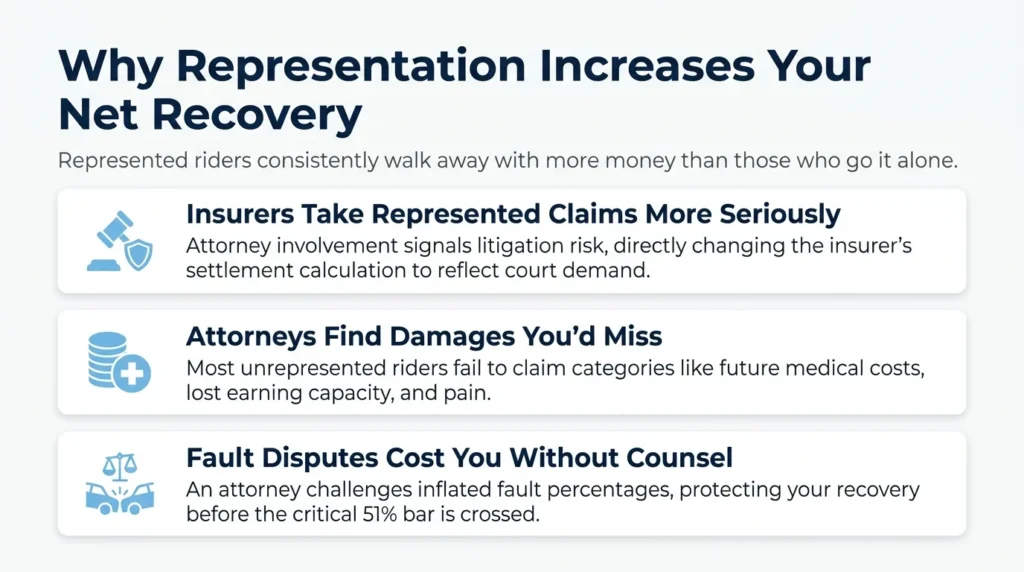
Experienced attorneys find damages that you might never think to claim on your own. Future medical care, lost earning capacity, pain and suffering, and the full cost of permanent impairment or disfigurement all add up fast.
Disputed-fault cases carry particular risk. When an insurer argues you share blame under the state’s fault-sharing rules, your recovery can shrink. An attorney familiar with motorcycle accident claims can evaluate how liability disputes may affect your recovery before you respond to an insurer’s initial offer.
Under the Texas Civil Practice and Remedies Code § 16.003, you generally have two years from the date of the crash to file a personal injury lawsuit. Waiting too long can make it harder to preserve evidence, identify witnesses, and fully document your damages.
Talk to an Attorney About Your Case
The cost of hiring a lawyer should never be the reason you settle for less than your injuries are worth. Angel Reyes & Associates has spent more than 30 years helping injured Texans understand their options, and we have recovered more than $1 billion for injured clients across the state. You pay no fee unless we win your case.
We will review your situation, explain exactly how fees and expenses would work for you, and answer your questions with no obligation. Schedule a free consultation and find out where you stand before you respond to any insurance offer.
Past results do not guarantee future outcomes.
Motorcycle Accident Lawyer Fees FAQs
Can I still hire a lawyer if the crash was partly my fault?
Yes. Texas allows injured riders to recover damages even if they share some of the blame, as long as their share of fault does not exceed 50%. An attorney can still represent you and work to limit how much fault gets assigned to you.
Can I hire a motorcycle accident lawyer after speaking with the insurance company?
Yes. Speaking with an insurance adjuster does not prevent you from hiring an attorney later. Consulting a lawyer before accepting a settlement offer can help you understand the full value of your claim and your legal options.
Do medical liens affect how much money I keep after a settlement?
Yes. If your health insurer, Medicare, Medicaid, or a hospital paid for your treatment, they may hold a lien against your settlement and must be repaid from your recovery. These lien amounts come out after the attorney’s fee and expenses, which can significantly reduce what you take home.
Does the contingency fee cover an appeal if the case goes to trial and the verdict is appealed?
Not always. Many contingency fee agreements either set a higher percentage for trial or treat appellate work as a separate engagement. Review the agreement carefully to understand which stages of the case are covered and how fees may change if an appeal becomes necessary.
Will I receive less compensation if my case settles quickly?
Not necessarily. A quick settlement does not automatically mean a lower recovery. The value of a case depends on factors such as liability, injuries, available insurance coverage, and the strength of the evidence.
About the Authors

Angel Reyes
Writer
Angel L. Reyes, III is the Founder and Managing Partner of Angel Reyes & Associates. A nationally recognized trial attorney and business leader, Angel has helped over 70,000 injury victims recover more than $1 billion since founding the firm in 1993. Named to the Texas Super Lawyers list annually since 2008, Angel brings Wall Street experience, Ivy League education, and a deep commitment to client advocacy. He is a frequent legal commentator and published author with extensive contributions to legal scholarship, trial strategy, and consumer protection.

Kyle Nicolas
Editor
Kyle Nicolas is the Web Content & SEO Manager at Angel Reyes & Associates. He has more than 10 years of experience as a marketing co...

Angel Reyes
Reviewer
Angel L. Reyes, III is the Founder and Managing Partner of Angel Reyes & Associates. A nationally recognized trial attorney and business...