Legal Options for Pedestrians Hit By a Self-Driving Car in Texas


Every article on this site is researched by our internal team, reviewed for legal accuracy against current Texas law, and held to State Bar of Texas advertising standards before publication. We do not publish content that overstates outcomes or makes promises about results.
Learn more about our
editorial standards .
Key Takeaways
- Multiple parties may be liable when a self-driving car hits a pedestrian in Texas, including the robotaxi company, vehicle owner, and manufacturers.
- Texas's 51% bar rule means your recovery can be reduced or eliminated based on your share of fault, making right-of-way evidence and documentation critical.
- Digital evidence from autonomous vehicles can disappear quickly, so sending preservation letters and securing sensor data, video, and logs should happen as soon as possible after the crash.
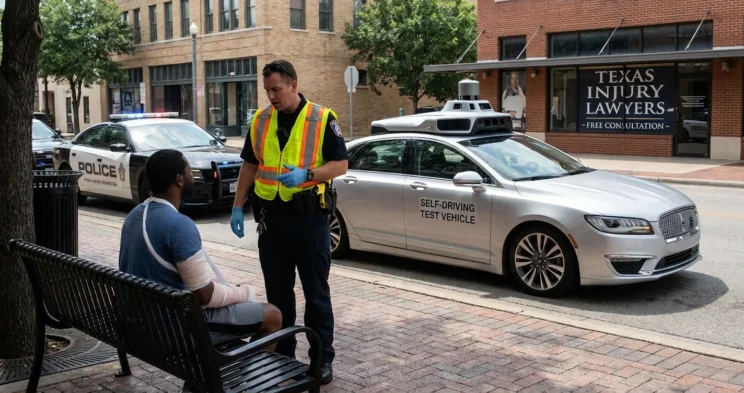
You were crossing Lamar Boulevard in Austin when a robotaxi rolled through the intersection and struck you. Now you’re dealing with injuries, medical bills, and a confusing situation where there was no traditional driver behind the wheel. The company’s representatives are already reaching out, but you’re not sure who is actually responsible or what your rights are.
Pedestrian accidents involving self-driving cars can be complicated. Multiple parties may share responsibility, and critical digital evidence can disappear quickly if you don’t act fast.
First Steps to Take After a Robotaxi or Self-Driving Car Hits You
Your actions in the first hours after a crash can protect both your health and your legal options. This is especially true in autonomous vehicle cases.
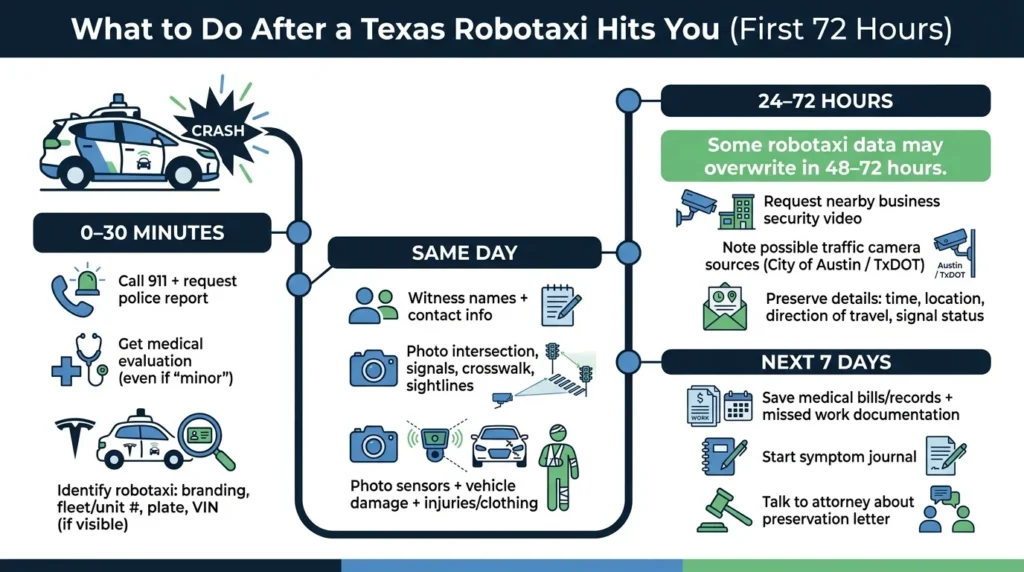
While traditional cars save data during a crash, robotaxis generate terabytes of data that may be overwritten in as little as 48 to 72 hours if the system’s internal sensors don’t automatically flag the contact as a major event.
Here’s what to do immediately after you are hit by a self-driving car:
- Call 911 and get medical attention, even if your injuries seem minor. Adrenaline can mask serious problems, and a medical record created immediately after the crash becomes important evidence later. Make sure a police report is created.
- Identify the vehicle and service. Look for company branding, fleet numbers, and any app trip details if you were a passenger or had interaction with the service. Try to confirm whether the vehicle was operating in autonomous mode at the time of the collision.
- Collect names and contact information from witnesses before they leave the scene.
- Collect third-party evidence. Nearby businesses may have security cameras. The City of Austin or TxDOT may have traffic camera footage. Signal timing data can confirm whether you had a walk signal.
What to Photograph at the Scene
Capturing accident photos at the scene can be extremely helpful for your claim. Take wide shots showing the intersection layout, traffic signals, crosswalk markings, and sightlines. These details matter because autonomous vehicle disputes often center on what the vehicle’s sensors should have detected.
You should also take photos of:
- The vehicle’s license plate
- The vehicle’s VIN, if visible
- The vehicle’s fleet or unit number
- Any visible damage
- The sensor housings (cameras, lidar units, radar)
- Your visible injuries and the clothing and shoes you were wearing
Pedestrian Rights in the Age of Self-Driving Cars
Liability in a pedestrian crash often hinges on a balance of responsibility: who had the right-of-way and whether both parties exercised “due care.” In Texas, this is determined by Texas Transportation Code Chapter 552, but for robotaxis, the evidence of “care” shifts from human witness accounts to digital perception data.
How Right-of-Way Is Determined
Under Texas Transportation Code § 552.003, the operator of a vehicle must stop and yield the right-of-way to a pedestrian in a crosswalk when traffic signals permit. Furthermore, the law requires all operators to exercise “due care” to avoid a collision, which includes giving a warning by sounding the horn when necessary.
However, right-of-way doesn’t offer complete protection for pedestrians. Under Texas Transportation Code § 552.003(b), a pedestrian may not “suddenly leave a curb” and proceed into the path of a vehicle that is so close it is impossible for the operator to stop.
How “Due Care” Is Proven Digitally
While a human driver might claim they “didn’t see” a pedestrian, a robotaxi’s “due care” is measured by its software’s logic and sensor performance. In corridors like Austin’s Lamar Boulevard or the busy University of Texas campus, right-of-way disputes are resolved by examining the vehicle’s Perception Data and Actuation Logs.
These logs include information on:
- Detection: Did the LiDAR or Radar identify you as a “pedestrian” or misclassify you as a static object?
- Prediction: Did the system’s “path planning” correctly predict your movement based on your trajectory?
- Reaction: How many milliseconds passed between the moment you entered the vehicle’s “Operational Design Domain” and the moment the system initiated braking?
In a Texas personal injury claim, these logs serve as the ultimate “witness.” If the data shows the robotaxi detected you 40 feet away but failed to reduce the risk of an accident (braking until 5 feet before impact), the company may be found to have breached its duty of due care, regardless of whether you were technically outside of a marked crosswalk.
Who Can Be Held Liable for a Robotaxi Crash?
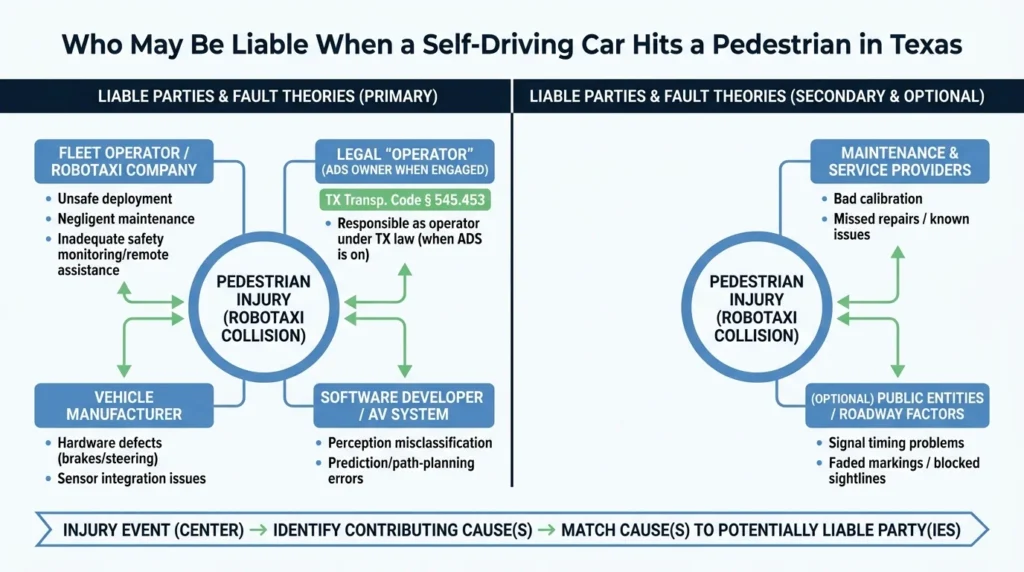
Autonomous vehicle crashes often involve a web of responsible parties. Because the technology replaces the human driver, Texas law allows you to pursue claims against several different entities depending on what caused the collision.
Liability in a self-driving accident involving pedestrians may fall on:
- The Fleet Operator (The Robotaxi Company): Often responsible for negligent maintenance, unsafe deployment, or inadequate safety monitoring.
- The Legal “Operator”: Under Texas Transportation Code § 545.453, the owner of the automated driving system is legally considered the operator when the system is engaged.
- Vehicle Manufacturers: The companies that built the physical car and integrated the sensors.
- Software Developers: The engineers responsible for the “brain” of the vehicle and its decision-making algorithms.
- Maintenance & Service Providers: Third-party vendors who may have incorrectly calibrated sensors or failed to repair known hardware issues.
Product Liability: When the System Fails
While traditional accidents focus on human error, many robotaxi crashes result from product defects. In these cases, you are not just proving the “driver” was careless, but that the technology itself was “unreasonably dangerous” or failed to perform as intended.
Common technical failures that lead to product liability claims include:
- Perception Failures: The sensor suite (LiDAR, radar, and cameras) fails to detect a pedestrian due to “noise,” low light, or misclassification.
- Prediction Errors: The software detects the pedestrian but incorrectly predicts their path, leading the vehicle to continue on a collision course.
- Sensor Occlusion: Design flaws that allow dirt, rain, or heat to blind the vehicle’s “eyes” without triggering a safe-stop protocol.
- Mapping & Localization Flaws: The vehicle misinterprets its position relative to the crosswalk or lane markings.
Proving a product defect requires preserving the vehicle’s disengagement logs (the records that show exactly when the software “gave up” or failed to react).
Evidence Preservation Letters
Autonomous vehicle cases depend heavily on digital evidence that may be overwritten or deleted within days or weeks.
Send a preservation letter immediately. Your attorney can send a formal notice to the robotaxi company, fleet operator, and any maintenance vendors, requiring them to retain all logs, video, sensor data, and records related to the crash. Failure to preserve evidence after receiving such notice can have legal consequences.
You might consider sending a preservation letter to request:
- Onboard video from interior and exterior cameras.
- Sensor data from LiDAR, radar, and cameras.
- Telemetry showing speed, braking, and steering inputs.
- Disengagement logs showing when the system requested human intervention.
- Remote operator communications if the vehicle had remote assistance capability.
- Event data recorder (EDR) information.
Acting quickly matters. Our firm has over 30 years of experience handling complex injury cases and understands how to secure time-sensitive evidence.
Texas Fault Rules: The 51% Bar
Texas uses a proportionate responsibility system that can reduce or eliminate your recovery based on your share of fault. Under Texas Civil Practice and Remedies Code Chapter 33, you cannot recover any damages if you are found more than 50% responsible for the accident.
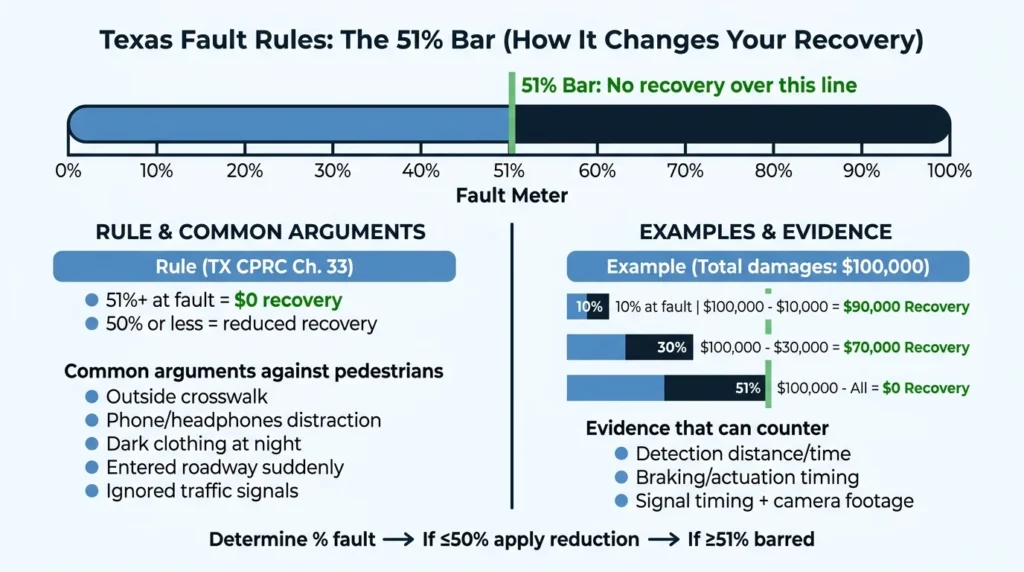
If you are 50% or less at fault, your recovery is reduced by your percentage of responsibility. For example, if your damages total $100,000 and you are found 30% at fault, you would recover $70,000.
Common comparative fault arguments in pedestrian cases include:
- Crossing outside a marked crosswalk
- Distraction from a phone or headphones
- Wearing dark clothing at night
- Entering the roadway suddenly
- Ignoring traffic signals
Strong evidence from the autonomous vehicle’s own systems can counter these arguments. Data showing the vehicle detected you well before impact, combined with braking data showing a delayed response, can demonstrate the system had time to stop safely.
Deadlines: The Two-Year Statute of Limitations
Texas generally allows two years from the date of injury to file a personal injury lawsuit. This deadline comes from Texas Civil Practice and Remedies Code § 16.003. Wrongful death claims also generally have a two-year limitations period.
However, waiting until close to the deadline is risky in autonomous vehicle cases. Digital evidence may be overwritten within weeks. Witnesses become harder to locate. Corporate defendants may restructure or change policies.
Starting your investigation early gives your legal team time to send preservation letters, obtain records through formal discovery if needed, and build a complete picture of what happened.
Insurance & Coverage in Robotaxi Accidents
Self-driving vehicle crashes can involve multiple insurance policies. The robotaxi company typically carries commercial liability coverage. If a product defect is involved, the manufacturer’s coverage may apply.
Your own auto insurance may also provide protection. Texas requires insurers to offer uninsured/underinsured motorist (UM/UIM) coverage under Texas Insurance Code Chapter 1952. While you must reject this coverage in writing if you don’t want it, many Texans have UM/UIM protection that could apply in certain scenarios.
Insurance companies are businesses focused on minimizing payouts. They may dispute who qualifies as the “operator,” argue policy exclusions apply, or downplay your injuries. Thorough documentation of your damages strengthens your position.
You may be eligible for compensation for the following types of damage:
- Medical expenses (past and future treatment, rehabilitation, medications)
- Lost income and reduced earning capacity
- Pain and suffering
- Physical impairment and disfigurement
- Loss of enjoyment of life
Keep all medical records, bills, and receipts. Save pay stubs and documentation of missed work. Consider keeping a symptom journal to document your daily pain levels and limitations.
Talk to a Texas Pedestrian Accident Lawyer Today
Autonomous vehicle crashes add technical complexity that requires prompt action. If you’ve been hit by a robotaxi or self-driving car in Texas, getting legal help early can make a significant difference in preserving evidence and identifying all responsible parties.
Angel Reyes & Associates offers free initial consultations and works on a contingency basis, meaning we charge no fees unless we win. With more than $1 billion recovered for clients and 16 office locations across Texas, we have the resources to handle complex cases involving corporate defendants and technical evidence. We also offer service in Spanish.
Contact us today to discuss your situation and learn how we can help protect your rights.
Self-Driving Car Pedestrian Accident FAQs
Can a pedestrian use their own car insurance after a robotaxi crash in Texas?
Sometimes. If the at-fault vehicle is uninsured, underinsured, or coverage is being disputed, your own UM/UIM coverage may help even though you were walking at the time.
What if the robotaxi company says the car was not in self-driving mode?
That dispute usually turns on records like onboard video, trip data, system logs, and any takeover alerts or remote-assistance communications. Preserving those records early can be important because they may show whether a human or the automated system was controlling the vehicle.
Do I need the police report before I get medical treatment?
No. Get medical care right away if you are hurt, because your health comes first, and early treatment also creates a clearer record of when your symptoms began.
Can poor road design or a broken crosswalk signal affect a Texas pedestrian claim?
Yes. In some cases, unsafe signal timing, faded markings, blocked sightlines, or other roadway problems may become part of the investigation along with the vehicle’s actions.
What if the self-driving car only “clipped” me and I felt okay at first?
You should still get checked out as soon as possible. Pedestrian crashes can cause delayed symptoms, and waiting too long can make it harder to connect the injury to the collision.
About the Authors

Spencer Browne
Writer
Spencer Browne is a partner at Angel Reyes & Associates and a Board Certified personal injury trial lawyer with nearly 100 jury trials across Texas. He focuses on car, truck, and wrongful death cases, with notable verdicts including a landmark win in the Choctaw Casino bus crash case. A recognized speaker and legal educator, Spencer is a member of the American Board of Trial Advocates and has been honored as a Texas Super Lawyer and one of D Magazine’s Best Lawyers in Dallas. He brings deep trial experience and relentless advocacy to every client he represents.

Kyle Nicolas
Editor
Kyle Nicolas is the Web Content & SEO Manager at Angel Reyes & Associates. He has more than 10 years of experience as a marketing co...

Angel Reyes
Reviewer
Angel L. Reyes, III is the Founder and Managing Partner of Angel Reyes & Associates. A nationally recognized trial attorney and business...