Can You Sue a Self-Driving Car Manufacturer for a Defective Product?


Every article on this site is researched by our internal team, reviewed for legal accuracy against current Texas law, and held to State Bar of Texas advertising standards before publication. We do not publish content that overstates outcomes or makes promises about results.
Learn more about our
editorial standards .
Key Takeaways
- Texas injury victims may sue vehicle manufacturers when a self-driving defect contributes to a crash, but they must prove that a specific defect caused their injuries.
- Under Texas law, fault is divided among all responsible parties, and a claimant's share of responsibility can reduce or prohibit recovery.
- Preserving vehicle data, system logs, and update history in the first 48 hours after a crash is often critical to prove whether automation was engaged and how it behaved.
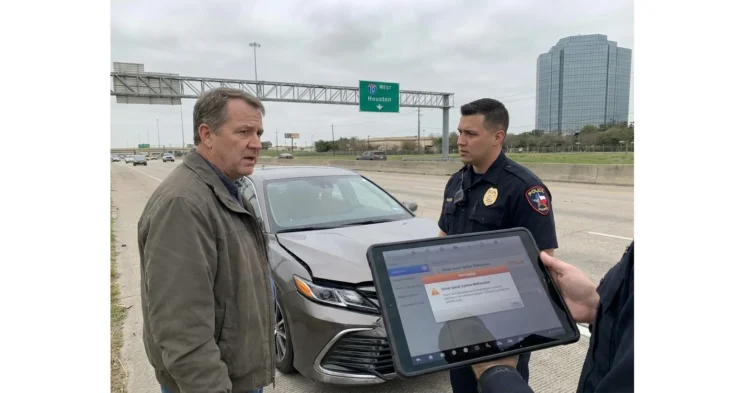
You were driving home on I-10 near the Galleria when your vehicle’s lane-keeping system suddenly steered toward the guardrail. You grabbed the wheel, but not fast enough. Now, you’re dealing with injuries, a totaled car, and questions about what went wrong.
The car manufacturer says you should have been paying closer attention. But how are you supposed to anticipate the vehicle doing what that system is expressly designed to prevent?
Crashes involving self-driving features and advanced driver-assistance systems (ADAS) raise complicated questions about who’s responsible for the accident. Texas law allows injury victims to pursue claims against vehicle manufacturers and technology suppliers when a defect contributes to a crash.
What “Self-Driving” Means in a Texas Crash Case
The term “self-driving” covers a wide range of technologies. The distinction matters because liability in a car accident often depends on what the system was designed to do and whether the driver was expected to remain in control.
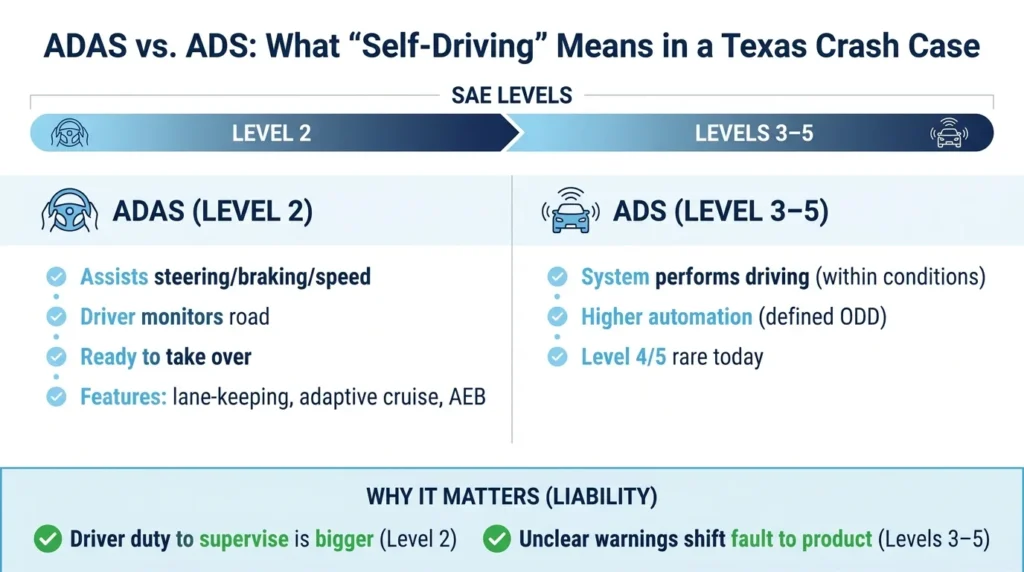
ADAS (Advanced Driver-Assistance Systems) include features like adaptive cruise control, lane-keeping assist, and automatic emergency braking. These are considered Level 2 systems under SAE standards. In this case, the driver must remain engaged and ready to take over at any moment.
ADS (Automated Driving Systems) refer to higher levels of automation in which the vehicle handles more driving tasks within specific conditions. True Level 4 and Level 5 systems are still rare on public roads.
This distinction shapes legal arguments. If you were using a Level 2 system, the manufacturer will likely argue that you were responsible for monitoring the road. If the system’s warnings were unclear or its limitations weren’t properly communicated, that argument becomes weaker.
Common Scenarios In Which Automation Is a Liability Issue
Several patterns exist in ADAS-related crashes across Texas, including:
- Phantom braking, when the system brakes suddenly without an actual obstacle
- Lane-keeping failures that drift the vehicle toward barriers or other lanes
- Sensor misreads in challenging conditions, like heavy rain on US-290 or sun glare on westbound highways during evening rush hour
- Delayed or confusing driver-monitoring alerts that fail to get the driver’s attention before a collision
Over-the-air software updates add another challenge. A feature that worked one way when you bought the vehicle may behave differently after an update you didn’t request or fully understand.
Who Is Liable in a Texas Self-Driving or ADAS Crash?
Texas car accident claims involving automation often involve multiple defendants. Fault can be spread among several parties, depending on what caused the crash.
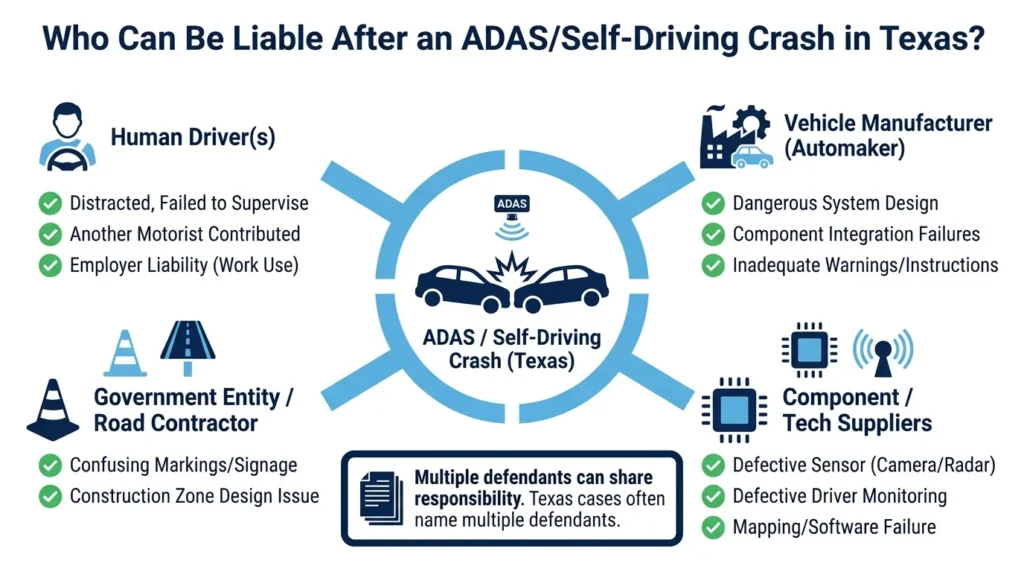
Human drivers remain potentially liable. This includes the ADAS user who may have been distracted, another driver who caused the initial collision, or an employer if the vehicle was being used for work purposes.
Product-side defendants include the vehicle manufacturer, and possibly the companies that supplied specific components. Sensors, cameras, radar systems, mapping software, and driver-monitoring technology often come from different suppliers. Each supplier may bear responsibility if their component was defective.
Government entities or contractors are less common defendants but may be relevant if confusing lane markings, missing signage, or construction zone design contributed to a sensor misread.
Can You Sue Tesla (or Another Car Manufacturer) for an Autopilot Crash?
Yes, a product liability claim may be possible if you can prove a defect contributed to your crash and caused your injuries.
Texas law recognizes three types of product defects:
- Design defects, in which the system is unreasonably dangerous as designed
- Manufacturing defects, in which a particular unit was not made according to specifications
- Warning defects, in which instructions or limitations were inadequately communicated
You can expect the manufacturer to challenge the claim. They’ll point to warnings in the owner’s manual and on-screen alerts, and they may argue that you misused the system or weren’t paying attention. These defenses won’t automatically defeat your claim, but they will shape how the case develops.
Preserving evidence early is critical. Vehicle data, app records, dashcam footage, and update history can disappear or be overwritten. Promptly sending a preservation letter will help you protect this information.
Texas Product Liability Basics for ADAS Defects
Texas courts require more than just showing that a crash happened. You must also identify a specific defect that caused your injuries.
The Texas Supreme Court emphasized this requirement in Kia Motors Corp. v. Ruiz. A general claim that “the system malfunctioned” isn’t enough. You’ll also need evidence pointing to what specifically failed, and why it made the product unreasonably dangerous.
In ADAS cases, this might mean proving that:
- The object-classification algorithm failed to recognize a stationary vehicle
- The driver-monitoring system didn’t detect that the driver’s eyes were off the road
- The warning messages were too small, too brief, or appeared in locations that drivers don’t naturally look
Building this proof requires technical experts. Accident reconstructionists, software engineers, and human factors experts work together to identify the defect and eliminate alternative explanations.
How Texas Comparative Fault Works in Multi-Party Cases
Texas uses a proportionate responsibility system under Texas Civil Practice and Remedies Code Chapter 33. This means that fault is divided among all responsible parties, including the injured person.
If you’re found partially at fault, your recovery is reduced by your percentage of responsibility. If your share exceeds 50%, you may not recover anything.
In ADAS cases, juries often split fault among the driver, car manufacturer, component suppliers, and possibly other drivers. A manufacturer might be assigned 60% responsibility for a warning defect, while the driver might be assigned 40% for not paying attention.
Factors That Could Increase Your Share of Fault
Certain facts make it easier for defendants to shift blame, such as:
- Ignoring repeated hands-on-wheel warnings
- Using features outside of their intended conditions (such as heavy fog or unmarked roads)
- Evidence of phone use or other distractions
- Modifications to the vehicle’s systems
However, strong counterarguments exist. For example, if the warnings were confusing, the system’s limitations weren’t clearly communicated, or the manufacturer knew that drivers commonly used features in ways that caused crashes, these facts will support your claim.
Often, missing data is what harms the injured party. Without logs showing the system was engaged and how it behaved, the story can default to “driver error.”
Dealer and Seller Responsibility Limits in Texas
Texas Civil Practice and Remedies Code Chapter 82 governs product liability claims and includes protections for non-manufacturing sellers like dealerships.
Generally, a dealer that simply sold you the vehicle without modifying it or making independent representations about its safety features has limited exposure, as compared to the manufacturer. However, if the dealer made specific claims about ADAS capabilities or failed to pass along safety recalls, they may remain present in the case.
Component suppliers raise a different set of issues to consider. If a sensor manufacturer or software developer created a defective product that was integrated into the vehicle, they may share liability with the car manufacturer.
Evidence You Need to Prove an ADAS Defect
These cases are won or lost on evidence. The data that proves what happened often exists only briefly before being overwritten or lost.
Vehicle data sources include the event data recorder (EDR), ADAS-specific logs showing system engagement, camera and radar status, and steering and braking inputs. Some vehicles record whether the driver’s hands were on the wheel and eyes on the road.
Digital ecosystem evidence includes manufacturer app data, telematics records, cloud-stored logs, software version history, and service records showing calibration or repairs.
Traditional evidence is also still vital. Scene photos, witness statements, police reports, and surveillance footage help establish what happened in the physical world.
NHTSA Crash Reporting Rules That May Help You Locate Evidence
The National Highway Traffic Safety Administration requires manufacturers to report certain crashes involving ADAS and automated driving systems under its Standing General Order. The detailed reporting requirements specify what incidents must be reported and when.
This is important because it means documentation may exist. Manufacturers track these incidents, so an attorney can send preservation letters and discovery requests to ensure this information isn’t destroyed.
What to Do in the First 48 Hours After a Crash
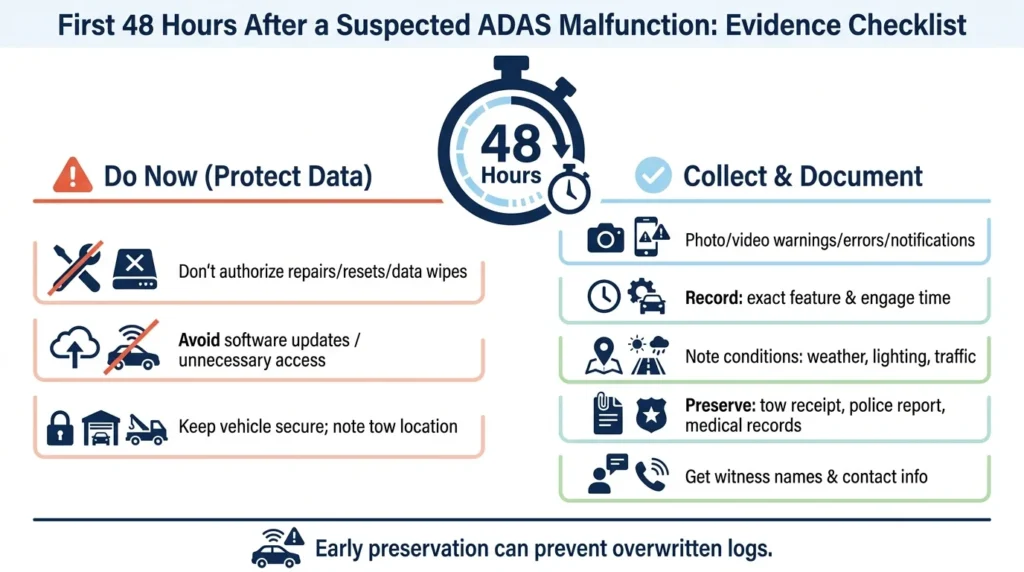
If you suspect an ADAS issue contributed to your crash:
- Do not authorize repairs, resets, or data wipes on the vehicle.
- Document the vehicle’s state, including any warning lights, error messages, or app notifications.
- Identify the exact feature you were using, when it was engaged, and the conditions under which you used it (including weather, lighting, and road markings).
- Preserve all records, including tow receipts, storage location, police report number, hospital records, and witness contact information.
Knowing what to do after a car accident in Texas becomes even more important when technology may be involved.
How an Attorney Builds a Texas ADAS Product Liability Claim
These cases require significant investigation. A typical approach includes:
- Retaining reconstruction experts to analyze the crash
- Engaging defect engineers to examine the vehicle and its systems
- Hiring human factors experts to evaluate warnings and driver expectations
- Pursuing discovery of internal testing documents, prior incident reports, and engineering communications
Damages in serious cases include medical expenses, lost income, physical impairment, pain and suffering, and property loss. If a loved one died, wrongful death claims involve additional categories.
ADAS crashes often cause severe injuries because they can involve high speeds and unexpected loss of control. These cases may overlap with truck accidents or motorcycle accidents when commercial vehicles or vulnerable road users are involved.
Talk to a Texas Injury Attorney About Your ADAS Crash
Self-driving and ADAS technology is evolving faster than the law, but Texas product liability principles still apply. If a defect in your vehicle’s automation contributed to your crash, you may have a claim against the manufacturer, a component supplier, or both.
At Angel Reyes & Associates, we’ve spent over 30 years helping Texas injury victims hold negligent parties accountable. Our firm has recovered more than $1 billion for clients across the state. We offer free consultations and work on contingency, meaning you pay no fee unless we win.
If you were injured in a crash involving Autopilot, lane-keeping assist, automatic emergency braking, or any other driver-assistance feature, contact us to discuss your options. Taking early action to preserve evidence can make a significant difference in these technically complex cases.
Self-Driving Product Liability FAQs
Will my insurance still cover a crash if a self-driving feature was on?
Auto insurance often still applies after a crash, but coverage can depend on your policy terms, claim type, and whether another party or product defect also played a role in the crash. A product-liability claim against a manufacturer is separate from what your own insurer may pay.
Can a software update after the crash affect my case?
Yes. Later updates can change how the system behaves or what data is stored, which may make it harder to compare the vehicle’s pre-crash condition to its post-crash condition. That is why it is important to avoid updates, resets, or unnecessary vehicle access until the evidence is preserved.
Do federal investigators automatically decide who is legally at fault in an ADAS crash?
No. Agencies like NHTSA can investigate safety issues and gather data, but they do not decide civil liability in your injury case. Fault in a Texas lawsuit is decided based on the evidence, the law, and sometimes a jury’s allocation of responsibility.
Can a used car sale affect a Texas ADAS defect claim?
Not necessarily. A used vehicle can still be the subject of a product-defect claim, but the seller’s role, any post-sale modifications, maintenance history, and what the buyer was told about the system may all come into play. The age and condition of the vehicle can also affect what evidence is available.
What if the self-driving feature worked fine before and only failed once?
A single failure does not automatically rule out a defect claim. In some cases, one serious malfunction can still support a claim if the evidence shows that a specific design, manufacturing, or warning problem contributed to the crash.
About the Authors

Angel Reyes
Writer
Angel L. Reyes, III is the Founder and Managing Partner of Angel Reyes & Associates. A nationally recognized trial attorney and business leader, Angel has helped over 70,000 injury victims recover more than $1 billion since founding the firm in 1993. Named to the Texas Super Lawyers list annually since 2008, Angel brings Wall Street experience, Ivy League education, and a deep commitment to client advocacy. He is a frequent legal commentator and published author with extensive contributions to legal scholarship, trial strategy, and consumer protection.

Kyle Nicolas
Editor
Kyle Nicolas is the Web Content & SEO Manager at Angel Reyes & Associates. He has more than 10 years of experience as a marketing co...

Angel Reyes
Reviewer
Angel L. Reyes, III is the Founder and Managing Partner of Angel Reyes & Associates. A nationally recognized trial attorney and business...