Who’s Liable for a Self-Driving Truck Crash in Texas?


Every article on this site is researched by our internal team, reviewed for legal accuracy against current Texas law, and held to State Bar of Texas advertising standards before publication. We do not publish content that overstates outcomes or makes promises about results.
Learn more about our
editorial standards .
Key Takeaways
- Texas law treats the automated driving system as the "operator" when engaged, which shifts liability focus to technology developers and carriers.
- EDR, ELD, telematics, and ADS logs are critical evidence that can be lost quickly without prompt preservation efforts.
- Texas's two-year statute of limitations and 51% comparative fault bar make early legal action essential in autonomous truck crash cases.
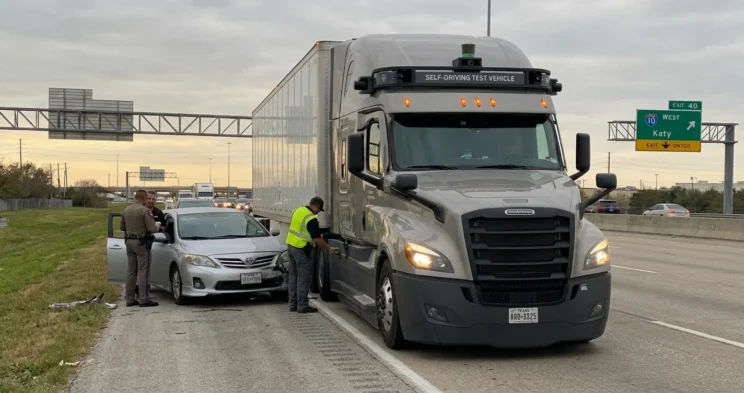
You were driving home on I-10 near Katy when a semi-truck drifted into your lane without warning. The cab had no visible driver. Now, you’re dealing with serious injuries, mounting bills, and a confusing situation: who exactly is responsible when the truck was operating itself?
Autonomous and semi-autonomous commercial trucks are already on Texas highways. When crashes happen, the question of liability becomes far more complex than a typical collision. Multiple parties may share responsibility, and critical electronic evidence can disappear within days if not preserved.
Why Autonomous Truck Crashes Create “Layered” Liability
Traditional truck accident cases focus on driver error and carrier negligence. Autonomous trucks add new “layers” (or challenges) to the problem. In these cases, liability can shift between the motor carrier, human safety operator, technology developers, and maintenance vendors, depending on whether automation was engaged at the moment of impact.
These cases hinge on fast evidence preservation. EDR data, ELD records, telematics, and onboard video illustrate what the truck’s systems were doing in the seconds before a crash. Police reports alone rarely capture this information.
Understanding how truck accident claims work is a starting point. Autonomous cases build on these foundations, while adding technology-specific requirements to the investigation.
The Texas “Operator” Rule When Automated Driving Is Engaged
Texas has addressed automated vehicles in its Transportation Code. Under Subchapter J, when an automated driving system (ADS) is engaged, the ADS itself is treated as the operator of the vehicle.
This is an important distinction for liability. The traditional question of, “Who was driving?” becomes, “Was the automated system in control, and if so, was it functioning properly?”
The question of whether or not automated driving is “engaged” is proven by data. Mode status logs, control inputs, disengagement records, and alert histories show whether the system was actively operating at the time of impact. Marketing labels like “autopilot” or “self-driving” don’t determine legal status.
When ADS is engaged, duty of care arguments shift toward the technology developer and the company that deployed the system. When a human driver or safety operator has taken over (or should have taken over), traditional negligence principles apply.
Semi-Autonomous vs. Autonomous: How Driver Assist Affects Who’s At Fault
Not all automation is equal. “Level 2” driver-assist systems (such as adaptive cruise control and lane-keeping) still require human monitoring. Higher-level autonomous systems may operate without constant human oversight.
For driver-assist crashes, common disputes include:
- Driver inattention or delayed takeover response
- Overreliance on system capabilities
- Warning fatigue from frequent alerts
For higher-autonomy systems, disputes often focus on:
- System design limitations
- Operational design domain (ODD) boundaries
- Remote support or dispatch involvement
The same crash can involve both negligence claims (against the driver or carrier) and product liability claims (against the technology developer). Required evidence differs for each type of dispute.
Who Can Be Held Financially Responsible
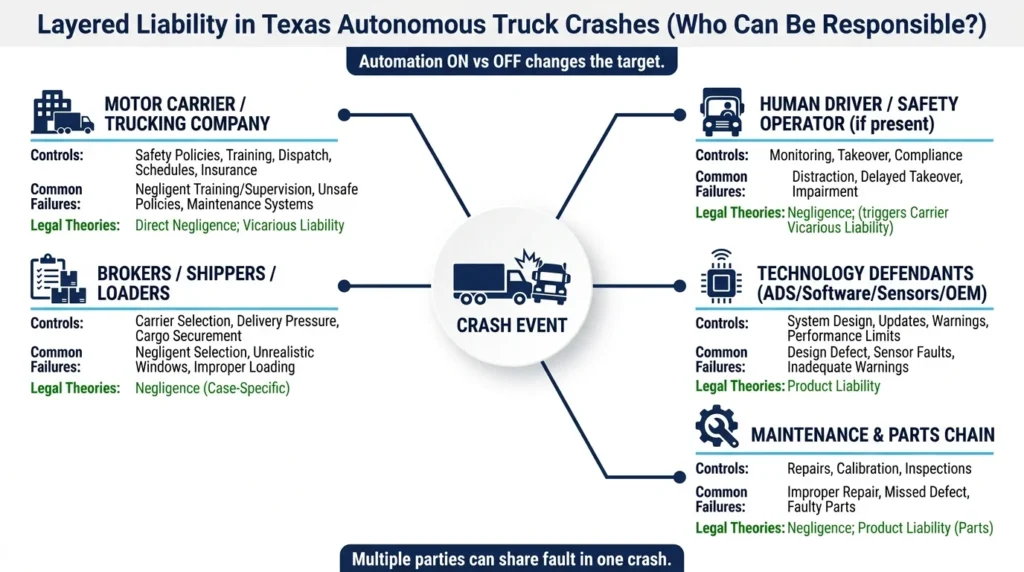
Accidents involving commercial autonomous trucks may have multiple potential defendants. Each defendant controls a different aspect of the operation.
Motor Carrier/Company: The trucking company bears responsibility for safety management, training, dispatch decisions, scheduling pressure, and contractor oversight. Carriers also maintain insurance coverage that may apply to crashes. Trucking companies can face direct negligence claims for systemic failures.
Human Driver or Safety Operator: If a human was present and responsible for monitoring operation of the vehicle, their actions are important. Failure to take over when required, distraction, impairment, or compliance violations can establish individual liability.
Technology Defendants: ADS developers, vehicle manufacturers, sensor suppliers, braking and steering component makers, and software update managers may all bear responsibility for system failures. Defective software, sensor malfunctions, or inadequate safety margins can support product liability claims.
Maintenance and Parts Chain: Third-party maintenance contractors, brake and tire vendors, and calibration specialists may be liable if their work contributed to the crash. In this case, maintenance records and post-repair testing documentation are critical evidence.
Brokers, Shippers, and Loaders: In some cases, responsibility may be shared between freight brokers who selected an unsafe carrier, shippers who imposed unrealistic delivery windows, or loaders who improperly secured cargo.
Vicarious Liability vs. Direct Negligence vs. Product Liability
Understanding the following legal theories will help you clarify how different defendants can be held accountable:
Vicarious liability holds a company responsible for the actions of their employees. For example, if a safety operator’s negligence caused the crash, the carrier may be vicariously liable.
Direct negligence targets the company’s own failures, such as negligent hiring, inadequate training, poor supervision, deficient safety policies, or improper maintenance systems.
Product liability applies when a defect in the vehicle or its systems caused or contributed to the crash. This includes design defects, manufacturing defects, or a failure to disclose known limitations.
The Evidence Trail That Decides These Cases
Autonomous trucking cases are data cases. Electronic evidence often determines liability more than witness testimony.
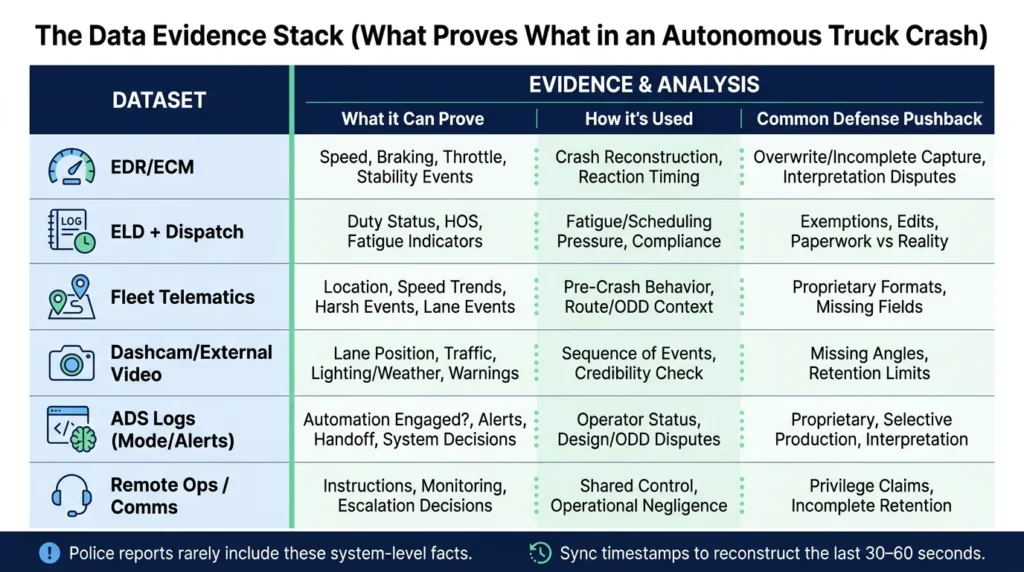
Key data sources include:
- EDR (Event Data Recorder): Captures a snapshot of speed, braking, throttle position, and other parameters in the seconds surrounding a crash
- ELD (Electronic Logging Device): Records hours-of-service compliance and duty status
- Fleet telematics: Tracks location, speed, hard-braking events, and other operational data
- Dashcam and external video: Provides a visual record of the crash sequence
- ADS logs: Provides mode status, alerts, disengagements, and system decisions
The NHTSA provides helpful background information on what EDRs capture, as well as their limitations. Understanding black box evidence in truck accidents is essential for building these cases.
Synchronizing timestamps across multiple data sources will allow you to reconstruct exactly what happened: when automation was engaged, what alerts occurred, when (or if) a human took control, and how the truck’s systems responded.
What Each Dataset Can Prove
EDR/ECM data shows speed, brake application, throttle position, and stability events. Defense attorneys may argue incomplete capture or data overwrites.
ELD and dispatch records reveal duty status, driving time, and potential fatigue indicators. Defenses may focus on exemptions or record edits.
Telematics, video, and ADS logs document lane events, system alerts, disengagements, and remote operator involvement. Proprietary data formats can complicate access to these records.
Texas Recording Device Law & Black Box Access
Texas Transportation Code § 547.615 addresses recording devices and limits on data retrieval. Accessing EDR data typically requires owner consent or a court order.
For crash victims, this should be done as soon as possible. Preservation letters sent to the carrier and technology vendors can prevent data destruction. When cooperation isn’t forthcoming, early legal action may be necessary to secure court-ordered access.
When retrieving data and preserving the physical device, both steps require fast action. Vehicles may get repaired, sold, or scrapped. Data may get overwritten. Waiting weeks or months can mean losing evidence that would otherwise have proven your case.
Early Evidence Preservation Steps
Immediately after the crash:
- Seek medical care
- Obtain the crash report number
- Take photos of all vehicles, the scene of the accident, and any visible damage
- Collect witness contact information
- Request that vehicles and data be preserved (without interfering with the investigation)
With attorney assistance:
- Send preservation and spoliation notices to the carrier and technology vendors
- Request download and inspection protocols
- Secure video from dashcams, nearby businesses, and roadway cameras
When necessary:
- Request a court order to prevent alterations to the recordings and to ensure access in compliance with Texas recording device requirements
Deadlines & Fault Allocation in Texas
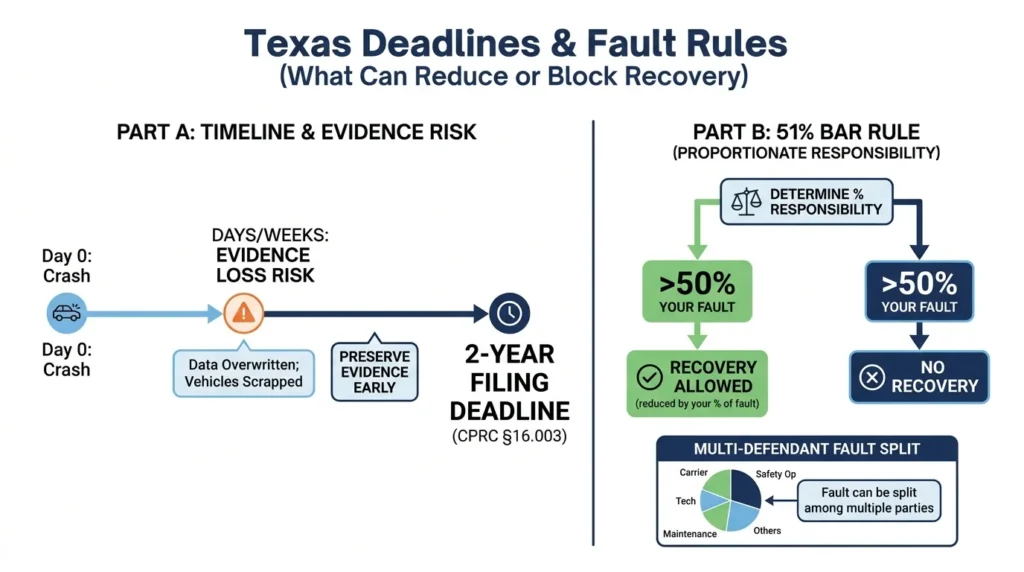
Even strong liability evidence can be undermined by missed deadlines or comparative fault rules.
The two-year deadline: Under Texas Civil Practice and Remedies Code § 16.003, personal injury and wrongful death claims must generally be filed within two years of the crash. Electronic evidence can be lost long before this deadline, which makes early action critical.
The 51% bar rule: Texas uses proportionate responsibility in Chapter 33. If you’re found more than 50% responsible for the crash, you cannot recover damages. If you’re found 50% or less at fault, your recovery is reduced by your percentage of responsibility.
In multi-defendant autonomous truck cases, fault allocation across all parties is a major strategic issue. Identifying and naming all responsible parties early can affect both recovery amounts and settlement leverage.
When to Contact a Texas Self-Driving Truck Accident Lawyer
Certain situations call for immediate legal consultation:
- Severe injuries or fatality
- Commercial truck involvement
- Unclear automation status at the time of the crash
- The carrier or insurer has already contacted you
- The vehicle has been moved, repaired, or scrapped
Gather what you can, including crash report number, photos and video, medical records, insurer correspondence, trucking company identifiers (such as USDOT number and trailer markings), and witness information.
At Angel Reyes & Associates, we’ve spent over 30 years helping Texans injured in complex truck accidents. We offer free consultations, and you pay no fee unless we win. Our team has recovered more than $1 billion for clients, and we have the resources to take on cases involving multiple defendants and sophisticated technology evidence. We serve the entire state of Texas and can handle the majority of your case remotely.
Contact us to discuss your autonomous truck crash case and learn how we can help preserve critical evidence before it disappears.
Self-Driving Truck Liability FAQs
Will the trucking company’s insurer automatically cover a self-driving truck crash?
Not always. Coverage can depend on the policy language, who owned the truck, whether a contractor or vendor was involved, and whether the claim points to negligence, a product defect, or both.
What is an operational design domain (ODD) in a self-driving truck case?
An ODD is the set of conditions the automated system is designed to handle, such as certain roads, speeds, weather, or lighting. If the truck was operating outside those limits, that can become important evidence in deciding fault.
Can bad weather affect who is responsible for an autonomous truck crash?
Yes. Rain, fog, glare, and road conditions can affect sensors and system performance. Investigators may consider these conditions when determining whether the truck should have reduced speed, disengaged automation, or avoided the trip altogether.
Do I need the truck’s USDOT number after the crash?
Yes. It can be very helpful to identify the motor carrier and related records faster. You can often find the USDOT number on the truck cab, crash report, shipping documents, or carrier markings.
Can a remote operator or dispatch team be part of the case?
Sometimes. If a remote support team gave instructions, monitored the truck, or helped manage a disengagement or route decision, their communications and logs may factor into the investigation.
About the Authors

Alex Ivanov
Writer
Alex Ivanov is a personal injury attorney at Angel Reyes & Associates, focused on car, truck, and motorcycle accident cases. Licensed in Texas and multiple federal districts, Alex brings international legal experience and a global education to his practice. He earned his LL.M. from Texas A&M University School of Law after graduating from Belarussian State University in 2016. Alex is fluent in Russian, English, Ukrainian, and Belarussian, and is recognized by multiple national trial lawyer associations for his results and leadership under 40.

Kyle Nicolas
Editor
Kyle Nicolas is the Web Content & SEO Manager at Angel Reyes & Associates. He has more than 10 years of experience as a marketing co...

Angel Reyes
Reviewer
Angel L. Reyes, III is the Founder and Managing Partner of Angel Reyes & Associates. A nationally recognized trial attorney and business...