Types of Trucks involved in Accidents


Every article on this site is researched by our internal team, reviewed for legal accuracy against current Texas law, and held to State Bar of Texas advertising standards before publication. We do not publish content that overstates outcomes or makes promises about results.
Learn more about our
editorial standards .
Key Takeaways
- Tractor-trailer jackknifes start at the fifth-wheel coupling.
- A partially full tanker sloshes and shifts its weight, which significantly raises its rollover risk.
- A car hauler's long wheelbase makes its rear end swing wider than the cab during turns.
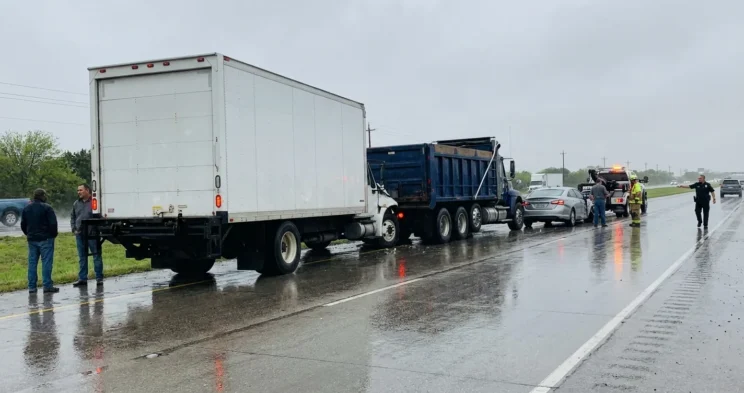
You merge onto I-610 near the Houston Ship Channel, surrounded by tankers, loaded flatbeds, and dump trucks rumbling past your window. In seconds, you’re hit by one of them, and in the moment, you’re not even sure which type of truck caused the crash.
Days after the crash, you are still trying to piece together what happened and understand how the collision caused your injuries. The type of truck involved can provide important clues. Tankers, flatbeds, and dump trucks have different designs, centers of gravity, cargo, and handling characteristics. These differences can affect how the truck moves, how it responds in a crash, and the types of injuries that result from a collision.
Tractor-Trailer Jackknife Accidents
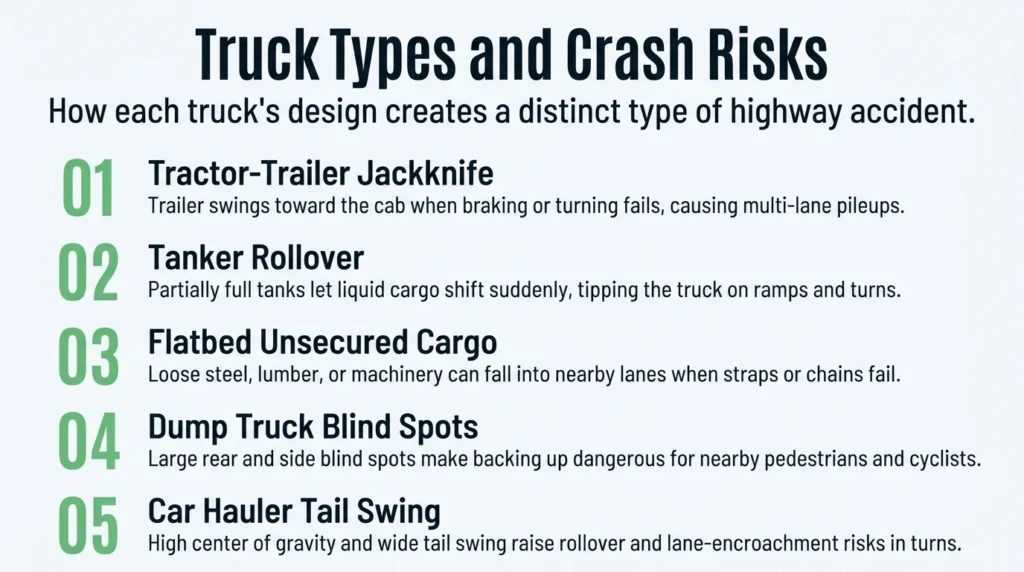
A jackknifing tractor-trailer is one of the most dangerous types of semi trucks you can encounter in a crash. It happens when the trailer swings outward at the connection between the truck and trailer and folds toward the cab, causing the truck to swing across several lanes. Sudden braking, sharp steering, or a rain-slicked freeway can cause the trailer to lose control and trigger the swing.
A jackknife truck accident often turns one vehicle’s skidding into a multi-car pileup. It ranks among the most common types of commercial truck accidents on Texas highways. Research from the Insurance Institute for Highway Safety shows that loaded trailers need far more distance to stop than passenger vehicles, especially on wet roads, which gives the driver less time to regain control once the trailer starts to slide.
Driver fatigue is a common cause of jackknife crashes. Long routes and tight delivery deadlines push some drivers past the federal hours-of-service limits. A tired driver reacts too slowly to regain control when the trailer starts to swing.
Fault in a jackknife crash may involve more than just the truck driver. A trucking company’s delivery schedule or skipped brake inspection may also have contributed to the crash. Before assuming the driver was solely responsible, it helps to understand how fault is established in a truck accident.
If you are trying to identify a tractor-trailer, start with this guide to Texas truck accident claims, which explains how to file a claim against a trucking company.
Tanker Truck Rollover Accidents
A tanker truck rolls over more easily than a truck carrying dry goods because its liquid cargo moves inside the tank. When the tank is only partially full, the liquid can shift suddenly when the truck breaks or turns. This movement can change the truck’s balance and cause it to tip before the driver can regain control.
The risk of a tanker truck rollover accident is especially high on sharp ramps and highway interchanges. Drivers who merge or turn quickly near a corridor like Houston’s Ship Channel face an even greater risk.
It also depends on what the tanker is carrying. A tanker that is hauling fuel or industrial chemicals can catch fire, release toxic fumes, or force a highway shutdown that lasts for hours.
Fuel and chemical carriers must follow federal hazardous materials shipping rules, which require the driver to carry paperwork identifying exactly what the tanker holds. This paperwork often becomes evidence in a rollover accident claim because it tells investigators what materials were involved. For more information about claims and liability after a hazmat-related crash, see our complete guide to Texas truck accidents.
Flatbed Truck Unsecured Cargo Accidents
A flatbed truck has no walls or roof to hold its cargo in place. If the load is too heavy or not balanced properly, it can shift when the truck turns and fall into nearby lanes. This is the major danger in flatbed truck accidents involving unsecured cargo. Steel pipes, lumber, or machinery can come loose without warning after straps, chains, and tie-downs fail. A single worn or broken strap can cause an entire load to slide off the truck while traveling at highway speeds.
Federal rules set safety standards for securing cargo on flatbed trucks, including how loads must be tied down and blocked. Under 49 CFR 392.9, drivers must also inspect the cargo before the trip and check it again during the trip.
If a trucking company fails to follow these rules, and the cargo comes loose, they may be held responsible for the crash. If you were injured by falling or loose cargo, our walkthrough of how a truck accident claim works explains what happens next.
Dump Truck Blind Spot Accidents
A dump truck’s raised bed and heavy load create several safety risks. The truck can roll over on uneven ground, and a full load can result in a longer stopping distance. If the bed is overfilled, or the load is not properly secured, then debris can also fall onto the road behind the truck.
A dump truck’s height and length create another risk: large blind spots around the rear and sides of the truck. These blind spots become even more dangerous when the truck is backing up or moving around a construction site. Pedestrians and cyclists near active work zones are especially vulnerable to these blind spots. A driver who is backing up may not see someone standing just behind or beside the truck.
Responsibility for a blind-spot crash may not fall entirely on the driver. The trucking company’s safety policies or the construction site’s traffic plan may also have contributed to the crash. It is important to consider all the potentially responsible parties before deciding on your next steps.
Car Hauler Accidents
A loaded car hauler carries several vehicles high off the ground, which raises the truck’s center of gravity. This makes the truck more likely to rollover on curves, ramps, and highway interchanges. The higher the vehicles are stacked, the more the truck can lean when turning.
A car hauler’s long frame can make its rear section swing wider than the cab when turning, especially the part that extends behind the rear axle. This is called “tail swing.” It is different from offtracking, which happens when a truck’s rear wheels follow a tighter path than its front wheels. That wider swing can hit or squeeze a vehicle in the next lane. Often, a car hauler accident starts during what seems like a normal turn or lane change.
A vehicle that is not properly secured on a car hauler can come loose and hit another vehicle. Just like unsecured cargo on a flatbed, a car that falls off a hauler can cause a serious crash because the vehicle is being carried higher off the ground, so it can hit with significant force when it lands.
If you are trying to identify a car hauler, start with this overview of Texas car accident claims, which explains how filing a claim against the owner of a car hauler is different from a typical car accident case.
What to Do Immediately After a Truck Accident
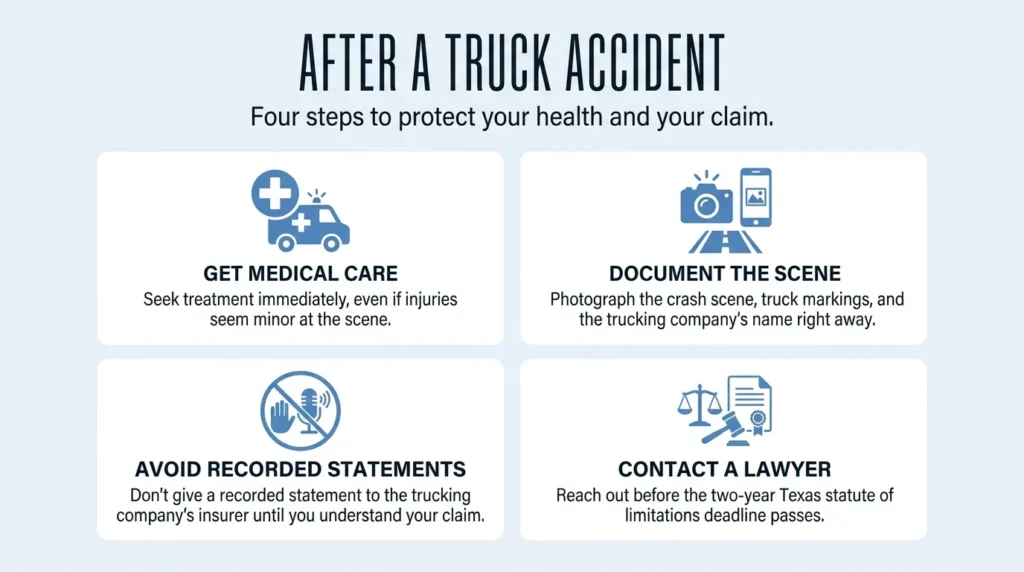
No matter what type of truck was involved, take these steps immediately after the crash:
- Get medical care first, even if your injuries feel minor at the scene.
- Document the crash scene, the truck’s markings, and the trucking company’s name before the information disappears.
- Avoid giving a recorded statement to the trucking company’s insurer until you understand your claim.
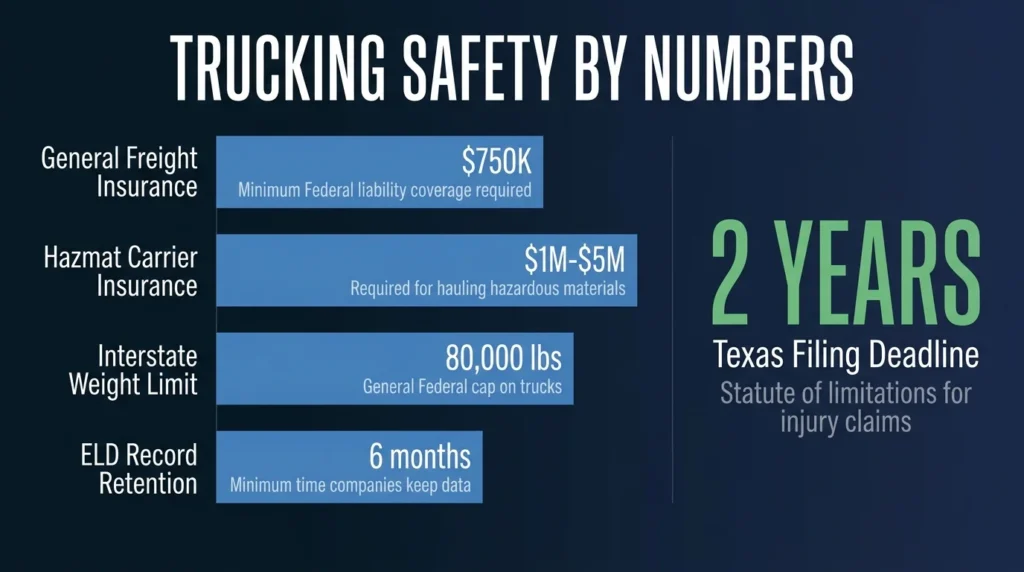
- Contact a lawyer before the Texas Civil Practice and Remedies Code § 16.003 two-year deadline passes.
Work with an Attorney on Your Truck Accident Claim in Texas
Angel Reyes & Associates has represented truck accident victims across Texas for over 30 years, and we have recovered more than $1 billion for our clients. We work on a contingency fee basis, so you pay nothing unless we win your case.
Reach out today to discuss your case and find out what the truck involved in your accident means for your claim.
Past results do not guarantee future outcomes.
Truck Accident FAQs
What is an underride accident, and how is it different from a jackknife or rollover?
An underride crash happens when a car slides partially or completely underneath the back or side of a trailer. Unlike a jackknife or rollover, an underride crash is usually caused by the difference in height and the lack of protection between the car and the trailer. Federal rules require guards on the back of trailers to help prevent these crashes, but similar guards are not required on the front or sides.
How much liability insurance is a trucking company required to carry?
Federal rules generally require trucking companies that are carrying general freight to have at least $750,000 in liability insurance. Trucking companies that are carrying certain hazardous materials must have between $1 million and $5 million in coverage, depending on what they are transporting.
Can a truck's electronic logging device help prove what happened in a crash?
Federal rules require most commercial trucks to use an electronic logging device to record information about the driver’s hours, speed, and location. Trucking companies must generally keep these records for at least six months. After a crash, this information can help show where the truck was and how fast it was traveling before the crash.
Is there a weight limit for commercial trucks on U.S. highways?
Federal rules generally limit most trucks to 80,000 pounds on the interstate. This limit can be lower, depending on the truck’s axle spacing, and the federal bridge weight formula. If a truck exceeds the weight limit, then the driver or trucking company may receive a citation. This violation can also be used as evidence when determining who was responsible for a crash.
About the Authors

Spencer Browne
Writer
Spencer Browne is a partner at Angel Reyes & Associates and a Board Certified personal injury trial lawyer with nearly 100 jury trials across Texas. He focuses on car, truck, and wrongful death cases, with notable verdicts including a landmark win in the Choctaw Casino bus crash case. A recognized speaker and legal educator, Spencer is a member of the American Board of Trial Advocates and has been honored as a Texas Super Lawyer and one of D Magazine’s Best Lawyers in Dallas. He brings deep trial experience and relentless advocacy to every client he represents.

Kyle Nicolas
Editor
Kyle Nicolas is the Web Content & SEO Manager at Angel Reyes & Associates. He has more than 10 years of experience as a marketing co...

Angel Reyes
Reviewer
Angel L. Reyes, III is the Founder and Managing Partner of Angel Reyes & Associates. A nationally recognized trial attorney and business...