Rollover Truck Accidents in Texas


Every article on this site is researched by our internal team, reviewed for legal accuracy against current Texas law, and held to State Bar of Texas advertising standards before publication. We do not publish content that overstates outcomes or makes promises about results.
Learn more about our
editorial standards .
Key Takeaways
- Carrier routing, loading, and scheduling choices often cause rollovers, not just driver error.
- Texas's 51% Bar Rule cuts a $500,000 recovery to $400,000 at 20% fault.
- Black box data and scene evidence like yaw marks can disappear within days.
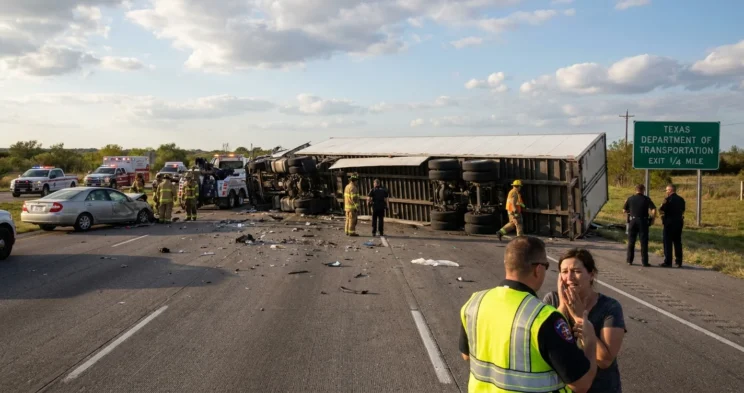
You’re merging onto I-45 near downtown Houston when the 18-wheeler ahead of you drifts wide on a curve and rolls across two lanes. Cargo and metal scatter across the roadway, and your car is caught in the wreckage. Within days, an adjuster calls, and the trucking company’s account focuses only on the driver. However, the decisions that contributed to the rollover may have been made long before the truck reached that curve.
Carrier Liability in Rollover Crashes
Rollover accidents involving 18-wheelers can be especially deadly, according to federal crash data. Many of these crashes trace back to decisions the carrier made long before the driver reached the curve where the truck tipped over.
Carriers sometimes send drivers onto tight curves, highway ramps, or unfamiliar roads to save time. A dispatcher chasing a delivery window may pick the fastest route instead of the safest one, and that choice belongs to the carrier, not the driver.
Loading practices can also contribute to a rollover. Cargo stacked too high can raise the truck’s center of gravity, while an improperly secured load may shift as the truck turns. Depending on who loaded and secured the cargo, responsibility may rest with the carrier, shipper, loading company, or more than one party.
Schedule pressure creates a similar risk. Federal hours of service rules under 49 CFR Part 395 cap how long commercial drivers may remain on the road. When a carrier pressures a driver to meet an unrealistic schedule, fatigue and speeding may contribute to a loss of control. Reviewing driving logs, dispatch messages, and delivery records can reveal hours-of-service violations connected to the crash.
A rollover claim may extend beyond the driver named in the police report. A closer look at truck accident liability may show that the carrier, shipper, loading company, or maintenance contractor also shares responsibility.
Trucking companies and their insurers often try to close a claim fast. Learning how they delay or deny claims can help you avoid signing away your case before you understand what it is worth.
When carrier-level negligence contributes to a fatal rollover, the surviving family may have a wrongful death claim against the carrier, not just the driver.
Truck Rollover Causes in Texas
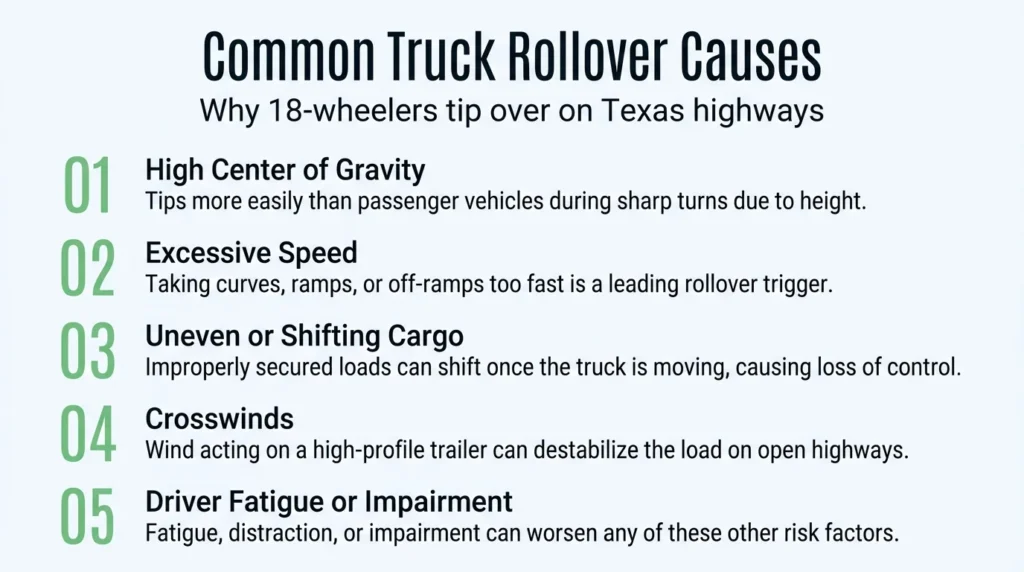
A tractor-trailer’s high center of gravity makes it more likely to tip during a sharp turn than a passenger vehicle.
Excessive speed through curves, on-ramps, and off-ramps is a leading rollover trigger. Federal guidelines urge truckers to slow down for road conditions before reaching a curve.
On high-volume Texas corridors like I-35, I-45, and I-10, a truck taking a ramp too fast can tip before the driver reacts. This pattern shows up consistently in Texas crash statistics.
Uneven or shifting cargo adds to the danger. A load that was not properly secured before departure may shift once the truck is moving. Evidence of shifting cargo in a truck accident can help show how the rollover happened and who may be responsible.
Crosswinds acting on a high-profile trailer add another risk, especially on open highway stretches. Evasive steering, an overcorrection after drifting or dodging a sudden obstacle, can tip an already unstable load.
Driver fatigue, distraction, or impairment can make any of these factors worse. Federal rules under 49 CFR § 382.201 set a lower blood alcohol limit for commercial drivers than for drivers of passenger vehicles.
How the 51% Rule Impacts Compensation
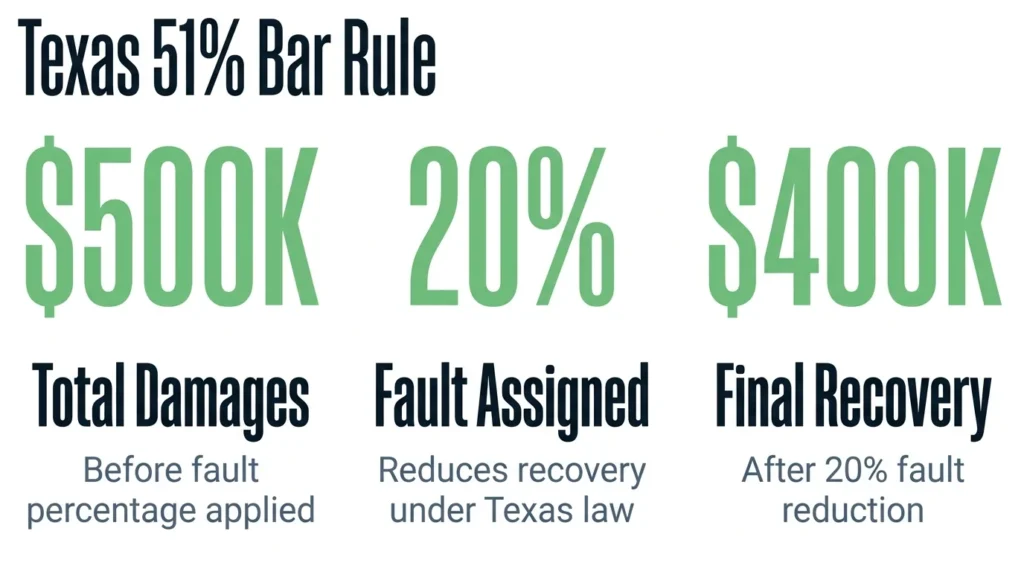
Texas follows a modified comparative negligence rule under Texas Civil Practice and Remedies Code § 33.001. You can recover damages only if you are found less than 51% at fault for the crash under the 51% rule.
For example, if your damages total $500,000 but you are found 20% at fault for the crash, your recovery would be reduced by 20% to $400,000.
Evidence of carrier-level fault, including routing, loading, or scheduling failures, can affect how responsibility is divided. Looking beyond the driver may reveal that the carrier or another company also contributed to the rollover.
Preserving Truck Rollover Evidence
The truck’s digital data and the physical marks left at the scene can both disappear quickly after a rollover. Both must be preserved within days, not weeks.
Recovering Black Box Data Quickly
The truck’s Electronic Control Module can record speed, braking, and steering activity in the seconds before a rollover. Black box evidence can help show what happened immediately before the truck tipped over.
This data may be overwritten during the truck’s normal operating cycle. An attorney can send a spoliation letter requiring the carrier to preserve it.
Physical Scene Evidence After a Rollover
Accident reconstruction often relies on physical evidence left at the scene, which can disappear quickly. According to federal rollover research, skid and yaw marks can help show the truck’s path before it tipped.
Gouge marks and patterns in scattered cargo or debris may also help establish where the rollover began. If you can do so safely, photograph the scene before cleanup begins.
Responsibility for a trucking crash may be divided among several parties, not just the driver. Preserving evidence from the scene can help determine who contributed to the rollover.
Steps to Take After a Rollover Crash
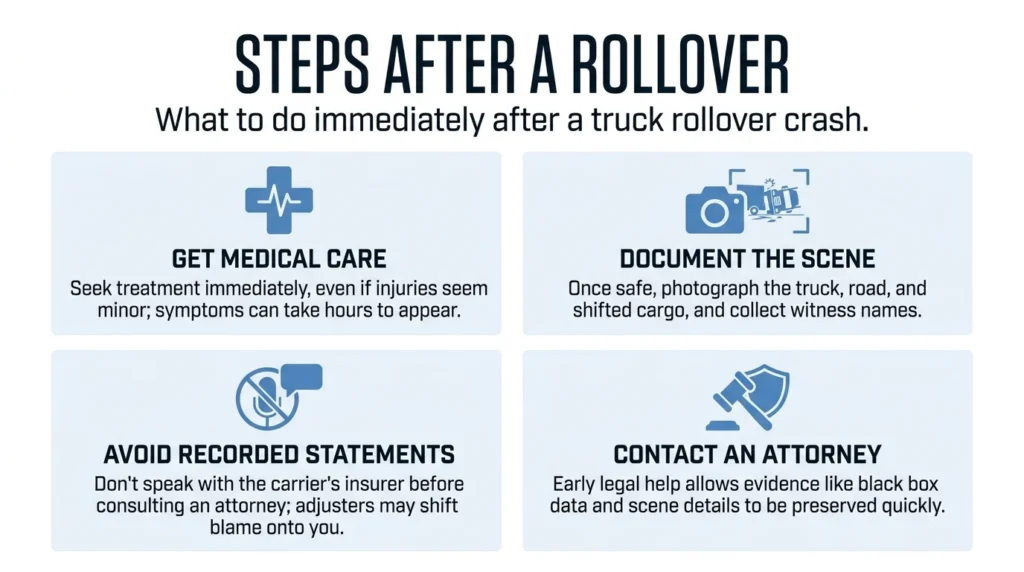
Get medical care first, even if your injuries seem minor at the scene. Some rollover injuries, like internal bleeding or a concussion, take hours to show symptoms.
Document the scene as soon as it is safe. Photograph the truck, the road, and any cargo that shifted or spilled, and collect the names of nearby witnesses.
Avoid giving a recorded statement to the carrier’s insurer before you speak with counsel. Adjusters are trained to ask questions that shift blame onto you.
Contact an attorney early so evidence preservation, like black box data and scene evidence, can start right away.
Work with an Accident Attorney
A rollover crash involving a commercial truck rarely has one simple cause, and rarely just one defendant. Angel Reyes & Associates has spent more than 30 years holding trucking companies, shippers, and negligent drivers accountable across Texas. We have recovered more than $1 billion for our clients, and we work on contingency, so you pay no fee unless we win.
If a commercial truck rollover has upended your life, Angel Reyes & Associates is ready to review what happened and who is responsible. Contact us today for a free consultation.
Past results do not guarantee future outcomes.
Truck Rollover Claim FAQs
How long do I have to file a truck rollover accident lawsuit in Texas?
Texas law generally gives you two years from the date of the crash to file a personal injury lawsuit, under Civil Practice and Remedies Code Section 16.003. Missing this deadline usually bars you from recovering in court, even if the crash clearly was not your fault.
What is the minimum insurance a trucking company must carry?
Federal rules require most interstate general freight carriers to hold at least $750,000 in liability coverage, though many carry more. This coverage is often what pays out after a serious rollover crash, separate from whatever fault percentage gets assigned to you.
Is there a cap on how much I can recover in a Texas truck accident case?
Texas does not cap pain and suffering or other non-economic damages in standard truck accident cases. The caps that apply to claims like medical malpractice do not apply here, so your recovery depends on your actual damages and fault percentage, not a statutory ceiling.
Who can file a wrongful death claim after a fatal rollover crash?
Under Texas law, only a surviving spouse, children, or parents of the person killed can bring a wrongful death claim. If none of them files within three months of the death, the estate’s executor or administrator can bring the claim instead.
About the Authors

Angel Reyes
Writer
Angel L. Reyes, III is the Founder and Managing Partner of Angel Reyes & Associates. A nationally recognized trial attorney and business leader, Angel has helped over 70,000 injury victims recover more than $1 billion since founding the firm in 1993. Named to the Texas Super Lawyers list annually since 2008, Angel brings Wall Street experience, Ivy League education, and a deep commitment to client advocacy. He is a frequent legal commentator and published author with extensive contributions to legal scholarship, trial strategy, and consumer protection.

Kyle Nicolas
Editor
Kyle Nicolas is the Web Content & SEO Manager at Angel Reyes & Associates. He has more than 10 years of experience as a marketing co...

Alex Ivanov
Reviewer
Alex Ivanov is a personal injury attorney at Angel Reyes & Associates, focused on car, truck, and motorcycle accident cases. Licensed in...