Tesla’s Robotaxi Crash Rate: What the Data Says


Every article on this site is researched by our internal team, reviewed for legal accuracy against current Texas law, and held to State Bar of Texas advertising standards before publication. We do not publish content that overstates outcomes or makes promises about results.
Learn more about our
editorial standards .
Key Takeaways
- Headline crash rate comparisons often mislead because the math shifts based on what events are counted.
- Texas's AV authorization law is enforceable May 28, 2026, with insurance and safety requirements.
- Fault in a robotaxi crash depends on case-specific facts and evidence, not fleet-wide statistics.
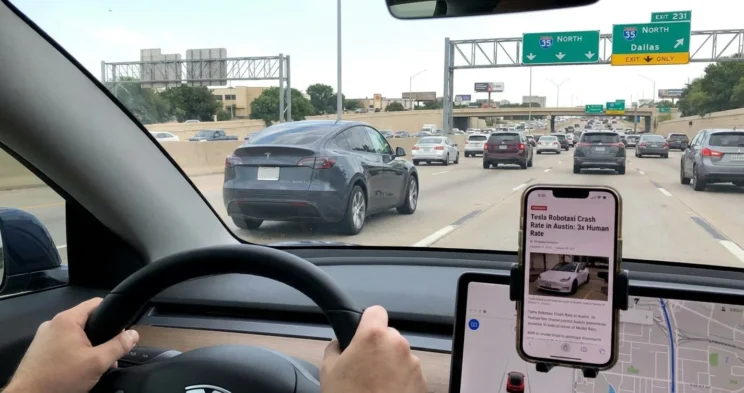
You got home from a drive on I-35 through Dallas and saw the headline: “Tesla robotaxis crashing at 3x the human rate in Austin.” Tesla is pushing deeper into Texas, and one of these vehicles could be two lanes over from you on your next commute. What happens if one hits you?
The headlines grab attention, but the numbers behind them deserve a closer look. “Crash rate” can mean different things depending on who’s doing the math. Understanding how these figures are calculated helps you separate genuine safety signals from statistical noise.
What “Tesla Robotaxi Crash Rate” Actually Measures
When you see a headline claiming robotaxis crash “3x more” or “4x more” than human drivers, the first question should be: compared to what?
Crash rate calculations depend entirely on two choices: what you count and what you divide by. Different ways of counting tell different stories.
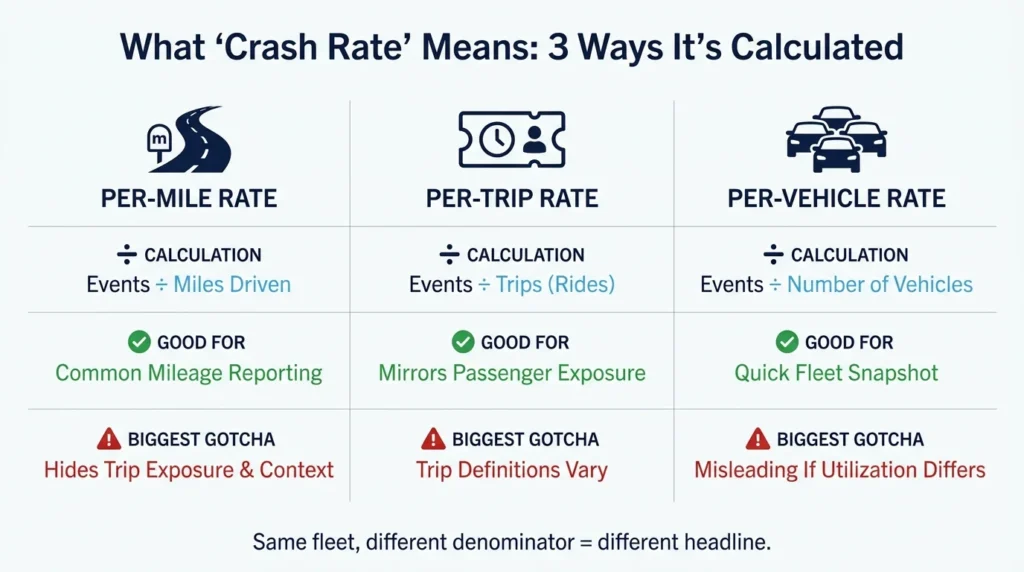
Per-mile rates divide incidents by total miles driven. This is the most common approach because mileage data is relatively available. One outlet might report “one incident every 57,000 miles” based on this method.
Per-trip rates divide incidents by completed rides. This can better reflect passenger exposure but depends heavily on how “trip” is defined. Does a canceled pickup count? What about drives with no passenger on board?
Per-vehicle rates divide incidents by fleet size. This hides how much each vehicle is actually used. A robotaxi operating 20 hours daily accumulates far more exposure than one running 8 hours.
What gets counted matters just as much. “Crash” versus “incident” versus “reportable event” can mean vastly different things. A minor curb scrape, a fender-bender in a parking lot, and a serious intersection collision might all count equally in some tallies.
Early-rollout data is especially unstable. Small fleets operating in limited areas over short time windows produce statistics that can swing dramatically with just a few additional events. Software updates, route changes, and operational adjustments all affect the numbers.
What’s Publicly Documented About Austin Incidents
Public information about Tesla’s Austin robotaxi operations comes from several sources, each with limitations.
Federal incident reporting provides one dataset. The National Highway Traffic Safety Administration requires certain automated driving system incidents to be reported under its Standing General Order. This creates a searchable record, but reporting thresholds and categorization differ from traditional police-reported crashes.
Tesla’s own mileage disclosures provide the basis for many rate calculations. When the company reports total miles driven, analysts divide incident counts by that figure to produce per-mile rates.
Media compilations aggregate social media videos, witness accounts, and official reports into incident lists. These can capture events that might not appear in formal databases, but verification and consistency vary.
What you can reasonably conclude: Events have occurred during Austin operations, and federal regulators have expressed concern about some of them.
What you cannot conclude: Who was at fault, whether the vehicles are definitively more dangerous, or how these numbers will look as the fleet grows. Redactions in reports often obscure what actually happened, and “incident” does not automatically mean “the robotaxi caused the crash.”
How Crash Rates Are Calculated: A Step-by-Step Look
Understanding the math helps you evaluate any rate claim you encounter.
The basic formula is straightforward: Rate = Counted Events ÷ Exposure (miles or trips)
If a fleet logs 1 million miles and experiences 10 counted events, the rate is 10 per million miles, or “one every 100,000 miles.”
Small differences in counting can cut the rate in half or double it. If one analysis counts “any contact with another object” while another counts only “collisions resulting in property damage over $1,000,” their rates will differ even using identical mileage figures.
Comparing robotaxi rates to human driver rates adds another layer of complexity. Human crash rates vary by road type, time of day, weather, and driver age. A robotaxi running only in urban Austin during daylight hours faces different conditions than the average driver nationwide. Comparing that fleet to national statistics that include rural highways, nighttime driving, and impaired drivers is not a fair comparison.
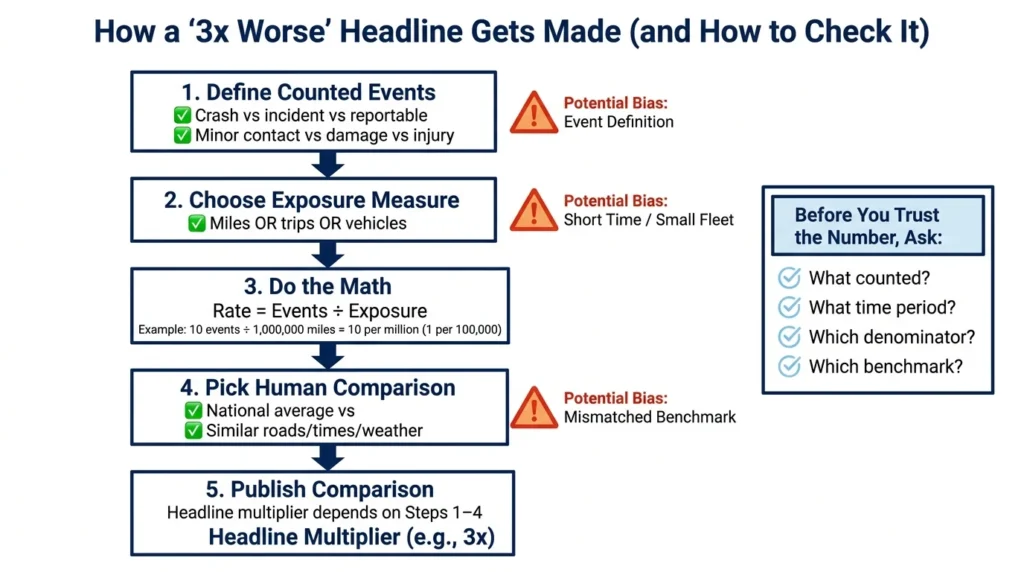
When evaluating any “X times worse than humans” claim, ask:
- What events are being counted?
- What time period does the data cover?
- What exposure measure is used?
- What human benchmark is being compared, and does it match the robotaxi’s actual operating conditions?
Texas Automated Vehicle Law & the TxDMV Authorization Framework
Texas has established new requirements for commercial automated vehicle operations through SB 2807, creating a regulatory framework that Dallas-Fort Worth drivers should understand as these vehicles move beyond Austin.
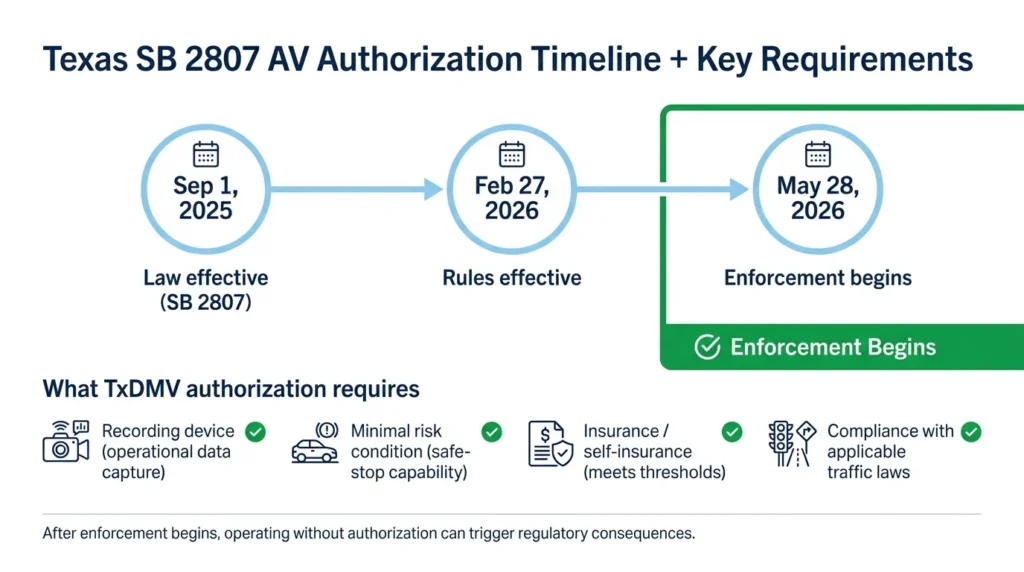
The TxDMV Automated Vehicles Regulatory Program requires commercial AV operators to obtain authorization before operating on Texas roads. Key requirements include:
- Recording device requirements for capturing operational data
- Minimal risk condition capability — the vehicle must be able to reach a safe stop on its own
- Insurance or self-insurance meeting specified thresholds
- Compliance with traffic laws applicable to the vehicle’s operation
The timeline matters for enforcement. The law became effective September 1, 2025. Rules became effective February 27, 2026. Enforcement begins May 28, 2026. After that date, commercial AV operators without proper authorization face regulatory consequences.
Operator Responsibility & Post-Collision Duties Under Texas Law
Texas Transportation Code Chapter 545 addresses automated motor vehicles, including provisions on operator responsibility and how traffic citations are handled.
After any collision in Texas, certain duties apply regardless of whether the other vehicle was human-driven or automated. These include remaining at the scene, exchanging information, and contacting police when injuries or significant damage occur. Our guide on what information to collect after an accident covers these steps in detail.
Getting a ticket and being legally responsible for someone’s injuries are two different things. A traffic citation addresses a specific violation at a specific moment. A personal injury claim involves broader questions: did someone act carelessly, did that cause harm, and how much did that harm cost you? Even with vehicle logs and video, fault can be disputed.
What Crash Rates Don’t Tell You About Liability After a Collision
Aggregate statistics cannot determine fault in your specific crash. If a robotaxi rear-ends you at a red light on Preston Road in Dallas, the fleet’s overall rate is irrelevant to your claim.
What matters is the facts of your collision: what the vehicle did, what you did, what the evidence shows, and whether someone’s carelessness caused your injuries.
Evidence in automated vehicle cases may include:
- Vehicle data and recording device logs
- In-car and external camera footage
- Mapping and routing logs
- Remote support or intervention records
- Maintenance and software update history
Multiple parties could potentially bear responsibility depending on the circumstances: the commercial operator, any remote supervisor, other drivers involved, or maintenance providers. An experienced car accident attorney can help identify the right parties and make sure critical evidence is preserved before it disappears.
Practical Steps If You’re in a Crash Involving a Robotaxi
Whether you’re in Austin, driving through Fort Worth on I-30, or anywhere else in Texas, these steps apply after any collision:
At the scene:
- Move to safety if possible
- Call 911 if anyone is injured or damage is significant
- Take photos and video of all vehicles, damage, and the scene
- Get contact information from witnesses
- Note any identifying markings on the automated vehicle and the company operating it
After the scene:
- Seek medical attention even if injuries seem minor
- Keep records of all symptoms, treatments, and expenses
- Report the collision to your insurance company
Protecting your claim:
- Avoid giving recorded statements to the other party’s insurer without legal guidance
- Preserve all communications related to the crash
- Consult with an attorney before accepting any settlement offer
Insurance companies, whether representing you or the AV operator, are businesses focused on resolving claims at the lowest possible cost. Their initial offers may not reflect the full value of your injuries and losses. Understanding how many accidents happen daily in Texas provides context for how insurers handle the volume of claims they process.
What to Watch as Texas AV Regulations Take Effect
As the TxDMV authorization framework becomes enforceable and federal attention continues, the rules around automated vehicles in Texas will keep evolving.
The authorization requirements create accountability that didn’t previously exist at the state level. Recording device mandates, insurance requirements, and safe-stop standards give regulators real tools to address problems.
For Dallas-Fort Worth drivers, more robotaxis on Texas roads means learning to share space with vehicles that behave differently than human-driven cars. Construction zones along I-635, unpredictable weather, and dense traffic in areas like Uptown or Deep Ellum present different challenges than Austin’s initial operating environment.
Track primary sources rather than relying solely on headlines. The TxDMV program page and Texas Transportation Code provide authoritative information that won’t be filtered through competing interpretations.
How Angel Reyes & Associates Can Help
Injury claims involving automated vehicles raise questions that standard car accident cases don’t. Evidence is time-sensitive, and identifying every responsible party requires understanding both the technology and Texas law.
Angel Reyes & Associates has served Texas injury victims for over 30 years, recovering more than $1 billion for clients across the state. Past results do not guarantee future outcomes. We offer free consultations and work on contingency — you pay no fee unless we win. Our team can investigate your crash, preserve critical evidence, and pursue fair compensation on your behalf.
With more than 20 locations across Texas and 24/7 availability, we’re ready to help wherever you are. Contact us to discuss your situation and understand your options.
Tesla Robotaxi Crash FAQs
Do police reports and NHTSA incident reports count the same events?
No. A police report follows Texas crash-reporting rules, while NHTSA’s automated-driving reporting system uses separate federal triggers, so an event may appear in one system, both, or neither depending on the facts.
Can a video on social media prove a robotaxi caused a crash?
Not by itself. A clip may show part of an event, but fault usually depends on the full picture: vehicle data, witness statements, scene evidence, and any police investigation.
Does Texas require a human driver inside a commercial robotaxi?
Not necessarily. Texas law allows automated motor vehicles to operate without a human driver if they meet the legal requirements that apply to that kind of operation.
If a robotaxi company is authorized to operate in Texas, does that mean the vehicles are "safe"?
Authorization means the operator met the state’s regulatory requirements. It is not a guarantee that every trip will be crash-free, and individual liability questions still depend on what happened in a specific incident.
Why might one article say "crash" while another says "incident" for the same robotaxi event?
Different sources use different labels and thresholds. Some counts include any reported contact or safety-related event, while others count only collisions with documented damage or injuries.
About the Authors

Angel Reyes
Writer
Angel L. Reyes, III is the Founder and Managing Partner of Angel Reyes & Associates. A nationally recognized trial attorney and business leader, Angel has helped over 70,000 injury victims recover more than $1 billion since founding the firm in 1993. Named to the Texas Super Lawyers list annually since 2008, Angel brings Wall Street experience, Ivy League education, and a deep commitment to client advocacy. He is a frequent legal commentator and published author with extensive contributions to legal scholarship, trial strategy, and consumer protection.

Graham Griffin
Editor
Graham Griffin is the Web & Content Manager at Angel Reyes & Associates, where he oversees content strategy, AI-powered workflows, a...

Angel Reyes
Reviewer
Angel L. Reyes, III is the Founder and Managing Partner of Angel Reyes & Associates. A nationally recognized trial attorney and business...