Common Causes of Truck Accidents in Texas


Every article on this site is researched by our internal team, reviewed for legal accuracy against current Texas law, and held to State Bar of Texas advertising standards before publication. We do not publish content that overstates outcomes or makes promises about results.
Learn more about our
editorial standards .
Key Takeaways
- Electronic Logging Device data can reveal a truck driver's actual hours worked.
- Dispatch and telematics data often expose distraction or scheduling pressure.
- Federal law requires alcohol and drug testing after certain truck crashes.
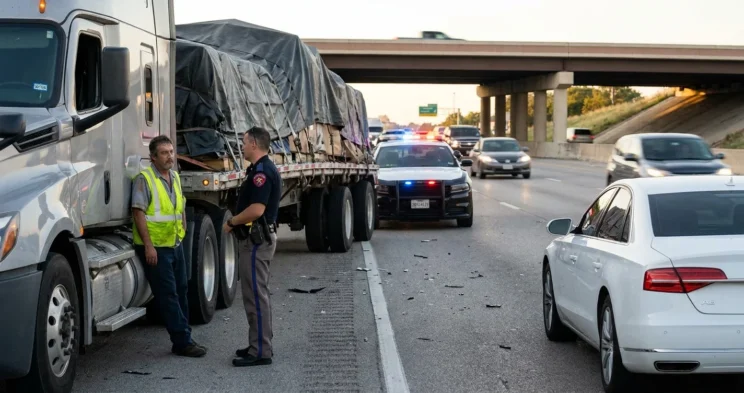
You are driving home on I-20 near Fort Worth when a loaded semi truck drifts into your lane and hits your car. In the days after, you want to know why it happened. Somewhere in that truck’s electronic records, dispatch files, or driver logs sits proof that could support your claim, if it is found before it disappears.
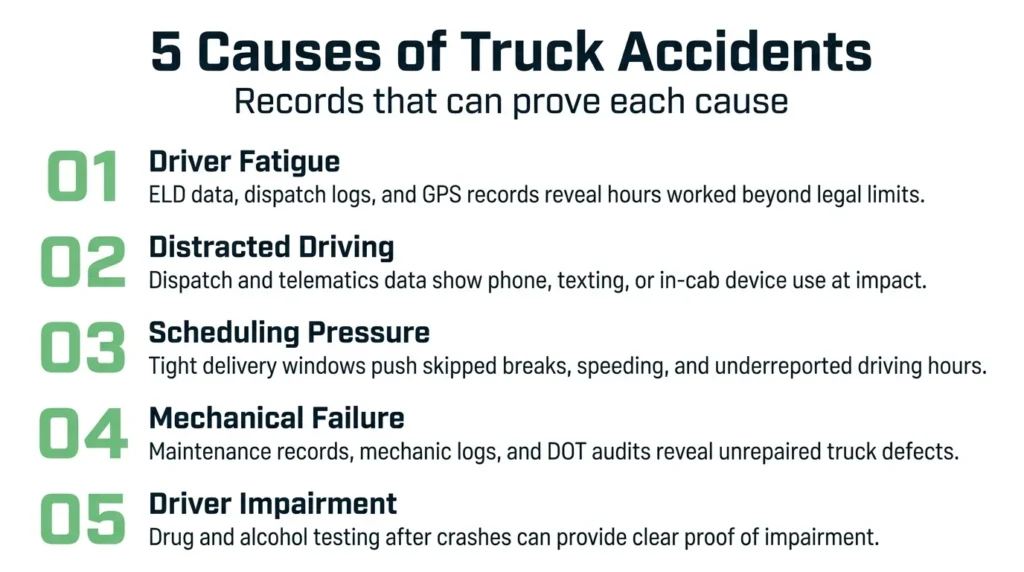
Driver Fatigue in Truck Accidents
Fatigue often shows up in a truck’s own electronic records before it shows up anywhere else. Electronic Logging Device data can reveal hours worked against legal limits. Dispatch schedules and driver-to-carrier messages can help confirm that timeline.
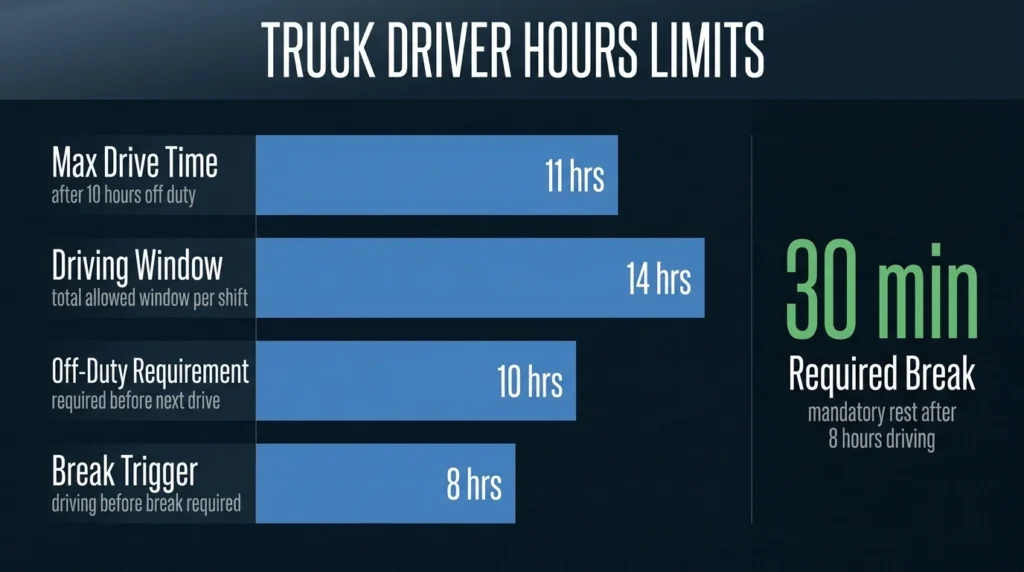
Under 49 CFR § 395.3, a driver may drive up to 11 hours after 10 consecutive hours off duty. That drive time must fall within a 14-hour window, with a required 30-minute break after 8 hours behind the wheel.
Carriers must also keep automated records under 49 CFR § 395.8, the Electronic Logging Device rule. This creates a time-stamped trail investigators can pull after a crash.
Some drivers try to hide fatigue with dual logbooks or a tampered ELD. Subpoenaed GPS data can expose the gap between a paper log and what a truck actually did.
A truck accident attorney who knows trucking cases will know which of these records to request quickly, before a carrier’s retention window closes.
Distracted Truck Driving
Texting, phone calls, in-cab technology, and eating are common causes of distracted truck driving. Any one of them can pull a driver’s eyes off the road long enough to cause a crash.
Dispatch records and telematics data can show whether a driver was on a call, sending a message, or using an in-cab device at the moment of impact.
Studies have long linked texting while driving to a much higher crash risk, though the exact figure varies between studies and vehicle types.
These records do not last forever. Reviewing dispatch and telematics data early, before a carrier can overwrite it, gives a claim its best chance.
Scheduling Pressure on Truck Drivers
Tight delivery windows push some drivers into unsafe choices. Skipping rest breaks, speeding to make up time, or logging fewer hours than actually driven are common results of scheduling pressure.
Dispatch and telematics data can show whether a delivery schedule left a driver too little time to reach a destination legally. These records often line up with the hours a driver actually logged, exposing the pressure behind a rushed decision.
Mechanical Failures in Truck Accidents
A truck with worn brakes, bald tires, or a cracked frame is a hazard on any highway. Maintenance records, mechanic logs, and DOT audits often show whether a known problem went unrepaired before a crash.
Federal rules require drivers to complete a Driver Vehicle Inspection Report under 49 CFR § 396.11 at the end of each day’s work when a defect is found. This creates a daily record of any defect the driver noticed.
Carriers must also document an annual inspection of each truck under 49 CFR § 396.17. A missing or incomplete filing can point to a maintenance gap.
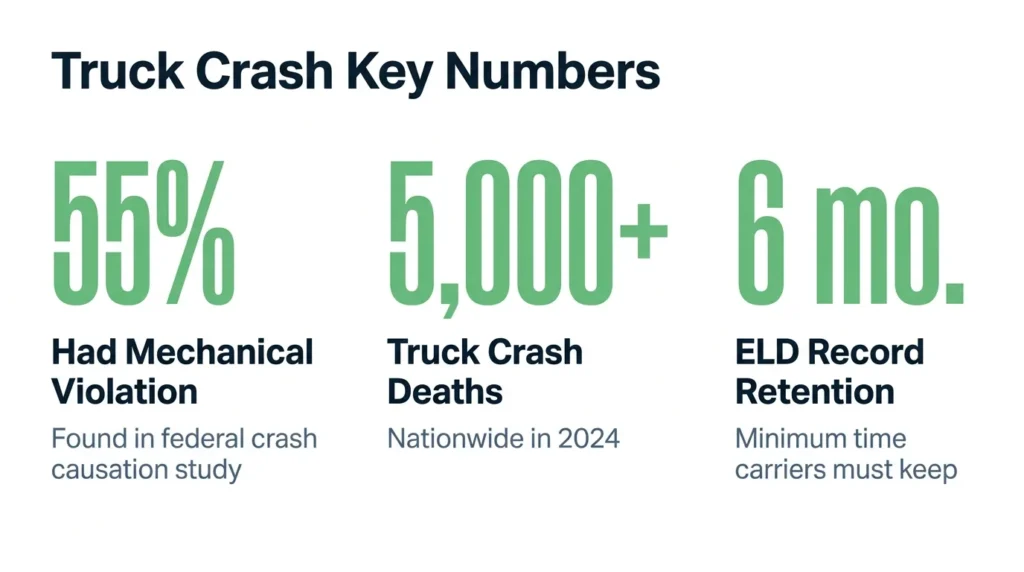
A federal Large Truck Crash Causation Study of crashes from 2001 to 2003 found that almost 55 percent of the trucks examined had at least one mechanical violation. A Texas truck accident claim built on this kind of proof often starts with pulling these records fast.
Proof of mechanical failure typically comes from:
- Maintenance records
- Mechanic logs
- DOT audit findings
- Driver Vehicle Inspection Reports
- Periodic inspection filings
Impairment in Truck Accidents
A positive drug or alcohol test after a crash can be some of the clearest proof of impairment available. Federal rules require carriers to test a driver for drugs or alcohol following certain crashes under 49 CFR § 382.303, and set strict windows for when that testing must happen.
Under Texas Penal Code § 49.07, causing serious bodily injury while intoxicated behind the wheel can carry criminal penalties separate from a civil claim.
Impairment remains a factor in a meaningful share of Texas crashes each year.
Requesting toxicology results and refusal records early matters. Carriers are not required to hold onto them indefinitely.
Discuss Your Case With an Experienced Attorney
Proving what caused your truck accident often depends on records that will not stay available forever. Angel Reyes & Associates has spent years building cases around exactly this kind of evidence.
Learn more about our firm’s approach to truck accident cases before you decide how to move forward.
Our case results include more than $1 billion recovered for clients in truck and other motor vehicle crash cases.
We work on a contingency fee basis, so you pay no fee unless we win. Contact us today for a free consultation about your truck accident claim.
Past results do not guarantee future outcomes.
Truck Accident Cause FAQs
How long do trucking companies have to keep driver logs and maintenance records?
Federal rules require carriers to keep electronic logging device records for at least six months and vehicle maintenance records for one year while the truck is in service, plus six months after that. These are minimum time limits, so records can still exist well after a crash if they are requested in time.
Do commercial trucks have a black box like an airplane?
Many large trucks have an engine control module that can record data such as speed, braking, and cruise control status in the moments before a crash. That data can be downloaded with special software and used to help reconstruct what happened.
How many people die in large truck crashes each year?
More than 5,000 people died in large truck crashes nationwide in 2024, and most of them were riding in a passenger vehicle rather than the truck. That makes large truck crashes especially dangerous for people in smaller vehicles.
Can unsecured or improperly loaded cargo cause a truck accident?
Yes. Federal rules require cargo to be loaded and secured so it cannot shift, spill, or fall from the truck, and a violation of these rules can lead to a rollover or loss of control.
Why do large trucks take longer to stop than cars?
A loaded truck’s weight and braking system give it a much longer stopping distance than a passenger car, and that gap grows even wider on wet or icy roads. This difference in stopping power can contribute to rear end and multi vehicle crashes.
About the Authors

Alex Ivanov
Writer
Alex Ivanov is a personal injury attorney at Angel Reyes & Associates, focused on car, truck, and motorcycle accident cases. Licensed in Texas and multiple federal districts, Alex brings international legal experience and a global education to his practice. He earned his LL.M. from Texas A&M University School of Law after graduating from Belarussian State University in 2016. Alex is fluent in Russian, English, Ukrainian, and Belarussian, and is recognized by multiple national trial lawyer associations for his results and leadership under 40.

Kyle Nicolas
Editor
Kyle Nicolas is the Web Content & SEO Manager at Angel Reyes & Associates. He has more than 10 years of experience as a marketing co...

Angel Reyes
Reviewer
Angel L. Reyes, III is the Founder and Managing Partner of Angel Reyes & Associates. A nationally recognized trial attorney and business...