How to Prove Truck Driver Negligence in Texas


Every article on this site is researched by our internal team, reviewed for legal accuracy against current Texas law, and held to State Bar of Texas advertising standards before publication. We do not publish content that overstates outcomes or makes promises about results.
Learn more about our
editorial standards .
Key Takeaways
- Texas's 51% bar rule reduces your recovery by your own share of fault.
- Trucking companies must give drivers drug testing quickly after a serious crash.
- A driver qualification file can prove that a trucking company knew a driver was unsafe.
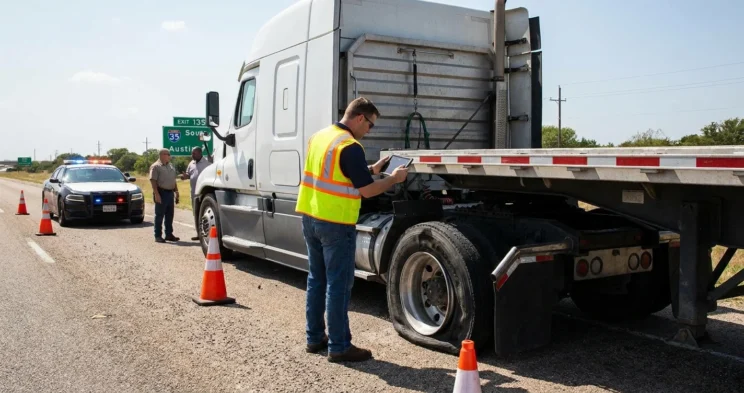
You are stopped in traffic on the Sam Houston Tollway when an 18-wheeler slams into your rear bumper. The driver tells the officer you stopped short, but his logbook and dispatch records tell a different story.
Before you can hold the other driver accountable, you need to know exactly what Texas law requires you to prove.
Truck Driver Negligence Under Texas Law
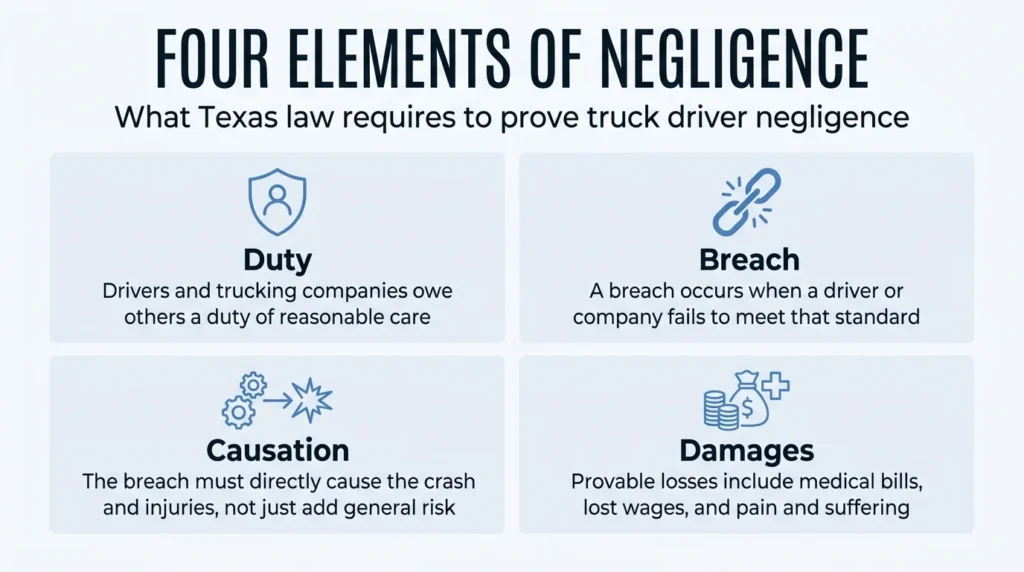
Texas law holds a truck driver liable for negligence when four elements line up:
- Duty
- Breach
- Causation
- Damages
Every commercial driver and trucking company owes other drivers on the road a duty of reasonable care. A breach happens when a driver or trucking company fails to meet that standard.
Common examples of a breach are:
- Speeding
- Driving while fatigued
- Skipping a required inspection
Causation means that breach must directly cause the crash and your injuries, leading to provable damages, not just contributing to general risk on the road.
Provable damages are your actual losses, including:
- Medical bills
- Lost wages
- Pain and suffering
Without provable damages, even a clear breach will not support your claim.
Texas Comparative Fault Rules Explained
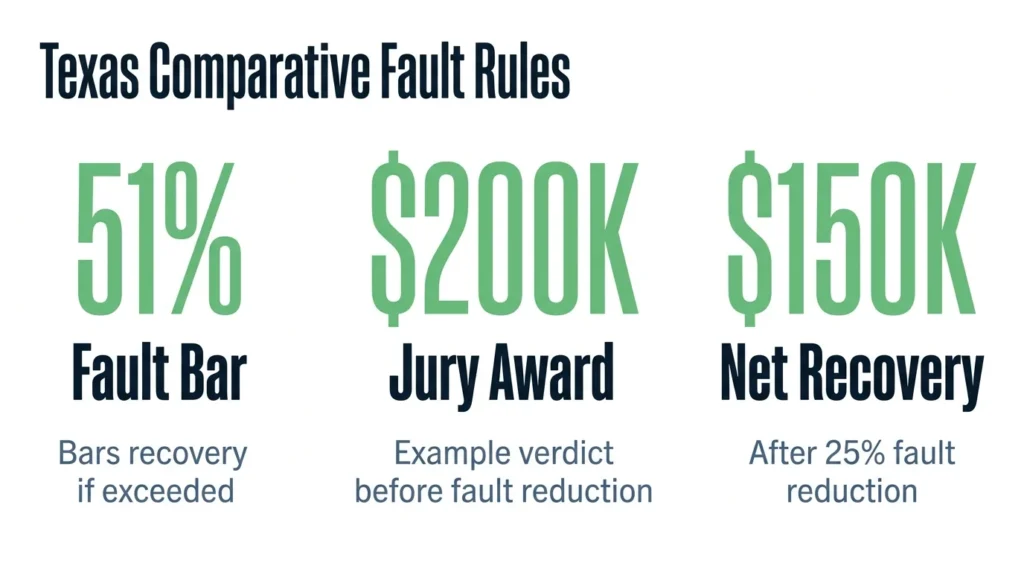
Texas also follows a 51% percent bar rule. Under Texas Civil Practice and Remedies Code Section 33.001 , a person who is found to be more than 50% at fault for a crash cannot recover any damages. If a driver is found to be 50% or less at fault, then any recovery they receive is reduced by their percentage of fault.
For example, a jury might award $200,000 in damages but find you 25% at fault. That reduces your actual recovery to $150,000. Truck crash claims often carry higher stakes than standard car accident claims, since commercial trucking companies typically carry much larger insurance policies.
Common Types of Truck Driver Negligence
Certain driver behaviors show up often in truck crash cases, and each one leaves behind different records. Knowing what the driver may have done before the crash can help you identify which records and evidence to seek out.
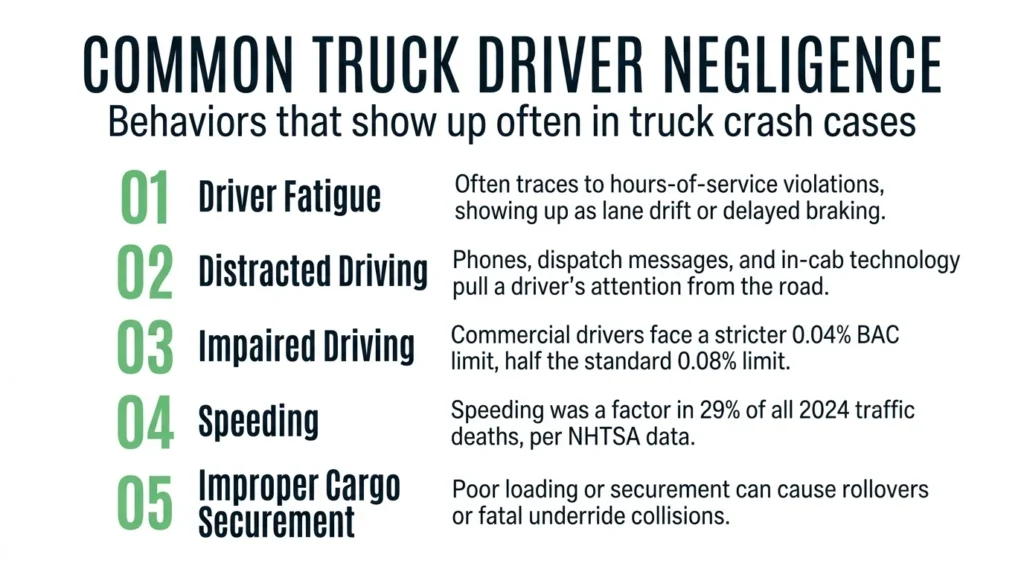
- Driver fatigue often traces back to hours of service violations. This occurs when a driver stays behind the wheel longer than federal rules allow. Irregular driving patterns like a sudden lane drift or delayed braking often point to a tired driver.
- Distracted driving is another common cause of crashes. Phones, dispatch messages, and in-cab technology all pull a driver’s attention away from the road.
- Impaired and drunk driving carry a stricter standard for commercial drivers than for ordinary motorists. Under 49 CFR Section 382.201, a commercial driver cannot operate a vehicle with a blood alcohol concentration of 0.04%. That is half the legal limit of 0.08% set for a standard license under Texas Penal Code Section 49.01.
- Speeding remains one of the most common factors in fatal truck crashes. NHTSA data shows that speeding was a factor in 29% of all traffic deaths in 2024, leading to a total of 11,288 lives lost nationwide.
- Improper cargo loading or securement can turn a routine stop into a rollover or an underride collision. These crashes are often fatal.
Trucking Company Negligent Hiring & Supervision
A trucking company can be held responsible for a crash even if the driver was not personally reckless. The company’s own hiring and supervising decisions can create separate legal responsibility.
You can pursue the driver and the trucking company in the same claim. They can be held responsible under different legal theories, and each claim will require its own evidence.
It’s worth noting that trucking companies rarely hand over their hiring and training records without pressure from someone who knows exactly what to request. An experienced truck accident attorney will know which records to demand, and how to get them before they disappear.
Vicarious Liability for the Driver’s Actions
Under respondeat superior, a trucking company is automatically responsible for a driver’s negligence committed while on the job. The same law applies when an employee causes a crash while working.
Negligent entrustment is an alternative way to hold a trucking company responsible. It applies when a company allows an unqualified or unsafe driver to operate the truck.
Direct Negligence in Hiring, Training & Retention
A trucking company can also be held directly responsible for its own negligent practices, such as hiring an unqualified driver, failing to provide proper training, or allowing an unsafe diver to stay on the road. This type of claim does not require you to prove that the driver was careless; instead, the focus is on whether the trucking company made the mistake of letting the driver on the road.
Questions about how companies supervise and retain employees have also been surfacing in self-driving truck crash cases in Texas. Even in these cases, courts look at who was responsible for training and supervising the people behind the technology.
Evidence Used to Prove Truck Driver Negligence
Records carry far more weight than eyewitness accounts in a truck crash claim, since logs and data are harder to dispute than memory. Building your case starts with gathering the right evidence early.
Under 49 CFR Part 395, Subpart B, trucking companies must keep hours-of-service logs and electronic logging device evidence that documents exactly when a driver was on duty, driving, or resting.
This data typically shows:
- Total hours driven before the crash
- Any required rest breaks that the driver may have skipped
- Whether the driver’s duty status changed throughout their shift
- Inspection and maintenance records related to the trip
Telematics and black box data also record a truck’s speed, braking, and overall behavior in the seconds before a crash.
Under 49 CFR Section 382.303, trucking companies must arrange drug and alcohol testing shortly after a serious crash. Results from that testing can directly support or negate a driver’s account of what happened.
All of the above data can be overwritten, deleted, or destroyed within days of the crash. Acting quickly often makes the difference between preserving this evidence and losing it for good.
Driver Qualification File & Violation History
A trucking company’s own paperwork can prove that they knew or should have known that a driver was unsafe before putting them on the road. This record is called a driver qualification file.
Under 49 CFR Section 391.51, every driver qualification file must include the following:
- The driver’s application
- Their road test results
- Their medical certification
- Their employment history
Missing or incomplete entries can point to a carrier that cuts corners. The driver’s prior violation history and safety scores can also prove that a carrier ignored clear warning signs and kept an unsafe driver behind the wheel anyway.
Talk to an Attorney About Your Truck Accident in Texas
You should not have to sort through logbooks, black box data, and driver qualification files on your own. Angel Reyes & Associates has more than 30 years of experience holding negligent drivers and trucking companies accountable across Texas. We have recovered more than $1 billion for clients.
We work on a contingency fee basis, so you pay no fee unless we win your case. That means pursuing the driver and the trucking company will cost you nothing upfront, and you can focus on recovering from your injuries.
Contact us today for a free consultation.
Past results do not guarantee future outcomes.
Trucking Negligence FAQs
How long do you have to file a truck accident lawsuit in Texas?
Texas law generally gives you two years from the date of the crash to file a personal injury lawsuit, under Texas Civil Practice and Remedies Code Section 16.003. Missing that deadline usually means losing the right to seek compensation, so it helps to act quickly before it arrives.
Can a trucking company avoid liability by calling its driver an independent contractor?
Not always. Courts look at who actually controlled the driver’s schedule, routes, and safety compliance, rather than the “independent contractor” label, and federal rules treat many interstate drivers as employees for safety purposes, regardless of how a trucking company classifies them.
What happens if the trucking company destroys evidence after a crash?
A formal letter can notify a trucking company to preserve crash-related records. If they destroy the evidence anyway, a judge can tell the jury to assume that the missing evidence would have hurt the trucking company’s case. In extreme cases, a court may also exclude certain evidence or rule against the trucking company on liability.
Is there a cap on damages in a Texas truck accident case?
Texas does not limit compensatory damages (such as medical bills, lost wages, and pain and suffering) in truck accident cases. However, punitive damages (which require clear and convincing proof of gross negligence) are capped at two times the amount of economic damages, plus up to $750,000 in noneconomic damages, or $200,000, whichever amount is greater.
About the Authors

Alex Ivanov
Writer
Alex Ivanov is a personal injury attorney at Angel Reyes & Associates, focused on car, truck, and motorcycle accident cases. Licensed in Texas and multiple federal districts, Alex brings international legal experience and a global education to his practice. He earned his LL.M. from Texas A&M University School of Law after graduating from Belarussian State University in 2016. Alex is fluent in Russian, English, Ukrainian, and Belarussian, and is recognized by multiple national trial lawyer associations for his results and leadership under 40.

Kyle Nicolas
Editor
Kyle Nicolas is the Web Content & SEO Manager at Angel Reyes & Associates. He has more than 10 years of experience as a marketing co...

Angel Reyes
Reviewer
Angel L. Reyes, III is the Founder and Managing Partner of Angel Reyes & Associates. A nationally recognized trial attorney and business...