Uber Pool Accident Liability with Multiple Passengers


Every article on this site is researched by our internal team, reviewed for legal accuracy against current Texas law, and held to State Bar of Texas advertising standards before publication. We do not publish content that overstates outcomes or makes promises about results.
Learn more about our
editorial standards .
Key Takeaways
- Each Uber Pool passenger files a separate claim that doesn't cancel out another rider's claim.
- Uber's $1 million coverage applies per crash, so large combined injuries can reduce each payout.
- Texas gives most injured Pool passengers two years from the crash date to file a lawsuit.
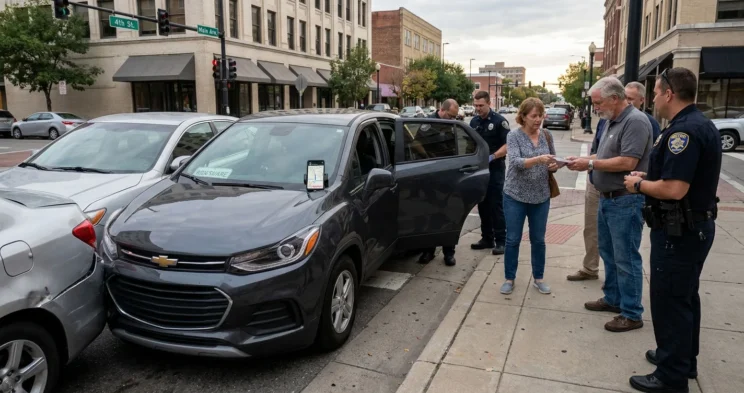
You were heading downtown on I-35 one evening, sharing an Uber Pool with two strangers. Then another car slammed into your side of the vehicle. Now your back hurts, the other riders are filing claims, and you’re wondering if their injuries affect what you can recover. Since you’re one of several injured people pulling from the same insurance, this uncertainty is keeping you up at night.
What’s Uber Pool & Why Does it Complicate Claims?
Uber Pool, now called Uber Share, puts several unrelated passengers in one vehicle on overlapping routes. When a crash happens, each rider becomes a separate injured party with a separate claim, yet all rider claims draw from the same insurance pool.
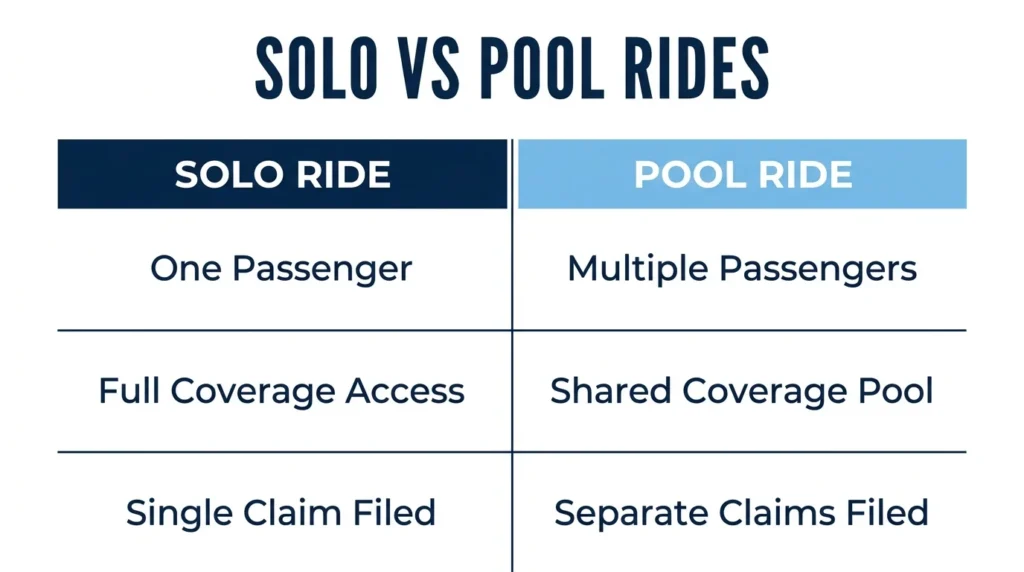
This shared-pool structure makes these crashes different from a standard solo Uber trip. In a solo ride, you’re the only passenger competing for coverage. In a Pool ride, you may be one of three or four people seeking compensation from a single policy.
Fault can land in more than one place too. A third-party driver, your Uber driver, or both can be responsible for the wreck. How fault gets divided changes what each injured passenger can recover, so the details of who hit whom matter to your bottom line.
Uber’s Insurance Coverage in a Pool Crash
Uber carries a $1 million commercial liability policy that applies while you’re riding in the car during an active trip. This coverage exists whether you’re the only rider or one of several Pool passengers.
The $1 Million Per-Occurrence Limit
This $1 million applies per occurrence, meaning it covers the entire crash, not each passenger separately. Texas sets these coverage requirements under Texas Insurance Code § 1954.053, which requires $1 million in liability coverage while a driver is transporting a rider.
So if you and two other passengers are hurt, all three of you draw from that same $1 million pool. When the total of everyone’s injuries stays well under the limit, this rarely affects you. The concern arises when combined damages climb toward or past $1 million.
Texas also requires rideshare companies to register and hold a permit to operate in the state under Texas Occupations Code § 2402.051. This licensing rule brings these companies under state oversight.
When a Third-Party Driver Is at Fault
When another motorist causes the Pool crash, that driver’s liability policy becomes the primary payment source. Uber’s uninsured and underinsured motorist coverage may step in if the at-fault driver carries too little insurance to cover everyone’s injuries.
Multiple passengers filing against the same at-fault driver share that driver’s per-occurrence limit, which is often far smaller than Uber’s $1 million. Fault is not always all-or-nothing either. When responsibility is split, Texas applies its proportionate responsibility rules under Texas Civil Practice and Remedies Code (CPRC) § 33.001, which assigns a percentage of fault to each party.
How Multiple Passenger Claims Interact
Each passenger files their own individual claim. Being one of several injured riders doesn’t mean you share a single claim, and another passenger’s claim doesn’t cancel or absorb yours.
Your claim stands on your own injuries, your own medical records, and your own documented losses. Two passengers in the same crash can recover very different amounts based on how badly each was hurt.
The practical risk shows up only at the edges. If injuries across all passengers are severe and combined damages pass the $1 million limit, individual payouts may shrink through pro-rata distribution or hard settlement negotiation. Insurers know this, and some will push every claimant toward a single global settlement. Accepting a fast offer before you know what the others are claiming can leave money on the table.
What Each Passenger Should Do After a Pool Crash
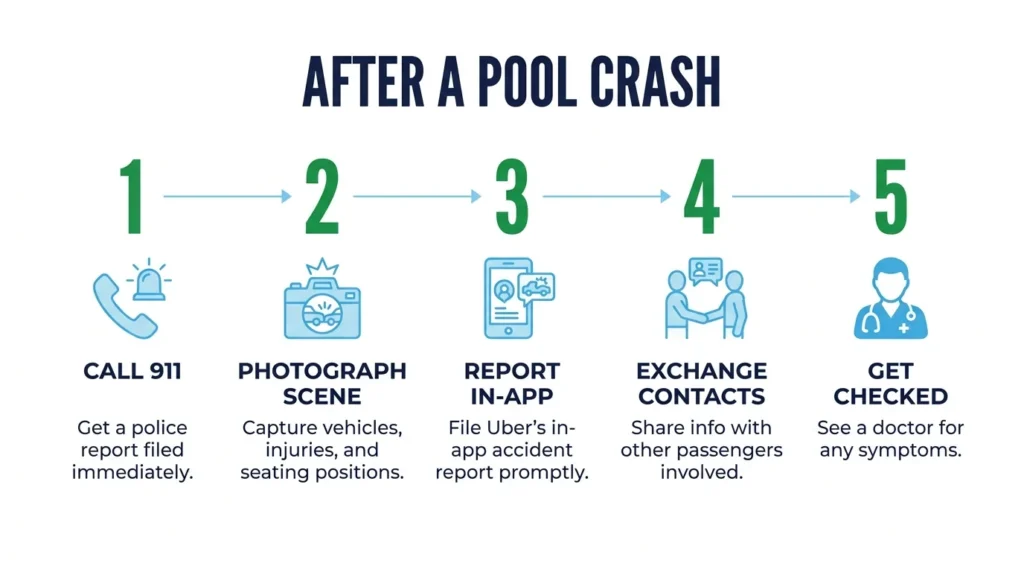
Step 1: Call 911 and get a police report. Make sure your name, your injury, and your presence in the vehicle are recorded. In a Pool ride with several riders, an accurate report keeps your claim from being overlooked.
Step 2: Photograph everything at the scene. Capture all vehicles, your injuries, the seating positions, and your phone screen showing the active Pool trip and route.
Step 3: File an in-app accident report through Uber right away. This creates a timestamped record confirming you were in an active trip when the crash happened.
Step 4: Exchange contact information with the other passengers. You may need to compare claim timelines or coordinate later as everyone’s case moves forward.
Step 5: Get a medical evaluation, even for minor symptoms. Delayed-onset injuries are common after crashes, and gaps in your medical records can lower what your claim is worth.
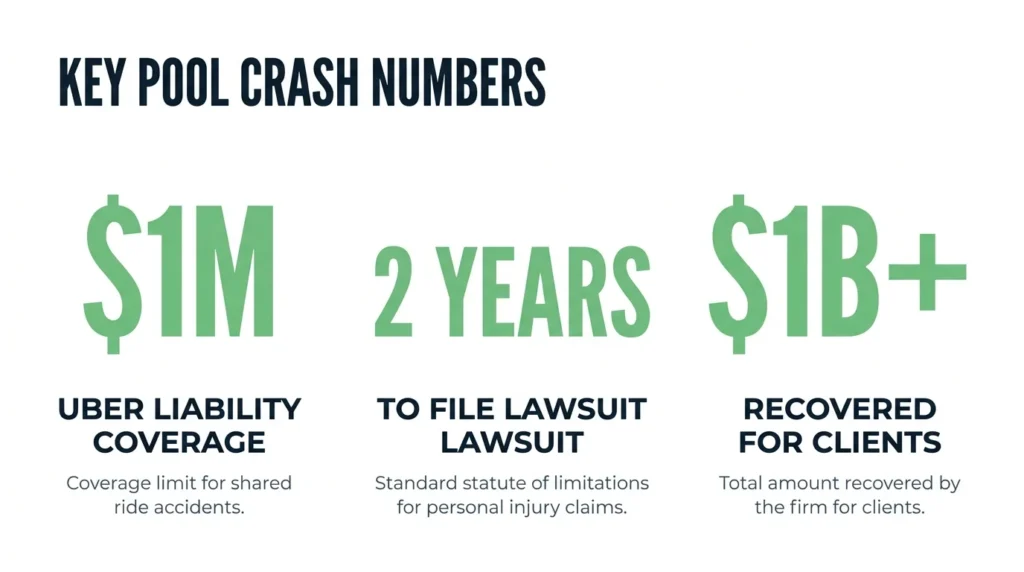
Texas gives most injured passengers two years from the crash date to file a personal injury lawsuit under CPRC § 16.003. If you miss that window, your right to sue is almost always gone.
Talk to a Texas Rideshare Injury Attorney
Just because you’re one of several injured passengers doesn’t mean you have to settle for less. Angel Reyes & Associates has guided injured Texans through rideshare claims for over 30 years, and we know how insurers handle shared-ride crashes with multiple claimants.
We handle Uber Pool accident cases on a contingency basis, which means there’s no fee unless we win. Our team has recovered more than $1 billion for clients across Texas. Reach out to us for a free consultation.
Past results do not guarantee future outcomes.
Frequently Asked Questions
Does your personal auto insurance cover you as a passenger in an Uber Pool crash?
In most cases, no. Personal auto policies typically exclude injuries that occur while you’re riding in a vehicle owned by someone else, and many specifically exclude rideshare trips. Uber’s commercial policy is the primary coverage for passengers during an active trip.
Can you sue Uber directly, or can you only file against its insurance?
You can file a direct claim against Uber as a company, not just against its insurance policy, but this requires showing Uber was independently negligent. Negligent hiring or retaining of a driver with a disqualifying background is the most common route, since Uber’s independent contractor classification blocks a straightforward vicarious liability claim.
If a minor was injured in the Pool crash, does the two-year filing deadline still apply?
Texas tolls the deadline for injured minors under CPRC § 16.001. The two-year clock doesn’t start until the child turns 18, giving most injured minors until their 20th birthday to file a suit.
Once you settle your Pool crash claim, can you reopen it if your injuries get worse?
No. Signing a settlement release closes the claim permanently, even if your condition worsens later. Before accepting any offer, make sure your medical treatment is complete or your doctor has given a clear picture of your long-term prognosis.
About the Authors

Angel Reyes
Writer
Angel L. Reyes, III is the Founder and Managing Partner of Angel Reyes & Associates. A nationally recognized trial attorney and business leader, Angel has helped over 70,000 injury victims recover more than $1 billion since founding the firm in 1993. Named to the Texas Super Lawyers list annually since 2008, Angel brings Wall Street experience, Ivy League education, and a deep commitment to client advocacy. He is a frequent legal commentator and published author with extensive contributions to legal scholarship, trial strategy, and consumer protection.

Graham Griffin
Editor
Graham Griffin is the Web & Content Manager at Angel Reyes & Associates, where he oversees content strategy, AI-powered workflows, a...

Spencer Browne
Reviewer
Spencer Browne is a partner at Angel Reyes & Associates and a Board Certified personal injury trial lawyer with nearly 100 jury trials a...