What Are the Distracted Driving Laws in Texas?


Every article on this site is researched by our internal team, reviewed for legal accuracy against current Texas law, and held to State Bar of Texas advertising standards before publication. We do not publish content that overstates outcomes or makes promises about results.
Learn more about our
editorial standards .
Key Takeaways
- Texas bans texting while driving statewide, with stricter rules near school zones.
- Austin and San Antonio ban the use of nearly all handheld devices while driving citywide.
- A distracted driving citation can support negligence in a civil claim.
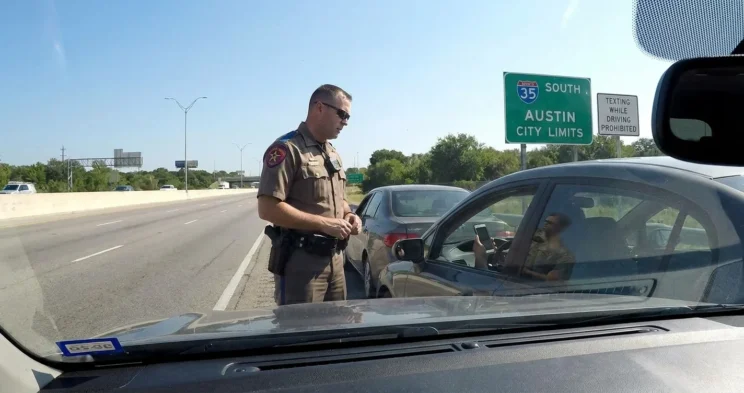
You’re stopped at a light on Guadalupe Street in Austin when the driver behind you plows through the intersection. They’re scrolling on their phone instead of watching the road, and in an instant, you’re witnessing a crash caused by distracted driving.
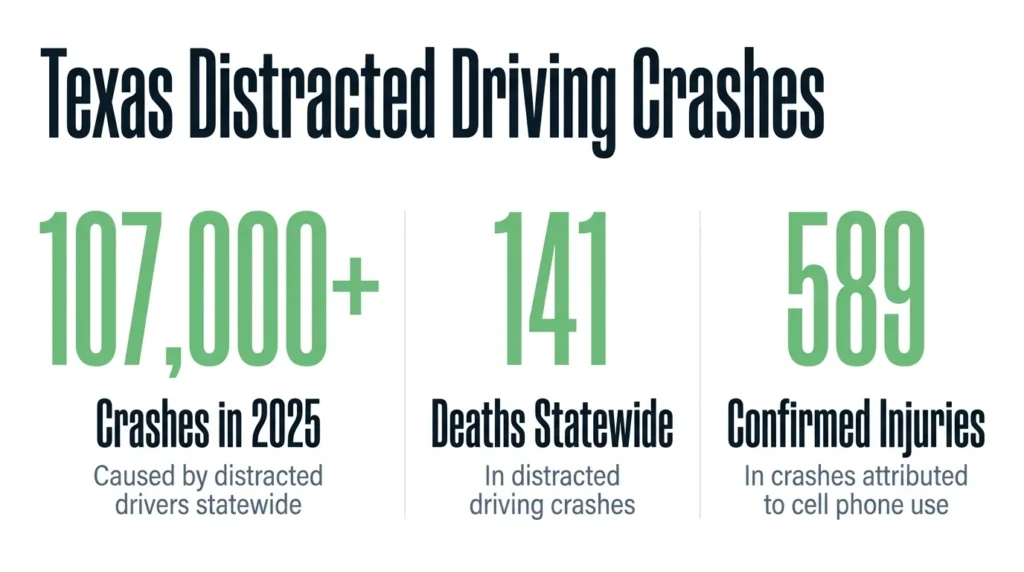
Distracted driving is one of the leading causes of car accidents in Texas. In 2025, it caused more than 107,000 crashes and killed 141 people statewide. So, what does Texas law say about using a phone behind the wheel? Well, Texas employs statewide restrictions on distracted driving, but additional rules may apply, depending on exactly where the crash happened.
What Texas Law Says About Texting and Driving
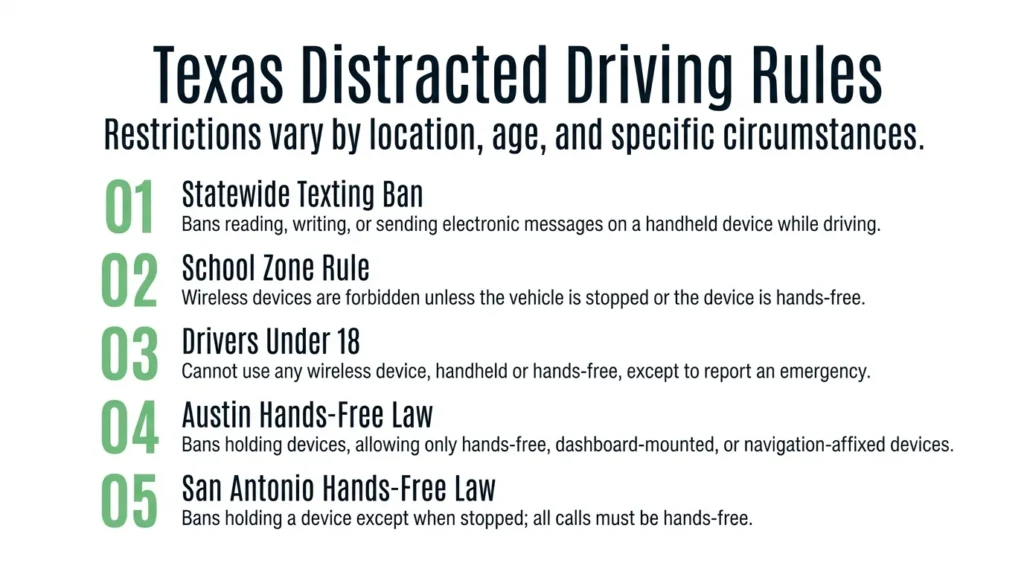
Texas bans reading, writing, or sending electronic messages on a handheld device while driving, under Texas Transportation Code Section 545.4251. The law makes narrow exceptions for hands-free use, GPS navigation, and reporting an emergency.
Police officers routinely cite drivers for texting while driving, without needing to observe another traffic violation first.
School Zone Restrictions
Inside a marked school crossing zone, a driver cannot use a wireless communication device unless the vehicle is stopped or the device is hands-free, under Texas Transportation Code Section 545.425. This restriction is stricter than the general statewide ban.
Rules for Drivers Under 18
A driver younger than 18 cannot use a wireless communication device while driving, regardless of whether it’s handheld or hands-free. Texas Transportation Code Section 545.424 allows only one exception to report an emergency.
Austin and San Antonio Hands-Free Laws
In addition to the statewide rules, Austin and San Antonio ban the use of nearly all handheld devices behind the wheel.
The City of Austin also prohibits even holding a phone or other electronic device while driving, allowing only hands-free devices, devices that are mounted to the dashboard, or devices that are affixed for navigation. San Antonio also restricts drivers from holding a device for any reason while driving, except when the vehicle is stopped. All calls must be hands-free.
These rules apply only within city limits. Whether a specific rule applies to a specific crash depends on exactly where the crash happened. Our breakdown of Texas’s hands-free rules explains this in more detail.
Evidence Used in Distracted Driving Claims
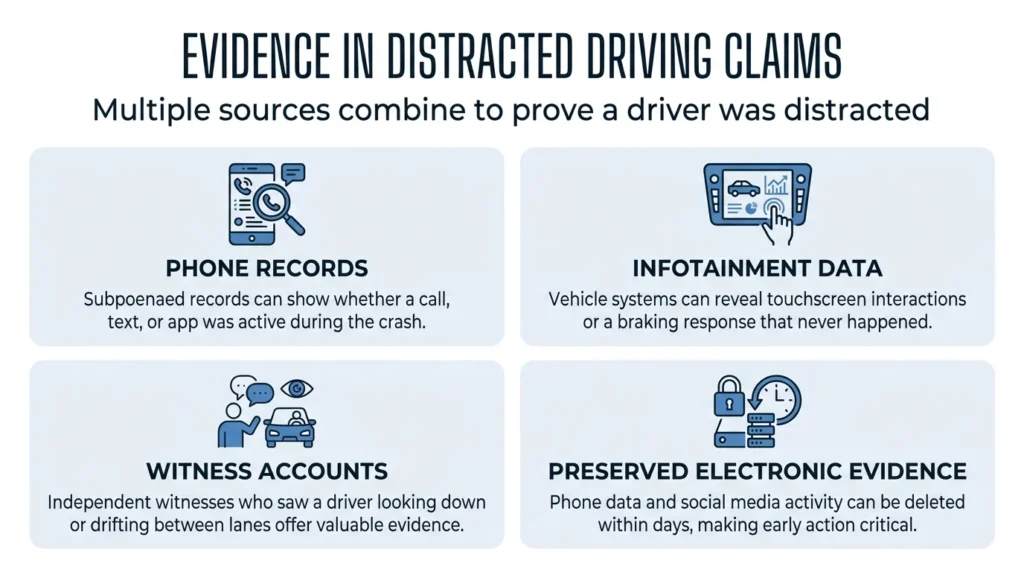
Proving that a driver was distracted rarely comes down to a single piece of evidence. Instead, it usually comes from a combination of sources that rely on each other to form a complete picture.
These sources include:
- Phone records: A subpoena seeking the other driver’s phone records can show whether a call, text, or app was active at the time of the crash.
- Infotainment and event data: A vehicle’s infotainment system or event data recorder can show touchscreen interactions or a braking response that never happened.
- Witness accounts: An independent witness who saw a driver looking down, drifting between lanes, or holding a phone can be valuable evidence that doesn’t depend on the other driver’s version of events.
- Preserved electronic evidence: Phone data and social media activity can be deleted or overwritten within days after the crash, so acting early will help protect your claim.
Texas Distracted Driving Fines Explained
A first offense under the statewide texting ban carries a fine of $25 to $99. A repeat offense costs $100 to $200, and the charge becomes a Class A misdemeanor if the crash caused serious injury or death.
Local fines can be even higher. For example, Austin carries a fine of up to $500 per violation.
Texting Violations and Negligence Per Se
A citation isn’t required to win your claim, but it does help. Texas courts can treat a proven statutory violation (such as violating the texting-while-driving ban) as negligence per se, which presumes that the driver breached their legal duty of care.
As a result, your car accident claim may be easier to prove because you won’t have to argue that the driver was careless, only that they violated a specific law. (Note that the driver can still try to argue this claim.)
How Comparative Fault Affects Your Recovery
Additionally, Texas’s comparative fault rule applies. Under Texas Civil Practice and Remedies Code Section 33.001, your recovery is reduced by your percentage of fault, and if you are found to be more than 50% at fault for the crash, you generally cannot recover damages.
Work with an Attorney on Your Distracted Driving Claim in Texas
If a distracted driver hit you, the specific law they broke and the evidence behind it can determine how strong your claim is. Angel Reyes & Associates has represented Texas crash victims for more than 30 years, including cases built on exactly this kind of evidence.
We work on contingency, which means you pay no fees unless we win your case. Contact us for a free consultation today.
Past results do not guarantee future outcomes.
Distracted Driving FAQs
Is it illegal to read a text message while stopped at a red light in Texas?
No. The statewide ban under Texas Transportation Code Section 545.4251 only applies while the vehicle is in motion, so reading a text message at a red light or in stopped traffic isn’t a violation of the law.
How long do I have to file a claim after a distracted driving crash in Texas?
Texas gives injury victims two years after the date of the crash to file a lawsuit under Texas Civil Practice and Remedies Code Section 16.003. Missing that deadline can dismiss your claim entirely.
Does Austin's hands-free law also apply to bicyclists?
Yes. The City of Austin’s hands-free law restricts phone and device use for drivers and bicyclists alike.
If the other driver was on a hands-free call, does that mean they weren't breaking the law?
Yes, but only if the driver was 18 or older. Texas’s statewide ban and the Austin and San Antonio ordinances all allow hands-free use, but drivers under 18 have no hands-free exception under Texas Transportation Code Section 545.424.
Does the statewide ban cover browsing the internet or looking at photos, or only sending messages?
The ban is limited to reading, writing, or sending an electronic message. Browsing the internet or viewing photos falls outside Texas Transportation Code Section 545.4251, but it can still count as distracted driving in a negligence claim.
About the Authors

Spencer Browne
Writer
Spencer Browne is a partner at Angel Reyes & Associates and a Board Certified personal injury trial lawyer with nearly 100 jury trials across Texas. He focuses on car, truck, and wrongful death cases, with notable verdicts including a landmark win in the Choctaw Casino bus crash case. A recognized speaker and legal educator, Spencer is a member of the American Board of Trial Advocates and has been honored as a Texas Super Lawyer and one of D Magazine’s Best Lawyers in Dallas. He brings deep trial experience and relentless advocacy to every client he represents.

Kyle Nicolas
Editor
Kyle Nicolas is the Web Content & SEO Manager at Angel Reyes & Associates. He has more than 10 years of experience as a marketing co...

Angel Reyes
Reviewer
Angel L. Reyes, III is the Founder and Managing Partner of Angel Reyes & Associates. A nationally recognized trial attorney and business...