What Causes a Truck to Jackknife?


Every article on this site is researched by our internal team, reviewed for legal accuracy against current Texas law, and held to State Bar of Texas advertising standards before publication. We do not publish content that overstates outcomes or makes promises about results.
Learn more about our
editorial standards .
Key Takeaways
- Tractor and trailer jackknifes can start when different axle groups lock up first.
- Rule 393.47 sets limits for brake adjustment to help keep braking balanced across the entire truck.
- Excessive speed, following too closely, or unevenly loaded cargo can also contribute to a jackknife event.
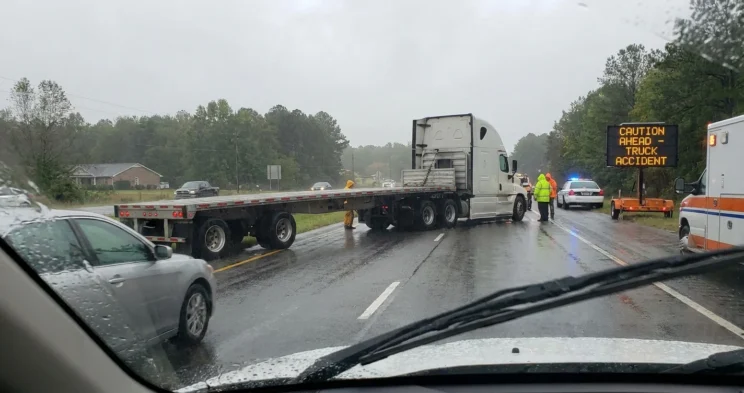
You are driving down a Texas highway when the tractor-trailer ahead of you suddenly begins to fold across the lanes. The trailer swings toward your car, leaving only seconds to react before the impact.
Now, you’re left wondering why the truck jackknifed. Was the truck traveling too fast for the road conditions? Did the driver brake suddenly or make a sharp steering correction? Was there a problem with the brakes, tires, or cargo? Understanding how a jackknife happens can help answer these questions and determine who should be held responsible for the crash.
How Truck Jackknife Crashes Happen
A jackknife happens when a tractor-trailer folds at a sharp angle where the trailer connects to the tractor, causing the two sections to move out of alignment instead of staying in a straight line. The name “jackknife” comes from the shape that the truck creates as it folds in on itself.
Not every skid is a jackknife. A trailer may slide sideways and then straighten itself back out on its own, but a true jackknife occurs when the tractor and trailer remain folded at an angle.
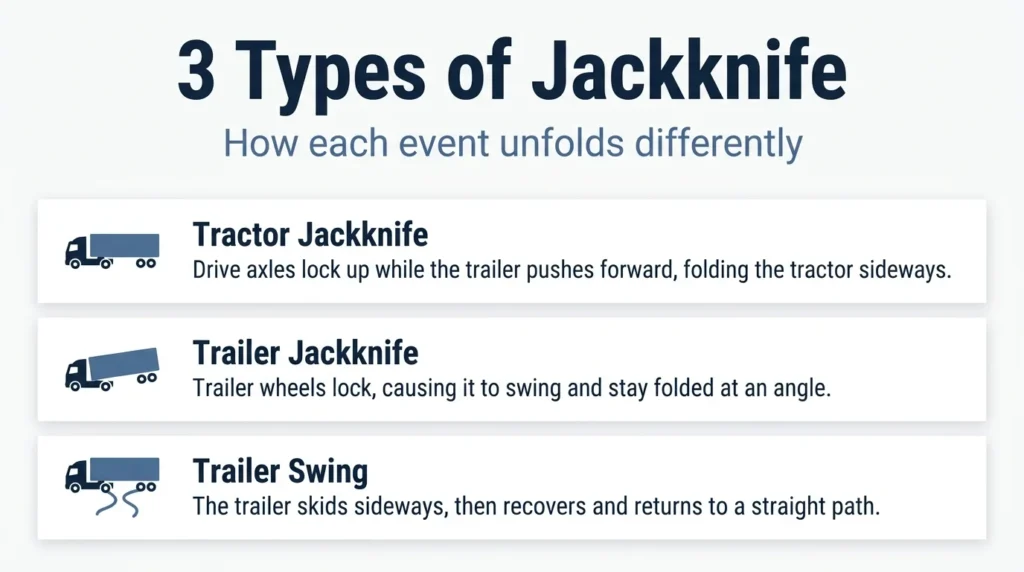
A tractor jackknife, trailer jackknife, and trailer swing can result from different parts of the truck losing traction, and each may have a different cause. Understanding how each event occurs can help explain why a crash happened.
Factors that can play a role include:
- Which axle lost traction first
- Whether the truck’s braking and maintenance systems were properly maintained
- The truck’s speed and following distance
- How the truck’s cargo was loaded
How Brake Problems Can Cause a Tractor Jackknife
A tractor jackknife happens when the truck’s drive-axle wheels lose traction or lock up while the loaded trailer keeps moving forward. The trailer pushes against the tractor through the fifth wheel, causing the back of the tractor to swing sideways and fold toward the trailer. This is more likely to happen when the drive-axle brakes lock up before the brakes on the other axles.
Federal rule 49 CFR 393.40 requires all commercial trucks to have brakes strong enough to safely stop and hold the truck and trailer. The braking system must also include parking and emergency brakes.
If the brakes on one axle are not working properly or are weaker than the others, they may not brake evenly. This can cause those brakes to lock up first. Since this problem is caused by the condition of the tractor’s braking system, a tractor jackknife is often linked to a maintenance issue. Therefore, it is not something a driver can prevent by reacting faster once the jackknife begins.
Trailer Jackknife vs. Trailer Swing
A trailer jackknife happens when the trailer’s wheels lock up, while the tractor keeps moving forward. The trailer then swings sideways, causing its rear end to move out of line with the tractor and creating a sharp angle between them.
Trailer swing may look like a jackknife at first, but it is a shorter event. The trailer skids to one side, often because it is empty or lightly loaded, and then it returns to its normal position as the truck keeps moving forward. Unlike a jackknife, the trailer does not stay folded at an angle.
In simpler terms, the difference is:
- Trailer jackknife: The trailer’s wheels lock up, causing the trailer to swing sideways, and the truck and trailer to remain folded at an angle.
- Trailer swing: The trailer skids sideways but then recovers and returns to a straight path.
Both types of trailer movements can be caused by a braking problem on the axle that locked up first. If the trailer brakes engage too strongly or out of sync with the tractor’s brakes, they can cause the trailer to skid or jackknife.
This is generally a maintenance issue involving the trailer’s braking system, rather than something that can be fixed by the driver as it happens.
Federal Brake Standards for Trucking Companies
Three federal rules set the basic brake safety standards that help prevent braking problems from turning into a jackknife:
- 49 CFR 393.40 requires all commercial trucks to have brakes that are strong enough to safely stop and hold the truck and any trailer it is pulling.
- 49 CFR 393.47 sets limits for how far air brake pushrods can move when the brakes are applied. If a brake moves beyond this limit, then it is considered to be out of adjustment, even if the brake has not completely failed.
- 49 CFR 396.3 requires trucking companies to regularly inspect, repair, and maintain all the vehicles they operate, and to keep records of this maintenance.
A brake that is out of adjustment under 393.47 may show a problem with one specific truck, while repeated brake problems may point to a larger maintenance issue under 396.3. In either case, the problem may point to the party responsible for maintaining the brakes, rather than the driver who was behind the wheel when the crash happened.
These rules apply to all interstate trucking companies traveling through Texas, just as they do anywhere else in the country.
Speed, Following Distance, and Load
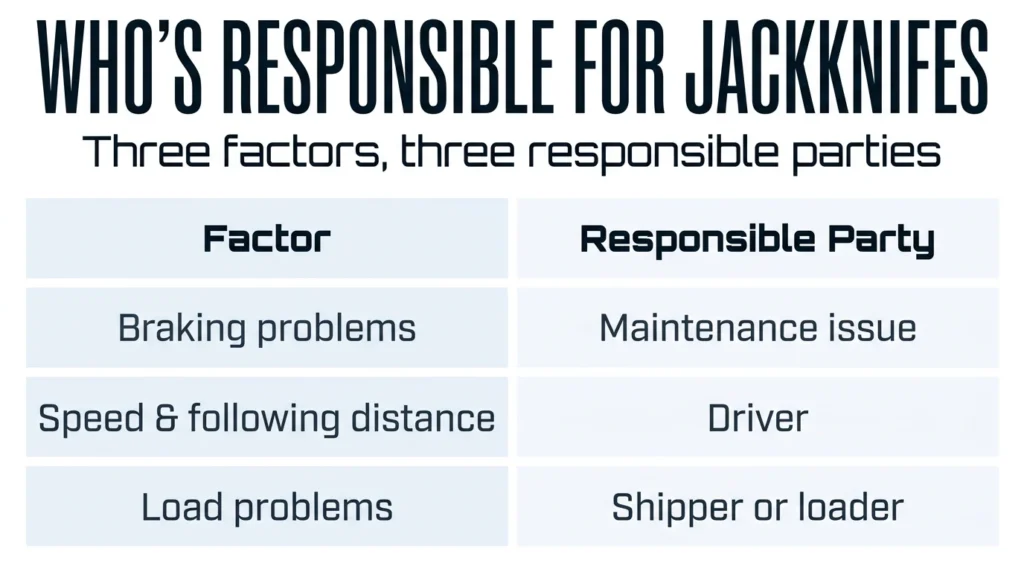
Even well-maintained brakes can be overwhelmed by how a truck is driven or loaded. The driver controls factors such as speed and following distance, and under 49 CFR 392.14, drivers are required to use extreme caution and reduce their speed when road conditions such as snow, ice, fog, or rain make driving more dangerous. A driver who is going too fast or following too closely has less time and space to slow down gradually, which can lead to harder braking and increase the chances that a single axle’s brakes will lock up before the others.
Load distribution is generally the responsibility of the shipper or party who is loading the trailer. Under 49 CFR 393.100, cargo must be secured so that it cannot shift enough to affect the truck’s stability or handling. Uneven weight across the axles can also change how much braking force each axle can handle before the wheels lock up. A trailer that is loaded too heavy in the front or back (or whose cargo shifts during braking) can cause an axle to lock up, even if all the brakes are correctly adjusted.
In other words:
- Braking problems may trace back to maintenance issues.
- Speed and following distance may trace back to the driver.
- Load problems may trace back to the shipper or loader.
Three Types of Evidence in a Jackknife Crash
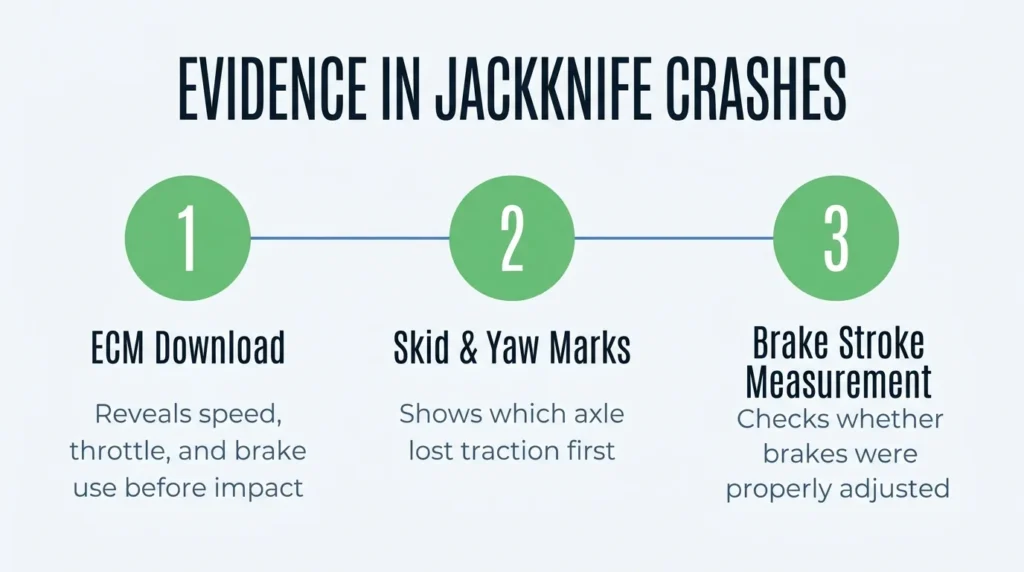
After a jackknife, three kinds of evidence can help show what caused the crash:
- An engine control module (ECM) download can provide important information about what happened just before the jackknife. This includes the truck’s speed, throttle position, and brake use. This data can be overwritten as the truck remains in operation, so it is important to preserve it as soon as possible after the crash.
- Skid and yaw mark analysis examines the tire marks left on the road after a crash. The direction and shape of the tire marks can help show which axle lost traction first, and how the truck and trailer moved as the jackknife developed.
- Brake stroke measurement checks how far a brake pushrod moves when the brakes are applied. This test can show whether the brakes on a specific axle were properly adjusted or exceeded the legal limit under 393.47.
Together, these three types of evidence can help show what caused the jackknife.
For example, if an axle shows both locked-wheel skid marks and improperly adjusted brakes, then it may point to a maintenance problem. If the brakes were properly adjusted, but the ECM shows excessive speed or hard braking, then the evidence may point to how the truck was loaded, or how it was being driven at the time of the crash.
Talk With Angel Reyes & Associates About Your Texas jackknife crash
If you or a loved one were injured in a Texas jackknife crash, you may be left facing serious injuries, mounting expenses, and questions about who is responsible.
Angel Reyes & Associates has represented truck crash victims for over 30 years on a contingency basis, which means you pay no fee unless we win your case. With more than $1 billion recovered for our clients, including victims of truck crashes across Texas, our attorneys can help investigate what caused the jackknife and pursue the compensation you deserve.
Contact us today for a free case review.
Past results do not guarantee future outcomes.
Jackknife FAQs
Do anti-lock brakes prevent a truck from jackknifing?
Anti-lock brakes help prevent wheels from locking up during hard braking, which can reduce the risk of tractor and trailer jackknifes. However, anti-lock brakes do not eliminate the risk completely. Poorly adjusted brakes, an unevenly loaded trailer, or excessive speed compared to road conditions can still cause an axle to lose traction and cause a jackknife.
Why do empty or lightly loaded trailers swing or jackknife more easily?
An empty or lightly loaded trailer has less weight pressing its tires against the road, which reduces traction. This makes it easier for the trailer’s wheels to lock or slide during braking or in strong crosswinds. This is one reason that trailer swing is more common with empty trailers. A lighter trailer can lose traction even if its brakes are working properly.
Is trailer swing dangerous even though it self-corrects?
Trailer swing is less severe than a jackknife because the trailer usually returns to its normal position, instead of staying folded. However, it can still be dangerous. While the trailer is swinging, it can move into another lane or hit a nearby vehicle before the driver can regain control. The same loss of traction that causes a jackknife can also cause a trailer swing. The difference is that the trailer is able to recover before fully folding.
Can a truck jackknife even if every brake is within its legal adjustment limit?
Yes. Brake adjustment is only one possible cause. Driving too fast for road conditions, following too closely, or carrying shifting cargo can also cause an axle to lock during hard braking. This is why a jackknife investigation should look at speed, cargo, and braking conditions, instead of assuming that the crash was caused by a mechanical problem.
About the Authors

Angel Reyes
Writer
Angel L. Reyes, III is the Founder and Managing Partner of Angel Reyes & Associates. A nationally recognized trial attorney and business leader, Angel founded the firm in 1993, which has gone on to help over 70,000 injury victims recover more than $1 billion. Named to the Texas Super Lawyers list annually since 2008, Angel brings Wall Street experience, Ivy League education, and a deep commitment to client advocacy. He is a frequent legal commentator and published author with extensive contributions to legal scholarship, trial strategy, and consumer protection.

Kyle Nicolas
Editor
Kyle Nicolas is the Web Content & SEO Manager at Angel Reyes & Associates. He has more than 10 years of experience as a marketing co...

Angel Reyes
Reviewer
Angel L. Reyes, III is the Founder and Managing Partner of Angel Reyes & Associates. A nationally recognized trial attorney and business...