What Do Texas Crash Report Codes Mean?


Every article on this site is researched by our internal team, reviewed for legal accuracy against current Texas law, and held to State Bar of Texas advertising standards before publication. We do not publish content that overstates outcomes or makes promises about results.
Learn more about our
editorial standards .
Key Takeaways
- Read each Texas crash report code inside its field, using the code sheet for your crash date.
- Contributing factor and Unit 1 entries reflect the officer's view, not a civil fault verdict.
- Compare every disputed code with photos, vehicle damage, witnesses, and your medical records.
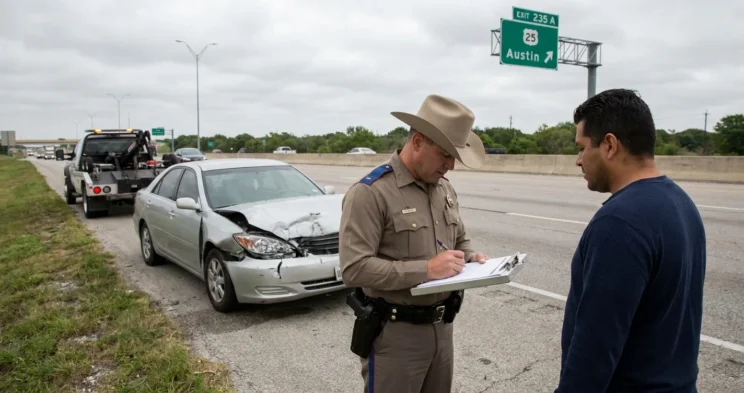
The car accident happened, and now you need your crash report. But what do the codes on these reports represent?
Texas crash report codes are shorthand for specific fields on the CR-3. When your report arrives filled with unfamiliar numbers and letters, the TxDOT code sheet and officer instruction manual explain what they mean.
A code records information or an officer’s investigative opinion. It does not decide who is legally at fault, what your injuries mean, or what your claim is worth. You get the most from the report when you read it against the photos, vehicle damage, witness accounts, and medical records.
Where Do You Find the Meaning of Texas Crash Report Codes?
The meanings come from the TxDOT code sheet for your crash date, read together with TxDOT’s official instructions to officers. TxDOT’s crash report forms page lists the 2023 CR-3 and CR-3 code sheet (CR-3CS) for crashes on or after April 1, 2023. It also links the current officer manual, CR-100 version 29.0, revised June 4, 2025, which defines each field.
Why an Officer Prepares the Report
Under Texas Transportation Code §550.062, an officer investigating a collision in the regular course of duty must prepare a report when the crash causes injury, death, or apparent damage of at least $1,000 to any one person’s property. TxDOT’s crash records guidance confirms that the report must be filed electronically by the 10th day after the collision.
That deadline belongs to the officer. It is not the deadline for an injury lawsuit, and it does not promise that you can get a copy on any particular day.
How to Read a Texas Crash Report in Order

Read the report in this order:
- Confirm your crash date and use the matching TxDOT code sheet.
- Find your unit and person entries so you know which rows describe you, your vehicle, and your passengers.
- Read each code inside its own field. The same number can mean different things in different lists.
- Read the narrative and diagram, which often explain what the codes cannot.
What Do Contributing Factor Codes Say?

Contributing factor codes record the conditions the officer identified as factors, or possible factors, in the crash. They do not establish civil fault. Charges are recorded separately.
These entries appear in CR-100 code-sheet list 38:
- 4 – Changed lane when unsafe
- 15 – Disregarded stop-and-go signal
- 16 – Disregarded stop sign or light
- 20 – Driver inattention
- 22 – Failed to control speed
- 35 – Failed to yield right-of-way at stop sign
- 60 – Unsafe speed
- 61 – Speeding over the limit
Contributing vs May-Have-Contributed
The report has two factor columns. A contributing entry reflects a factor the officer identified. A may-have-contributed entry records an existing condition whose contribution to the crash is uncertain. Reading the second column as a firm finding overstates what the officer recorded.
Speed Codes That Are Easy to Confuse

Code 22 does not mean speeding over the limit. Code 61 covers that. Code 60, unsafe speed, applies to a driver going under the posted limit but too fast for conditions, such as rain on I-35 or a flash-flooded frontage road.
Testing a Factor Code Against the Evidence
In a hypothetical crash, the report lists code 4, changed lanes when unsafe, for the other driver. Scene photos can show the lane markings, and damage to the side of your vehicle can match a merge rather than a rear-end impact. Witnesses who saw the movement can confirm or contradict the entry.
What Do the Injury Severity Codes Mean?
Injury severity codes classify what the report records about each person at the scene. They do not predict a diagnosis or a recovery period, and they do not set the value of a claim.
The current CR-100 lists these values for list 16:
- K – Fatal injury
- A – Suspected serious injury
- B – Suspected minor injury
- C – Possible injury
- N – Not injured
- 99 – Unknown
Code C can include pain without visible wounds. Compare the entry with medical records.
An N entry, or light vehicle damage, does not prove that someone was unhurt.
Older forms or reproduced code sheets may use different wording for B and K. The June 2025 manual updated those labels, so check the code sheet that applies to your crash date. Always confirm that you are reading the correct person’s row, then compare that entry with your medical records rather than drawing conclusions from the code alone.
How Do Unit Numbers & Vehicle Damage Fields Work?
A unit number identifies a participant in the crash. The unit description classifies what that participant is.
Damage fields describe the direction, area, and severity of damage to a vehicle. None of these fields is a fault percentage or an injury score.
Unit Numbers & Unit Descriptions
Unit-description list 5 uses these values: 1 motor vehicle, 2 train, 3 pedalcyclist, 4 pedestrian, 5 motorized conveyance, 6 towed, pushed, or trailer, 7 non-contact, and 98 other, with an explanation in the narrative.
TxDOT recommends that officers number the motor vehicle regarded as the proximate cause as Unit 1. This reporting convention reflects the officer’s view; it is not a binding legal finding of fault. Trailers receive their own unit numbers, so a tractor-trailer may appear as more than one unit.
Reading the Damage Code
Damage entries follow XX-ABC-Y. XX is the optional clock-direction of force, ABC identifies the damaged area with letters, and Y rates severity from 0 to 7. The rating is not a repair estimate.
The manual’s own example, 12-FR-0, describes front-right contact without vehicle damage. The report provides two ratings. Rating 1 holds the more severe damage area, and rating 2 holds the next; consult the narrative for additional areas.
To check these entries, confirm that you are reading the correct unit. Then compare the coded area with photographs of every side of every vehicle, not only the most visible dent. A code that points to the front while your photos show heavy side damage deserves a closer look.
How Much Weight Does a CR-3 Carry in an Injury Case?
A CR-3 is a starting point for understanding a crash. But a code, a citation, or a missing citation does not settle who is responsible in a civil case. Whether the report can be used as evidence and how persuasive it is are two separate questions.
What the Texas Rules of Evidence Say
Texas Rule of Evidence 803(8) creates a hearsay exception for qualifying public records. In a civil case, that can include factual findings from a legally authorized investigation, subject to the rule’s trustworthiness condition. The rule treats criminal cases differently.
Rule 803(8) is not blanket approval for every statement in a CR-3. An embedded witness statement may present another layer of hearsay. Under Rule 805, each hearsay layer needs its own qualifying basis.
Rule 902(4) covers authentication of certified copies of public records. Proving a copy is genuine is different from proving its contents are true.
Comparing a Disputed Entry With the Evidence
If an entry looks wrong, a careful, organized approach helps:
- Identify the correct unit and person before assigning any entry to yourself.
- Write down the exact entry you believe is wrong, including its field and code.
- Gather the matching evidence, such as scene photos, lane markings, vehicle damage, witness accounts, and medical records.
- Bring the discrepancy and supporting materials to the investigating agency or an attorney for review.
Be precise about what each piece of evidence shows. For a signal entry, a photo of the intersection shows the lights and their position. It does not show what color the signal was at the moment of impact. A witness who personally watched the light can address its color at impact.
Raising a disagreement does not guarantee the agency will amend the report, and a corrected code does not guarantee compensation.
Get Help Reading Your Texas Crash Report
Angel Reyes & Associates can help you compare your crash report with the photos, vehicle damage, and witness accounts behind its entries.
Contact Angel Reyes & Associates for a free consultation to walk through your report and your options. Our attorneys are here to help.
Past results do not guarantee future outcomes.
Texas Crash Report Code FAQs
Does Unit 1 mean the officer found that driver legally at fault?
No. TxDOT recommends labeling the motor vehicle regarded as the proximate cause Unit 1, so the number can reflect the officer’s view, but it is not a binding civil fault finding. Read the narrative and compare the report with the other crash evidence.
How long should you keep a Texas crash report after an accident?
It is generally useful to keep the CR-3 with your insurance correspondence, photographs, medical records, repair documents, and other accident-related records for as long as the claim or potential legal matter remains unresolved.
Can insurance companies use Texas crash report codes when evaluating a claim?
Insurance adjusters may consider information in a crash report, including coded observations and contributing factors, but the codes are only one source of information and can be evaluated alongside other evidence.
About the Authors

Angel Reyes
Writer
Angel L. Reyes, III is the Founder and Managing Partner of Angel Reyes & Associates. A nationally recognized trial attorney and business leader, Angel founded the firm in 1993, which has gone on to help over 70,000 injury victims recover more than $1 billion. Named to the Texas Super Lawyers list annually since 2008, Angel brings Wall Street experience, Ivy League education, and a deep commitment to client advocacy. He is a frequent legal commentator and published author with extensive contributions to legal scholarship, trial strategy, and consumer protection.

Graham Griffin
Editor
Graham Griffin is the Web & Content Manager at Angel Reyes & Associates, where he oversees content strategy, AI-powered workflows, a...

Angel Reyes
Reviewer
Angel L. Reyes, III is the Founder and Managing Partner of Angel Reyes & Associates. A nationally recognized trial attorney and business...