What Do These Trucking Terms Mean in an Injury Claim?


Every article on this site is researched by our internal team, reviewed for legal accuracy against current Texas law, and held to State Bar of Texas advertising standards before publication. We do not publish content that overstates outcomes or makes promises about results.
Learn more about our
editorial standards .
Key Takeaways
- Learn what common trucking terms mean after a crash.
- See which federal regulations and Texas laws govern trucking terms and safety requirements.
- Understand how inspection, maintenance, and hours-of-service records can explain what happened in a truck crash.
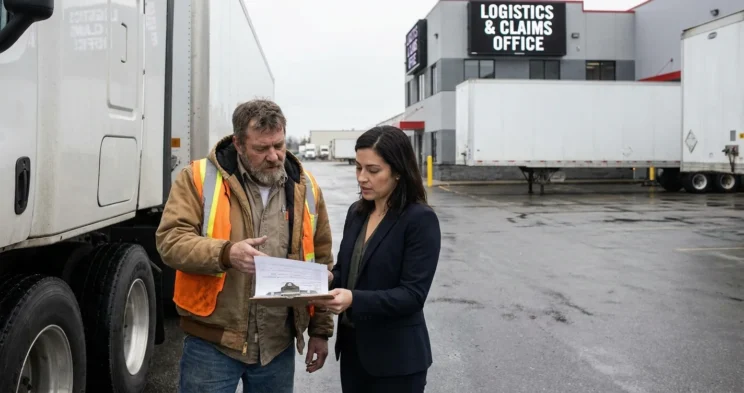
After an 18-wheeler crash on I-35, you may find yourself reading police reports, inspection records, and insurance documents filled with words you have never heard before. Suddenly, you’re trying to understand phrases like “fifth wheel,” “hours of service,” and “out of service.”
In a Texas truck accident claim, these terms are more than just industry jargon. Each can point to a federal safety rule, Texas requirement, or important piece of evidence for your claim.
This trucking terms glossary will explain what each term means so that you can understand the definition and why the term is important. This guide will focus specifically on trucking terminology so that you can find the language most relevant to your claim.
Coupling and Trailer Safety Terms
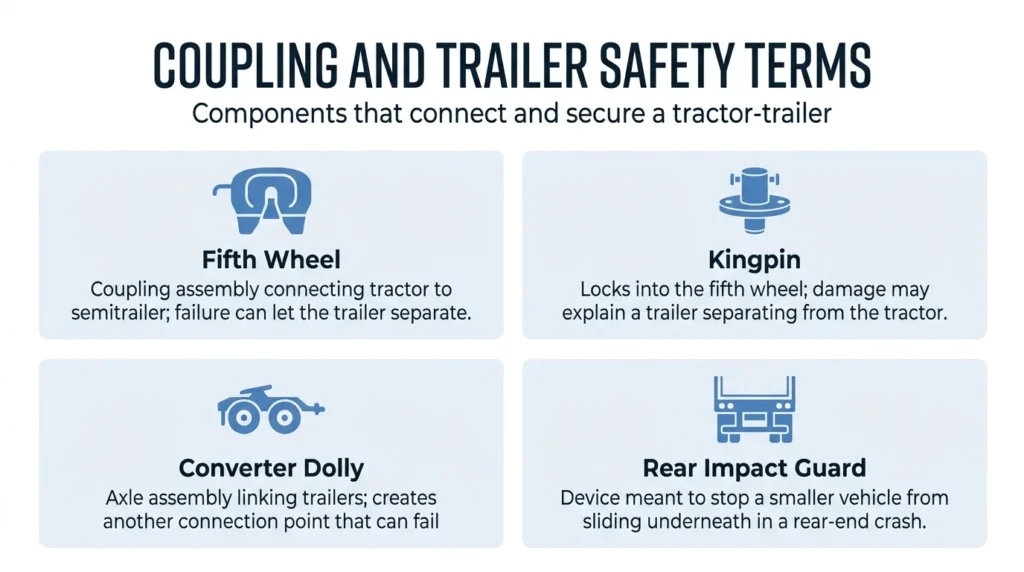
49 § CFR 393.70 sets requirements for coupling devices and towing methods, including these terms:
- Fifth wheel: This is the coupling assembly that connects a tractor to a semitrailer. The fifth wheel must be securely attached to the tractor’s frame and designed to prevent the coupling from shifting. The upper and lower halves must both be properly secured. If the fifth wheel fails, then the trailer can separate from the tractor, instead of moving with it.
- Kingpin: This is the metal pin on a semitrailer that fits into the tractor’s fifth wheel and locks into place. It is a key part of the coupling system protected by locking requirements. If the kingpin is worn, damaged, or improperly secured, then it may explain how the trailer separated from the tractor.
- Converter dolly: This is an axle assembly that allows a semitrailer to be connected to and pulled by another trailer. Its tow-bar and locking system must meet federal safety requirements. In a combination involving multiple trailers, the converter dolly creates another connection point that can fail and cause a trailer to separate.
- Rear impact guard: The rear impact guard (or underride guard) is a safety device attached to the rear of certain trailers and semitrailers. It is designed to help prevent a smaller vehicle from sliding underneath the trailer in a rear-end crash.
Coupling devices are also specifically listed on the driver vehicle inspection report required by 49 CFR § 396.11. These reports can help show whether the coupling system was inspected and whether any problems were reported.
Hours of Service Terms
Hours of service are federal rules that limit how long a commercial driver can drive and work. Hours-of-service records can help show whether a driver had been on the road or on duty longer than federal rules allowed before the crash.
49 CFR § 395.3 sets the driving limits for drivers carrying property, while 49 CFR § 395.2 defines the key terms used to calculate the driving limits, including:
- 11-hour rule: A property-carrying commercial driver may drive for a maximum of 11 hours after meeting the required off-duty period.
- 14-hour window: A property-carrying commercial driver may not drive after being on duty for 14 consecutive hours. The driver must have at least 10 consecutive hours off duty before starting a new 14-hour window.
- 30-minute break: A driver generally may not continue driving after more than 8 hours of driving time without taking at least a 30-minute break from driving. The break may be off duty, in the sleeper berth, or on duty if the driver is not driving.
- 60/70-hour limit: A driver may not be on duty for more than 60 hours in 7 consecutive days if the carrier does not operate every day, or 70 hours in 8 consecutive days if the carrier operates every day.
- Electronic logging device (ELD): This is a device that records a commercial driver’s driving and duty status information electronically.
- Record of duty status: This is the record of a driver’s work and driving hours required by 49 CFR § 395.8. Most drivers who are required to keep these records must use an ELD, subject to limited exceptions. The ELD requirement took effect for covered drivers on December 18, 2017.
Cargo Securement Terms
Cargo securement refers to how a load is contained and held in place on a commercial vehicle. Federal rules set specific requirements for how cargo must be contained and secured. 49 CFR § 393.100 applies to trucks, truck tractors, semitrailers, full trailers, and pole trailers. The rule requires cargo to be loaded and secured so that it does not leak, spill, blow away, or fall from the vehicle. It must also be contained or secured well enough to prevent shifting that could affect the vehicle’s stability or handling.
The following are terms related to cargo securement:
- Cargo securement system: This is the combination of vehicle structure, tiedowns, blocking, and bracing used to keep cargo safely in place.
- Tiedown: This is a strap, chain, wire rope, or similar device used to secure cargo to a vehicle.
- Load shift: This is the process of cargo moving from its original position while the vehicle is in transit. Cargo must be secured so that it does not shift in a way that could affect the vehicle’s stability or handling.
Carrier Authority
Under 49 U.S.C. § 13902, certain motor carriers must meet federal requirements before operating, including requirements related to safety, financial responsibility, and registration.
These terms help identify the companies involved in operating and transporting goods with the truck:
- Operating authority: This is the federal authority that allows a motor carrier to provide certain types of interstate transportation for compensation. The carrier must stay within the limits of the authority it has been granted.
- MC number: This is the identification number associated with a motor carrier’s federal operating authority.
- USDOT number: This is the identification number issued by FMCSA to certain motor carriers. Under 49 CFR § 390.21, the number must generally appear on both sides of the vehicle, preceded by “USDOT.” These markings can help investigators identify the carrier responsible for a truck shown in a crash photograph.
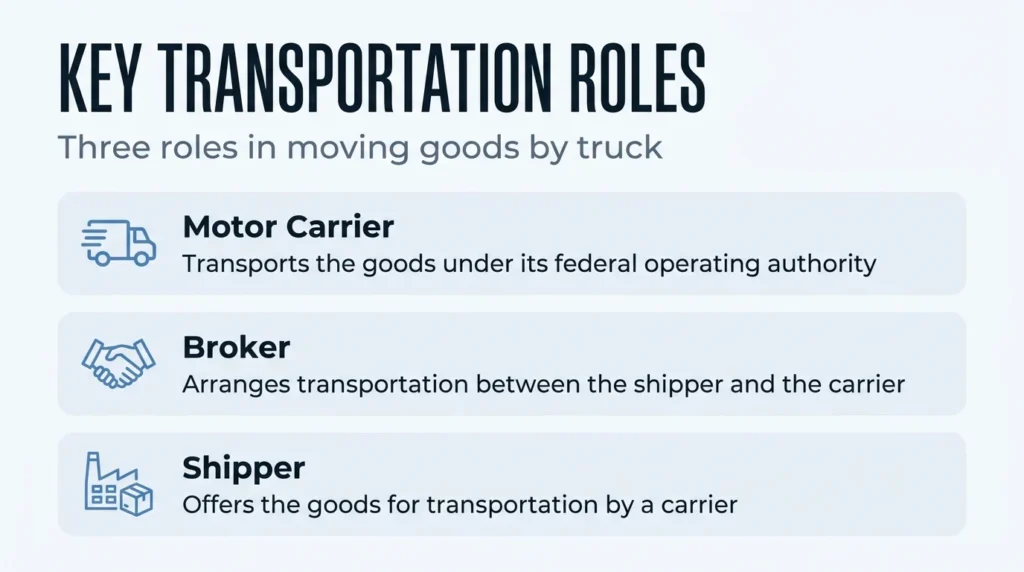
- Motor carrier, broker, and shipper: These are three different roles in the transportation process. A motor carrier transports the goods. A broker arranges transportation between the shipper and carrier. A shipper is the person or company that offers the goods for transportation.
- Owner-operator: This is a driver who owns or leases the truck they operate and may work under another motor carrier’s operating authority.
- Lease agreement: Under 49 CFR § 376.12(c), a written lease must state that the motor carrier leasing the equipment has exclusive possession, control, and use of the equipment during the lease. The carrier must also assume responsibility for operating the equipment. The lease can therefore help identify which carrier was responsible for the truck.
Out of Service and Inspection Record Terms
Federal regulations also govern what happens when a truck or its equipment is found to be unsafe. The following terms describe out-of-service orders, inspection reports, and maintenance records that may appear after a truck crash:
- Out-of-service order: A vehicle out-of-service order prevents the vehicle from being operated until the safety problem is corrected. A driver out-of-service order prevents the driver from operating a commercial motor vehicle until the applicable requirements are met.
- Driver/vehicle examination report: This is the report that is completed after a roadside inspection of a commercial motor vehicle and its driver. The carrier must complete and return the Motor Carrier Certification of Action Taken section within 15 days when the rule applies.
- Driver vehicle inspection report (DVIR): Under 49 CFR § 396.11, a driver must report any defect or problem they find or are told about that could affect the vehicle’s safe operation or cause a mechanical breakdown. The report covers important safety components, including brakes, steering, lights, tires, wheels, coupling devices, and emergency equipment.
- Systematic maintenance. Under 49 CFR § 396.3, motor carriers and intermodal equipment providers must regularly inspect, repair, and maintain the vehicles they control. The vehicle’s parts and equipment must be kept in safe and proper working condition at all times.
Talk to a Lawyer About Your Texas Truck Accident Case
The records that may help explain a truck crash will not remain available indefinitely. Records of duty status can be discarded after six months, while inspection reports may be discarded after three months. It’s important to act before these records are lost.
Angel Reyes & Associates has guided injured Texans for more than 30 years, and we have recovered over $1 billion for our clients. We handle truck accident cases throughout Texas and remotely. We work on contingency, which means you pay no fee unless we win your case. Consultations are free, our team is reachable 24/7, our staff are also available to speak with you in Spanish.
If unfamiliar trucking terms appeared in your crash report or an insurance letter, then request a free consultation today to discuss what they mean for your case.
Past results do not guarantee future outcomes.
Trucking Terms FAQs
How can I tell whether a definition in a trucking glossary is still current?
Start by checking the date the page was last reviewed. This guide was reviewed on August 21, 2026. Without a review date, it is difficult to tell how current the information is. Some rules in this area can change and are especially worth checking against the current law before relying on them. These include the roadside inspection standards, the Texas rule adopting federal motor carrier safety regulations for intrastate carriers, federal minimum financial responsibility amounts, and any amendments to Texas Civil Practice and Remedies Code Chapter 72.
Who holds the records these terms come from: the driver, the trucking company, or a state agency?
The motor carrier is generally responsible for keeping these records. The carrier must keep records of duty status and supporting documents. The carrier must also keep the driver vehicle inspection report, along with the required repair and review certifications. Maintenance records must also be kept where the vehicle is housed or maintained. This is important after a crash because a driver may create the record, but the carrier is generally responsible for preserving it under the regulations. This means a written preservation request should usually be sent to the carrier.
Are there Texas-specific versions of any of these terms that differ from the federal ones?
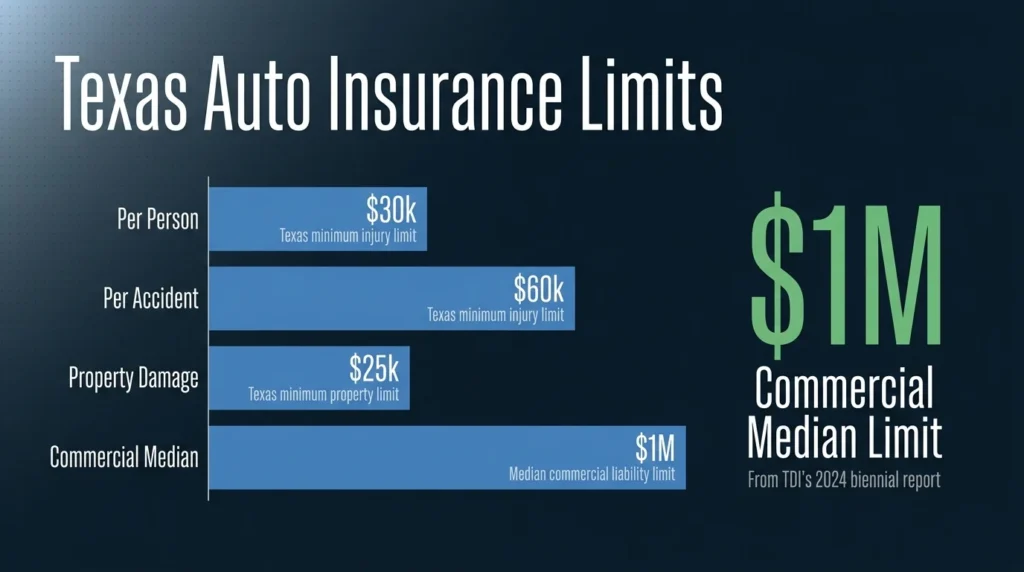
Two areas are specifically governed by Texas law. The first is motor carrier registration. Under Texas Transportation Code § 643.051, a motor carrier generally cannot operate a commercial motor vehicle on a Texas road or highway unless it is registered with the Texas Department of Motor Vehicles. The carrier is also required to maintain liability insurance in an amount set by department rules. The second area is size and weight limits. Under Texas Transportation Code § 621.101, the limits are 20,000 pounds for a single axle, 34,000 pounds for a tandem axle, and 80,000 pounds for two or more consecutive axles, including applicable enforcement tolerances. Outside these areas, most of the terms in this guide come from federal regulations, which Texas has adopted by reference for most intrastate motor carrier operations.
About the Authors

Angel Reyes
Writer
Angel L. Reyes, III is the Founder and Managing Partner of Angel Reyes & Associates. A nationally recognized trial attorney and business leader, Angel founded the firm in 1993, which has gone on to help over 70,000 injury victims recover more than $1 billion. Named to the Texas Super Lawyers list annually since 2008, Angel brings Wall Street experience, Ivy League education, and a deep commitment to client advocacy. He is a frequent legal commentator and published author with extensive contributions to legal scholarship, trial strategy, and consumer protection.

Kyle Nicolas
Editor
Kyle Nicolas is the Web Content & SEO Manager at Angel Reyes & Associates. He has more than 10 years of experience as a marketing co...

Angel Reyes
Reviewer
Angel L. Reyes, III is the Founder and Managing Partner of Angel Reyes & Associates. A nationally recognized trial attorney and business...