What Does Vehicle Damage Reveal About a Crash?


Every article on this site is researched by our internal team, reviewed for legal accuracy against current Texas law, and held to State Bar of Texas advertising standards before publication. We do not publish content that overstates outcomes or makes promises about results.
Learn more about our
editorial standards .
Key Takeaways
- Crush profile analysis reveals a crash impact direction, PDOF, and energy absorbed.
- Texas crash reports code vehicle damage using a clock-based direction and severity scale.
- Matched paint transfer and damage patterns can resolve disputed contact claims.
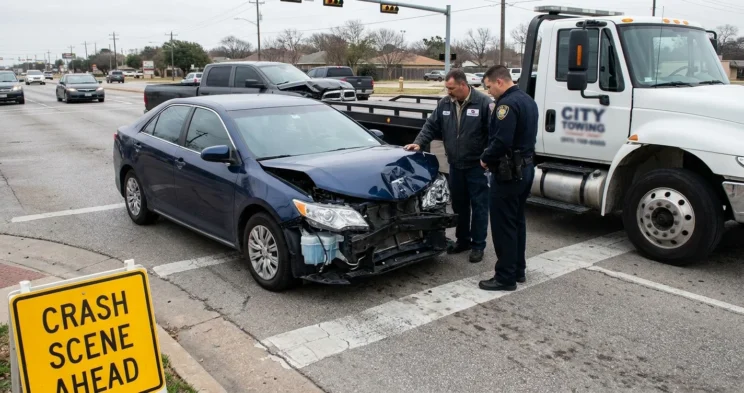
You’re standing on the shoulder of I-35 looking at your crumpled bumper, and the other driver is already telling the officer it never happened the way you remember it. Your account is clear. Theirs does not match the damage in front of you.
When two stories conflict, the vehicles themselves become witnesses. Every dent, scrape, and crushed panel carries information about how a crash unfolded: what struck what, from which direction, and how hard. Reconstructionists read this vehicle crash damage information through crush profile analysis, and in Texas it follows a standardized coding system that turns physical damage into evidence a claim can rely on.
What Crush Profile Analysis Measures
Crush profile analysis reads the shape, depth, and spread of the deformation left on a vehicle’s damaged face to determine how that vehicle was struck. It is not a single depth reading taken at one spot.
Analysts measure crush at multiple points across the damaged width, along with crush depth, crush width, vertical deformation, and structural intrusion where it applies. Those measurements are compared against the undamaged dimensions of the same make and model to isolate what the crash actually changed.
Uneven crush across that width tells its own story. A deeper crush on one side than the other points to an angled or offset impact rather than a square, head-on hit.
The crush profile is the physical link between the vehicle’s condition after the crash and the mechanics that caused it.

The CDC & TxDOT Damage Coding Convention
Vehicle damage is not just described in plain language. It is coded using a standardized system so investigators and reconstructionists across the country are measuring the same things the same way.
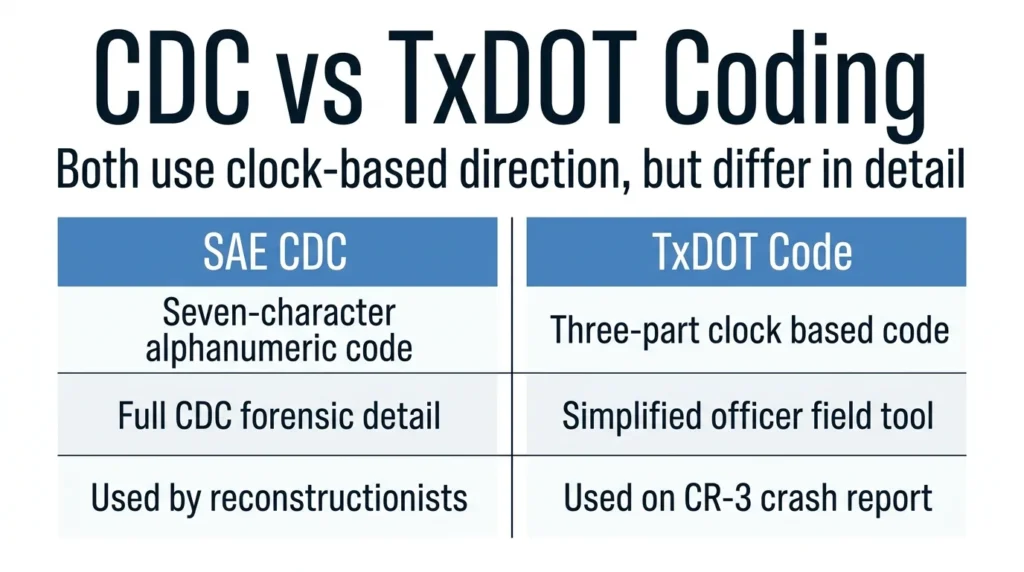
SAE International maintains that standard as SAE J224, the Collision Deformation Classification, or CDC. It has been in place since 1980 and uses a seven-character alphanumeric code, three numbers followed by four letters and numbers, to record the direction, location, and extent of a vehicle’s damage.
Texas built its own version of this idea directly into crash reporting. The Texas Department of Transportation’s Vehicle Damage Guide governs the Vehicle Damage Rating field on the Texas Peace Officer’s Crash Report, the CR-3.
It combines three parts into a single code: a Direction of Force number from 1 to 12, read like a clock face around the vehicle; a Damage Description of two or three letters, such as FD for a distributed front-end hit or LP for a side impact near the passenger compartment; and a Damage Severity number from 0 to 7. Combined, a code might read 12-FD-6 or 9-LP-2.
This TxDOT scheme is a simplified field-coding tool for the officer completing a crash report, not the full forensic CDC analysis a reconstructionist performs under SAE J224. Both share the same clock-based direction-of-force logic, but they are not the same level of detail, and one should not be mistaken for the other.
From Crush to Impact Direction, PDOF, & Energy Absorbed
Once crush is measured and coded, reconstructionists use it to determine from what single direction did the collision force act. That answer is the Principal Direction of Force, or PDOF, a directional vector that summarizes the combined forces acting on the vehicle during impact.
PDOF is commonly expressed in degrees or as a clock position, which lines up directly with the CDC and TxDOT clock convention already used to code the damage.
The same crush measurements also point toward how much energy the structure absorbed during impact, which feeds into an estimate of delta-V, the change in the vehicle’s speed from first contact to separation. The concept is straightforward even without a formula: deeper, more concentrated crush generally reflects more absorbed energy and a greater speed change.
Crush-based PDOF and delta-V analysis is one part of a reconstruction, not the whole picture. Reconstructionists weigh it alongside other evidence, including event data recorder readings, scene evidence, and scaled photographs of the damage.
How Vehicle Damage Resolves Disputed Contact & Sequence
When drivers give conflicting accounts, or one denies contact ever happened, investigators stop relying on testimony and start comparing the damage itself. Location, direction of force, crush depth, contact height, and paint transfer are checked across every vehicle involved to see whether the reported contact is even physically possible.
That comparison checks specific things. Do the contact heights on both vehicles line up? Do the damage profiles correspond to each other?
Does the paint transfer match? Are the deformation patterns consistent with a single, described impact rather than two separate stories? When those elements align, they confirm contact occurred and narrow down which vehicle struck which, and at what angle.
Insurance fraud investigators run the same logic in reverse. They examine the height, direction, and character of damage to tell whether it actually came from another vehicle or from a stationary object like a pole or a wall, since stationary objects lack the automotive clear coat that a vehicle-to-vehicle impact leaves behind.
Paint transfer alone can carry a lot of weight. It can show that contact happened and reveal its direction and sequence even without deep crush damage, which means a lot when a driver denies a collision occurred at all.
Damage location is a strong starting indicator of fault, but it is not conclusive on its own. It has to be read together with traffic law and the rest of the evidence, which is exactly the kind of analysis a car accident team works through with clients facing a disputed claim.
How Measurement, Photos, & Paint Transfer Build the Evidence
Three things anchor a reliable crush analysis, and timing matters for all three:
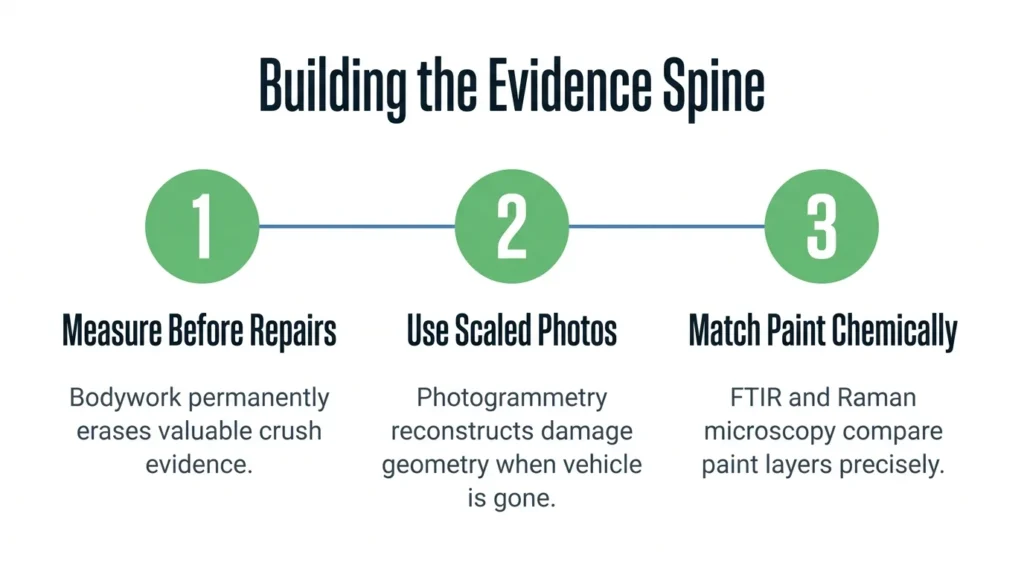
- Measure crush before repairs begin. Once bodywork starts, valuable crush evidence can be lost permanently. Early inspection preserves the ability to measure accurately and to see structural damage that a cosmetic repair would otherwise hide.
- Use scaled photographs when the vehicle is gone. If a vehicle has already been repaired or sold for salvage, photogrammetry steps in. Multiple photographs from different angles are used to reconstruct the damaged geometry to scale, then compared against an undamaged exemplar of the same make and model.
- Match paint transfer chemically, not just visually. Automotive paint has a distinct layered structure, and forensic techniques such as FTIR and Raman microscopy can compare those layers to match a transfer to a specific vehicle’s paint system. Paint evidence is fragile and can degrade or wash away over time, which is another reason to document it early.
Talk to an Attorney About Your Crash Evidence
If the other driver is disputing what happened, or denying they hit you at all, the damage on both vehicles may already hold the answer. Crush measurements, damage codes, and paint transfer only help your claim when someone knows how to gather them correctly and present them clearly.
Angel Reyes & Associates has guided injured Texans through disputed crash claims for over 30 years. Our licensed attorneys work alongside investigators and accident reconstruction specialists who understand this evidence.
Contact Angel Reyes & Associates for a free consultation to talk through your crash and your options.
Past results do not guarantee future outcomes.
Crash-Related Vehicle Damage FAQs
Can vehicle damage alone prove which car struck first?
Not on its own. Damage location, crush depth, and direction of force suggest the likely angle and point of contact, but reconstructionists confirm sequence by comparing contact heights, deformation patterns, and paint transfer across every vehicle involved. Damage evidence carries the most weight when read alongside other evidence, such as scene evidence or witness statements.
What happens to crush evidence if a vehicle is repaired before an expert can inspect it?
Once bodywork begins, the crush evidence needed for precise measurement can be lost for good. When a vehicle has already been repaired or salvaged, analysts turn to photogrammetry, reconstructing the damaged geometry to scale from multiple photographs and comparing it against an undamaged exemplar of the same make and model.
Does matching paint transfer prove who was at fault?
No. Matched paint transfer confirms that two vehicles made contact and can reveal the direction and sequence of that contact, even without extensive crush damage. It does not by itself establish fault; that determination still depends on traffic law and the rest of the evidence.
About the Authors

Spencer Browne
Writer
Spencer Browne is a partner at Angel Reyes & Associates and a Board Certified personal injury trial lawyer with nearly 100 jury trials across Texas. He focuses on car, truck, and wrongful death cases, with notable verdicts including a landmark win in the Choctaw Casino bus crash case. A recognized speaker and legal educator, Spencer is a member of the American Board of Trial Advocates and has been honored as a Texas Super Lawyer and one of D Magazine’s Best Lawyers in Dallas. He brings deep trial experience and relentless advocacy to every client he represents.

Kyle Nicolas
Editor
Kyle Nicolas is the Web Content & SEO Manager at Angel Reyes & Associates. He has more than 10 years of experience as a marketing co...

Angel Reyes
Reviewer
Angel L. Reyes, III is the Founder and Managing Partner of Angel Reyes & Associates. A nationally recognized trial attorney and business...