What to Do When Someone Runs a Red Light and Hits You


Every article on this site is researched by our internal team, reviewed for legal accuracy against current Texas law, and held to State Bar of Texas advertising standards before publication. We do not publish content that overstates outcomes or makes promises about results.
Learn more about our
editorial standards .
Key Takeaways
- Get medical care immediately – even if you feel fine. Insurance companies use lack of treatment against you.
- Don’t talk to their insurance – they have more resources and experience. They’ll try to pay you far less than you deserve.
- Texas assigns fault to victims – you can get zero compensation if they claim you’re 51% at fault, even in red-light crashes.
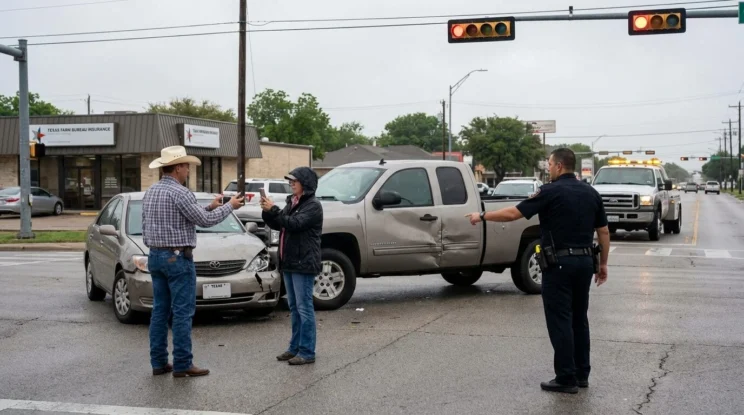
What to Do When Someone Runs a Red Light and Hits You
The light turned green and you accelerated forward to cross Congress Avenue in Austin. However, without warning, a driver coming from the other direction careened into the intersection to turn left, clipping the front of your car in the process. You were positive that your light was green, so clearly the other driver must have ran a red light to make this happen.
In Texas, a driver facing a steady red signal must stop at the marked stop line or, if there is no stop line, before entering the crosswalk. Texas law also allows limited exceptions, such as certain lawful turns when they can be made safely.
When a driver ignores that rule and causes a crash, Texas Transportation Code § 544.007 says that traffic violation can become a central part of the injury claim.
If you were hurt in this type of wreck, a car accident claim often turns on quick evidence collection, medical records, and how fault is framed from the start.
How Insurance Companies Try to Shift Fault
Even when the other driver ran the light, the insurer may still argue that you share blame. In Texas, your recovery can be reduced by your percentage of responsibility, and you cannot recover damages if your percentage of responsibility is greater than 50 percent under Texas Civil Practice and Remedies Code § 33.001.
For this reason, it’s extremely important to document the incident thoroughly and pursue a claim quickly.
These are common arguments insurers use to push fault back onto an injured driver.
- You entered the intersection too fast.
- You were distracted when the light changed.
- You accelerated through a yellow light.
- You could have avoided the crash if you had waited before moving on green.
- Your own lane position or turn path contributed to the impact.
Gathering evidence early can shut down blame-shifting before it hardens into the insurer’s version of events.
Evidence That Can Strengthen a Red-Light Claim
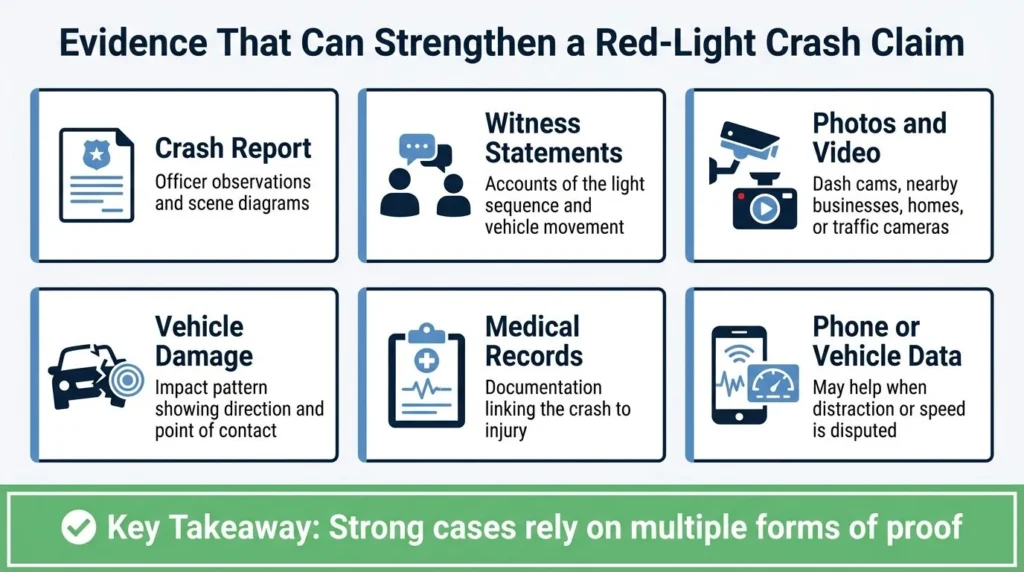
A strong case usually depends on more than one piece of proof. In fact, a solid case will usually have multiple pieces of irrefutable evidence that show who is really at fault for an incident.
This can include:
- The crash report and any diagrams or officer observations from the scene
- Witness statements about the light sequence and each vehicle’s movement
- Photos and video from nearby businesses, homes, dash cams, or intersection cameras
- Vehicle damage patterns that show direction and point of impact
- Medical records that tie the crash to your injuries
- Phone records or vehicle data, when legally obtainable, if distraction or speed is disputed
Good evidence does two jobs at once. It helps show who caused the crash, and it helps show how the crash caused your losses.
Steps to Take at the Scene & In the First 24 Hours
Moving quickly is important when it comes to establishing your case. Your actions from the moment the incident happen can have a far bigger impact on the final outcome of your claim than you might realize, so it’s important to be prepared.
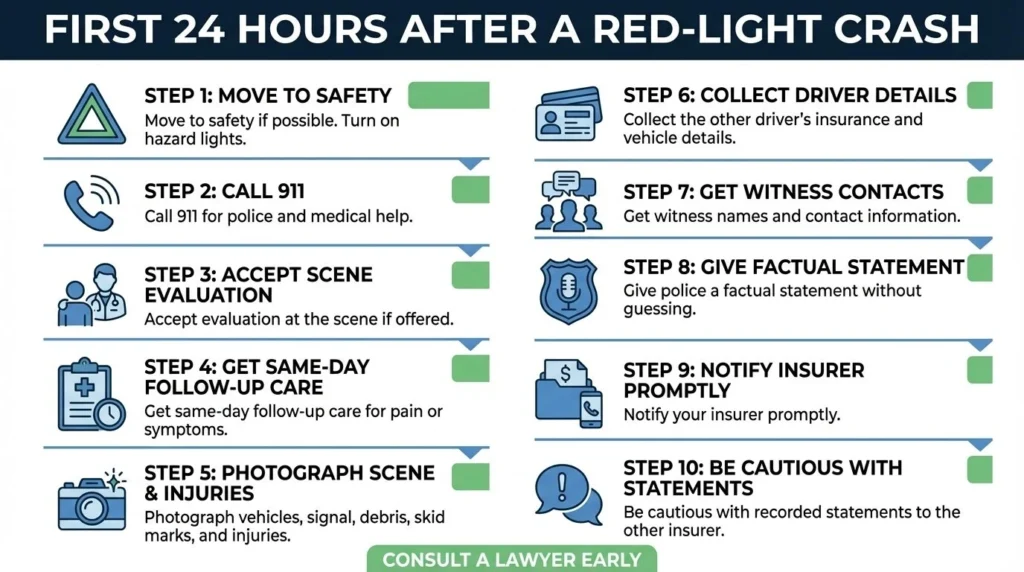
These are the first actions that protect your safety and preserve the proof your case may need later:
- Move to a safe location if you can do so without making your injuries worse.
- Call 911 and ask for both police and medical help.
- Accept medical evaluation at the scene if offered, and get follow-up care the same day if you have pain, dizziness, numbness, headache, or limited movement.
- Photograph the vehicles, the intersection, the traffic signal, debris, skid marks, lane positions, visible injuries, and weather or lighting conditions.
- Get the other driver’s name, insurance information, plate number, and vehicle details.
- Get witness names and contact information before they leave.
- Give the law enforcement officer on the scene a clear factual statement about what happened, but do not guess about speed, timing, or injuries you do not yet understand.
- Notify your own insurer promptly, but be careful about giving a recorded statement to the other driver’s insurance company before you understand your injuries and legal options.
Compensation That May Be Available
A red-light injury claim should account for more than the first repair bill or emergency room visit. This is the range of losses that may be part of the case.
- Medical bills and expected future treatment
- Lost wages and reduced earning ability
- Vehicle repair or replacement costs
- Physical pain and mental anguish
- Long-term limitations that affect daily life
The value of a case depends on liability, medical proof, insurance coverage, and whether your injuries continue after the first few weeks.
Deadlines, Records & Next Steps
Texas generally gives injured people two years to file suit for personal injury claims under § 16.003. Waiting too long can also make it harder to find witnesses, preserve video, and build a clean medical timeline.
While your claim is developing, it helps to keep every document tied to the crash in one place. That usually includes medical bills, discharge papers, prescription receipts, repair estimates, towing invoices, missed-work records, and insurer communications.
For a fuller picture of how cases are resolved, check out our articles on how fault is investigated after a crash and what affects a car accident settlement timeline.
Get Help Before the Insurance Company Defines the Crash
A red-light case can look obvious at the intersection and still become complicated once the insurance company starts disputing fault, injuries, or treatment. Fast action helps preserve video, protect your statements, and build the medical proof your case needs.
For more than 30 years, Angel Reyes & Associates has represented injured Texans and fought for their rights and best interests against insurance companies. With 18 offices located across the state, we are nearby and can help you with either a minor fender-bender or a major incident alike. And we never collect any legal fees unless we win.
Use this contact form to request a free consultation or check out our prior case results to see for yourself how we might be able to help.
Past results do not guarantee future success.
About the Authors

Spencer Browne
Writer
Spencer Browne is a partner at Angel Reyes & Associates and a Board Certified personal injury trial lawyer with nearly 100 jury trials across Texas. He focuses on car, truck, and wrongful death cases, with notable verdicts including a landmark win in the Choctaw Casino bus crash case. A recognized speaker and legal educator, Spencer is a member of the American Board of Trial Advocates and has been honored as a Texas Super Lawyer and one of D Magazine’s Best Lawyers in Dallas. He brings deep trial experience and relentless advocacy to every client he represents.

Kyle Nicolas
Editor
Kyle Nicolas is the Web Content & SEO Manager at Angel Reyes & Associates. He has more than 10 years of experience as a marketing co...

Angel Reyes
Reviewer
Angel L. Reyes, III is the Founder and Managing Partner of Angel Reyes & Associates. A nationally recognized trial attorney and business...