What Uber’s Corporate Representative Must Answer


Every article on this site is researched by our internal team, reviewed for legal accuracy against current Texas law, and held to State Bar of Texas advertising standards before publication. We do not publish content that overstates outcomes or makes promises about results.
Learn more about our
editorial standards .
Key Takeaways
- Name precise, relevant topics so Uber can designate witnesses for each subject.
- Ask what trip records mean, how Uber searched them, and whether they were preserved.
- Read company testimony in context; an answer does not automatically prove liability.

If you were hurt in an Uber crash in Texas, the company may hold records you cannot explain on your own. A corporate representative deposition requires Uber to designate people to answer properly noticed, discoverable topics using information known or reasonably available to the company. Their testimony can be used against Uber, but it does not automatically establish liability.
Your lawyer can use this procedure to investigate app data, record retention, and what the company learned about the crash. The notice, Uber’s witness designation, and the resulting transcript show what the company was asked to address and what it actually said.
A Texas Notice Defines the Company’s Deposition Topics

Texas Rule of Civil Procedure 199.2(b)(1) requires an organization-directed notice to describe the examination topics with reasonable particularity. Uber must designate witnesses to testify about information known or reasonably available to it on those topics.
Under the rule, the organization must:
- Designate one or more individuals to testify on its behalf
- Make that designation a reasonable time before the deposition
- Identify the matters each designated person will address
- Provide testimony on matters known or reasonably available to the organization
Listing a topic does not defeat objections based on relevance, privilege, or proportionality. The court can limit what the company must address.
The Notice, Designation & Transcript Work Together
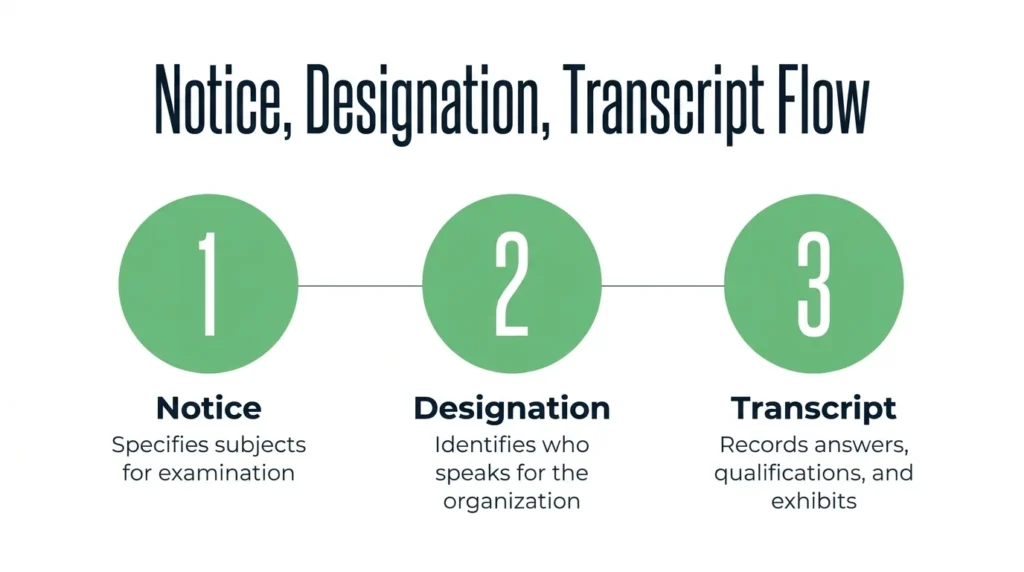
The notice specifies the subjects for examination. The designation identifies who will speak for Uber on each subject. The transcript records the answers, qualifications, unanswered questions, and references to exhibits.
Keep those records connected. An isolated transcript excerpt can make it appear that the company conceded more than it did.
Company Knowledge Goes Beyond One Employee’s Memory
A representative need not have witnessed your crash to testify about company information. In In re USAA General Indemnity Co., the Texas Supreme Court rejected a categorical personal knowledge requirement for an organizational deposition. Although that case involved an insurance dispute, its discussion explains why organizational knowledge matters.
Questions can establish which records the witness reviewed, which departments supplied information, and whether an answer reflects personal memory or the company’s available knowledge. The witness need not know something the organization does not know and cannot reasonably obtain.

Federal Court Uses Rule 30(b)(6)
In federal court, the corresponding procedure is a 30(b)(6) deposition, named for Federal Rule of Civil Procedure 30(b)(6). It also requires specific topics and testimony about organizational information. The federal rule expressly requires a good faith conference about examination topics; that requirement does not appear in Texas Rule 199.2(b)(1).
Document Requests Require a Separate Step
A deposition topic does not itself require document production. Texas Rule 199.2(b)(5) separately addresses accompanying production requests. Rule 215.1 permits motions addressing failures to designate, appear, or answer; relief depends on the applicable process and the court’s ruling.
App Data Topics Seek the Meaning of Company Records
A properly scoped notice can require Uber’s designee to explain relevant trip and app records, including their fields, timestamps, and how the company found them. The questions should connect those records to the identified driver, trip, time period, and disputed issues.
Uber’s Privacy Notice for Drivers and Delivery People identifies location data, trip details, usage data, and device information. Trip details include dates, times, and requested pickup and dropoff addresses. The policy supports investigating these categories; it does not prove a particular record exists for your crash or establish continuous tracking.
Illustrative questions can ask which system held responsive records, what a field or timestamp means, and what information identifies a trip request, acceptance, or completion. Other questions can address how Uber searched and exported records, checked completeness, and identified limits on interpreting location entries. These are suggested subjects, not descriptions of verified Uber systems.
For someone seeking car accident representation, understanding company-held records can help identify what further evidence the case needs.
Retention & Crash Investigation Topics Test What Uber Did
The representative can address relevant, nonprivileged facts about record retention, searches, and Uber’s investigation of the reported crash. Those answers must concern what happened in this case, rather than assume that a standard file or investigation exists.
Retention Policies & Preservation Address Different Questions
Ordinary retention policy describes how long a company generally keeps categories of data. Case-specific preservation concerns keeping evidence connected to a particular incident or claim.
Uber’s privacy notice says retention varies by data type and purpose, and identifies litigation or insurance claims as reasons to retain potentially relevant incident data. That policy does not establish compliance in your case or guarantee a complete crash history.
Useful examination topics include which policy version applied, which systems and custodians held relevant records, whether records remained available, and what searches occurred. If something is missing, the witness can be asked for nonprivileged facts explaining why.
Investigation Topics Examine the Company’s Factual Account
Questions can address when Uber received the crash report, which team handled it, what nonprivileged materials it gathered, and which factual findings support its position. Follow-up questions can connect those findings to documents produced in the case.
The examination should establish whether a report, recording, or conclusion exists rather than assume one does. The USAA decision also underscores the importance of relevance, proportionality, and privilege. Listing an investigation topic does not entitle someone to protected attorney advice or litigation strategy.
The Transcript Can Be Used Against Uber Without Settling Liability
Uber’s designated testimony can be attributed to the company and used against it as evidence. Being bound in that sense differs from making an automatic, conclusive judicial admission.
Evidence & Conclusive Admissions Have Different Effects
An evidentiary admission is a statement attributable to the company that can be used as evidence and assessed in context. A judicial admission conclusively establishes the admitted fact, removing the need to prove it.
Texas Rule of Evidence 801(e)(2) excludes qualifying party or authorized representative statements offered against that party from hearsay. Rule 801(e)(3) separately covers deposition statements in the same civil proceeding without requiring the witness’s unavailability. Other admissibility requirements still apply.
The Gozan Decision Illustrates the Distinction
In Union Pacific Railroad Co. v. Gozan, decided November 10, 2026, the Houston 14th Court of Appeals declined to treat a corporate representative’s qualified, nonspecific answers as judicial admissions. Adverse testimony is generally evidence, although a particular statement can satisfy the requirements for a judicial admission.
Gozan involved a railroad injury claim. Its relevance here is the Texas admissions analysis, not the law governing responsibility for a rideshare crash.
The Full Answer Determines What the Company Conceded
Before describing testimony as a company concession, compare the passage with the witness’s designated subject, the full question, any qualifications, and the related exhibits. Those details help show whether an answer actually supports the point being made.
Uber’s testimony means something, but the company may try to explain an evidentiary admission. Neither the naming of a witness nor an unfavorable answer automatically proves liability.
Discuss the Records & Questions in a Free Consultation
You do not need Uber’s internal records before seeking help. Bring what you have, such as a crash report, ride information, available app records, and relevant messages or emails.
Angel Reyes & Associates can assess which company topics matter to your case and what lawful discovery may be available. The firm has guided injured Texans for over 30 years.
Contact Angel Reyes & Associates for a free consultation. Our team is available 24/7.
Past results do not guarantee future outcomes.
Uber’s Corporate Representative FAQs
Can a corporate representative deposition reveal whether Uber received earlier complaints about a driver?
Potentially. If prior complaints or reports are relevant to a negligent hiring, retention, or supervision claim, discovery may address responsive company records and the information Uber received. The scope remains subject to relevance, proportionality, and applicable privacy or privilege protections.
How does an Uber corporate representative deposition differ from the driver's deposition?
The driver’s deposition generally focuses on the driver’s personal knowledge, actions, and observations, while the corporate representative deposition addresses designated topics involving Uber’s organizational knowledge. Both examinations may provide different evidence about the same collision and can be used together to evaluate disputed facts.
Can Uber's corporate representative be questioned about changes to the company's app after a crash?
If relevant to the claims or defenses, a deposition may examine app features, data collection practices, or system changes during a specific period. Questions should focus on changes that could affect the interpretation or availability of evidence connected to the incident.
About the Authors

Angel Reyes
Writer
Angel L. Reyes, III is the Founder and Managing Partner of Angel Reyes & Associates. A nationally recognized trial attorney and business leader, Angel founded the firm in 1993, which has gone on to help over 70,000 injury victims recover more than $1 billion. Named to the Texas Super Lawyers list annually since 2008, Angel brings Wall Street experience, Ivy League education, and a deep commitment to client advocacy. He is a frequent legal commentator and published author with extensive contributions to legal scholarship, trial strategy, and consumer protection.

Kyle Nicolas
Editor
Kyle Nicolas is the Web Content & SEO Manager at Angel Reyes & Associates. He has more than 10 years of experience as a marketing co...

Angel Reyes
Reviewer
Angel L. Reyes, III is the Founder and Managing Partner of Angel Reyes & Associates. A nationally recognized trial attorney and business...