Which Truck Drivers Are Exempt From Hours of Service Rules?


Every article on this site is researched by our internal team, reviewed for legal accuracy against current Texas law, and held to State Bar of Texas advertising standards before publication. We do not publish content that overstates outcomes or makes promises about results.
Learn more about our
editorial standards .
Key Takeaways
- Hours of service exemptions apply trip by trip, never as permanent driver status.
- Short-haul and agricultural relief both stop at a 150 air-mile radius boundary.
- FMCSA says tank, sand, and water haulers fail the oilfield waiting-time test.
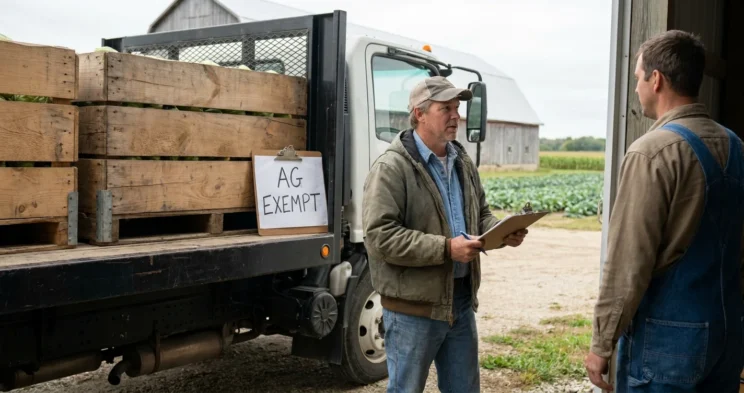
You asked the trucking company for the driver’s logs after the crash, and the answer came back in one word: exempt. No records of duty status, no electronic logging data, nothing to review.
Federal hours of service exemptions are real, but far narrower than you might think. Three of them cover most Texas trucking work: short-haul, agricultural, and oilfield.
Each one is a conditional test the driver has to satisfy on the specific day or trip in question. A driver who qualified last Tuesday may not have qualified on the day you were hurt.
The Hours of Service Rules These Exemptions Modify
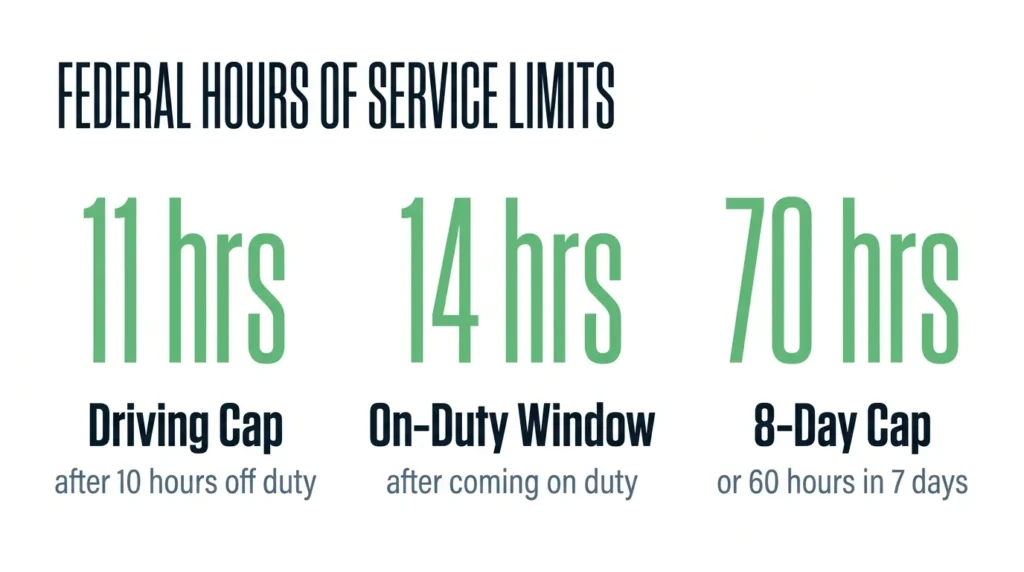
Federal hours of service rules cap how long a property-carrying truck driver can drive and work, and every exemption below relieves only part of that framework. Under 49 CFR Part 395, a driver may drive up to 11 hours after 10 consecutive hours off duty, may not drive beyond the 14th hour after coming on duty, and is capped at 60 hours in 7 days or 70 hours in 8 days.
Drivers must also keep a record of duty status, almost always through an electronic logging device. That record is the paper trail an attorney uses to reconstruct how long a driver had already been working when a crash happened.
Three categorical exemptions in 49 CFR 395.1 change that picture: short-haul in paragraph (e), agricultural in paragraph (k), and oilfield in paragraph (d). Sleeper berth and personal conveyance are different provisions.
One principle runs through all three. Every condition has to be satisfied at once, so a single failure on a given day means the exemption did not apply and standard limits and record-keeping were required.
The Short-Haul (150 Air-Mile) Exemption Under 49 CFR 395.1(e)
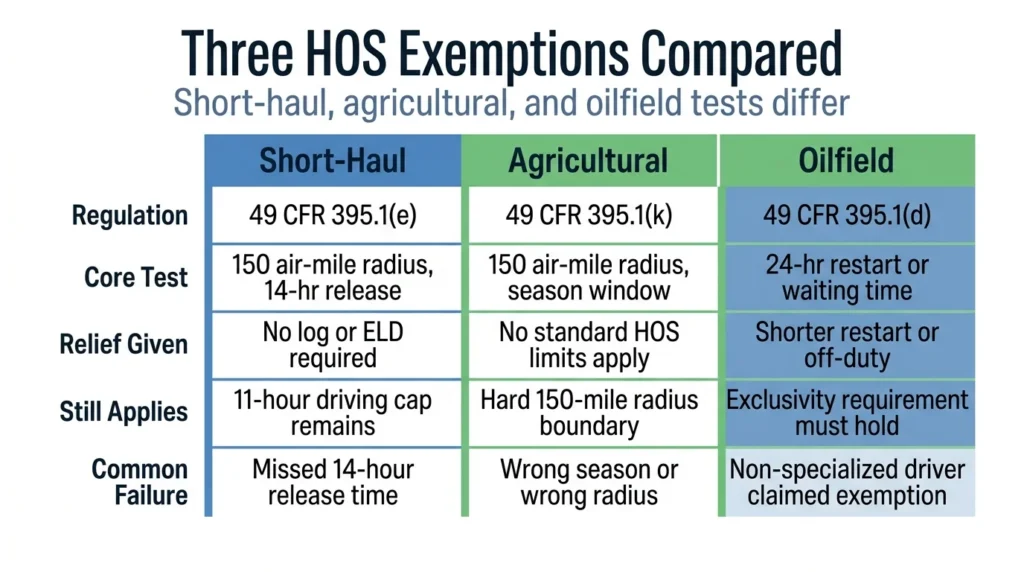
The short-haul exemption covers drivers who stay within a 150 air-mile radius of their normal work reporting location and return to it quickly, and it comes in two versions with two different tests. Neither version erases the driving limits themselves.
Under paragraph (e)(1), a driver who operates within 150 air miles (about 172.6 statute miles) of the normal work reporting location, returns and is released within 14 consecutive hours, and takes at least 10 consecutive hours off duty before the next on-duty period is relieved of the record of duty status and ELD requirements. The 11-hour driving cap still applies. This is relief from logging, not from the driving limits.
Paragraph (e)(2) covers drivers of property-carrying commercial vehicles that do not require a CDL. Those drivers also work within a 150 air-mile radius and return daily, but instead of a logging exemption they get a duty-time restriction: no driving after the 14th hour on duty on 5 days, and no driving after the 16th hour on duty on 2 days, of any 7 consecutive day period.
Both paragraphs use the same 150 air-mile radius. Older articles describing a 100 air-mile radius for CDL drivers quote a figure the current rule replaced, and the real difference is which duty-time test applies.
Carriers still have to track time. They must keep time records for drivers using this exemption, and under 49 CFR 395.8 supporting documents for records of duty status are retained for no less than six months.
The exemption can break on a single day. If the driver crossed the 150 air-mile radius or was not released within 14 hours, a full record of duty status was legally required, and compliance guidance describes the same fallback: a day that does not qualify sends the driver back to full logs.
The Agricultural Exemption Under 49 CFR 395.1(k)
The agricultural exemption is a radius-and-calendar test, not a general carve-out for anyone hauling farm freight. It reaches only qualifying cargo, within a fixed radius, during a window each state sets for itself.
The exemption applies when all of these conditions are met:
- The load is an agricultural commodity, which includes livestock, bees, horses, food fish, and other items meeting the definition in 49 CFR 395.2, or it is farm supplies moved for agricultural purposes.
- Commodities travel within a 150 air-mile radius of the source, and farm supplies travel within a 150 air-mile radius from a wholesale or retail distribution point to the place of use, or between distribution points.
- The driving happens during the planting and harvesting period as determined by the state.
That last condition is the one carriers most often assume away. Texas sets its own planting and harvesting window, as every state does, and a carrier should confirm the dates FMCSA currently lists rather than treat the exemption as year-round. Industry compliance guidance walks through the same commodity definitions, radius test, and state-set window.
The radius is a hard boundary. Once a trip passes 150 air miles from the source or distribution point, standard hours of service rules govern the rest of that trip, and driving back inside does not excuse the miles run outside it.
The Oilfield Exemptions Under 49 CFR 395.1(d)
Paragraph (d) holds two different oilfield provisions with two different tests, and treating them as one is a common error in Texas oil and gas hauling. One shortens the restart. The other pulls waiting time out of the on-duty clock.
The first, 395.1(d)(1), gives drivers used exclusively in transporting oilfield equipment and servicing oil or gas field operations a shorter restart. Their 8 consecutive day period, and the 70-hour clock that runs with it, may restart after 24 or more consecutive hours off duty instead of the standard 34.
The word “exclusively” carries real weight, because mixing oilfield and non-oilfield hauling in that period can defeat the restart.
The second, 395.1(d)(2), is much narrower. For specially trained drivers of vehicles specially constructed to service oil or gas wells, waiting time at the well site is not on-duty time. It is logged off duty with a remark identifying it as waiting time, and it does not count against the 14-hour window.
FMCSA’s regulatory guidance for the oilfield exception names the equipment it had in mind: heavy-coil vehicles, missile trailers, nitrogen pumps, wire-line trucks, sand storage trailers, cement pumps, frac pumps, blenders, hydration pumps, and separators. Their operators need extensive training well beyond ordinary driving.
Routine tank-truck, sand, and water delivery drivers do not qualify for the waiting-time exclusion. FMCSA has restated that position repeatedly, and it holds even when the driver delivers to a well site in a truck built for oilfield terrain.
The agency’s reasoning is that the provision was written for specialized equipment operators who occasionally drive a commercial vehicle, not for drivers whose primary job is delivery.
A sand or water hauler may still qualify for the (d)(1) 24-hour restart if the hauling is exclusively in service of oilfield operations, a separate and less demanding test. Compliance guidance on how the two oilfield provisions differ keeps them apart for that reason.
When a Carrier Wrongly Claims an Exemption
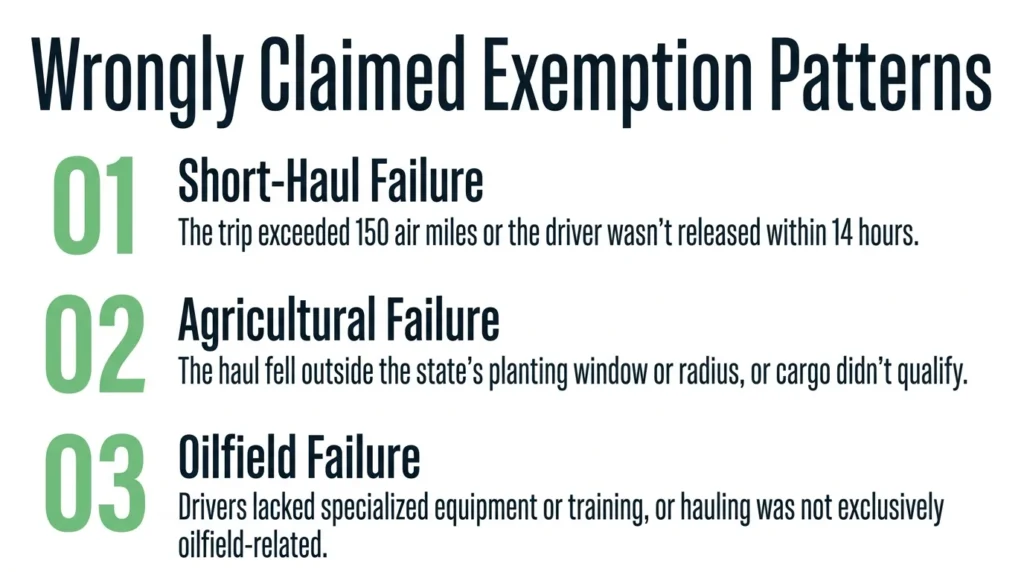
An exemption claimed on paper is not the same as an exemption earned in fact. Three patterns show up once the facts are checked against the actual trip:
- Short-haul: the trip went beyond 150 air miles, or the driver was not released within 14 hours, so a full log was required for that day and dispatch skipped it.
- Agricultural: the haul fell outside the state’s designated window, ran past the 150 air-mile radius from the source or distribution point, or carried cargo outside the regulatory definition of agricultural commodity or farm supply.
- Oilfield: a tank-truck, sand, or water delivery driver was logged as exempt waiting time under (d)(2) without the specially constructed equipment or specialized training the provision requires, or the hauling was not exclusively oilfield-related, defeating the (d)(1) restart.
When a fatigue-related crash happens on a trip the carrier treated as exempt, that gap becomes evidence. Radius, timing, cargo, equipment, and training are all checkable facts, and each one that fails supports the conclusion that the driver should have been under standard limits and logging every hour.
The evidence reaches past the individual driver. How a carrier decides which trips to call exempt says a great deal about its safety management, which is why truck accident claims often turn on dispatch and compliance records rather than the driver’s account.
Texas sits at the center of both problem areas. FMCSA held listening sessions in Texas, Pennsylvania, and Colorado before restating its oilfield guidance, and Permian Basin and Eagle Ford hauling runs alongside a major agricultural economy. Texas DPS enforces the federal framework rather than a separate state rulebook, so these tests govern Texas-based carriers.
Talk to an Attorney About a Suspected Hours of Service Violation
These exemptions are conditional, never automatic, so a carrier’s word that a driver was exempt is a claim to test, not a fact to accept. A close look at radius, release times, cargo, equipment, and training can show the exemption never covered the trip that injured you.
Angel Reyes & Associates has guided injured Texans through the legal process for over 30 years, working with investigators and accident reconstruction specialists who know which carrier records count the most.
If you were hurt in a crash with a commercial truck and the carrier says the driver was exempt from logging, contact Angel Reyes & Associates for a free consultation.
Past results do not guarantee future outcomes.
Truck Driver Hours of Service FAQs
If a driver qualifies for the short-haul exemption on Monday, does that exemption automatically continue for the rest of the week?
No. The short-haul exemption under 49 CFR 395.1(e) is a day-by-day test, not a standing status. On each work day, the driver has to independently stay within the 150 air-mile radius of the normal work reporting location, return, and be released within 14 consecutive hours.
If a driver loses the short-haul or agricultural exemption for one day, does that affect compliance on the days before or after it?
Each day is judged on its own facts. Because both the short-haul exemption (395.1(e)) and the agricultural exemption (395.1(k)) require every condition to be met on the specific day or trip in question, a non-qualifying day only means that a full record of duty status was required for that day. It does not retroactively undo an earlier day that independently met the radius and timing conditions, and it does not automatically disqualify a later day that meets them on its own.
Is the 395.1(d) oilfield waiting-time exclusion the same thing as the sleeper berth or personal conveyance rules?
No. The oilfield waiting-time exclusion in 395.1(d)(2) is a narrow provision that lets specially trained drivers of specially constructed well-servicing vehicles log waiting time at a well site as off-duty. Sleeper berth provisions and personal conveyance are separate, distinct parts of the hours-of-service rules that govern different situations.
About the Authors

Angel Reyes
Writer
Angel L. Reyes, III is the Founder and Managing Partner of Angel Reyes & Associates. A nationally recognized trial attorney and business leader, Angel has helped over 70,000 injury victims recover more than $1 billion since founding the firm in 1993. Named to the Texas Super Lawyers list annually since 2008, Angel brings Wall Street experience, Ivy League education, and a deep commitment to client advocacy. He is a frequent legal commentator and published author with extensive contributions to legal scholarship, trial strategy, and consumer protection.

Kyle Nicolas
Editor
Kyle Nicolas is the Web Content & SEO Manager at Angel Reyes & Associates. He has more than 10 years of experience as a marketing co...

Angel Reyes
Reviewer
Angel L. Reyes, III is the Founder and Managing Partner of Angel Reyes & Associates. A nationally recognized trial attorney and business...