Who Pays After a Tow Truck Crash?


Every article on this site is researched by our internal team, reviewed for legal accuracy against current Texas law, and held to State Bar of Texas advertising standards before publication. We do not publish content that overstates outcomes or makes promises about results.
Learn more about our
editorial standards .
Key Takeaways
- A towing company may be liable when its employee caused the crash during assigned work.
- Texas tow permits require $300,000 or $500,000 in liability coverage per truck per incident.
- Request the TDLR insurance filing, tow ticket, dispatch records, and scene photos early.
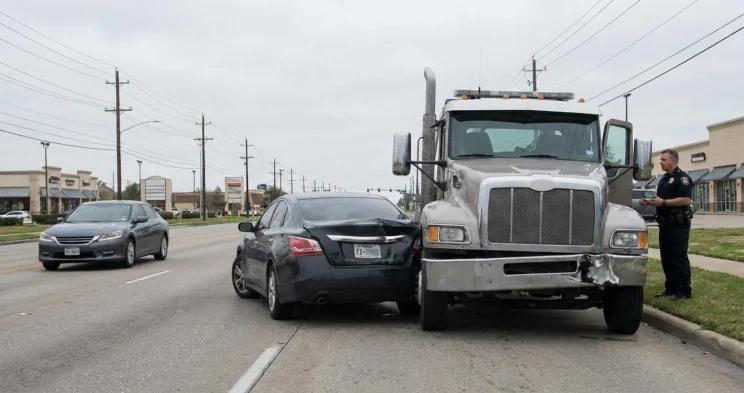
If you were hit by a tow truck or your car was damaged during a tow, identifying the responsible business and its insurance can help you address the repair costs and medical bills.
The tow driver who caused the crash may owe damages. The towing company may also be responsible when the driver was its employee acting within the course and scope of work. Applicable insurance can pay a covered tow truck accident claim. In Texas, the truck’s permit class sets minimum coverage, but fault and the crash-date policy determine who pays.
Who Can Be Responsible for a Tow Truck Crash?
The tow operator who drove or worked carelessly is the first possible responsible party. The towing company can also be responsible when the driver was its employee acting within the course and scope of the job. These are separate questions, and each one depends on facts.
In Painter v. Amerimex Drilling I, Ltd., the Texas Supreme Court explained that an employer answers for an employee’s negligence when the employee was acting within the course and scope of employment. Whether someone is an employee turns on the company’s overall right to control the work. Course and scope turns on whether the driver was doing authorized work that benefited the company.
Dispatch instructions and the purpose of the trip can help answer both questions. A company logo on the door does not prove the company is liable. Some operators work as contractors, and their status needs a close look. Other drivers at the scene may share fault, too.
Liability and insurance are also different questions. Liability coverage pays for the insured’s responsibility for other people’s injuries or property loss, and the policy terms control what it covers.
If the tow company’s coverage is disputed or too small, your own collision, personal injury protection, medical payments, or uninsured/underinsured coverage may apply, depending on your policy.
Whose property was damaged counts as well. A driver hit by a tow truck stands in a different position than an owner whose car was damaged while being towed.
The insurer’s adjuster understands these distinctions. Their job is to close your claim for as little as possible, and confusion about who is responsible works in their favor.
How do Texas Tow Licenses & Insurance Requirements Affect Who Pays?
Texas regulates the towing company, the individual operator, and each tow truck separately. The truck’s permit category sets its minimum insurance, and the operator’s license controls which trucks that person may drive. Those minimums set a floor. They do not promise any recovery.
Texas Occupations Code Chapter 2308 creates this structure. Section 2308.110 requires evidence of insurance filed with the Texas Department of Licensing and Regulation (TDLR) and kept in the permitted truck.
Minimum Insurance by Tow Truck Permit
Tow truck insurance requirements in Texas depend on the permit the truck holds. TDLR’s permit renewal guidance lists these minimums:
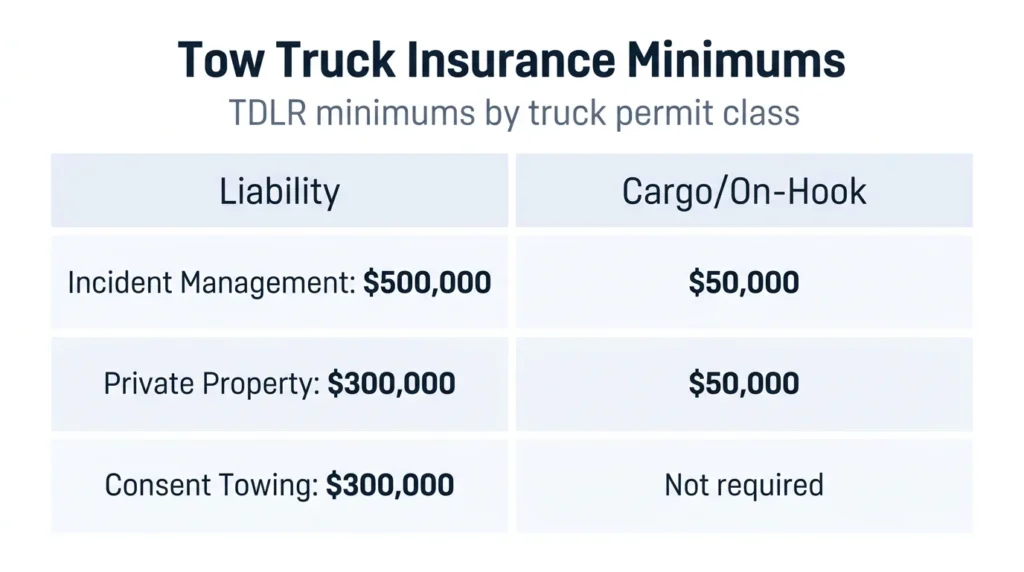
These amounts apply per truck per incident. They are not amounts owed to each injured person. Section 86.400 in TDLR’s 2021 rule compilation describes liability coverage as a combined single limit and treats cargo coverage separately, consistent with the current renewal guidance.
Cargo or on-hook coverage concerns the vehicle being transported. It does not add to the limit available for a bodily injury claim by another driver. A consent truck’s lack of required cargo coverage also does not mean the operator escapes responsibility for damaging a towed car.
Which Trucks Each Operator License Allows
TDLR issues three operator licenses, and they form a ladder. According to TDLR’s tow operator license guidance:
- An incident management license allows operation of all three permit classes.
- A private property license allows operation of private property and consent trucks.
- A consent license allows operation of consent trucks only.
These are towing licenses, not commercial driver’s license classes. A driver operating a truck outside their license class raises a regulatory question. That question alone does not decide who caused the crash.
Why the Tow’s Classification Means Something
Classification can change the insurance minimum in play. TDLR’s tow truck permit guidance treats a tow from a public roadway, for any reason, as incident management. A roadside crash tow does not become a consent tow just because the owner made the call.
Confirm the truck’s permit, the pickup location, and the assignment. Then obtain the insurance filing the underwriter submitted to TDLR and the actual policy in force on the crash date, including endorsements and any additional limits.
What Happened in the Crash & How Does it Affect Fault?
How the crash happened shapes who is at fault and which evidence counts most. These three situations show the questions to ask. None of them proves negligence by itself:
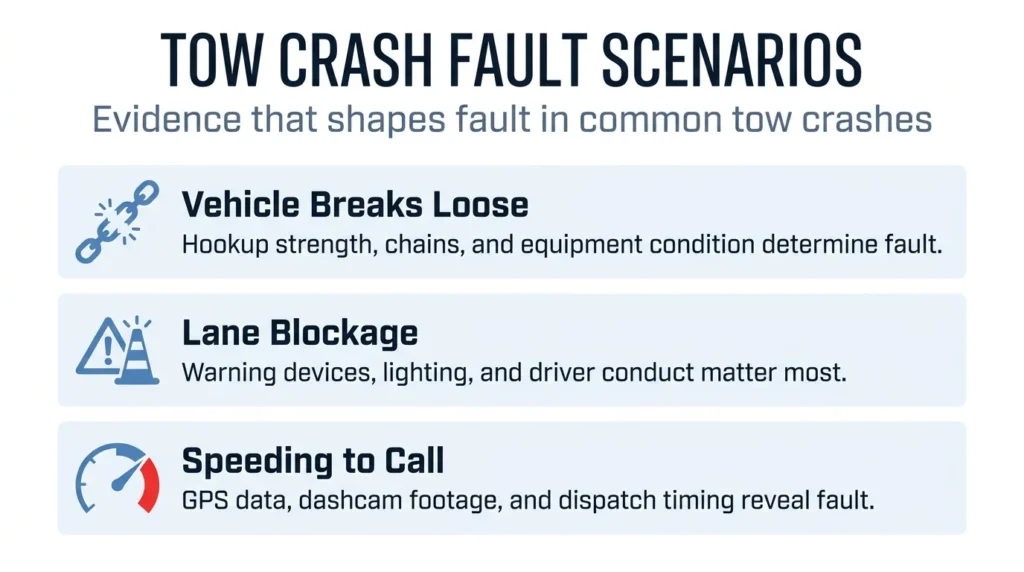
A Towed Vehicle Breaks Loose
When a car comes free from a wrecker, the investigation starts with the hookup. Texas Transportation Code § 545.409 requires a towing connection strong enough for the weight being drawn. Further chain requirements depend on the vehicle and setup.
Inspect and preserve the attachment points, chains or straps, cables, winch, and hydraulics.
Equipment ratings, repair records, and manufacturer instructions matter, too. TDLR’s towing enforcement guidance addresses safe towing and problems such as defective hydraulics and poorly maintained cables.
This evidence can separate a careless hookup from a part that failed. That distinction can point toward the operator, the company, or another party.
A Wrecker Blocks a Lane at a Crash Scene
A wrecker working in live traffic on LBJ Freeway can create a difficult scene for approaching drivers. Not every lane blockage is unlawful. The key questions are who directed the truck’s placement, why it blocked the lane, and how much warning approaching drivers had.
Sight distance, warning devices, lighting, traffic control, and the approaching driver’s own conduct all matter. Scene photos, video, and police or dispatch instructions help answer these questions.
Under Occupations Code § 2308.255(e), a narrow protection in Transportation Code Section 545.3051(e) applies to certain police-authorized removals. It addresses specified damage to removed property unless the removal was reckless or grossly negligent. It is not blanket immunity for an injury crash.
A Tow Operator Speeds to a Call
Transportation Code § 545.351 requires a speed that is reasonable for conditions. An urgent dispatch does not make fast driving safe.
Investigate the operator’s speed, signal compliance, visibility, and route. GPS data, dashcam footage, and dispatch timing can show what happened. The dispatch record may also connect the trip to company business, though it does not prove fault on its own.
Which Records Help Identify the Responsible Party & Available Coverage?
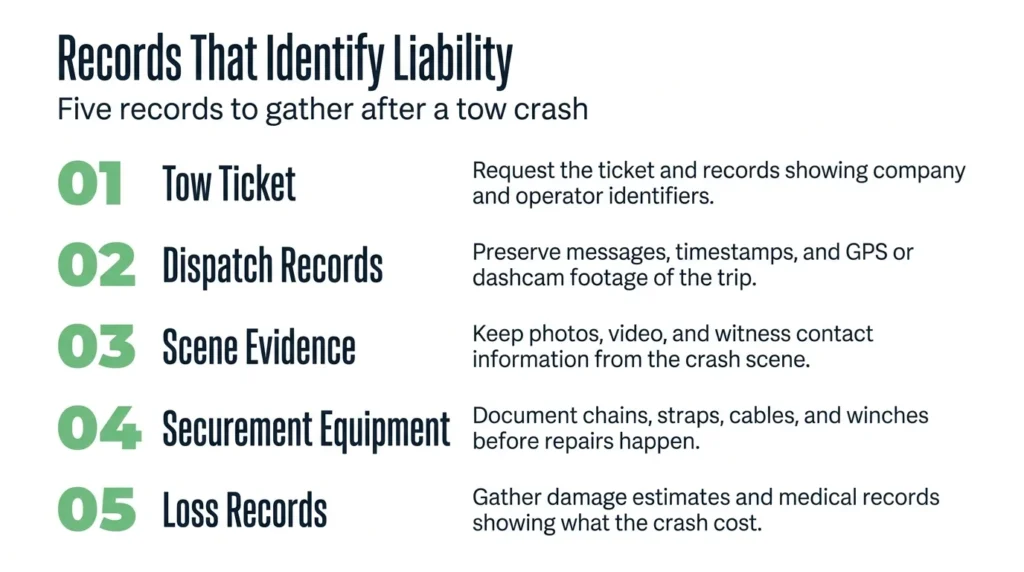
The right records help identify the responsible people and available insurance. Start with the company’s TDLR license, the operator’s license, the truck permit and cab card, and the crash-date insurance filing and policy. Cross-check the legal business name, truck and VIN, and permit class against the named insured:
- Tow ticket and tow records. For a nonconsent tow, TDLR rules require a tow ticket with company and operator identifiers. Request the ticket and associated records. TDLR’s sample tow tickets show the minimum information, though forms vary.
- Dispatch records. Preserve dispatch messages, trip timestamps, and any GPS or dashcam footage to show the assignment and the driving.
- Scene evidence. Keep original photos, video, and witness contact information to help reconstruct the crash.
- Securement equipment. Document the condition of chains, straps, cables, and winches before anyone repairs or replaces them.
- Loss records. Gather damage estimates and medical records to document what the crash cost you.
Act quickly. Electronic records do not all follow the same retention schedule, and some may not last.
Talk With Angel Reyes & Associates About a Texas Tow Truck Crash
You do not have to sort out licenses, permits, and policies on your own. Angel Reyes & Associates has guided injured Texans for over 30 years, and our team includes investigators and accident reconstruction specialists who know what records to request after a tow truck crash.
Bring your photos, medical records, and any tow ticket you have. We can review who may be responsible and what insurance may be available. You can reach us 24/7 to request a free consultation.
Past results do not guarantee future outcomes.
Tow Truck Crash FAQs
How long do I have to file a tow truck accident lawsuit in Texas?
Texas generally imposes a two-year statute of limitations for personal injury and property damage claims, although exceptions may apply depending on the circumstances, so identifying the applicable deadline early is important.
Can I recover compensation if I was partially at fault for a tow truck accident in Texas?
Yes, potentially. Under Texas’s proportionate responsibility rules, you may recover damages if you are not more than 50% responsible, but your compensation is reduced by your percentage of fault.
Can I recover damages if a tow truck accident damaged my vehicle but did not injure me?
Potentially. If another party’s negligence caused the collision, you may be able to seek compensation for vehicle repairs or other legally recoverable property losses, depending on the evidence and applicable law.
About the Authors

Spencer Browne
Writer
Spencer Browne is a partner at Angel Reyes & Associates and a Board Certified personal injury trial lawyer with nearly 100 jury trials across Texas. He focuses on car, truck, and wrongful death cases, with notable verdicts including a landmark win in the Choctaw Casino bus crash case. A recognized speaker and legal educator, Spencer is a member of the American Board of Trial Advocates and has been honored as a Texas Super Lawyer and one of D Magazine’s Best Lawyers in Dallas. He brings deep trial experience and relentless advocacy to every client he represents.

Kyle Nicolas
Editor
Kyle Nicolas is the Web Content & SEO Manager at Angel Reyes & Associates. He has more than 10 years of experience as a marketing co...

Angel Reyes
Reviewer
Angel L. Reyes, III is the Founder and Managing Partner of Angel Reyes & Associates. A nationally recognized trial attorney and business...