How Common Are Fatal Truck Accidents in Texas?


Every article on this site is researched by our internal team, reviewed for legal accuracy against current Texas law, and held to State Bar of Texas advertising standards before publication. We do not publish content that overstates outcomes or makes promises about results.
Learn more about our
editorial standards .
Key Takeaways
- TxDOT recorded 546 fatal commercial motor vehicle crashes in Texas in 2024.
- Harris, Dallas, Tarrant, Bexar, and Travis counties report the most fatal truck crashes.
- Rollover and jackknife crashes account for a large share of fatal truck accident deaths.
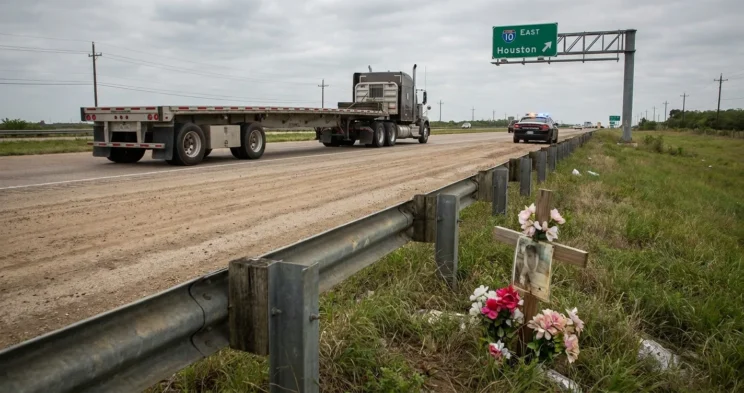
You merge onto I-35E in Dallas, and a loaded 18-wheeler looms in your mirror as traffic slows ahead. A crash like that can cause fatalities in seconds, and if you or someone you love just lived through one, you want to know how often this happens across Texas, not just in your lane. The honest answer starts with hard numbers, not headlines.
Fatal Truck Accident Frequency in Texas
Fatal truck accidents are not rare in Texas. According to Texas Department of Transportation (TxDOT) crash data, the state recorded 546 fatal crashes involving commercial motor vehicles in 2024, resulting in 608 deaths.
That figure covers TxDOT’s statewide count for that single year. Nationally, the Federal Motor Carrier Safety Administration (FMCSA) tracks large truck crashes across every state, and its data confirms these crashes remain a persistent safety problem well beyond Texas.
Because TxDOT’s totals and FMCSA’s national figures use different reporting years and vehicle definitions, treat them as separate data points rather than one combined statistic.
If you were hurt in a crash like this, Texas truck accident claims are handled in every region of the state. The right attorney has a background in such cases and can help guide you through the claim process.
Where Fatal Truck Crashes Concentrate in Texas
Fatal truck crashes cluster in a handful of Texas counties rather than spreading evenly statewide. Harris, Dallas, Tarrant, Bexar, and Travis counties report the highest totals, alongside the Midland-Ector corridor at the center of Permian Basin oil and gas truck traffic.
TxDOT’s crash data analysis shows both rural highway corridors and dense urban interstates carry heavy shares of fatal truck crashes. The exact rural-versus-urban split shifts from year to year, so treat any single ratio as a snapshot, not a fixed rule.
Dallas-Fort Worth is one high-volume point among several, not the state’s outlier. If your crash happened along Dallas-area trucking routes, it fits a broader statewide pattern rather than an isolated event.
Checking whether your crash location falls inside one of these known corridors can help you understand what happened and what to consider next.

Which Crash Types Cause the Most Fatalities?
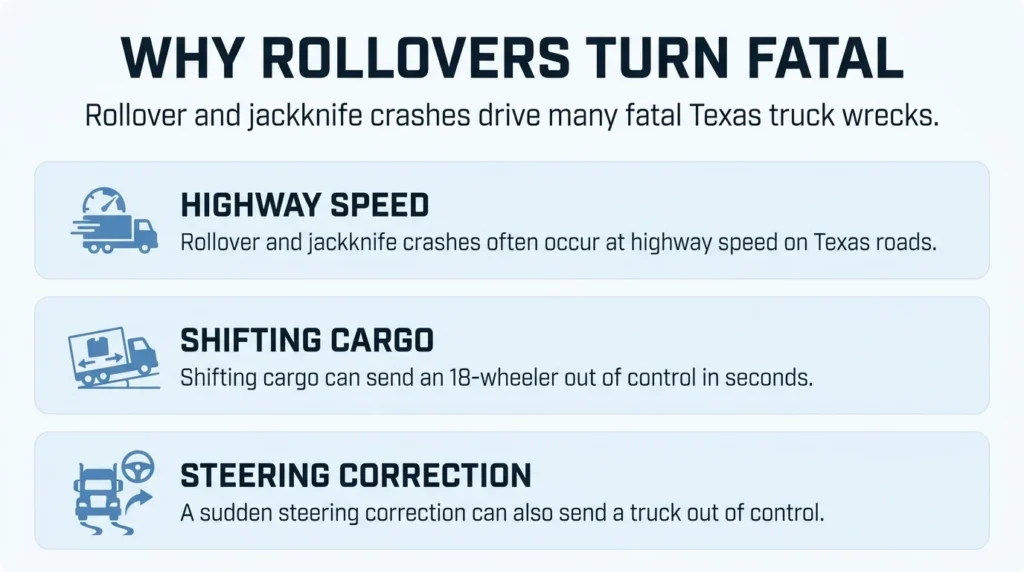
Rollover and jackknife crashes account for a large share of fatal large truck crashes in Texas. Both often occur at highway speed, when shifting cargo or a sudden steering correction sends an 18-wheeler out of control.
Truck Occupants vs. Other Vehicle Occupants
Many people assume truck drivers make up most fatal-crash deaths. National data shows the opposite is often true: most people killed in fatal large truck crashes are occupants of the other vehicle, not the truck itself.
That split reflects national data, not a confirmed Texas-specific figure. No verified Texas-only breakdown was available to confirm the same ratio at the state level, so read it as a national pattern rather than a Texas statistic.
What Causes Fatal Truck Accidents in Texas?
Speeding and reckless driving remain leading contributing factors in fatal Texas truck crashes. Large trucks need far more distance to stop than passenger cars, so excess speed often turns a survivable crash into a fatal one.
Current crash data points to speeding as one of the most common causes of truck accidents in Texas, alongside following too closely and unsafe lane changes.
Industry reports describe a persistent driver shortage that has pushed some carriers to hire less experienced drivers and shorten training time. Inexperienced or undertrained drivers are more likely to misjudge stopping distance, blind spots, and load balance, and each of those mistakes raises fatal crash risk.
Thinking through which of these factors may apply to your own crash can help you understand who bears responsibility.
Texas Intrastate 70 Hour 7 Day Rule
The Texas Intrastate 70 Hour 7 Day Rule limits how long a commercial driver working only within Texas may stay on duty before resting. It exists to keep fatigued drivers off the road.
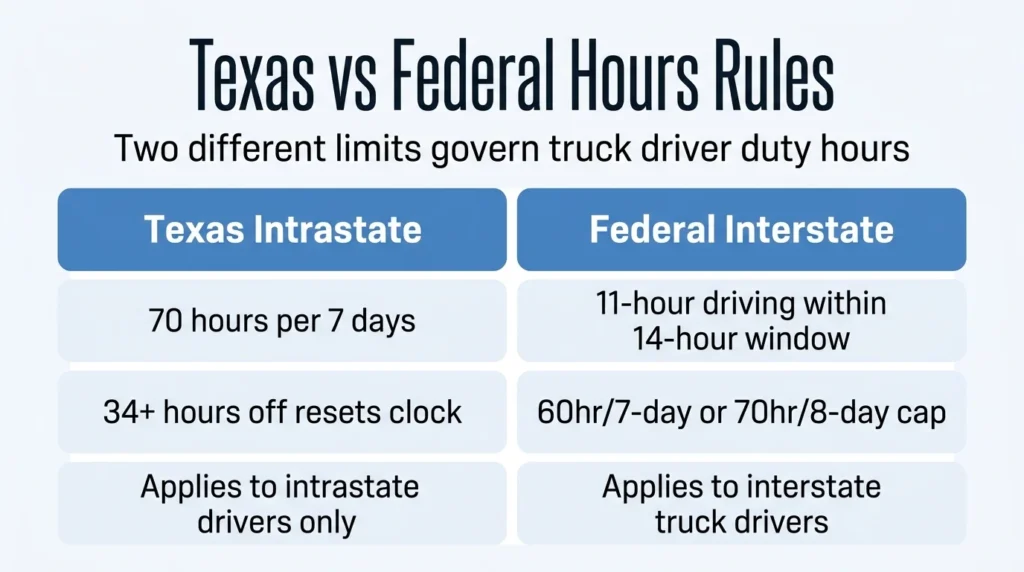
This limit comes from 37 Texas Administrative Code Section 4.12, the Texas Administrative Code rule governing intrastate commercial drivers, most recently amended effective October 23, 2024. Its core provisions include:
- Drivers may not continue operating after accumulating 70 hours on duty within 7 consecutive days.
- Taking 34 or more consecutive hours off duty resets the 7-day clock.
- Drivers must log on-duty and driving hours so a carrier or investigator can confirm compliance after a crash.
Federal Interstate Hours of Service Rule
Drivers who cross state lines follow a different framework. Under 49 CFR Part 395, interstate truck drivers face an 11-hour driving limit within a 14-hour on-duty window.
That federal rule also sets a separate 60-hour/7-day or 70-hour/8-day cap, depending on how many days the carrier operates. Both systems aim to prevent fatigue, but the hour limits and reset periods are not identical, so which rule applied can matter after a crash.
Work with a Knowledgeable Attorney
Fatal truck crashes leave families with medical bills, lost income, and unanswered questions about liability. Angel Reyes & Associates has represented injured Texans for more than 30 years, working on a contingency basis so you owe no fee unless we win your case.
The firm serves all of Texas, offers free initial consultations, and has more than $1 billion recovered for clients.
Meet the attorneys who handle truck accident claims statewide, and contact us today to discuss what happened to you.
Past results do not guarantee future outcomes.
Fatal Truck Accident FAQs
What should I do right after a fatal truck accident in Texas?
Call 911 so law enforcement can respond and create an official crash report, and get checked by a doctor right away even if you feel fine. Some injuries do not show symptoms until hours or days later.
Who can be held legally responsible for a fatal truck accident in Texas?
Under Texas law, a trucking company can often be held responsible for its driver’s negligence through a rule called respondeat superior. The company can also be directly liable for problems like poor hiring, training, or truck maintenance.
How much insurance are commercial trucks required to carry?
Federal rules generally require trucking companies to carry at least $750,000 in liability insurance for hauling most types of freight. Many carriers choose to carry more coverage than that minimum.
Why does it matter to preserve evidence quickly after a fatal truck crash?
Federal rules only require carriers to keep electronic logging device data, which tracks a driver’s hours, for six months. Key records can be lost for good if they are not requested soon after a crash.
About the Authors

Graham Griffin
Writer
Graham Griffin is the Web & Content Manager at Angel Reyes & Associates, where he oversees content strategy, AI-powered workflows, and digital marketing for the firm.

Kyle Nicolas
Editor
Kyle Nicolas is the Web Content & SEO Manager at Angel Reyes & Associates. He has more than 10 years of experience as a marketing co...

Angel Reyes
Reviewer
Angel L. Reyes, III is the Founder and Managing Partner of Angel Reyes & Associates. A nationally recognized trial attorney and business...