How Do You Dispute an Incorrect Police Report in Texas?


Every article on this site is researched by our internal team, reviewed for legal accuracy against current Texas law, and held to State Bar of Texas advertising standards before publication. We do not publish content that overstates outcomes or makes promises about results.
Learn more about our
editorial standards .
Key Takeaways
- Officers usually fix factual errors but rarely reverse a fault opinion without proof.
- Contact the specific agency that investigated your crash to request a correction.
- Write down your own account and gather evidence if the report cannot be changed.
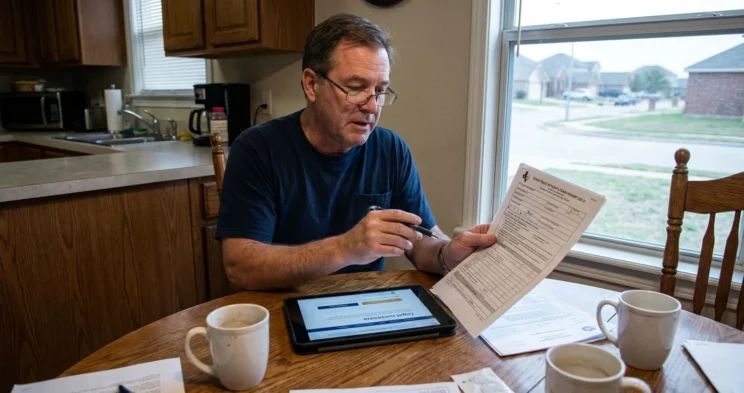
If you were in a car accident in Texas and the officer’s report got something wrong, that error can shape how your insurance claim turns out. The good news is that Texas drivers have a real path to fix it.
What to Do About an Incorrect Police Report
You have the right to dispute a police report that contains wrong information after a Texas car accident. A detailed report carries real weight in your case, since it typically records vehicle details, damage, vehicle positions, and which driver appeared at fault.
That said, a report can contain mistakes from the officer or from the other driver’s account.
Texas drivers can contest police report errors such as a misdescribed event, the wrong vehicle marked at fault, or missing details from the people involved.
Disputing a report can feel complicated, but it is necessary because insurers often lean on how much weight a police report carries in an insurance claim to decide fault and compensation.
A skilled attorney can help by gathering additional evidence, interviewing witnesses, or formally requesting corrections to the report.
Factors That Lead to an Incorrect Police Report
Not every problem with your report is the same kind of problem, and the fix depends on which kind you have:
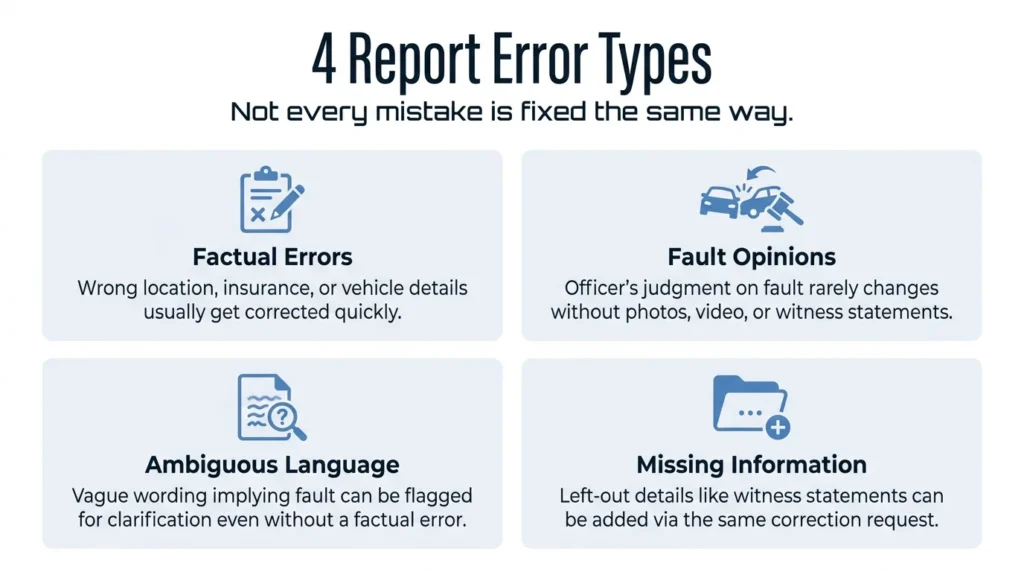
- Factual errors. Wrong location, street name, insurance details, or vehicle information are usually easy fixes. Since these are objective facts, an officer will typically amend them once you show the correct information.
- Fault opinions. The officer’s judgment about who caused the crash is different. Under Texas Transportation Code Section 550.062, an officer has a duty to file the report, but reversing a fault opinion afterward takes credible documentation, such as photos, video, or witness statements. Your word alone is unlikely to change it.
- Ambiguous language. Vague wording that unintentionally implies fault can be flagged for clarification, even when it is not a clean factual error.
- Missing information. Details the officer left out, such as an added witness statement or a corrected license plate number, can usually be folded into the same correction request as a factual error.
Preserve Your Own Version of Events
Even if the officer will not change a fault opinion, you can still protect your side of the story for your claim.
Write down your own account of what happened as soon as possible, while the details are still fresh. Note the time, location, weather, and anything the other driver said at the scene.
Keep photos of both vehicles, the surrounding scene, and any road conditions that played a role. Along with your notes, collect the other driver’s information and the contact details of any witnesses.
Store this documentation together with any correction request you file. That way, your version of events stands on its own even if the report itself never changes.
How to Request a Police Report Correction

Start by identifying the right agency. A crash inside city limits usually goes back to that city’s police department, while a crash on a state highway or in a rural area is typically handled by the Texas Department of Public Safety or the relevant county authority.
Contact the investigating officer or agency directly, explain the specific error, and provide documentation that supports the correction. Texas law enforcement agencies use a formal supplement process to update a crash report once an error is confirmed.
Keep in mind that the agency, not you, actually files the fix. If the officer agrees with your correction, the agency submits an amended or supplemental report rather than you resubmitting the form yourself.
Act quickly. The sooner you raise the error after the crash, the easier it typically is to resolve.
Work with an Attorney Today
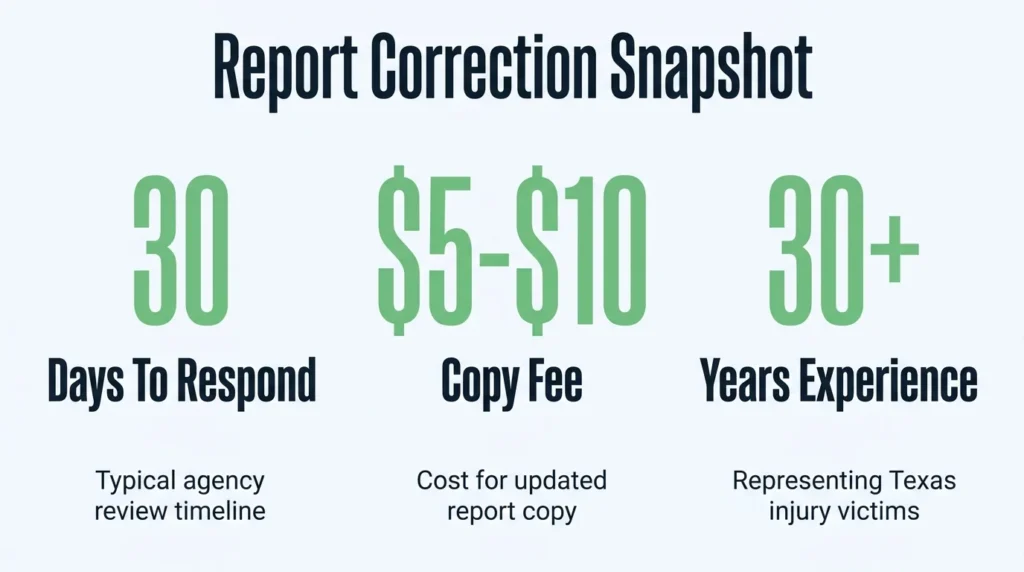
Disputing a police report on your own can be frustrating, especially while you are also recovering and dealing with an insurance company. Angel Reyes & Associates has spent over 30 years representing injury victims in truck accidents, car accidents, and motorcycle accidents across Texas.
Our attorneys work on contingency, so you pay nothing unless we win your case. We can review your case, gather the documentation an agency needs to correct your report, and handle communication with the insurance company on your behalf.
Contact us today for a free, confidential case review. You do not have to sort out a flawed police report alone.
Past results do not guarantee future outcomes.
Disputed Police Report FAQs
How long does it take to get a corrected police report back?
Timelines vary by agency, but many law enforcement agencies aim to review a correction request and respond within about 30 days.
Can you dispute a police report if you also received a traffic citation?
The citation and the report are separate. You contest a traffic ticket through the court system, while a report correction goes through the investigating agency directly.
Is there a fee to get an updated copy of your corrected police report?
Yes. Most Texas law enforcement agencies charge a small fee, often in the $5 to $10 range, to provide an updated copy of a crash report.
About the Authors

Angel Reyes
Writer
Angel L. Reyes, III is the Founder and Managing Partner of Angel Reyes & Associates. A nationally recognized trial attorney and business leader, Angel has helped over 70,000 injury victims recover more than $1 billion since founding the firm in 1993. Named to the Texas Super Lawyers list annually since 2008, Angel brings Wall Street experience, Ivy League education, and a deep commitment to client advocacy. He is a frequent legal commentator and published author with extensive contributions to legal scholarship, trial strategy, and consumer protection.

Graham Griffin
Editor
Graham Griffin is the Web & Content Manager at Angel Reyes & Associates, where he oversees content strategy, AI-powered workflows, a...

Spencer Browne
Reviewer
Spencer Browne is a partner at Angel Reyes & Associates and a Board Certified personal injury trial lawyer with nearly 100 jury trials a...