What To Do If A Bus Hits Your Car in Texas


Every article on this site is researched by our internal team, reviewed for legal accuracy against current Texas law, and held to State Bar of Texas advertising standards before publication. We do not publish content that overstates outcomes or makes promises about results.
Learn more about our
editorial standards .
Key Takeaways
- The Texas Tort Claims Act requires written notice to a transit authority within six months of the crash.
- Photograph the bus number, route, and operator ID to identify the right entity for your claim.
- Drivers more than 50% at fault under Texas proportionate responsibility cannot recover any damages.
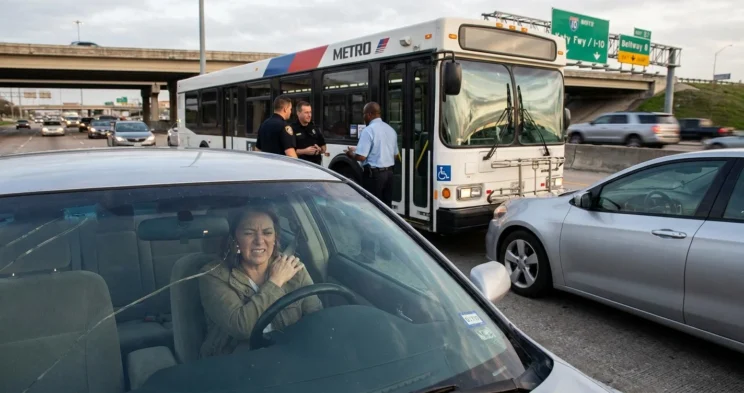
You were heading into work along the Katy Freeway when a city bus drifted out of its lane and clipped your driver’s side near the Beltway 8 interchange. Your car is dented, your shoulder hurts, and the bus operator is already on the phone with someone official.
You know this isn’t a normal fender-bender, and you’re not sure the usual rules apply. So what should you do next?
Your First Steps at the Scene
Stay in your vehicle if it is safe, and check yourself and any passengers for injuries before doing anything else. Call 911 right away. A police report is the foundation of any later claim, and officers will document the scene in a way you cannot. Do not move your car unless it’s creating a safety hazard.
Once help is on the way, start documenting. Photograph the damage to your vehicle, the position of the bus, traffic signals, skid marks, and anything else that shows how the crash happened. Take wide shots and close-ups before any vehicle is moved.
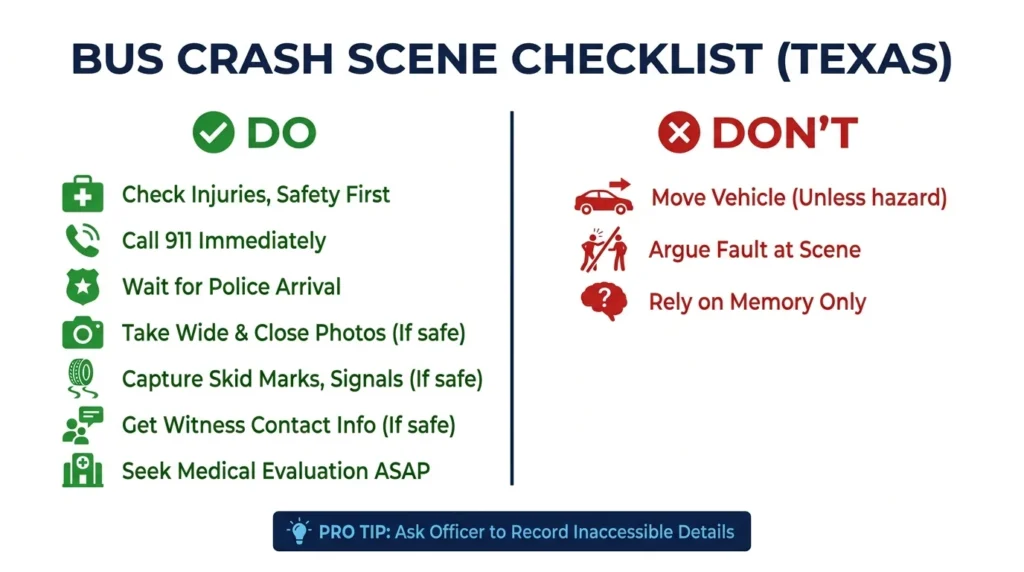
Get names and phone numbers from witnesses while they’re still around. Bystander accounts matter even more in transit collisions, where the bus operator may push back on fault. Do not discuss who caused the crash with the operator, transit staff, or anyone else at the scene. Save that conversation for the police and, later, your attorney for your bus accident claim.
Document the Bus, Not Just the Driver
A bus crash needs a different kind of evidence collection than a normal two-car crash. The bus number, route, and operator ID identify the exact vehicle and the entity responsible. Without those details, your claim can stall before it starts.
The bus number is usually printed on the front, rear, and sides of the vehicle. Photograph it from more than one angle if you can. Then capture the route number or designation on the marquee or placard above the windshield. That tells the transit authority which route the operator was on.
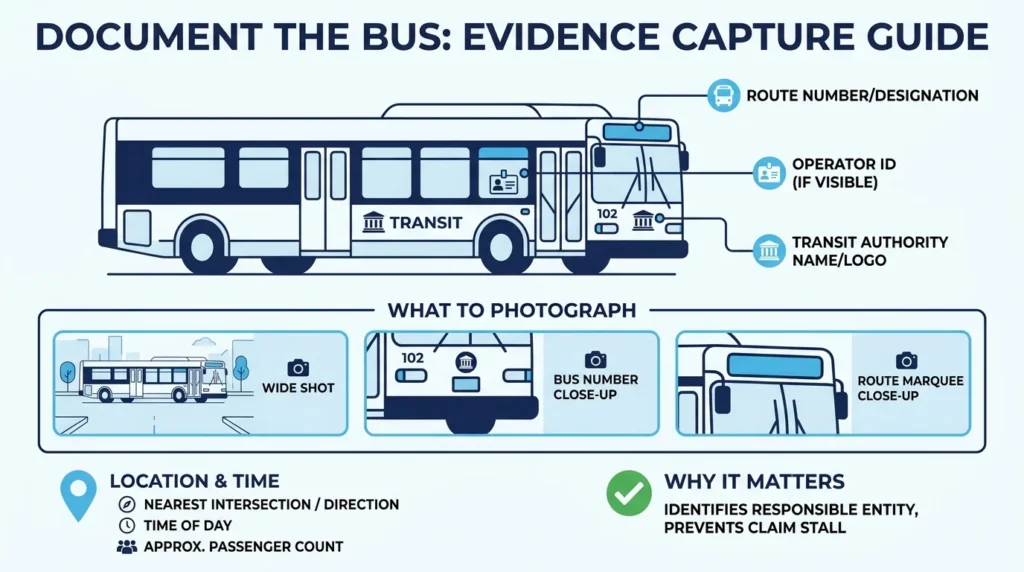
If you can see the operator’s ID badge through the window, photograph it. If not, ask the responding officer to record it for you. Note the name of the transit authority on the bus:
- DART in Dallas
- METRO in Houston
- VIA in San Antonio
- Capital Metro in Austin
The transit authority name decides which government or private entity carries the liability.
Write down the time, the direction the bus was traveling, and the nearest intersection. Transit authorities log every vehicle’s movements, and your notes from just after the crash can confirm or challenge that log later. Note how many passengers were on board if you can see inside.
Government Bus vs. Private Bus: Why It Changes Your Claim
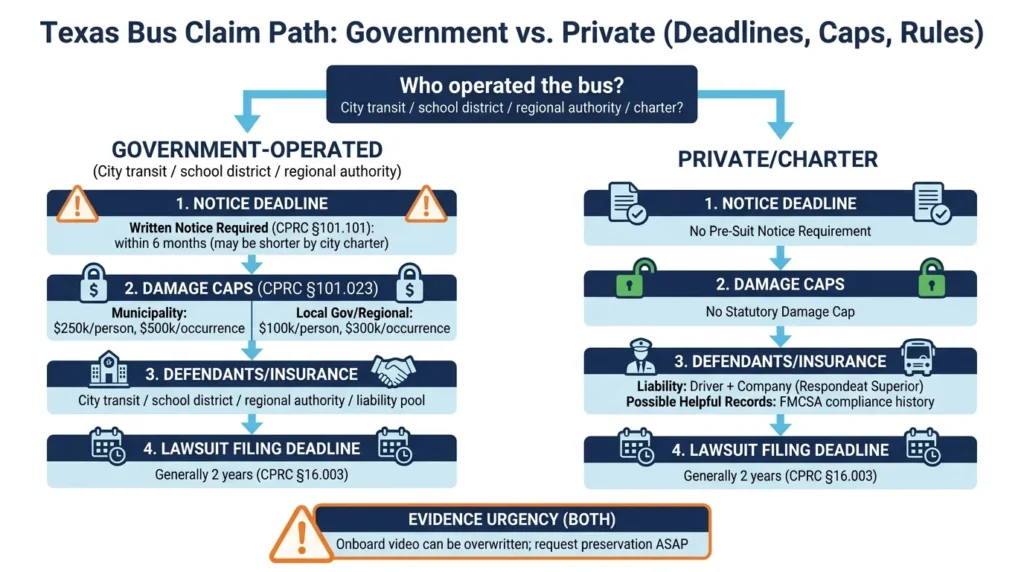
Whether a city transit authority or a private company was operating the bus decides which legal track your claim follows. Government buses are protected by sovereign immunity, with a narrow waiver and tight deadlines. Private buses follow the standard Texas negligence rules. Confusing the two can cost you the case.
Claims Against a Government-Operated Transit Authority
City and county transit agencies in Texas are governmental entities. Texas Civil Practice and Remedies Code (CPRC) § 101.101 requires written formal notice to the governmental unit within six months of the incident. Miss that window and your claim can be barred entirely, no matter how strong it is on the facts.
Some Texas cities impose even shorter local notice deadlines under their city charters, so the window in your specific city may be shorter than six months. That’s a strong reason to act quickly and get advice early rather than waiting to see how injuries develop. Understanding the rules for suing a public transit agency before you contact a lawyer helps you move faster once you do.
Damage caps also apply, and the amount depends on the type of governmental entity. Under CPRC § 101.023, recovery against a municipality is capped at $250,000 per person and $500,000 per single occurrence for bodily injury or death. Recovery against a unit of local government—which can include regional transit authorities—is capped at $100,000 per person and $300,000 per single occurrence.
An attorney can identify which cap applies to the specific transit agency involved in your crash. The general two-year filing deadline under CPRC § 16.003 also applies, but the six-month notice rule is the earlier and more urgent obligation.
Claims Against a Private or Charter Bus
A private or charter bus operator is not a governmental entity. The claim follows standard Texas negligence law, with no pre-suit notice requirement and no statutory damage cap. Liability can fall on the driver, the operating company, or both under respondeat superior, which holds employers responsible for an employee’s on-the-job conduct.
A lawsuit against a bus driver often names the company too. Commercial bus carriers usually have far higher insurance limits than personal auto policies, which can change how a claim is structured. If the operator is a federally regulated motor carrier, Federal Motor Carrier Safety Administration records may also help show compliance history.
Fault, Injuries, & What You Can Recover
Texas uses a fault-sharing rule called proportionate responsibility under CPRC Chapter 33. You can still recover damages if you were partly at fault, as long as your share is 50% or less. Your total recovery is then reduced by your percentage of fault. If you are found more than 50% responsible, you recover nothing.
Evidence drives the fault analysis:
- Traffic camera footage
- The bus’s onboard cameras
- The police report
- Witness statements
Transit authorities must maintain vehicle data, but that evidence can be overwritten quickly if no one asks for it.
Recoverable damages include medical bills (current and future), lost wages and lost earning capacity, vehicle repair or replacement, pain and suffering, and mental anguish. In a government bus claim, the statutory cap limits the final settlement amount regardless of what the math says you’re owed. Settlement value in bus cases depends on factors most drivers don’t think about until a claim is underway, like coverage layers and comparative fault findings.
After the accident, get medical attention even if you feel fine. Whiplash, soft tissue damage, and concussion symptoms often show up days later. A documented exam right after the crash protects both your health and your claim.
Talk to an Attorney About Your Case
Bus collisions involve deadlines and procedural traps that don’t exist in normal car accident claims. Angel Reyes & Associates has more than 30 years of experience handling bus and transit authority claims across Texas, with more than $1 billion recovered for clients.
We offer free consultations and work on contingency, meaning no fee unless we win. Meet our attorneys, or contact us today to talk through your situation.
Past results do not guarantee future outcomes.
Bus Accident FAQs
Can the transit authority's onboard camera footage be deleted before I request it?
Yes. Transit agencies typically overwrite onboard video on a rolling schedule, sometimes within 30 to 90 days. Sending a written evidence preservation letter to the transit authority as soon as possible after the crash is the best way to stop that from happening.
Does my own auto insurance play any role after a government bus hits my car in Texas?
Your own insurance policy may still apply, depending on your coverage. If you have medical payments coverage or personal injury protection, those benefits can help cover immediate medical costs while your claim against the transit authority is pending.
Can a bus passenger who witnessed the crash testify on my behalf?
Yes. Bus passengers are third-party witnesses with no financial stake in either side of the claim, which can make their accounts valuable. Asking the responding officer to collect passenger contact information at the scene gives you access to those witnesses later.
What if the bus that hit me was operated by a school district rather than a city transit authority?
School district buses in Texas are also governmental entities, so the Texas Tort Claims Act applies, including the six-month notice requirement and the applicable damage caps. The same urgency to act quickly applies as it does with city transit claims.
What does "respondeat superior" mean in a private bus accident claim?
Respondeat superior is a legal rule that holds an employer responsible for harm their employee causes while acting within the scope of their job. In a private bus crash, this means you can pursue compensation from the operating company, not just the individual driver.
About the Authors

Alex Ivanov
Writer
Alex Ivanov is a personal injury attorney at Angel Reyes & Associates, focused on car, truck, and motorcycle accident cases. Licensed in Texas and multiple federal districts, Alex brings international legal experience and a global education to his practice. He earned his LL.M. from Texas A&M University School of Law after graduating from Belarussian State University in 2016. Alex is fluent in Russian, English, Ukrainian, and Belarussian, and is recognized by multiple national trial lawyer associations for his results and leadership under 40.

Kyle Nicolas
Editor
Kyle Nicolas is the Web Content & SEO Manager at Angel Reyes & Associates. He has more than 10 years of experience as a marketing co...

Angel Reyes
Reviewer
Angel L. Reyes, III is the Founder and Managing Partner of Angel Reyes & Associates. A nationally recognized trial attorney and business...