Bus Passenger Accident Claims in Texas


Every article on this site is researched by our internal team, reviewed for legal accuracy against current Texas law, and held to State Bar of Texas advertising standards before publication. We do not publish content that overstates outcomes or makes promises about results.
Learn more about our
editorial standards .
Key Takeaways
- Texas bus operators owe passengers the highest degree of care under the common carrier standard.
- Government bus claims require written notice within 6 months, and Houston requires it in 90 days.
- A passenger found 51% or more at fault recovers nothing under Texas comparative negligence rules.
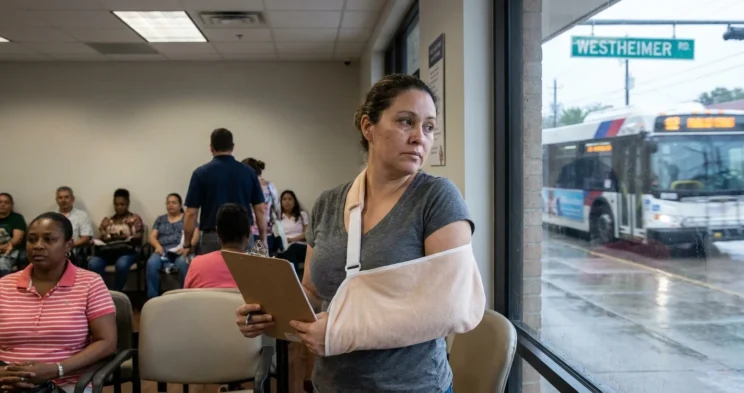
You were riding the bus home from work in Uptown Houston when the driver braked hard to avoid a stopped car on Westheimer Road. You were thrown forward, your shoulder slammed into the seat in front of you, and now you’re sitting in an urgent care lobby wondering who pays for this. The bus company’s insurance representative has already called twice, and the questions feel less like concern and more like a setup. What rights do you actually have as a passenger?
The Common Carrier Standard in Texas Bus Claims
Bus operators in Texas are legally classified as common carriers, which means they owe passengers a high degree of care. This means the care a very cautious, competent, and prudent person would use under similar circumstances. This standard is materially higher than the ordinary care a regular driver owes. For an injured passenger, that elevated burden tilts the case in your favor from the start.
This duty cannot be passed off to someone else. A bus company cannot escape liability by pointing at a maintenance vendor, a staffing agency, or a subcontracted driver. If the operation failed and you were hurt, the carrier remains responsible.
The duty also covers every part of the trip. Route planning, vehicle upkeep, driver hiring and training, boarding conditions, and conduct during transit all fall under the carrier’s responsibility. A failure in any one area that causes injury can support your claim.
The practical effect is significant. To prevail, a plaintiff must show the carrier failed to use the high degree of care, meaning a more demanding standard than the ordinary reasonable care applied to everyday drivers. That difference shapes how your case is investigated, negotiated, and tried. If you want a deeper look at how these claims work, our Texas bus accident practice page covers the legal framework in more detail.
Private vs Government Bus Claims in Texas
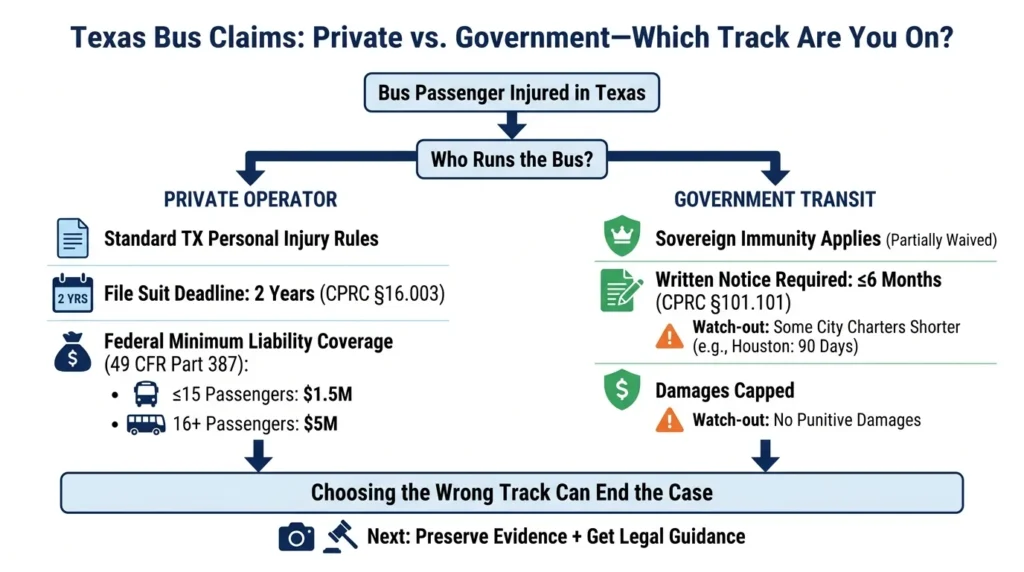
The path your claim takes depends on who runs the bus. Private operators face standard personal injury rules. Government-operated transit systems are protected by sovereign immunity, which is only partially waived under a specific Texas statute. The procedures, deadlines, and damage limits differ enough that picking the wrong path can end your case before it begins.
Private Bus & Charter Operator Claims
Claims against private operators follow standard Texas personal injury law. The deadline to file a lawsuit is two years from the date of injury under the Texas Civil Practice and Remedies Code (CPRC) § 16.003. Missing that window almost always ends the claim.
Charter and interstate operators are also subject to federal insurance rules. Under 49 CFR Part 387, buses carrying 15 or fewer passengers must carry at least $1.5 million in liability coverage, and buses carrying 16 or more must carry $5 million. Those minimums set a practical floor on what may be available to recover.
If you’re unsure whether the driver, the company, or both can be held responsible, our overview of whether you can sue a bus driver after a crash walks through how liability is sorted out in private-carrier cases.
Government-Operated Transit Claims
Claims against systems like DART, Houston Metro, or VIA in San Antonio follow a different track. The Texas Civil Practice and Remedies Code § 101.101 requires written notice to the governmental unit no later than six months after the incident. Some city charters cut that window even shorter; Houston’s charter requires notice within 90 days.
Damages against government entities are also capped under the Tort Claims Act, and punitive damages are not available against a government operator. That is a meaningful difference from private-carrier cases involving egregious conduct.
A short overview of suing public transportation in Texas can help you understand what these notice rules look like in practice.
Steps to Take After a Bus Passenger Injury
What you do in the first days after a bus injury shapes the strength of your claim. Evidence disappears quickly, and insurers move fast. The actions below protect both your health and your legal position.
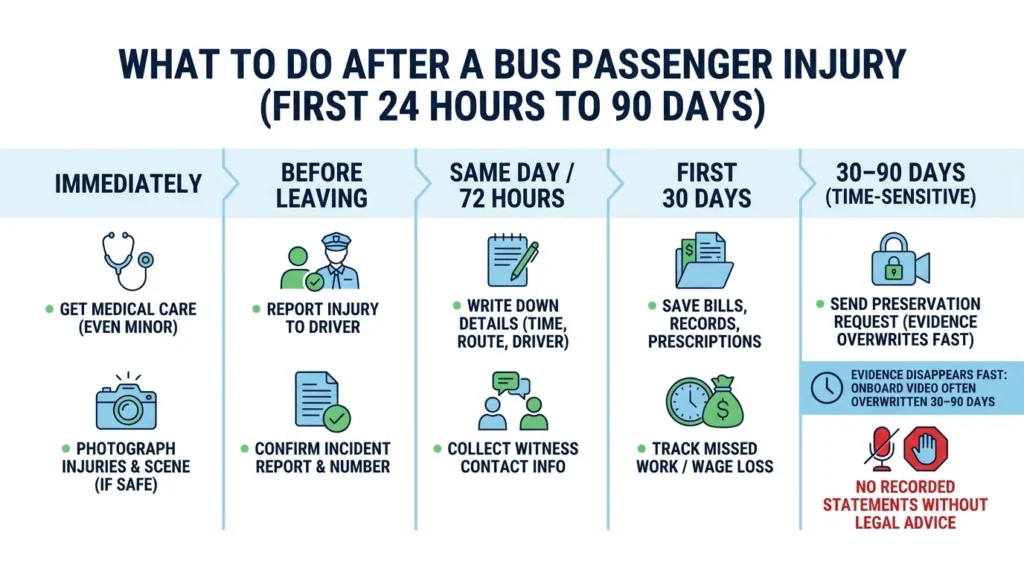
Get medical attention right away, even if injuries seem minor. A medical record from the day of the incident is one of the most durable pieces of evidence in a passenger claim. It links the injury directly to the crash.
Report the injury to the driver or operator before leaving the scene. Confirm that a written incident report was created and get the report number. For government transit, this also starts the paper trail that supports your formal notice.
Collect what you can at the scene. Take photos of the vehicle, the point of impact, your visible injuries, and the surroundings. Get full names and contact information from witnesses. Most transit buses have onboard cameras, but the footage is usually overwritten within 30 to 90 days, so a legal preservation request needs to go out fast.
Keep every medical record, bill, and message from the carrier or its insurer. Do not give a recorded statement and do not sign any release before talking to a lawyer. For more on protecting yourself early, see our guide on what to do if a bus hits your car.
Damages & Comparative Fault in Bus Passenger Claims
Recoverable damages include economic losses like medical bills and lost wages, plus non-economic losses like pain and suffering, mental anguish, physical impairment, and disfigurement. In private-carrier cases involving gross negligence, exemplary damages may also be available. The size of these claims can be substantial; our case results include a $4,163,597.50 recovery in a bus accident case. Past results do not guarantee future outcomes.
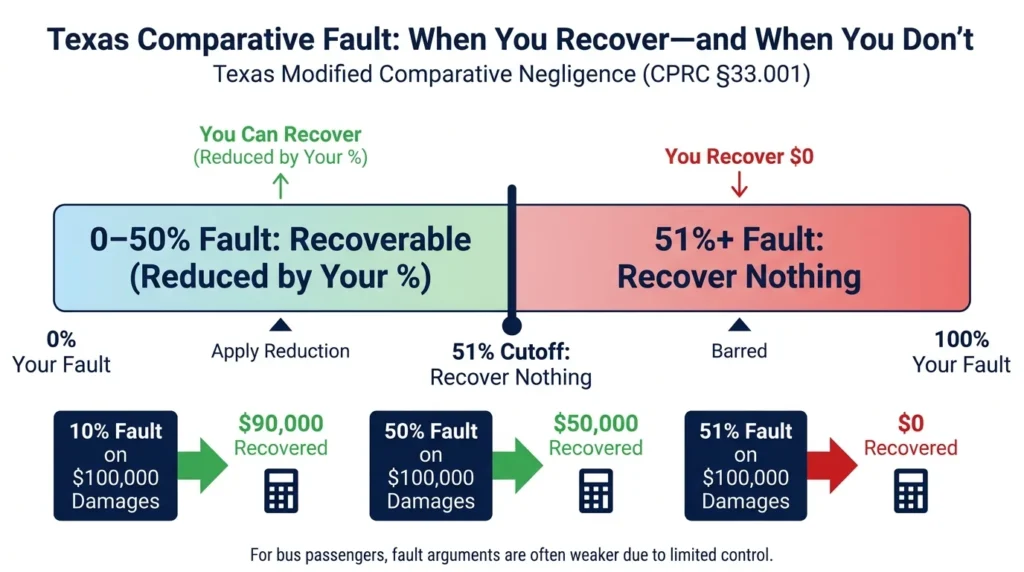
Texas applies modified comparative negligence under Texas Civil Practice and Remedies Code § 33.001. If your share of fault reaches 51% or more (meaning it is greater than 50%) you recover nothing. Below that threshold, your damages are reduced by your fault percentage.
For passengers, fault arguments by carriers tend to be weak. A seated or standing rider has limited control over what causes a crash. Courts applying the common carrier standard look hard at any attempt to shift blame onto the passenger.
If you want a sense of how these cases are typically valued, our breakdown of average bus accident settlements covers the factors that drive recovery amounts.
Need an Attorney? Reach Out Today
The common carrier standard works in your favor, but only if your claim is built and filed correctly under Texas’s notice rules and deadlines. Angel Reyes & Associates has over 30 years of experience handling Texas bus passenger injury claims and has recovered more than $1 billion for clients. We work on contingency, which means no fee unless we win, and free consultations are available 24/7. Contact us today to talk through your situation with our team.
Past results do not guarantee future outcomes.
Bus Passenger Accident Claim FAQs
Can a bus passenger in Texas recover damages if no other vehicle was involved in the crash?
Yes. A bus passenger can file a claim based solely on the operator’s conduct, such as sudden hard braking, unsafe speeds, or poor road conditions the driver failed to manage. The carrier’s duty of care applies regardless of whether another vehicle caused or contributed to the incident.
Does Texas law protect bus passengers who are hurt while boarding or exiting the bus?
Yes. Texas courts have recognized that a common carrier’s duty extends to the boarding and alighting process, not just the ride itself. A passenger injured on steps, at a stop, or while moving between the curb and the vehicle may still have a viable claim against the carrier.
Can a bus passenger's medical insurance company take part of a settlement in Texas?
Yes. If your health insurer paid for treatment related to the injury, it may have a subrogation right to recover those costs from any settlement or judgment you receive. The specific amount depends on your policy terms and whether state or federal law governs the plan.
Is there a damage cap on claims against private bus companies in Texas?
No. Texas does not impose a statutory cap on compensatory damages in personal injury cases against private carriers. Caps apply only to certain government-entity claims and to non-economic damages in medical malpractice cases, which is a separate category.
What if the bus involved in my accident was uninsured or underinsured?
Your own auto insurance policy may provide uninsured or underinsured motorist coverage if you were a named insured, though this depends on your specific policy language and whether the policy extends to injuries sustained as a vehicle passenger.
About the Authors

Alex Ivanov
Writer
Alex Ivanov is a personal injury attorney at Angel Reyes & Associates, focused on car, truck, and motorcycle accident cases. Licensed in Texas and multiple federal districts, Alex brings international legal experience and a global education to his practice. He earned his LL.M. from Texas A&M University School of Law after graduating from Belarussian State University in 2016. Alex is fluent in Russian, English, Ukrainian, and Belarussian, and is recognized by multiple national trial lawyer associations for his results and leadership under 40.

Kyle Nicolas
Editor
Kyle Nicolas is the Web Content & SEO Manager at Angel Reyes & Associates. He has more than 10 years of experience as a marketing co...

Angel Reyes
Reviewer
Angel L. Reyes, III is the Founder and Managing Partner of Angel Reyes & Associates. A nationally recognized trial attorney and business...