How the Texas Tort Claims Act Limits Bus Accident Recovery


Every article on this site is researched by our internal team, reviewed for legal accuracy against current Texas law, and held to State Bar of Texas advertising standards before publication. We do not publish content that overstates outcomes or makes promises about results.
Learn more about our
editorial standards .
Key Takeaways
- Typically, Texas caps city bus injury claims at $250,000 per person and $500,000 per occurrence.
- School district and county bus claims often face lower caps of $100,000 per person.
- Written notice to the government must be filed within six months, or the claim is barred.
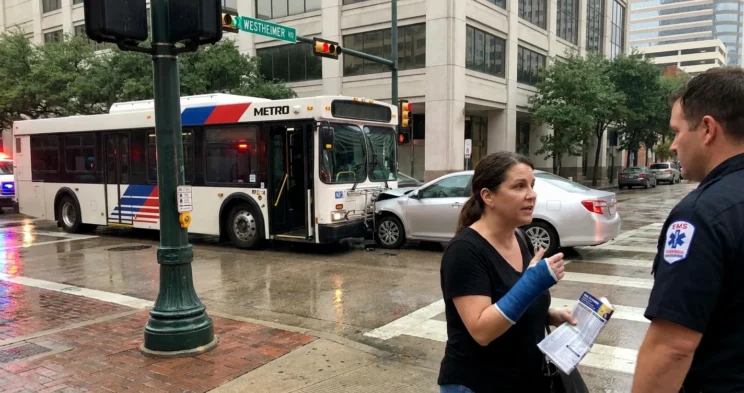
You were riding the city bus into downtown Houston when the driver ran a red light at Westheimer and slammed into another vehicle. Your back is hurting, your wrist is in a brace, and the medical bills are already piling up. Now you’re wondering whether you can even file a claim against a government agency, and how much it might actually cover.
How the TTCA Waives Government Immunity for Bus Accidents
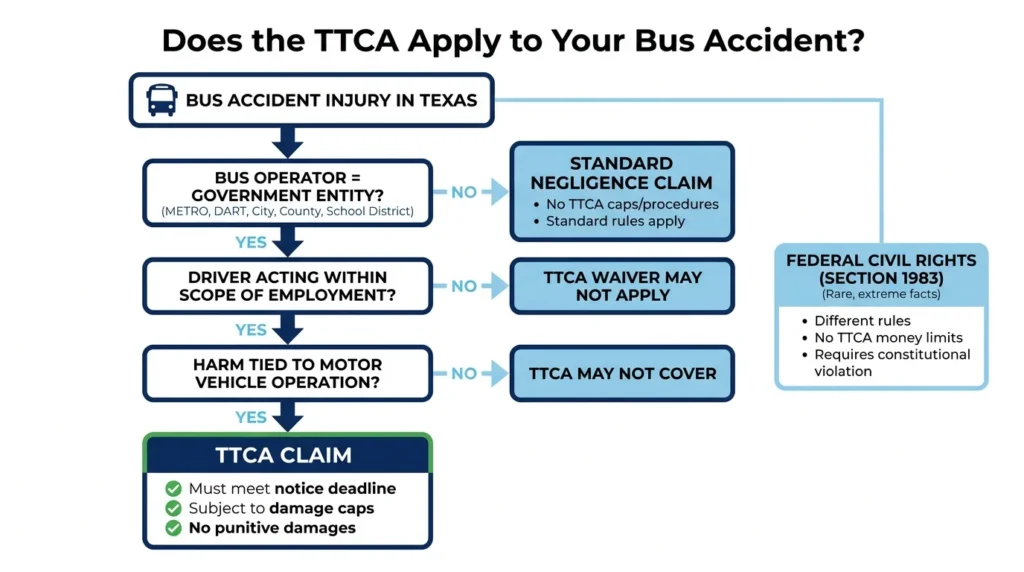
Typically, in Texas, government entities cannot be sued. However, the Texas Tort Claims Act (TTCA) — found under Texas Civil Practice and Remedies Code (CPRC) Chapter 101 — creates an exception that allows injured people to recover compensation when a government employee causes a crash while driving a government-owned vehicle. This waiver is limited and is the only path to recovery against most government bus operators.
TTCA applies when a government employee operates a motor vehicle within the scope of employment and causes injury, death, or property damage. This includes government employees of state agencies, cities, counties, school districts, and regional transit authorities.
Major transit agencies like DART and METRO are considered government entities under Texas law. Because of this, any lawsuit against them must follow the strict rules and deadlines set by TTCA.
Private bus companies are different. Charter operators and contracted carriers are not government entities, so the TTCA caps and procedures do not apply to claims involving them. In these claims, standard Texas negligence rules govern instead.
If you are unsure which kind of bus was involved in your accident, an attorney handling Texas bus accident cases can sort out the operator’s status before filing your lawsuit.
TTCA Damage Caps for Government Bus Injuries
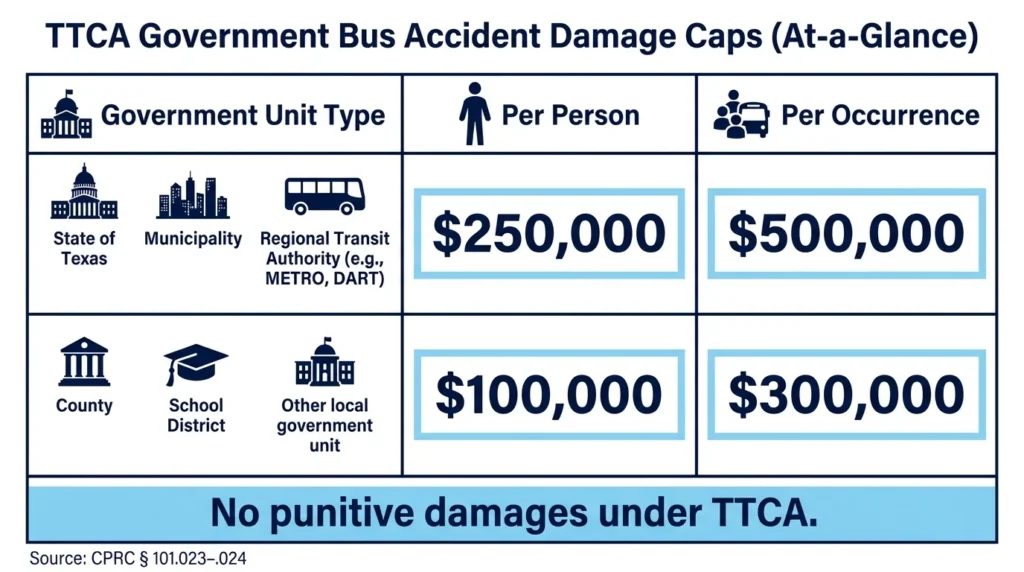
CPRC § 101.023 sets caps (maximum limits) on what you can recover against a government entity after a bus accident. There is no way around these limits. Even when the actual damages are far higher than the limit, the statutory cap controls the maximum payout.
State & Municipality Caps
Claims against the State of Texas or a municipality are capped at $250,000 per person and $500,000 per occurrence for bodily injury or death. A single injured rider on a city bus cannot recover more than $250,000 total, no matter what.
Because DART and METRO are regional transit authorities, they fall into this higher government tier. This is a critical detail for riders in cities like Houston, Dallas, and Austin, where transit use is highest. In these cities, your total recovery is strictly limited by these state-mandated caps.
Other Local Government Unit Caps
Accidents involving counties, school districts, and other non-municipal local government units fall under a lower tier: $100,000 per person and $300,000 per occurrence. A school bus crash, for example, triggers this lower ceiling. The per-person maximum is $100,000, even when the injuries are catastrophic.
Texas law (CPRC § 101.024) completely blocks punitive damages in government cases. That means that no matter how reckless the driver was, you cannot sue for ‘extra’ money to punish the agency. Because of this, the state-mandated damage caps are the absolute limit for what your claim is worth.
The Six-Month Notice Requirement
CPRC § 101.101 requires written notice to the governmental unit within six months of the incident. Missing this deadline generally bars the entire claim. The court will throw your case out on a technicality without ever listening to your side of the story.
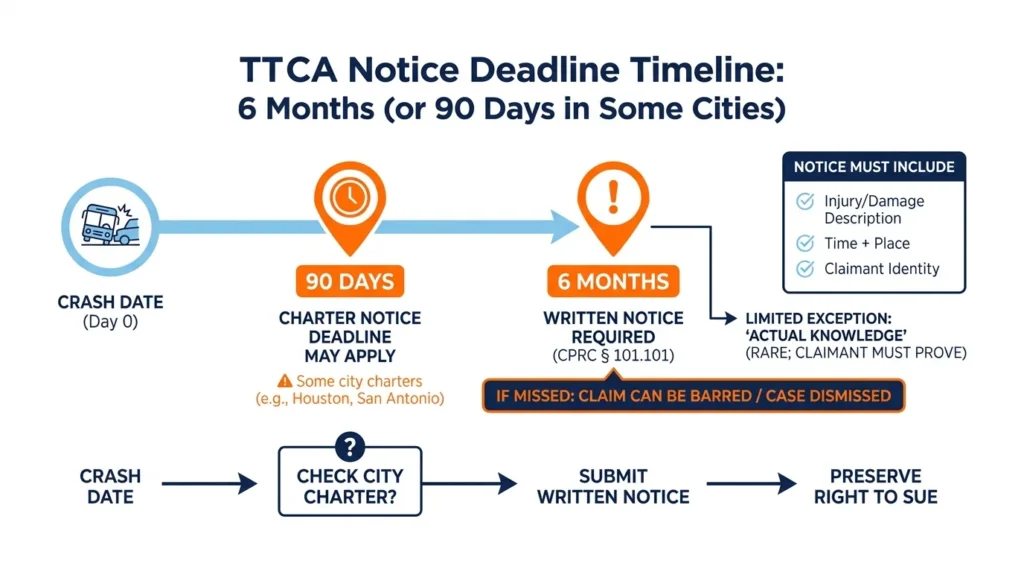
Your written notice must describe the damage or injury, the time and place of the incident, and your identity as the claimant. It is a short document, but the content requirements are not optional.
Some Texas cities operate under charters that shorten the deadline. Houston and San Antonio, for example, impose 90-day notice deadlines through their city charters. When the charter is stricter than the state statute, you must follow the charter. Always check the specific city’s governing documents quickly after an incident.
There is only one exception to this rule. If the government entity had actual knowledge of the incident and your injury within six months, courts may waive the written-notice defense. But the exception is rarely applied, and you will carry the burden of proving the agency truly had that knowledge. An attorney can help you understand what to do if a bus hits your car, so the clock does not run out before you act.
What Claims Can & Cannot Proceed Under TTCA
The TTCA waiver covers personal injury, death, and property damage tied to the operation of a government vehicle. It does not cover every tort (“legal wrong”) committed by a government employee. If the bus driver was acting outside authorized duties at the time, the waiver may not apply at all.
Wrongful Death Claims
Wrongful death claims face the same caps as injury claims. Surviving family members hit the per-person and per-occurrence ceilings just like injured riders do. That makes early case planning critical when permanent harm or a fatality is involved, especially in a wrongful death claim where multiple beneficiaries may share a single capped recovery.
Civil Rights Claims
In some rare and extreme cases, you may be able to sue under federal civil rights laws instead of the standard Texas rules. This is known as a “Section 1983” (42 U.S.C. § 1983) claim.
This path is different because there are no money limits — these claims are not restricted by the $250,000 Texas state caps — and they follow federal guidelines rather than the strict Texas Tort Claims Act.
However, this only applies if the government’s actions were so reckless that they violated your constitutional rights. Deciding whether your accident qualifies for this federal path or must stay within the state system is a complex decision that requires a lawyer’s review.
Pursue Your Government Bus Accident Claim Today
Government bus claims move on tight deadlines and tighter dollar ceilings. Angel Reyes & Associates brings over 30 years of experience to Texas injury cases, with more than $1 billion recovered for our clients across the state.
We work on a contingency basis, meaning there are no fees unless we win. Contact us today to review your notice deadline, the applicable cap tier, and your path forward. We are available 24/7 to discuss your case.
Past results do not guarantee future success.
Government Agency Bus Accident FAQs
Can a government bus accident claim be filed under both the TTCA and a private insurance policy at the same time?
Texas governmental units are required to maintain liability coverage or self-insurance to satisfy TTCA claims, but that coverage does not stack with any private uninsured or underinsured motorist policy the injured person carries. Recovery under a personal UIM policy after a government bus accident depends entirely on how that policy defines an “uninsured motor vehicle,” which varies by insurer.
Does the TTCA notice requirement apply to a passenger injured on a government bus, or only to drivers of other vehicles?
The notice requirement under CPRC § 101.101 applies to any claimant seeking recovery against a governmental unit, including passengers hurt on the bus itself. Your status as a passenger rather than a driver of another vehicle does not create an exception to the six-month written-notice deadline.
If multiple people are injured in the same government bus crash, how is the per-occurrence cap divided among them?
The per-occurrence cap sets a ceiling on the total paid to all claimants from a single incident. If total valid claims exceed that ceiling, each claimant’s share is reduced proportionally, which means individual recoveries can fall well below the per-person cap when injuries are widespread.
Can a minor's claim against a government bus operator be affected by the same notice deadline?
Texas courts have generally held that the TTCA notice deadline applies even when the claimant is a minor, with limited tolling protections available in some circumstances. A parent or guardian should not assume the deadline is automatically extended simply because the injured person is under 18.
Does the TTCA cover injuries that happen when boarding or exiting a government bus, not just during the ride?
Texas courts have recognized that the “operation” of a motor vehicle under the TTCA can extend to situations closely connected to vehicle use, but coverage for boarding and exiting injuries depends on the specific facts and how directly the vehicle’s operation contributed to the harm. Cases where the vehicle was stationary at the time of injury have produced inconsistent results across Texas courts.
About the Authors

Alex Ivanov
Writer
Alex Ivanov is a personal injury attorney at Angel Reyes & Associates, focused on car, truck, and motorcycle accident cases. Licensed in Texas and multiple federal districts, Alex brings international legal experience and a global education to his practice. He earned his LL.M. from Texas A&M University School of Law after graduating from Belarussian State University in 2016. Alex is fluent in Russian, English, Ukrainian, and Belarussian, and is recognized by multiple national trial lawyer associations for his results and leadership under 40.

Kyle Nicolas
Editor
Kyle Nicolas is the Web Content & SEO Manager at Angel Reyes & Associates. He has more than 10 years of experience as a marketing co...

Angel Reyes
Reviewer
Angel L. Reyes, III is the Founder and Managing Partner of Angel Reyes & Associates. A nationally recognized trial attorney and business...