2025 Texas Motorcycle Accident Statistics


Every article on this site is researched by our internal team, reviewed for legal accuracy against current Texas law, and held to State Bar of Texas advertising standards before publication. We do not publish content that overstates outcomes or makes promises about results.
Learn more about our
editorial standards .
Key Takeaways
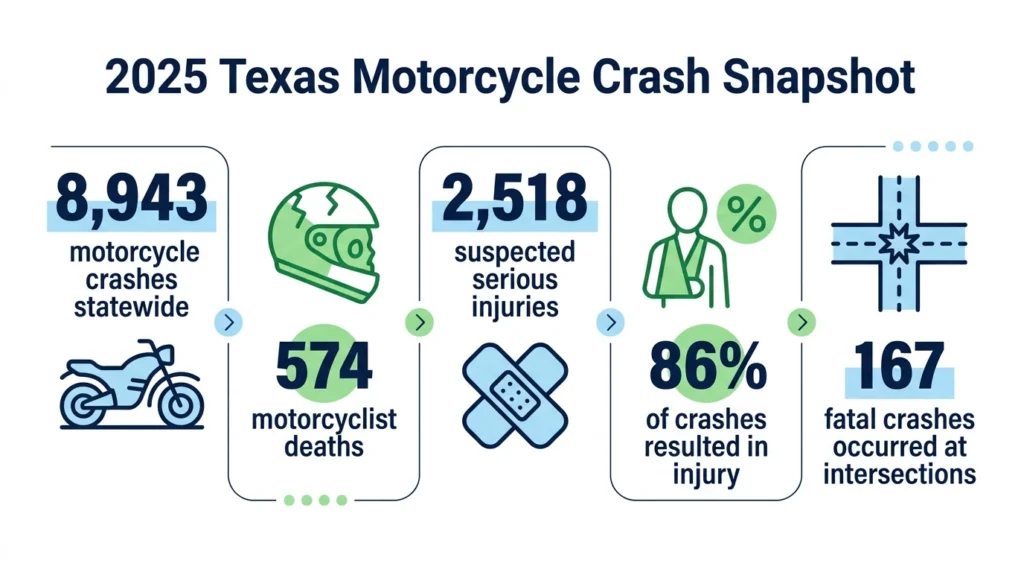
- A TxDOT report given to Angel Reyes & Associates shows 574 Texas motorcyclist deaths in 2025, a decrease of approximately 1.9% from 2024.
- Of the 561 fatal motorcycle crashes in 2025, 167 (nearly 30%) occurred at intersections.
- Harris, Bexar, Dallas, and Tarrant counties led in crash volume. The same five cities continue to top the state, with San Antonio now ranking second ahead of Dallas.
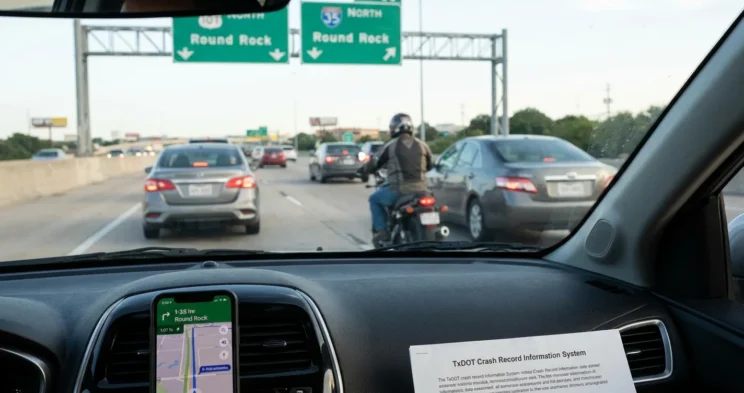
You ride the I-35 corridor between Austin and Round Rock most weekday mornings, and you’ve seen enough close calls to wonder how often Texas riders actually go down. Maybe a friend was hit last summer, or maybe you’re just trying to put a number on the risk you accept every time you swing a leg over the saddle.
Texas motorcycle accident statistics data exists, but it’s scattered across state databases and federal reports. Here is a clear snapshot of what the official records show.
Texas Fatalities & Crashes in 2025
In 2025, preliminary TxDOT data shows 574 motorcyclist deaths on Texas roads, drawn from a CRIS public extract performed by Angel Reyes & Associates as of May 2026. These figures come from the Crash Record Information System (CRIS), the state’s official crash database. The 2025 annual report has not yet been published; this data was extracted directly from the CRIS Query Tool to make these preliminary figures available ahead of the final release.
Crash reporting in Texas operates under a statutory framework. Officers and drivers report collisions under Texas Transportation Code Chapter 550, which sets the rules for when a crash must be documented and what data must be captured. Those reports flow into CRIS.
The figures discussed throughout this article come from the TxDOT Crash Data Analysis and Statistics page, where annual summaries and the CRIS Query Tool are publicly available. Readers seeking deeper breakdowns on Texas motorcycle accident claims can pull custom reports directly from the same source the figures here rely on.
Year-Over-Year Motorcycle Death Trends in Texas
Motorcyclist deaths in Texas decreased approximately 1.9% in 2025 compared to 2024, dropping from 585 to 574. Of the 561 total fatal motorcycle crashes recorded in 2025, 167 occurred at intersections, representing nearly 30% of all fatal motorcycle crashes statewide.
The annual data record shows some divergence in the COVID-era years from the surrounding trend line. TxDOT’s public statement on rising motorcyclist deaths summarizes the multi-year movement and provides the underlying counts.
Looking back further, annual motorcyclist fatality totals in Texas have ranged from roughly 400 to more than 600 across the past decade. The 2025 count of 574 places that year in the upper portion of the historical range. Families who have lost a loved one in a fatal crash can review information about Texas wrongful death claims to understand how these cases work.
Texas Motorcycle Crash Data by County & City
There were 8,943 motorcycle crashes statewide in 2025.
Motorcycle crashes in Texas continue to concentrate heavily in the largest cities, a pattern tied to the state’s biggest population centers. Houston led all cities with 685 crashes and 32 deaths, reflecting its large registered vehicle population and dense freeway network.
San Antonio ranked second with 547 crashes and 28 deaths, followed by Dallas (400 crashes, 24 deaths), Fort Worth (328 crashes, 18 deaths), and Austin (289 crashes, 17 deaths).
Combined, these five cities accounted for 2,249 crashes — roughly 1 in 4 of all motorcycle crashes recorded statewide.
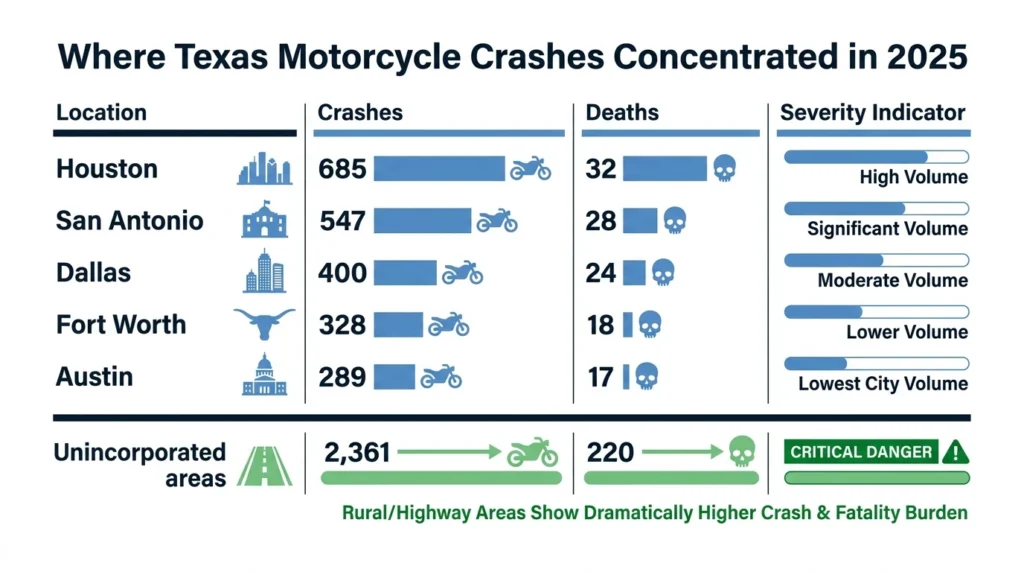
Crashes outside city limits told a different story. The 2,361 crashes recorded in unincorporated areas produced 220 fatalities, which is a fatal crash rate significantly higher than any individual city. This points to the elevated danger of highway and rural riding where emergency response times are longer and protective infrastructure is limited.
Statewide, motorcycle crashes resulted in injury 86% of the time. Of the 574 motorcyclists killed and 2,518 who suffered suspected serious injuries, the combined total of 3,092 people sustained fatal or life-altering harm. That equates to more than one every three hours throughout the year.
For readers who want the official statewide and regional breakdowns, the TxDOT Share the Road motorcycle safety campaign publishes CRIS-derived figures in accessible format. Riders looking at the data through the lens of personal harm may also want to review common injuries in motorcycle accidents to understand what these crash counts often mean for the people involved.
How Texas Compares to Other States in Motorcycle Fatalities
Texas consistently ranks among the top states for total motorcycle fatalities. The state’s large registered motorcycle population and high vehicle miles traveled drive much of that ranking. Texas accounts for a disproportionately high share of total U.S. motorcyclist deaths in NHTSA’s national tallies, though year-to-year shares shift modestly.
NHTSA tracks national motorcyclist fatalities and publishes them through its motorcycle safety data portal. One important caveat: NHTSA national data and TxDOT CRIS data use different counting methodologies and reporting periods. Direct equivalence between the two figures is not exact, and any comparison between them should be read as directional.
That caveat noted, the picture is consistent across both sources: Texas carries one of the heaviest motorcyclist fatality burdens in the country in absolute terms. Riders who want to understand what comes next after a serious crash can review legal strategies after a Texas motorcycle accident for a practical breakdown.
Legal Options After a Texas Motorcycle Accident
Numbers can frame the risk, but they don’t replace guidance when you or someone you love is the person behind the statistic. Angel Reyes & Associates has over 30 years of experience representing injury victims across Texas, with more than $1 billion recovered for clients.
We offer free consultations, work on contingency (no fee unless we win), and serve riders across Texas. Contact our team today to talk through your situation.
Past results do not guarantee future outcomes.
Motorcycle Fatality Statistics FAQs
What counts as a "serious injury" in Texas motorcycle crash data?
TxDOT CRIS classifies a serious injury as one that prevents a person from walking, driving, or continuing normal activity, such as a broken bone, severe laceration, or head trauma. This classification is recorded by the responding officer at the crash scene and follows definitions set by the Model Minimum Uniform Crash Criteria.
Can a rider who was not wearing a helmet still recover damages after a Texas motorcycle accident?
Texas law requires helmet use for riders under 21, but riders 21 and older may legally ride without one if they meet certain exemptions. Not wearing a helmet does not automatically bar a rider from recovering damages, though it may affect how fault and injury severity are weighed under Texas proportionate responsibility rules.
How long does a crash report stay on file in the TxDOT CRIS database?
TxDOT retains crash records in CRIS as part of the state’s permanent public safety data archive, and historical records going back many years are accessible through the CRIS Query Tool. There is no standard expiration date that removes a crash report from the system.
Does Texas track motorcycle crashes involving uninsured drivers separately?
CRIS crash reports capture whether a vehicle involved in a crash was insured, but TxDOT does not publish a standalone annual summary that isolates motorcycle crashes by the at-fault driver’s insurance status. Riders can query that data directly using filters in the public CRIS Query Tool.
What is the minimum insurance coverage a Texas motorcyclist is legally required to carry?
Texas requires motorcyclists to carry at least $30,000 per person and $60,000 per accident in bodily injury liability coverage, plus $25,000 in property damage liability. This is the same minimum liability requirement that applies to passenger vehicle drivers under Texas law.
About the Authors

Angel Reyes
Writer
Angel L. Reyes, III is the Founder and Managing Partner of Angel Reyes & Associates. A nationally recognized trial attorney and business leader, Angel has helped over 70,000 injury victims recover more than $1 billion since founding the firm in 1993. Named to the Texas Super Lawyers list annually since 2008, Angel brings Wall Street experience, Ivy League education, and a deep commitment to client advocacy. He is a frequent legal commentator and published author with extensive contributions to legal scholarship, trial strategy, and consumer protection.

Kyle Nicolas
Editor
Kyle Nicolas is the Web Content & SEO Manager at Angel Reyes & Associates. He has more than 10 years of experience as a marketing co...

Angel Reyes
Reviewer
Angel L. Reyes, III is the Founder and Managing Partner of Angel Reyes & Associates. A nationally recognized trial attorney and business...