Can You File a Claim After a Single-Vehicle Motorcycle Accident?


Every article on this site is researched by our internal team, reviewed for legal accuracy against current Texas law, and held to State Bar of Texas advertising standards before publication. We do not publish content that overstates outcomes or makes promises about results.
Learn more about our
editorial standards .
Key Takeaways
- Solo crashes can still support claims against a road authority, manufacturer, or phantom driver.
- Texas TTCA notice deadlines for road defect claims can be as short as 30 days by local ordinance.
- MedPay and PIP pay your medical bills after a solo crash regardless of fault.
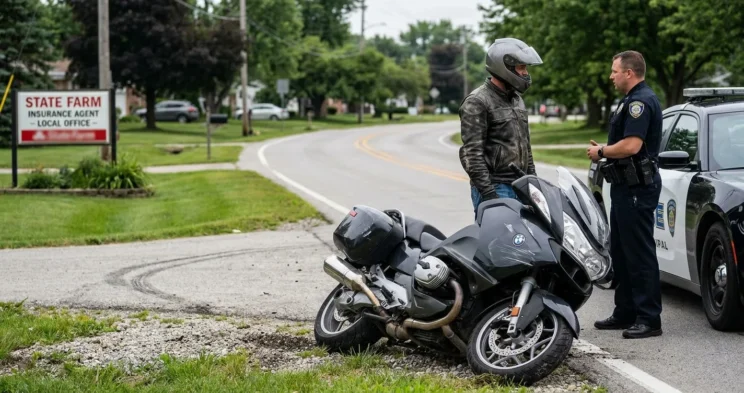
You were riding south on US-290 outside of Austin when a patch of loose gravel in an unmarked construction zone sent your bike sliding out from under you. No other vehicle touched you. By the time the ambulance arrived, you had already started wondering whether you had any legal options at all.
A Single-Vehicle Crash Can Still Have a Responsible Party
You can still potentially determine who is at fault in a motorcycle accident even if you didn’t collide with another vehicle. The question is what caused your crash. Motorcycle accident claims often stem from dangerous road conditions, defective motorcycle parts, or a driver who forces a rider off the road and leaves the scene.
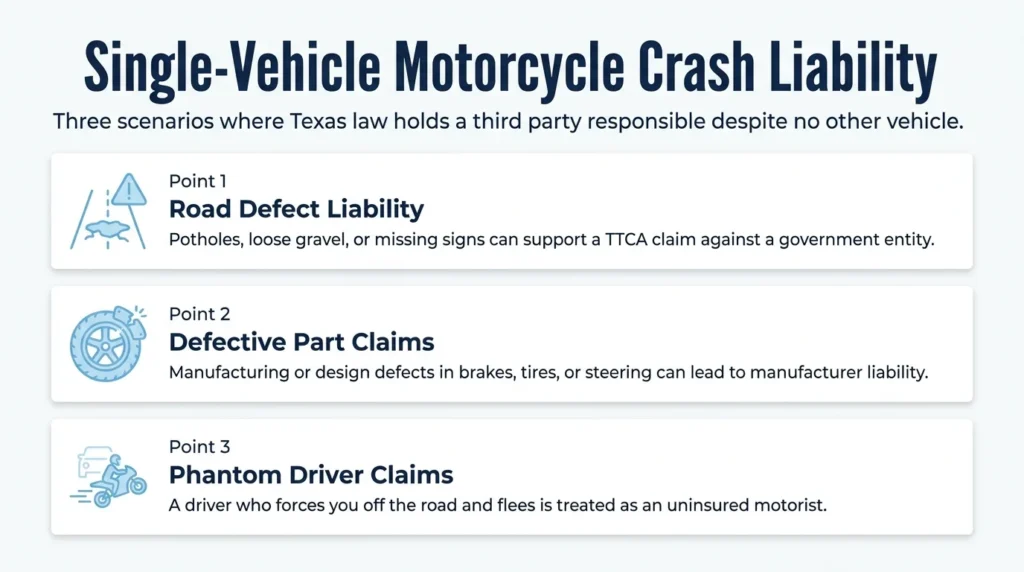
Texas also uses a proportionate responsibility system under Texas Civil Practice and Remedies Code Chapter 33. If you are found more than 50% at fault, you cannot recover anything. But if a road condition, defective part, or phantom driver contributed to the crash, fault may be shared rather than placed entirely on you. That distinction can significantly affect your ability to recover compensation.
When the Road Caused the Crash
In Texas, injured riders may have a claim against a government entity when a roadway defect contributes to a crash. These cases are different from standard personal injury claims because special notice requirements and shorter deadlines often apply.
Road defects can include potholes, broken pavement, missing or obstructed signs, unmarked construction zones, loose gravel, oil spills, or other hazardous conditions that make the road unsafe for riders. In most cases, you must show that the responsible government entity knew, or reasonably should have known, about the hazard before the crash occurred.
Under the Texas Tort Claims Act (CPRC Chapter 101), you must give formal written notice to the responsible government entity before a lawsuit can proceed. The agency responsible for the road depends on where your crash occurred. TxDOT handles state highways, while cities and counties are generally responsible for local roads within their jurisdiction.
The standard TTCA notice deadline is six months from the crash date. Some Texas cities shorten that window to 90 days or fewer by local ordinance. Missing the notice deadline can bar your claim before you ever reach a courtroom.

If you crashed on a government road and a defect may have played a role, document the scene:
Step 1: Photograph the defect from multiple angles. Get close-up shots of the surface condition and wide shots that show the surrounding road and any nearby signage.
Step 2: Record the location precisely. A GPS coordinate or the exact intersection identifier is more useful than a general description.
Step 3: Document physical evidence. Photograph skid marks, debris, and your bike’s final position. These establish how the crash unfolded.
Step 4: Note any construction or maintenance activity nearby. Signs, cones, equipment, or workers in the area establish who may have created or ignored the hazard.
When a Mechanical Failure Caused the Crash
If a mechanical failure caused you to lose control, the manufacturer of the motorcycle or a defective component may be responsible for your injuries. Common failures that may lead to a claim include brake malfunctions, defective tires, throttle problems, steering component failures, and other defects that interfere with the motorcycle’s safe operation.
Texas product liability claims cover three categories of defects. A manufacturing defect means a specific unit was built incorrectly. A design defect means all units of that model share an inherent flaw. A failure-to-warn defect means the manufacturer did not provide adequate instructions or warnings about a known risk.
In these cases, you must show that the defect existed when the part left the manufacturer’s control and that it caused the crash. To help your claim, preserve the bike and all components exactly as they were. Having an independent expert who examined the bike before any repairs or changes can also significantly strengthen your position.
When a Phantom Driver Forced the Crash
A phantom driver is someone whose negligent driving forced you to take evasive action, causing your crash, and who then left before you could identify them. Texas law treats unidentified drivers as uninsured motorists. That means a UM coverage claim may be your path to recovery.
The biggest challenge is proving what happened. You must show that your actions were a reasonable response to the other driver’s conduct and that the unidentified vehicle contributed to the crash. Dashcam footage, witness statements, skid marks, debris patterns, and other physical evidence can help establish the sequence of events.
Many Texas UM policies require independent evidence that the phantom vehicle actually existed. A witness statement, surveillance footage, or dashcam recording is often far more persuasive than a rider’s account alone.
Report the crash to the police immediately and describe exactly what you saw. Ask any bystanders who witnessed the incident for their contact information. The police report is the first layer of documentation your insurer will request.
When There Is No Identifiable External Cause
Not every motorcycle crash results in a liability claim. Sometimes an investigation finds no dangerous road condition, no defective motorcycle component, and no other driver whose actions contributed to the crash. That does not necessarily mean you are out of options.
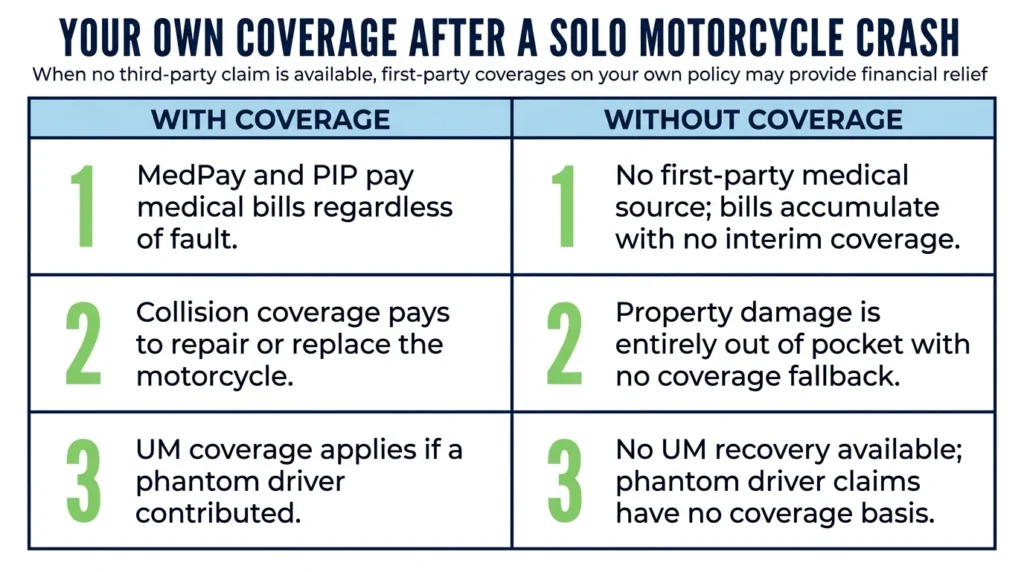
Your own insurance coverage may still provide financial protection. Medical Payments Coverage (MedPay) and Personal Injury Protection (PIP) can help pay medical expenses regardless of who caused the accident. Texas does not require MedPay or PIP on motorcycle policies. If you declined these coverages when you bought your policy, you may have no first-party medical source available. Collision coverage may help pay for repairs to your motorcycle or compensate you for a total loss.
If you believe a road condition contributed to the crash but cannot point to a specific defect, that angle still warrants investigation. Riders often miss road defect claims because they accept the road surface at face value after a crash. A legal investigation can uncover prior complaints, maintenance records, and inspection logs that paint a different picture.
Under CPRC § 16.003, the personal injury filing deadline is two years from the crash date. That window applies to every liability path above. The TTCA notice deadline for government claims may be shorter.
Talk to an Attorney Before You Decide You Have No Claim
If a solo motorcycle crash left you dealing with injuries, damaged equipment, and medical bills with no obvious person to hold responsible, do not assume you have no claim. Angel Reyes & Associates has helped injured Texans through situations exactly like this for over 30 years. We work on a contingency basis, meaning there is no fee unless we win. You can read what clients say about working with us on our client reviews page.
We can review the facts of your crash, explain which liability paths may apply, and help you understand how those issues can affect the value of a potential settlement. Reach out for a free consultation through our contact page.
Past results do not guarantee future outcomes.
Solo Motorcycle Accident FAQs
Can I file a road defect claim if I did not photograph the scene?
Yes, but your case becomes harder to prove without visual documentation. An attorney can request maintenance records, prior complaint logs, and inspection reports from the responsible agency, which may establish that the defect was known before your crash.
What if I had no insurance at all when the crash happened?
If you were uninsured, you would lose the ability to use your own UM, MedPay, or collision coverage. You may still be able to pursue a road defect or product liability claim against a third party. Still, your uninsured status can complicate settlement negotiations and reduce the value of those claims in some circumstances.
Can I still file a claim if nobody issued a traffic citation?
Yes. A traffic citation is not required to pursue compensation after a motorcycle accident. Many road defect, product liability, and phantom-driver claims proceed without any driver receiving a ticket because the focus is on what caused the crash.
Can a single-vehicle motorcycle accident still appear on a police report if another party contributed to the crash?
Yes. A police report may classify the incident as a single-vehicle accident even if a road defect, defective motorcycle component, or phantom driver contributed to the crash. The way a crash is categorized on a report does not necessarily determine who may be legally responsible.
Can weather alone create a valid motorcycle accident claim?
Usually not. Rain, wind, and other weather conditions do not automatically create liability. However, weather, combined with dangerous road conditions, poor maintenance, or an improperly marked construction zone, may still support a claim.
About the Authors

Spencer Browne
Writer
Spencer Browne is a partner at Angel Reyes & Associates and a Board Certified personal injury trial lawyer with nearly 100 jury trials across Texas. He focuses on car, truck, and wrongful death cases, with notable verdicts including a landmark win in the Choctaw Casino bus crash case. A recognized speaker and legal educator, Spencer is a member of the American Board of Trial Advocates and has been honored as a Texas Super Lawyer and one of D Magazine’s Best Lawyers in Dallas. He brings deep trial experience and relentless advocacy to every client he represents.

Kyle Nicolas
Editor
Kyle Nicolas is the Web Content & SEO Manager at Angel Reyes & Associates. He has more than 10 years of experience as a marketing co...

Angel Reyes
Reviewer
Angel L. Reyes, III is the Founder and Managing Partner of Angel Reyes & Associates. A nationally recognized trial attorney and business...