Who Is at Fault in a Motorcycle Accident in Texas?


Every article on this site is researched by our internal team, reviewed for legal accuracy against current Texas law, and held to State Bar of Texas advertising standards before publication. We do not publish content that overstates outcomes or makes promises about results.
Learn more about our
editorial standards .
Key Takeaways
- Texas reduces your damages by your fault share and bars recovery if you are 51% or more at fault.
- CPRC § 16.003 gives Texas riders two years to file, but evidence fades long before that.
- The CR-3 crash report is not final on fault but heavily shapes how insurers assess liability.
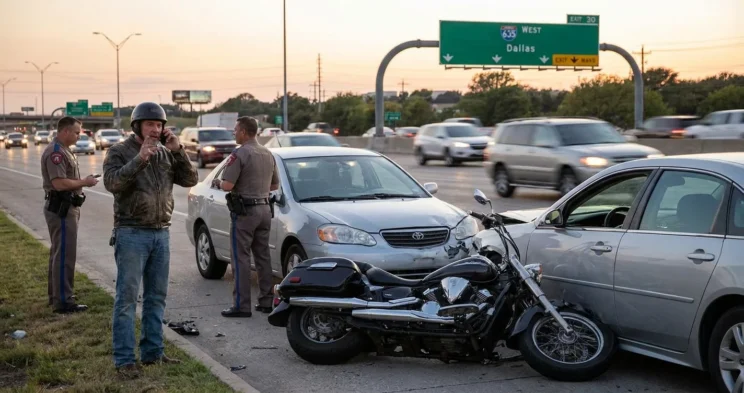
You were riding home from a job site in Garland one evening when a sedan drifted into your lane on I-635 and clipped your front wheel. The fall broke your wrist and left you with some serious road rash.
Now the other driver’s insurance is calling, and the adjuster is already hinting that you were riding too fast or in the driver’s blind spot. Knowing how Texas actually decides fault is the difference between a fair recovery and being blamed for a crash that you didn’t cause.
How Texas Law Determines Motorcycle Accident Fault
Who bears the fault in a Texas motorcycle crash is built on four elements: duty, breach, causation, and damages. Every driver owes a duty of reasonable care. When a driver breaks that duty and causes injury, they are negligent. Texas law also recognizes negligence per se, where a traffic law violation can establish fault on its own.
Negligence per se matters because it skips an argument. If a driver runs a red light or makes an unsafe lane change, the statute itself proves they breached their duty. The law has already decided, and you do not have to argue what a reasonable driver would do.
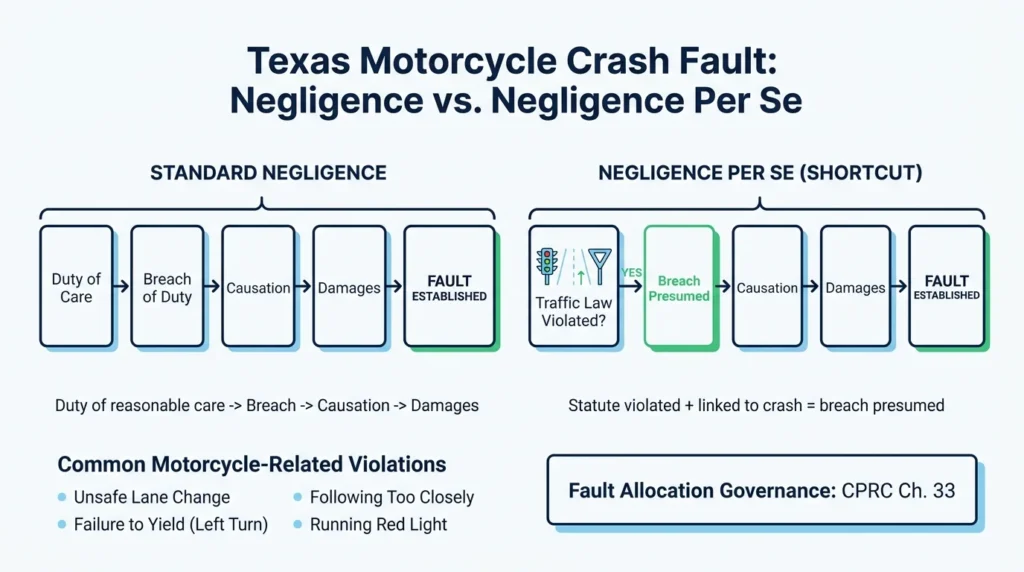
The traffic violations most often tied to motorcycle crashes are unsafe lane changes, failure to yield on left turns, following too closely, and running red lights. Each can stand on its own as fault evidence. They also tie directly into how courts apportion blame under the Texas Civil Practice and Remedies Code (CPRC) Chapter 33, which controls how fault is shared in injury cases.
For a broader context on how Texas courts and insurers weigh these factors, our overview of how fault is determined in Texas walks through the same framework across all crash types.
Evidence Used to Establish Fault in Texas Motorcycle Crashes
Fault is reconstructed from evidence, not assumptions. Investigators rely on physical signs at the scene, electronic records, the official crash report, and witness accounts. The strongest cases combine several sources, so the story of the crash holds up under scrutiny from insurers and, if needed, a jury.
Physical evidence at the scene tells the collision sequence. Skid marks, gouge marks, debris fields, and final vehicle positions each show a piece of what happened. Photographs taken before tow trucks and traffic clear the area often become the most useful exhibits later.
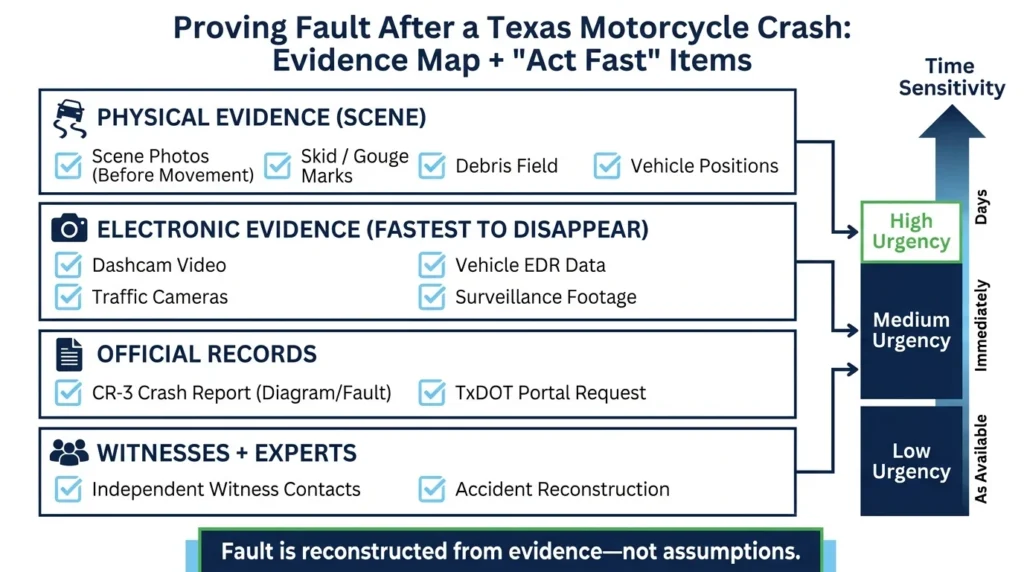
Electronic evidence can be decisive but disappears fast. Dashcam footage from nearby cars, traffic camera recordings, black box data from the other vehicle, and surveillance video from gas stations or storefronts all decay or get overwritten on short cycles. Securing this footage in days, not weeks, often controls the outcome.
Our Texas motorcycle accident practice page covers what evidence to preserve in the days right after a crash.
The Texas Peace Officer’s Crash Report (the CR-3) is the official record of the crash. Officers document their observations, witness statements, create a diagram of the scene, and conduct a preliminary fault assessment. The CR-3 is not the final word on fault, but TxDOT crash report records carry real weight with adjusters and courts.
Independent witnesses carry more weight than interested parties, since the driver in the next lane lacks the bias of a passenger or a friend. However, when witness accounts or physical evidence are contested, accident reconstruction specialists step in to build a scientific opinion from the surviving evidence.
Fault Scenarios by Crash Type
Different crash patterns create different fault questions. Most Texas motorcycle crashes fall into a small set of recurring scenarios, and each one comes with a typical fault answer along with the standard arguments insurers use to push blame back onto the rider.
- Left-turn crashes are the most common scenario. A driver turns across your path at an intersection and fails to see you. The turning driver usually bears fault for failure to yield. Insurers often counter by arguing that your speed or lane position contributed.
- Unsafe lane changes happen when a driver merges into your lane without clearance. Texas Transportation Code Chapter 545 sets out lane change duties, and a violation supports a negligence per se theory. Our breakdown of unsafe lane change crashes in Texas goes deeper into how these cases get proven.
- Rear-end collisions carry a rebuttable presumption of fault against the following driver under Texas law. Insurers may still try to blame the rider for a sudden stop or a brake light issue, but the starting point favors the motorcyclist.
- Road hazards and government fault come up when potholes, unmarked construction, or bad pavement cause the crash. A government entity may share fault, but these claims have strict notice deadlines that differ from the standard two-year window.
Rider conduct matters too. Riding without a valid endorsement, lane splitting in Texas, or impaired riding all give insurers leverage to argue that you bear part or all of the fault.
Rider Bias & How Insurers Shift Fault
Adjusters often start with an assumption that the rider was speeding, weaving, or riding recklessly. That bias shapes the first fault assessment, the early demand letters, and sometimes the final offer. Recognizing the playbook is the first step to pushing back on it.
The arguments are predictable:
- The rider was speeding.
- The rider was in a blind spot and failed to be visible.
- The rider wasn’t wearing a helmet.
- The rider lacked a proper endorsement.
Each one is designed to create comparative fault and shrink the insurer’s payout.
Helmet non-use is a frequent target. Texas Transportation Code § 661.003 requires helmets for riders under 21, and for older riders who have neither completed a qualifying safety course nor obtained qualifying health insurance coverage. Even when a rider legally qualifies for the helmet exemption under § 661.003(c), insurers may still raise non-use as a comparative fault factor in head injury cases.
Early evidence preservation is the strongest counter to any of these biases. Photographs, a prompt CR-3 request, dashcam footage, and witness contact information all undercut a fault narrative built on guesses. When both sides point fingers, our guide on what happens when both drivers claim the other is at fault explains how those disputes get resolved.
Riders dealing with serious injuries should also review common motorcycle accident injuries so the medical record matches the fault story.
Texas Comparative Fault & the 51% Bar
Texas uses a modified comparative fault rule under CPRC Chapter 33, which means that your damages are reduced by your share of fault. If you are found 51% or more responsible, you recover nothing. At 50% or less, you will recover damages, but the award is cut by the percentage by which you are at fault.
Fault percentages are not set by one party; while an adjuster will propose a split, a jury makes the final decision in a lawsuit. Contested cases often hinge on the quality of evidence and the credibility of the reconstruction experts who testify.
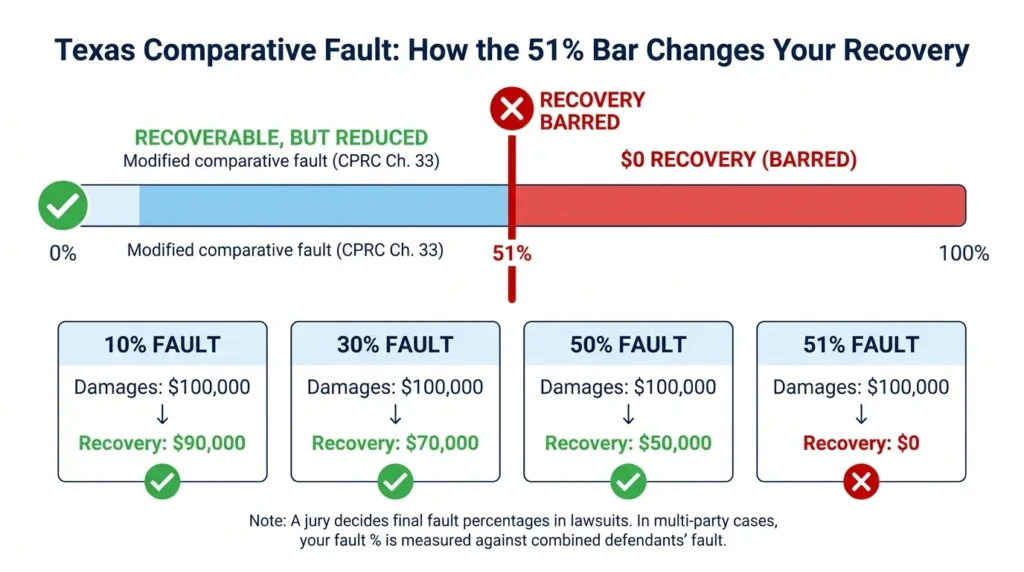
When more than one party contributed to the accident, fault is spread across all of them. A negligent driver and a road contractor might both share blame. Your percentage is measured against the combined fault of every defendant, which can change whether you clear the 51% bar.
Time pressure is real; the two-year filing deadline under CPRC § 16.003 is a hard limit, and evidence degrades long before that. An attorney can run an independent liability review before you respond to a first offer, so the proposed fault percentage gets tested against the actual evidence. Our piece on whether you can recover when partially at fault for a Texas crash walks through how the math actually works.
Talk to a Texas Motorcycle Accident Attorney
A disputed fault assignment can cost you the medical care, lost wages, and recovery you are owed. Angel Reyes & Associates has more than 30 years of experience handling motorcycle accident claims in Texas, with more than $1 billion recovered for clients.
We work on a contingency basis, so there is no fee unless we win. Our injury attorneys show what that representation looks like in practice. Contact us today for a free consultation before the insurer’s first fault assessment becomes the final one.
Past results do not guarantee future outcomes.
Motorcycle Accident Fault FAQs
Can I get a copy of the CR-3 crash report myself, and how long does it take?
Anyone involved in a Texas crash can request a copy of the CR-3 report directly from TxDOT through their online crash report portal, typically for a small fee. Reports can take up to 10 days to appear in the portal, depending on when the officer submits the document.
Does Texas require motorcyclists to carry a specific type of insurance, and does coverage type affect a fault claim?
Texas requires motorcyclists to carry at least the state minimum liability coverage, which mirrors the requirements for other motor vehicles: $30,000 per person, $60,000 per accident, and $25,000 for property damage. Your own coverage type, such as whether you carry uninsured motorist protection (UM), does not change who is at fault, but it can affect how much compensation you can actually collect if the at-fault driver is uninsured.
If a passenger vehicle's defective equipment caused the crash, can the manufacturer share fault?
Yes. If a defective part, such as a failing brake system or a tire blowout, contributed to the crash, the manufacturer or distributor may be liable under a products liability theory separate from negligence. Texas allows fault to be allocated across all responsible parties, including product makers, in the same case.
How does fault work if the crash happened in a construction zone with poor signage?
When missing or inadequate signage in a construction zone contributed to a crash, the contractor managing the zone, or the government agency overseeing the project, may share fault. Claims against a government entity in Texas require a formal notice of claim filed within six months of the incident under Texas Civil Practice and Remedies Code Chapter 101, the Texas Tort Claims Act.
Can a rider's prior traffic record be used against them in a Texas fault dispute?
A rider’s general driving history is typically not admissible to show fault in a specific crash, but a prior conviction directly related to the conduct at issue could come into play in some circumstances. Insurance companies may also factor driving history into coverage decisions separately from the legal fault determination.
About the Authors

Alex Ivanov
Writer
Alex Ivanov is a personal injury attorney at Angel Reyes & Associates, focused on car, truck, and motorcycle accident cases. Licensed in Texas and multiple federal districts, Alex brings international legal experience and a global education to his practice. He earned his LL.M. from Texas A&M University School of Law after graduating from Belarussian State University in 2016. Alex is fluent in Russian, English, Ukrainian, and Belarussian, and is recognized by multiple national trial lawyer associations for his results and leadership under 40.

Kyle Nicolas
Editor
Kyle Nicolas is the Web Content & SEO Manager at Angel Reyes & Associates. He has more than 10 years of experience as a marketing co...

Alex Ivanov
Reviewer
Alex Ivanov is a personal injury attorney at Angel Reyes & Associates, focused on car, truck, and motorcycle accident cases. Licensed in...