Highway Motorcycle Accidents in Texas


Every article on this site is researched by our internal team, reviewed for legal accuracy against current Texas law, and held to State Bar of Texas advertising standards before publication. We do not publish content that overstates outcomes or makes promises about results.
Learn more about our
editorial standards .
Key Takeaways
- Texas bars recovery if a rider is found 51 percent or more at fault for the crash.
- Highway crash evidence disappears fast, so it is important to preserve dashcam footage and scene photos within hours of the crash.
- Texas gives you two years from the crash date to file a motorcycle injury claim.
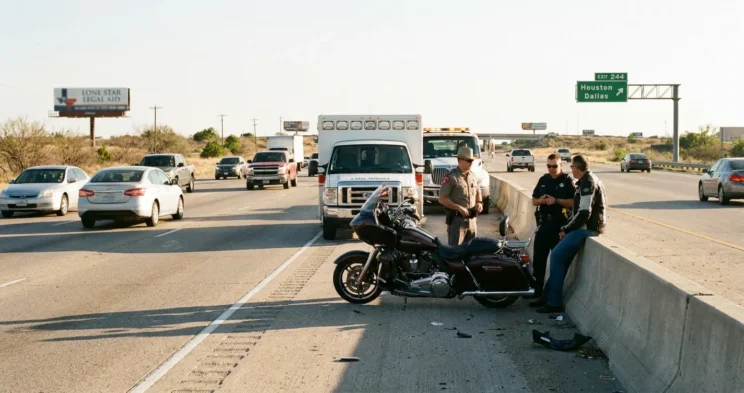
You were riding home on I-35 during evening rush hour traffic when a car drifted into your lane and struck your front wheel. At 70 miles an hour, there was no time to react. Now, you are in a hospital bed with a stack of bills, and the other driver’s insurer is already hinting that you were speeding.
You know the crash was not your fault. So, why does it feel like you are the one being blamed?
Why Highway Crashes Are Especially Dangerous for Motorcyclists
A highway crash is far more damaging to a motorcyclist than a crash on a city street. At 65 to 75 miles an hour, the forces involved produce far worse injuries than a surface collision on the street. The speed is the difference; more force means more harm to the human body. Even with full protective gear, riders can walk away from interstate crashes with traumatic brain injuries, spinal fractures, and damage to multiple organs.
Aggressive merges and sudden lane changes are a leading cause of these wrecks. When a car crosses into your lane at highway speeds, you have almost no time to respond. It is illegal in Texas for a driver to force a rider out of a lane, but many drivers do it anyway, treating the motorcycle as if it were not there.
Road debris adds another danger. A car can drive right over a blown tire tread or a gravel patch, but on a motorcycle at highway speed, these same hazards can cause you to lose control and crash immediately.
Commercial trucks raise the stakes further. An 18-wheeler creates wind turbulence, takes wide turns, and carries large blind spots where a rider disappears from view. A cargo spill or an unsafe lane change can take you down in a heartbeat, which is why commercial truck crash cases often rely on different evidence than a typical wreck.
Speed, Fault, & Texas Comparative Negligence
The first question an insurer will ask is how fast you were going at the time of the crash. This is because the way Texas law assigns fault is the most important part of your case.
In Texas, you can recover compensation even if you were partially at fault, as long as your share of fault does not pass 50 percent. Cross that line, and you recover nothing. This rule comes from the Texas Civil Practice and Remedies Code (CPRC) § 33.001. If a jury assigns you 51 percent or more of the blame, then you cannot file your claim at all.
This is why insurers fight so hard over fault. Pushing your share of the blame above 50% is the cheapest way for them to pay nothing, and saying you were speeding is their favorite way to do it.
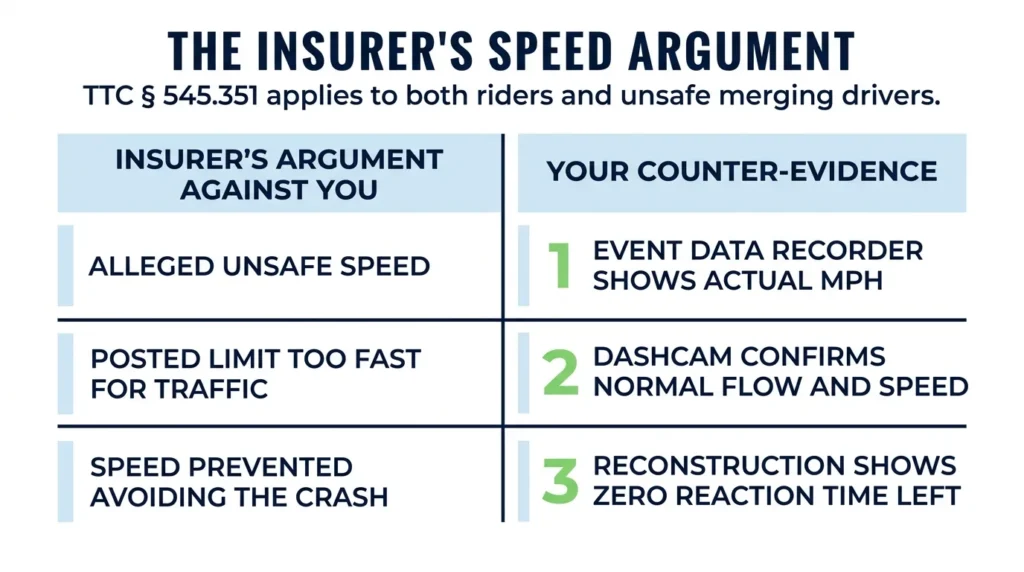
You could have been riding at or near the posted speed limit, and they will still say you were speeding. The adjuster only needs to argue that the conditions called for a slower speed that day. Knowing this tactic is the first step to fighting back.
Under Texas Transportation Code § 545.351, drivers must travel at a safe and reasonable speed according to the road conditions, not just the posted speed limit. This means a driver can break the law if they are driving at or below the posted speed limit if the road conditions make that speed unsafe.
This standard also applies to the other driver if they merged or changed lanes when it was not safe. Under § 545.060, every driver must stay within a marked lane and merge only when it is safe to do so. A sudden, unchecked lane change into your path is a direct violation of this rule, and it shifts fault to the other driver.
An attorney who handles Texas motorcycle crash cases can review how the fault percentages are likely to fall in your situation and help you avoid a settlement that pays far less than your claim is worth.
Evidence That Wins Highway Crash Claims
Highway crashes leave behind evidence that a crash on a city street doesn’t. The right records can prove that you weren’t speeding and show what really happened.
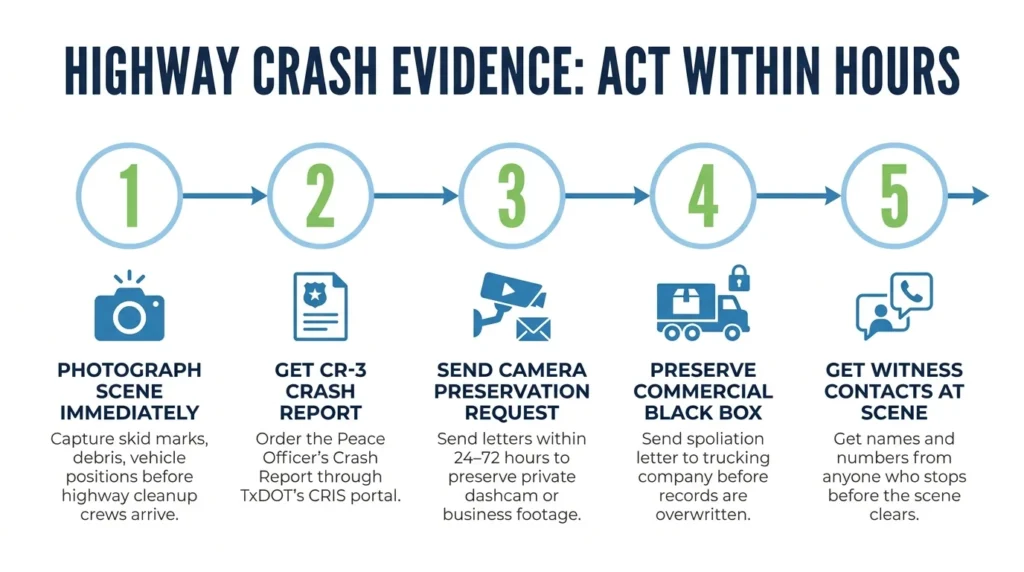
Start with the CR-3 crash report filed by the responding officer. This is a record of the parties involved, the witness statements, and the officer’s opinion on who was at fault. You can request your report through the state’s crash records system or from the agency that responded to the crash. If you are unsure how to track it down, our guide on pulling a Texas accident report can walk you through the process.
TxDOT runs traffic cameras on major Texas highways, but most of these cameras stream live footage and do not record or store footage. This means there may not be any archived video to retrieve after a crash. Other sources (like private business cameras, dashcams, and local city traffic systems) may capture footage, but it may be deleted quickly, so it is crucial to send a preservation request to any nearby camera operator immediately.
The state also keeps a public crash database called CRIS. An attorney can pull years of data for a single piece of highway and show that a particular stretch of road is a known danger zone. This will take the focus off your speed and onto the road’s documented safety record.
When a commercial truck is involved, another layer of evidence opens up. Federal rules require carriers to keep electronic logs under 49 CFR Part 395, driver qualification files under 49 CFR Part 391, and maintenance records under 49 CFR Part 396. These records can expose hours-of-service violations or known mechanical problems that contributed to the wreck.
Keep in mind that some of this evidence has a short shelf life. Skid marks, debris fields, and the final resting points of the vehicles are important evidence, but cleanup crews clear highways fast. Photograph the scene within the first few hours of the crash.
Compensation & the Filing Deadline
A highway crash usually results in a larger claim than a city crash because the injuries are more severe.
Your economic damages can cover emergency care, surgeries, rehabilitation, future treatment, and lost wages. You can also pursue non-economic damages, including pain and suffering, long-term disability, and the loss of things you used to enjoy doing.
When a crash takes a life, Texas also allows a spouse, children, and parents to file a separate wrongful death claim for their own losses. However, there is a hard deadline for your claim. The CPRC § 16.003 gives you two years from the date of the crash to file your claim. If you miss that window, you cannot recover any damages at all.
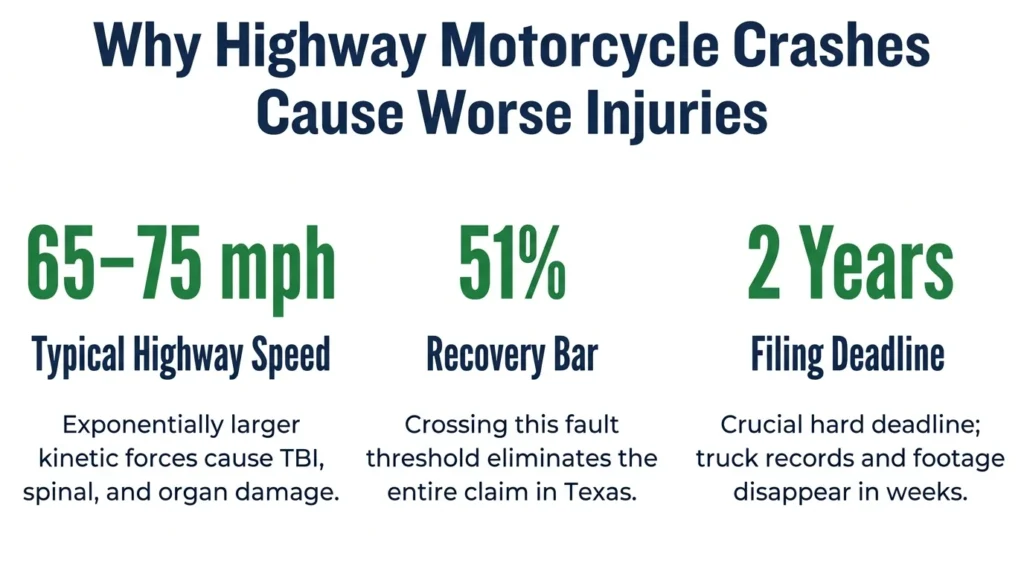
Remember, camera footage and truck records can vanish within weeks, so acting early will protect your evidence and ensure you meet the filing deadline.
If you are found partially at fault for the crash, you can still recover damages. As long as your share of the fault is 50 percent or less, the amount of compensation you can recover is reduced by your percentage. For example, a rider found 20 percent at fault on a $400,000 claim can still recover $320,000. Do the math before you respond to any offer. The first settlement offer an insurer makes is almost never what your claim is truly worth.
Talk to an Attorney About Your Highway Motorcycle Accident in Texas
A highway motorcycle crash can leave you facing serious injuries, a fault dispute, and urgent bills. The good news? You don’t have to take it on alone.
Angel Reyes & Associates has represented injured riders and their families across Texas for more than 30 years. We handle highway and interstate motorcycle crash cases on a contingency basis, which means you pay no fee unless we win, and there is no cost to you upfront. We have recovered more than $1 billion for clients, we serve the entire state of Texas, and we offer free consultations.
Learn more about our team here. You can reach us 24/7 to review our options.
Past results do not guarantee future outcomes.
Highway Motorcycle Accident FAQs
Will my Texas motorcycle injury claim be affected if I wasn’t wearing a helmet?
It depends. If an insurer argues that your injuries were worse because you were not wearing a helmet, then a jury may assign you a higher percentage of fault, which will lower your recovery. This argument applies even if another driver caused the crash.
What if a road defect on a Texas highway caused or contributed to my crash?
A government entity like TxDOT can be held liable for a known road hazard, but the Texas Tort Claims Act requires written notice within 180 days of the crash. This deadline is far shorter than the two-year window for standard personal injury claims, so it’s critical to act fast.
Can a passenger on my motorcycle file an injury claim after a highway crash?
Yes. A passenger can file a claim against any driver whose negligence caused the crash, and passengers are rarely found to share fault. The same two-year filing deadline applies.
What happens if the driver who hit me had no insurance?
If you have uninsured motorist coverage on your own policy, then you can file a claim through your insurer for your medical costs, lost wages, and other damages. Texas law requires insurers to offer this coverage, but riders must reject it in writing to opt out, so check your policy to confirm whether you have it.
Can I seek additional damages if the driver who caused my crash was texting or driving recklessly?
Yes, Texas law allows you to recover exemplary damages if a driver’s conduct can be considered gross negligence. This means they were aware of their risky behavior and acted without regard for others’ safety. A clear example of this is a driver who runs into a rider at highway speed while looking at their phone instead of the road.
About the Authors

Alex Ivanov
Writer
Alex Ivanov is a personal injury attorney at Angel Reyes & Associates, focused on car, truck, and motorcycle accident cases. Licensed in Texas and multiple federal districts, Alex brings international legal experience and a global education to his practice. He earned his LL.M. from Texas A&M University School of Law after graduating from Belarussian State University in 2016. Alex is fluent in Russian, English, Ukrainian, and Belarussian, and is recognized by multiple national trial lawyer associations for his results and leadership under 40.

Kyle Nicolas
Editor
Kyle Nicolas is the Web Content & SEO Manager at Angel Reyes & Associates. He has more than 10 years of experience as a marketing co...

Angel Reyes
Reviewer
Angel L. Reyes, III is the Founder and Managing Partner of Angel Reyes & Associates. A nationally recognized trial attorney and business...