Do You Need Insurance for an E-Scooter?


Every article on this site is researched by our internal team, reviewed for legal accuracy against current Texas law, and held to State Bar of Texas advertising standards before publication. We do not publish content that overstates outcomes or makes promises about results.
Learn more about our
editorial standards .
Key Takeaways
- Texas does not require liability insurance for e-scooter riders; riders are personally responsible for injuries and damages they cause.
- Personal auto and homeowner's policies typically exclude e-scooter accidents; rental company coverage protects the company more than it protects injured third parties.
- Injured parties can pursue the rider directly, check their own UM coverage, or explore TTCA claims if infrastructure contributed to the crash.
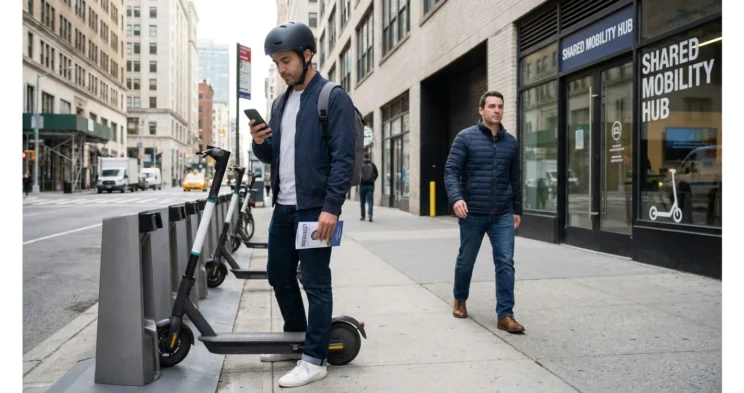
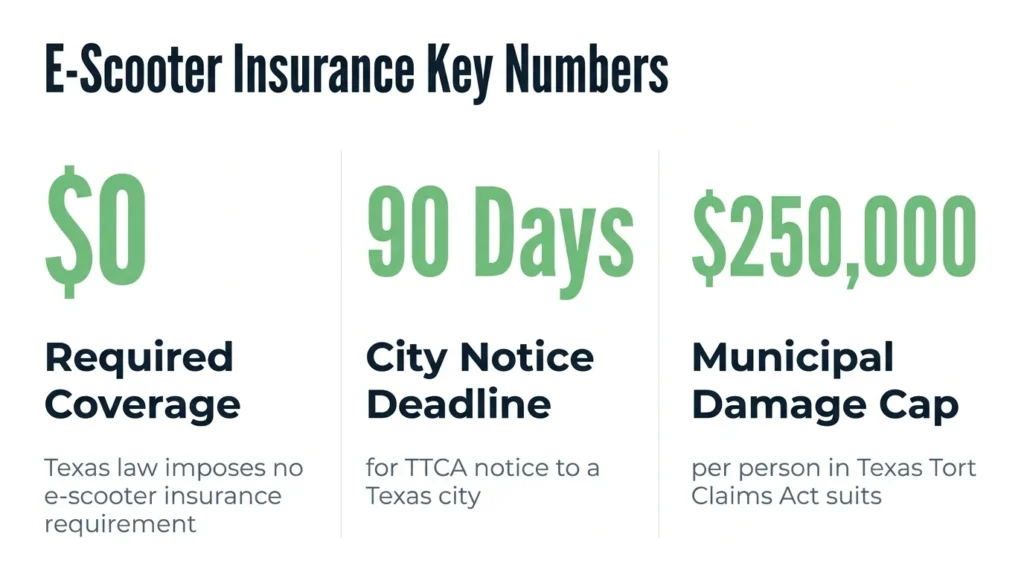
Texas does not require liability insurance for e-scooter riders. There is no state law that mandates coverage the way motor vehicle insurance is required, but the absence of a legal requirement does not mean riders have no financial exposure. If you cause an accident on an e-scooter, you are personally responsible for the injuries and damages that result. Whether any insurance picks up that responsibility depends on how you ride, owned or rented, and what your existing policies actually cover.
Texas Does Not Require E-Scooter Insurance
No, Texas law requires e-scooter riders to carry liability insurance before riding. This is different from motor vehicles, which must meet minimum insurance requirements under state law. The Texas Department of Insurance recommends that riders check with their insurance agent before riding to understand what coverage they have, and to consider adding coverage if they ride regularly.
What Coverage a Rental Scooter Provides
When you rent through an app like Lime or Bird, the company carries commercial liability insurance. That coverage is designed primarily to protect the company from liability, not to provide broad protection to riders or injured third parties.
Some Texas cities require rental operators to maintain insurance coverage for damage to public property. That requirement does not extend to injuries you cause to pedestrians, cyclists, or other road users.
Rental agreements from companies like Lime and Bird include language requiring riders to assume responsibility for harm they cause. The rider is expected to indemnify the company. If you injure someone while riding a rental scooter, the rental company’s insurance is not a reliable source of compensation for the injured party. That person will generally need to pursue the rider directly.
Does Your Personal Auto or Home Policy Cover You?
For riders who own their e-scooters, the question of personal coverage is an important one to answer. The answers from standard insurance policies are largely discouraging.
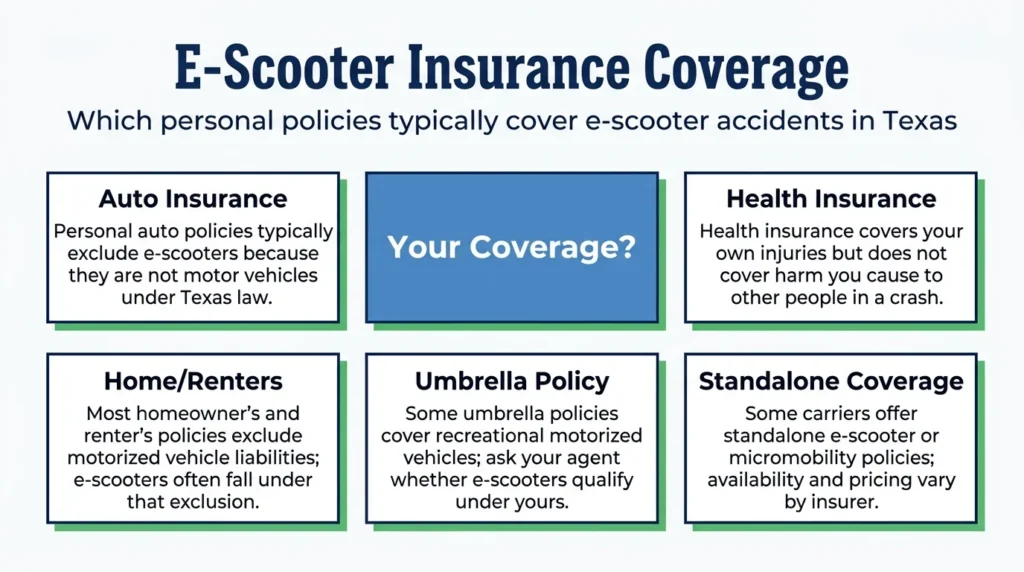
Personal auto insurance: Most personal auto policies cover motor vehicles. E-scooters are not classified as motor vehicles under Texas law. Many auto policies also exclude vehicles with fewer than four wheels. A Texas auto insurer will typically deny a claim arising from an e-scooter accident.
Homeowner’s and renter’s insurance: Standard homeowner’s and renter’s policies generally exclude liabilities caused by motorized vehicles. Because e-scooters have motors, they often fall within that exclusion. Whether coverage applies depends on your specific policy language. Do not assume you are covered without verifying with your carrier.
Umbrella policies: Some umbrella policies include coverage for recreational vehicles. An e-scooter may qualify under that category in some policies. Ask your agent whether your umbrella covers motorized recreational vehicles used on public roads.
Health insurance: Your health insurance will cover your own injuries. It does not cover injuries to other people you harm in a crash.
Standalone scooter coverage: Some carriers offer policies specific to e-scooters or micromobility devices. Others allow scooter coverage as an add-on to a motorcycle policy. Availability and pricing vary by insurer. If you ride an e-scooter regularly, the Texas Department of Insurance recommends asking your agent about adding appropriate coverage to your portfolio.
For more on how Texas law governs e-scooter use and liability, see e-scooter laws and liability in Texas.
What Injured Parties Can Do When Coverage Is Missing
If the e-scooter rider who injured you has no relevant insurance, several legal options remain.
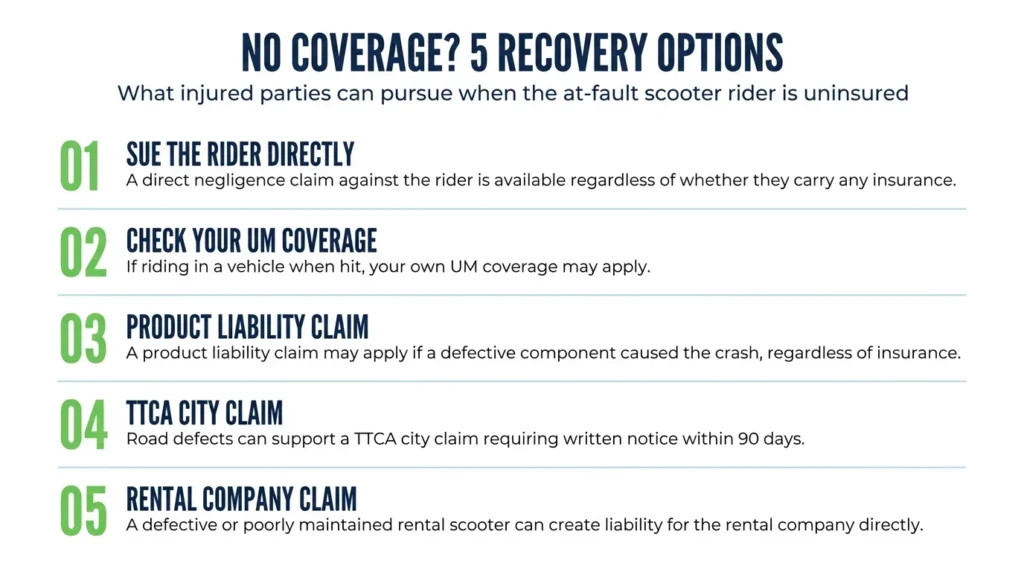
Direct negligence claim against the rider: You can file a personal injury claim against the rider regardless of whether they carry insurance. An attorney can evaluate the rider’s ability to satisfy a judgment. Insurance absence does not bar the claim.
Uninsured motorist coverage: If you were in a motor vehicle when the accident occurred, your own uninsured motorist (UM) coverage may apply. Whether it covers an e-scooter-caused accident depends on your policy language. Review your policy or ask your carrier.
Product liability claims: If a defective scooter component contributed to the crash, a product liability claim against the manufacturer or seller may be available independently of the rider’s insurance status.
Claims against the city: If a road defect, hazardous sidewalk, or inadequate infrastructure contributed to the accident, a claim against the municipality is possible under the Texas Tort Claims Act (CPRC Chapter 101). Cities require written notice within 90 days of the incident. Counties require notice within 180 days. Damages against municipalities are capped at $250,000 per person and $500,000 per occurrence.
Texas proportionate responsibility rules under CPRC Chapter 33 govern all civil claims. A jury assigns fault percentages to each party. Your recovery is reduced by your own share of fault. A party more than 50 percent at fault cannot recover. The statute of limitations for personal injury claims in Texas is two years under CPRC §16.003.
Work with a Texas Personal Injury Attorney
If an e-scooter rider injured you, you do not need to accept the consequences without recourse. An attorney can identify all available coverage, evaluate the rider’s liability, and pursue the full range of claims available under Texas law.
Angel Reyes & Associates has represented injury victims across Texas for more than 30 years. We have recovered more than $1 billion for our clients. We offer free initial consultations and work on a no-fee-unless-you-win basis. You can review outcomes from past cases we have handled to understand how we approach these claims. To discuss your situation, contact us for a free consultation.
Past results do not guarantee future outcomes.
FAQs
Do you need insurance to ride an e-scooter in Texas?
Texas does not require liability insurance for e-scooter riders. No state law mandates coverage the way it does for motor vehicles. However, riders are personally responsible for any injuries or property damage they cause. Riding without coverage creates real financial exposure. The Texas Department of Insurance recommends riders check with their agent and add coverage if they ride regularly.
Does Lime or Bird insurance cover injuries to other people?
Rental companies carry commercial liability insurance that is primarily designed to protect the company. Rental agreements typically require the rider to assume responsibility for third-party harm. A person injured by a rental scooter rider generally cannot rely on the rental company’s insurance as their primary source of compensation and will usually need to pursue the rider directly.
Does my auto insurance cover me on an e-scooter?
Usually not. Personal auto policies typically cover motor vehicles. E-scooters are not classified as motor vehicles under Texas law, and many policies exclude vehicles with fewer than four wheels. Most Texas auto insurers will deny an e-scooter liability claim. Check your specific policy language or ask your carrier.
Does homeowners insurance cover e-scooter accidents?
Most homeowners and renters policies exclude liabilities from motorized vehicles. Because e-scooters have motors, they often fall within that exclusion. Coverage depends on your specific policy language. Do not assume you are covered without verifying with your carrier. An umbrella policy may offer broader protection, so ask your agent.
What can I do if the e-scooter rider who hit me has no insurance?
You can pursue a direct negligence claim against the rider regardless of their insurance status. If you were in a vehicle at the time, your own uninsured motorist coverage may apply depending on your policy. If a road defect contributed to the crash, a Texas Tort Claims Act claim against the city is possible with written notice within 90 days of the incident.
How much does scooter insurance cost?
Scooter insurance costs vary by carrier, coverage level, and rider history. Some insurers offer standalone micromobility policies; others bundle coverage with motorcycle or umbrella policies. The Texas Department of Insurance recommends contacting an agent to compare options. There is no single standard rate, and availability varies by insurer in Texas.
About the Authors

Angel Reyes
Writer
Angel L. Reyes, III is the Founder and Managing Partner of Angel Reyes & Associates. A nationally recognized trial attorney and business leader, Angel has helped over 70,000 injury victims recover more than $1 billion since founding the firm in 1993. Named to the Texas Super Lawyers list annually since 2008, Angel brings Wall Street experience, Ivy League education, and a deep commitment to client advocacy. He is a frequent legal commentator and published author with extensive contributions to legal scholarship, trial strategy, and consumer protection.

Kyle Nicolas
Editor
Kyle Nicolas is the Web Content & SEO Manager at Angel Reyes & Associates. He has more than 10 years of experience as a marketing co...

Alex Ivanov
Reviewer
Alex Ivanov is a personal injury attorney at Angel Reyes & Associates, focused on car, truck, and motorcycle accident cases. Licensed in...