How Do You Read a Total Loss Valuation?


Every article on this site is researched by our internal team, reviewed for legal accuracy against current Texas law, and held to State Bar of Texas advertising standards before publication. We do not publish content that overstates outcomes or makes promises about results.
Learn more about our
editorial standards .
Key Takeaways
- Read the full report and check VIN, trim, mileage, and options against your own records.
- Test each comparable vehicle's trim, mileage, condition, location, and price basis.
- Send a written counter-valuation with listings, records, and receipts, and keep copies.

To read a CCC valuation report, compare your vehicle’s description, comparable listings, adjustments, and settlement math with records showing its pre-crash condition. Request the full report, then list any errors in a written counter-valuation. This review can help you determine whether the insurer used accurate information before you respond to the offer.
What Does the Valuation Figure Mean in Texas?
The valuation figure is the insurer’s estimate of your car’s actual cash value before the loss. The Texas Department of Insurance describes cash value as replacement cost minus depreciation for age or wear. The insurer generally compares your car with similar used vehicles.
Your loan balance does not set the value. If you owe more than the car is worth, the report still measures the car, not the debt. Texas gap insurance may cover some of that difference if you purchased it and the claim meets its terms.
The calculated value may differ from the settlement check. If you file under your own collision coverage, the insurer may subtract your deductible. A claim against the other driver’s liability insurer does not require you to pay a deductible.
Separate the calculated vehicle value from deductions or additions in the settlement summary before disputing either amount.
How Do You Read the Full CCC or Mitchell Report?
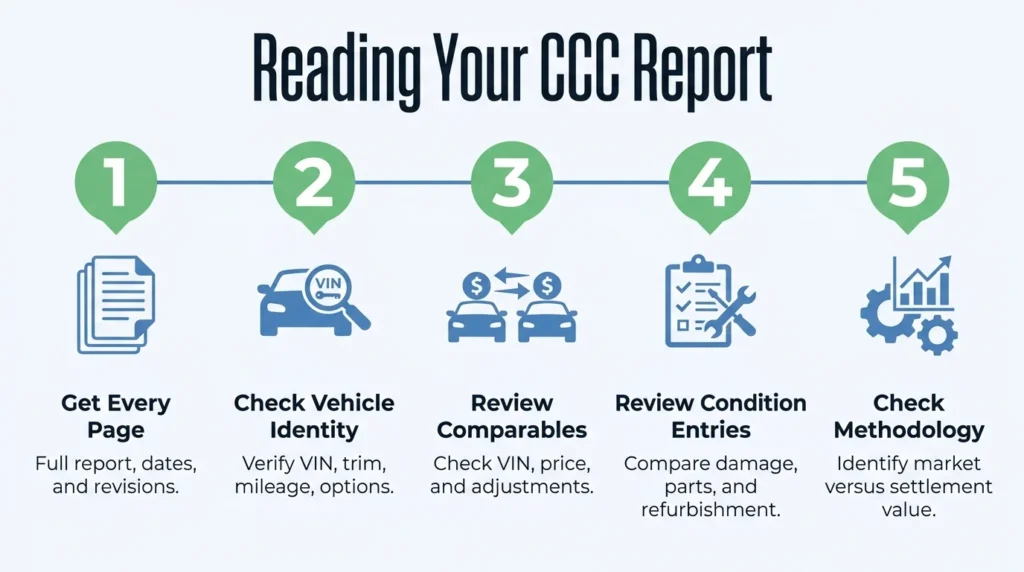
Start with the complete report, its valuation date, and any revisions. The layout may differ between CCC and Mitchell reports, but you can use the following steps to review the information.
1. Get every page. Ask the adjuster for the full report, including the valuation date, methodology, comparable vehicle details, condition notes, and revisions. CCC’s February 2026 release notes identify the Market Valuation Summary and Market Valuation Report as separate documents, so confirm that you received the complete report.
2. Check your vehicle’s identity. Compare the VIN, year, trim, drivetrain, mileage, packages, and options with your records. Mitchell’s documentation describes how it uses VIN decoding, manufacturer build sheets, and package information. Check those details against your window sticker, build sheet, or service records.
3. Review each comparable vehicle. Check its VIN, source, listing date, location, asking price, adjustments, and adjusted value. Mitchell’s U.S. brochure describes these comparison fields.
4. Review your car’s condition entries. Compare the pre-loss condition assessment, prior damage, aftermarket parts, and refurbishment entries with your photographs and receipts.
5. Check the methodology and summary. Identify the market value separately from the settlement value. Mitchell’s report guidance describes local, regional, national, dealer-quote, and specialty valuations. Check which method the report used and whether it relied on historical trends or dealer quotes.
Which Valuation Adjustments Should You Check?
Before judging the amount, check what each adjustment compares. Some entries reconcile differences between a comparable vehicle and yours. Others address your car’s own condition.
A negative entry is not automatically wrong. A comparable with lower mileage or more options can properly receive a deduction. Test the inputs, reference point, amount, and explanation against your evidence.
|
Adjustment |
What to check |
|
Mileage |
Your mileage at the crash and the comparable’s odometer reading |
|
Configuration and equipment |
Incorrect trim, drivetrain, packages, or missing options |
|
Condition |
Which vehicle is being rated, the reference standard, and supporting photos or records |
|
Prior damage |
Whether the damage existed before this crash and whether it was repaired |
|
Aftermarket parts and refurbishment |
Receipts and installation or reconditioning records |
|
Projected sold or similar |
The explanation and calculation for reducing an advertised price |
If a projected sold adjustment appears, it may estimate negotiation below an advertised price. A 2023 federal court opinion from Maine reproduced historical Mitchell methodology describing that adjustment. It does not establish how every current report works or what Texas allows. Ask the adjuster to explain the basis and calculation used in your report.
A 2020 New Jersey federal opinion describing an older CCC report distinguished adjustments to comparable vehicles from adjustments to the owner’s vehicle. The court addressed the allegations early and did not find the deductions improper. A deduction applied to a comparable vehicle does not mean your car was damaged. Ask which vehicle and reference condition each entry uses.
Do the Comparable Vehicles Match Your Car and Local Market?
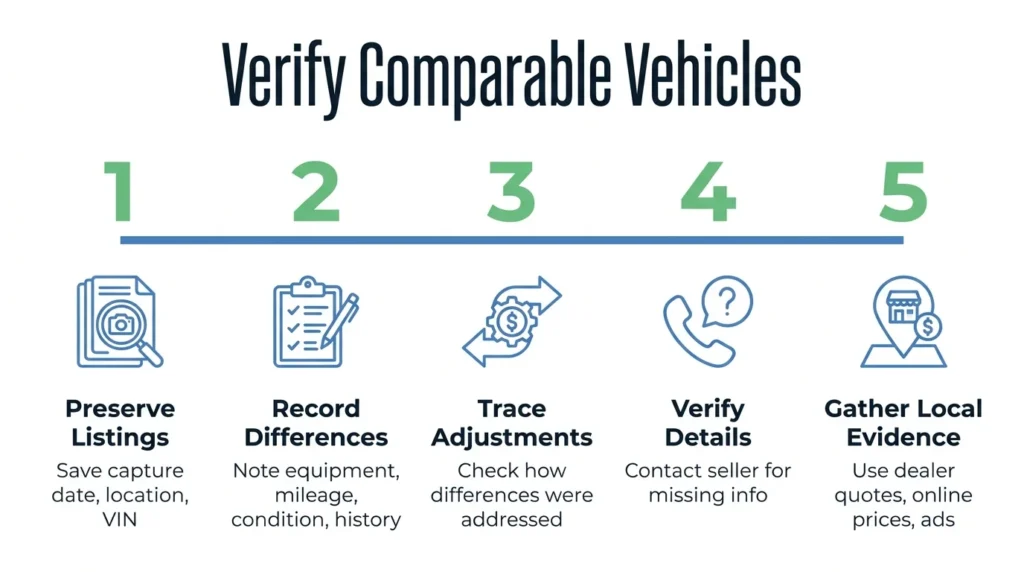
Check whether each vehicle is similar enough to provide a useful comparison and whether adjustments account for material differences. Compare trim, drivetrain, mileage, options, condition, history, listing date, seller location, and price basis.
Local prices may better reflect your Texas market. A distant listing is not automatically unsuitable, but the report should explain why it used a regional or national valuation.
1. Preserve full listings. Save each listing with its capture date, seller location, VIN, and identifying details.
2. Record material differences. Note differences in equipment, mileage, condition, or history. An asking price does not prove what a buyer paid.
3. Trace the adjustments. Check how the report accounted for those differences and flag any it ignored.
4. Verify unclear details. When feasible, contact the seller to confirm missing trim or option information.
5. Gather local evidence. TDI’s totaled-car guidance recommends local dealer quotes, online prices, and local ads, plus documentation of special features or custom parts.
Do not assume a fixed search radius or minimum listing count applies. Focus on how well the evidence reflects your car and market.
How Do You Send a Counter-Valuation to the Insurer?
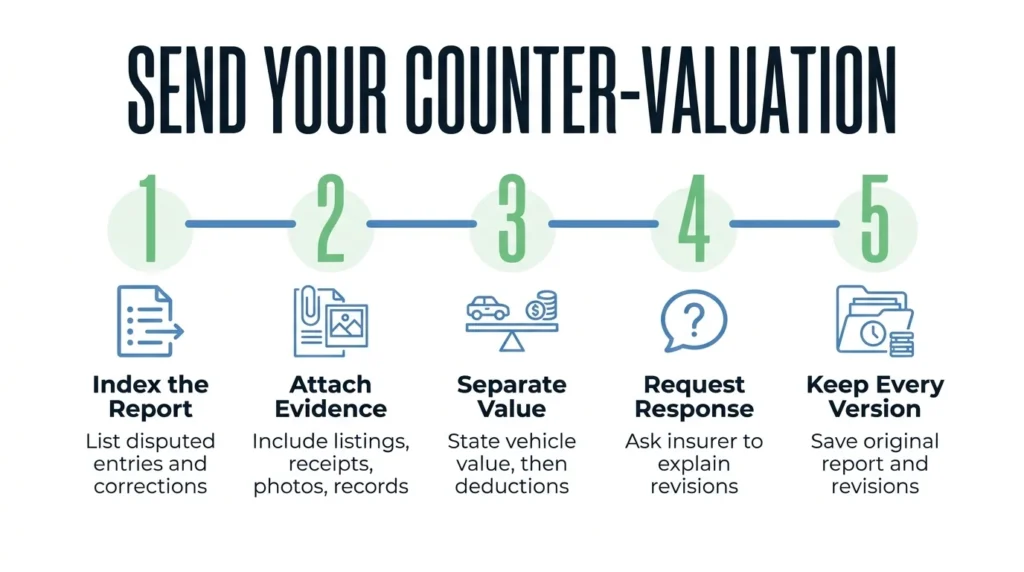
Send your counter-valuation in writing and organize each disputed entry with the correction you are requesting and the document that supports it. This format allows the adjuster to respond line by line.
1. Use the report as your index. Make a table with columns for the disputed entry, requested correction, and supporting attachment.
2. Attach your evidence. Include relevant local listings or quotes, a build sheet or window sticker, mileage records, pre-crash photographs, and maintenance or upgrade receipts.
3. Separate value from payment. State your proposed vehicle value first, then address payment deductions separately.
4. Request a written response. Send the counter-valuation to the insurer and ask for an explanation and any resulting revisions to the report.
5. Keep every version. Save the original report, revisions, and everything you sent.
Receipts help document equipment and condition during a counter-valuation or later Texas auto insurance appraisal. They do not guarantee dollar-for-dollar credit or a higher offer, but they give the adjuster specific evidence to review.
Get Help Reviewing the Valuation
Gather the full valuation report, comparable listings, counter-valuation, and records supporting your car’s condition and equipment. If the crash also injured you, Angel Reyes & Associates can review the valuation as part of your broader Texas car accident claim.
Our firm has guided injured Texans for over 30 years and is available 24/7. Bring your documents to a free consultation to discuss the valuation and any related injury claim.
Past results do not guarantee future outcomes.
Total Loss Valuation FAQs
Does a Texas total loss settlement include sales tax and title fees?
Texas total loss settlements may include applicable sales tax and title or transfer fees, depending on the insurance coverage and claim circumstances. Review these amounts separately from the vehicle’s actual cash value to determine whether the settlement accounts for them correctly.
Can you dispute a total loss valuation if the insurance company uses outdated vehicle prices?
Yes. If the insurer relies on outdated market data that does not reasonably reflect your vehicle’s pre-loss value, you can challenge the valuation with more recent pricing evidence from comparable vehicles.
What happens if you accept a total loss settlement and later discover a valuation error?
Whether you can seek additional payment depends on the settlement documents and whether you released further claims. Review any agreement before signing because accepting a final settlement may limit your ability to reopen the dispute.
Can you file a complaint about an inaccurate CCC valuation report in Texas?
You can file a complaint with the Texas Department of Insurance if you believe your insurer handled the valuation unfairly. The department can review claim-handling practices but generally cannot determine your vehicle’s value or require a higher settlement solely because you disagree with the offer.
Does a total loss valuation affect how much your lender receives?
The valuation helps determine the available insurance settlement, but an outstanding auto loan generally gives the lender the right to be paid from those proceeds. If the settlement exceeds the remaining loan balance, the excess typically goes to the vehicle owner, subject to applicable deductions.
About the Authors

Angel Reyes
Writer
Angel L. Reyes, III is the Founder and Managing Partner of Angel Reyes & Associates. A nationally recognized trial attorney and business leader, Angel founded the firm in 1993, which has gone on to help over 70,000 injury victims recover more than $1 billion. Named to the Texas Super Lawyers list annually since 2008, Angel brings Wall Street experience, Ivy League education, and a deep commitment to client advocacy. He is a frequent legal commentator and published author with extensive contributions to legal scholarship, trial strategy, and consumer protection.

Graham Griffin
Editor
Graham Griffin is the Web & Content Manager at Angel Reyes & Associates, where he oversees content strategy, AI-powered workflows, a...

Angel Reyes
Reviewer
Angel L. Reyes, III is the Founder and Managing Partner of Angel Reyes & Associates. A nationally recognized trial attorney and business...