Can Your Lawyer Help You With Negotiating Medical Bills After a Settlement?


Every article on this site is researched by our internal team, reviewed for legal accuracy against current Texas law, and held to State Bar of Texas advertising standards before publication. We do not publish content that overstates outcomes or makes promises about results.
Learn more about our
editorial standards .
Key Takeaways
- A lawyer can request lower medical payoffs, but reductions need agreement or a legal basis.
- Rule 1.15 protects disputed funds only when a claimant has a qualifying interest in them.
- Get every reduced payoff in writing and check each one on your final settlement statement.
When you get your medical bills after a car accident, you might not know where to turn first. It’s also normal to wonder if your attorney can negotiate your bills down.
Yes, your lawyer can ask medical providers to lower what you owe and address valid claims against your settlement before the money is distributed. A reduction requires agreement or another legal basis, such as correcting a billing error. With other deductions unchanged, a lower payoff increases what you keep without changing the gross settlement.
When you are facing bills after a crash, that take-home amount matters. Negotiating medical bills after settlement starts with checking balances and ends with documenting what each payment resolves. Texas trust-account rules also affect which disputed claims must be resolved before particular funds can be distributed.
Can a Texas Lawyer Ask to Lower Medical Bills Before Distributing a Settlement?
Yes. A lawyer can verify what you owe and request a lower payoff before distributing settlement funds. Texas ethics rules also determine which claims your lawyer must protect.
The current safekeeping rule is Rule 1.15 of the Texas Disciplinary Rules of Professional Conduct.
Older materials may call it Rule 1.14. It requires lawyers to separate client and third-party funds from their own and deliver funds promptly to those entitled to receive them, subject to the rule’s exceptions.
For a medical creditor with a qualifying interest in particular settlement funds, paragraph (c) requires protecting the disputed portion while distributing the undisputed remainder appropriately.
Why an Ordinary Medical Bill Is Different From a Claim on Your Settlement
Texas Professional Ethics Committee Opinion 681 explains that a creditor needs a matured legal or equitable interest in the particular funds. Examples include a valid statutory lien, assignment, subrogation right, qualifying letter of protection, or court order addressing those funds.
Providing treatment alone does not create that interest. An ordinary debt does not authorize a lawyer to withhold your money against your instructions. That does not erase the debt.
The opinion is nonbinding guidance. For a disputed protected claim, the lawyer holds the disputed amount and seeks resolution rather than deciding the parties’ dispute alone. Negotiation is one option; a court proceeding called interpleader may be another. An unpaid bill alone does not freeze your entire settlement.
How Does a Lawyer Check What Is Actually Owed?
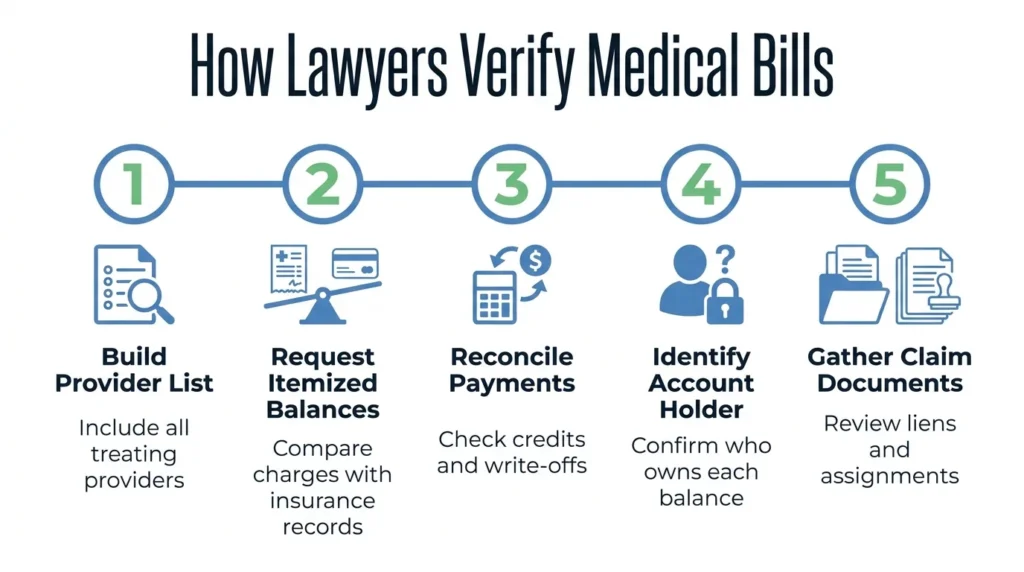
A review starts with an account list and current itemized balances, then reconciles charges, payments, and insurance adjustments. Correcting a billing error differs from negotiating a valid charge.
If you are seeking help with a Texas car accident claim, ask how outstanding balances will be reviewed. A lawyer can use this workflow:
- Build the provider list with you. Include hospitals, physicians, imaging centers, therapy providers, and other accounts in your records.
- Request itemized balances. Compare service dates and charges with records and insurance explanations of benefits. CMS recommends checking for billing errors, including duplicate charges.
- Reconcile payments and adjustments. Check insurance payments, credits, and write-offs.
- Identify the account holder. Confirm who owns or administers each balance, including any collector.
- Gather claim documents. Review liens, assignments, letters of protection, and reimbursement correspondence.
A tracking sheet can record each account, services, billed total, adjustments, claimed balance, basis for a claim to settlement funds, requested reduction, accepted payoff, and remaining obligation.
Itemization helps verify the starting balance; it does not reduce the bill by itself.
Which Medical Balances Can Be Reviewed for a Lower Payoff?
Hospital, physician, imaging, and therapy accounts can all be reviewed. No provider type is certain to accept less. The account’s legal status and the creditor’s response count.
A billing office may consider a lower bill, payment terms, or financial assistance. CMS guidance on medical bill payment options addresses patients who did not use insurance and cannot afford a facility bill. Its protections do not automatically apply to every accident claim.
Hospital Liens Follow Their Own Rules
A hospital bill is not automatically a valid, perfected lien. Texas Property Code Chapter 55 sets eligibility, attachment, amount, and notice requirements. A lawyer should check the lien documents against those requirements.
A statutory limit on a lien does not automatically erase the underlying bill. Letters of protection and assignments also require review of the actual agreement before treating the balance as an ordinary unsecured debt.
Insurance & Government Reimbursement Claims Are Separate
Medicare conditional-payment recovery concerns payments Medicare made, rather than an unpaid provider bill. CMS tells beneficiaries and attorneys to address reimbursement during settlement negotiations. Interim conditional-payment information can change, and documentation can support removing unrelated charges.
Medicare’s demand, appeal, and waiver procedures differ from asking a provider for a discount. If Medicaid paid for treatment, Texas HHSC guidance addresses reimbursement from settlements. A private insurer’s subrogation claim also needs separate review.
What Should a Reduction Request & Agreement Show?
A request should identify the account, verified balance, proposed payoff, and what payment would resolve. Financial circumstances and available settlement funds can support a request, but neither creates an automatic right to a concession.
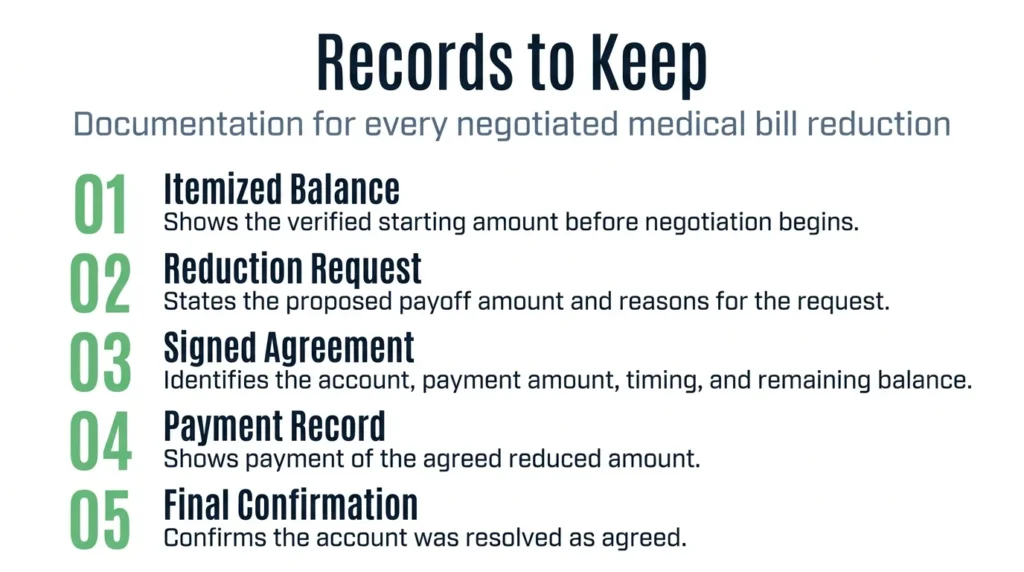
Before paying a reduced amount, obtain an authorized written acceptance. Keep these records together:
- Itemized balance showing the verified starting amount.
- Reduction request stating the proposed payoff and reasons.
- Signed agreement or authorized written acceptance identifying the account, payment amount, timing, and what remains owed, if anything.
- Payment record showing payment of the agreed amount.
- Final account confirmation showing resolution as agreed.
The acceptance should say whether payment fully satisfies the debt and whether a separate lien release is needed. A verbal assurance or partial payment does not prove the remaining debt is gone. For a Chapter 55 lien, section 55.006 provides for a filed discharge certificate when the covered debt is paid or released.
CFPB guidance on settling with a debt collector advises getting the collector’s promises in writing before paying. Written provider-payoff confirmation is also a practical safeguard; the cited guidance specifically concerns collectors.
How Does a Lower Payoff Change the Client’s Net Recovery?
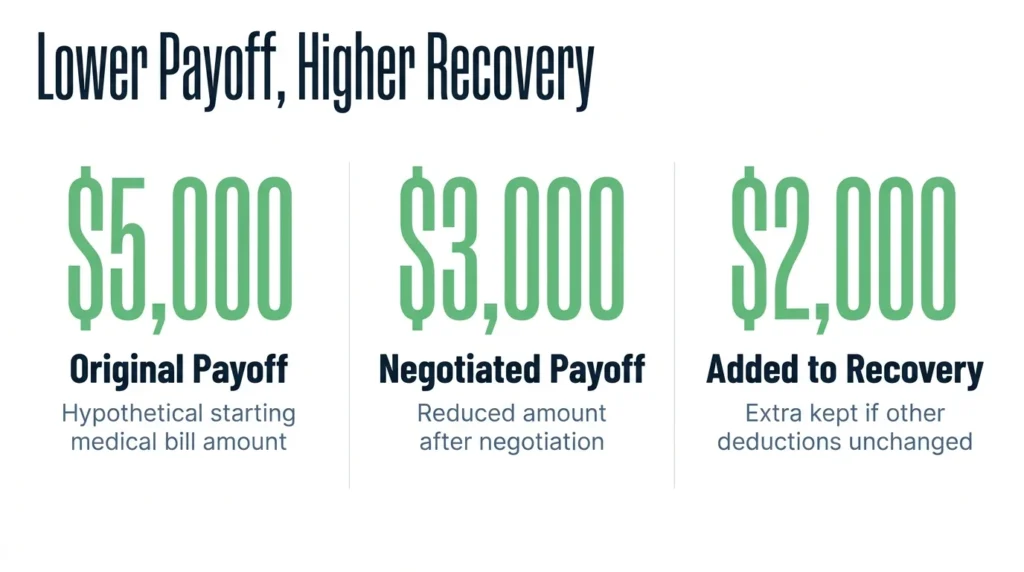
If every other deduction stays fixed, a lower payoff leaves more money for you. Efforts to reduce medical bills after a car accident can therefore improve your take-home amount without changing the gross settlement.
Start with the gross settlement and subtract attorney fees, case expenses, and authorized or legally required payoffs to calculate net recovery. If a disputed protected amount remains in trust, distinguish it from cash currently paid to you.
For a hypothetical example, reducing a $5,000 payoff to $3,000 adds $2,000 to net recovery if every other deduction stays fixed. This illustrates arithmetic, not a typical reduction or predicted result.
Avoid double-counting: a provider bill already paid by insurance should not be deducted again alongside the insurer’s reimbursement claim.
What Your Final Settlement Statement Should Show
Texas Rule 1.04(d) requires a written statement at the conclusion of a contingent-fee matter describing the outcome and, when there is a recovery, your remittance and how it was determined.
A clear statement should list each actual payoff and explain any holdback. Compare it with the itemized balances, accepted reduction agreements, and payment records.
Ask Angel Reyes & Associates About Your Medical Bills After a Crash
For a free consultation about your Texas injury claim, gather available bills, insurance explanations of benefits, lien notices, and reimbursement letters.
Contact Angel Reyes & Associates to review your situation and options. Our attorneys are here to help.
Past results do not guarantee future outcomes.
Medical Bill Negotiation FAQs
What happens to medical bills if my car accident settlement is not enough to pay them all?
The available settlement may not cover every outstanding balance, so each account should be reviewed separately to determine whether it is negotiable, subject to a lien or reimbursement claim, or still owed after the settlement.
Can a lawyer negotiate ambulance bills after a Texas car accident?
Yes. Ambulance charges can be included in a medical-account review, although whether the balance can be reduced depends on the provider, the account’s legal status, and any applicable reimbursement or lien rights.
How long does it take to negotiate medical bills after a car accident?
There is no fixed timeline because negotiations depend on the number of accounts, the creditors involved, the documentation available, and whether any lien or reimbursement dispute must also be resolved.
About the Authors

Angel Reyes
Writer
Angel L. Reyes, III is the Founder and Managing Partner of Angel Reyes & Associates. A nationally recognized trial attorney and business leader, Angel founded the firm in 1993, which has gone on to help over 70,000 injury victims recover more than $1 billion. Named to the Texas Super Lawyers list annually since 2008, Angel brings Wall Street experience, Ivy League education, and a deep commitment to client advocacy. He is a frequent legal commentator and published author with extensive contributions to legal scholarship, trial strategy, and consumer protection.

Graham Griffin
Editor
Graham Griffin is the Web & Content Manager at Angel Reyes & Associates, where he oversees content strategy, AI-powered workflows, a...

Angel Reyes
Reviewer
Angel L. Reyes, III is the Founder and Managing Partner of Angel Reyes & Associates. A nationally recognized trial attorney and business...