Broken Bone Claims in Bus Accidents in Texas


Every article on this site is researched by our internal team, reviewed for legal accuracy against current Texas law, and held to State Bar of Texas advertising standards before publication. We do not publish content that overstates outcomes or makes promises about results.
Learn more about our
editorial standards .
Key Takeaways
- Bus fractures requiring surgery typically yield higher compensation than non-surgical breaks.
- Public bus injury claims require written notice within six months, or the claim is barred.
- Private bus claims have a two-year filing deadline and no Texas damages cap.
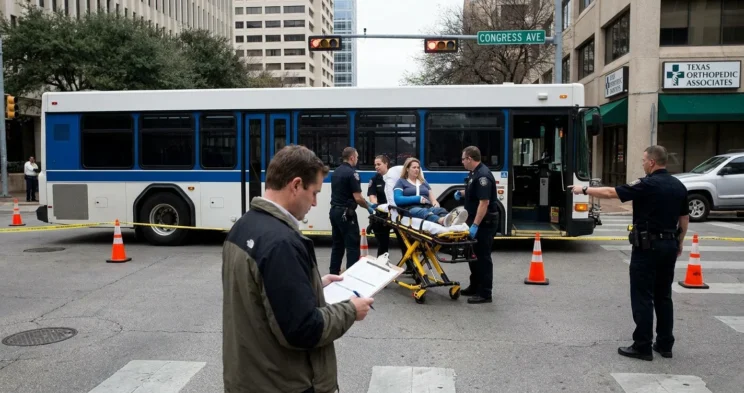
You boarded a Dallas city bus expecting an ordinary ride, when suddenly the driver braked hard, you were thrown forward, and now your wrist is in a cast and you cannot work. The medical bills are stacking up, and you are not sure who pays for any of it. Knowing how these claims work in Texas is the first step toward getting your costs covered.
Fractures that Bus Crashes Commonly Cause
Three fracture types show up again and again after bus crashes: wrist and forearm breaks, hip fractures, and skull or facial fractures. Each follows a different mechanism and a different recovery path.
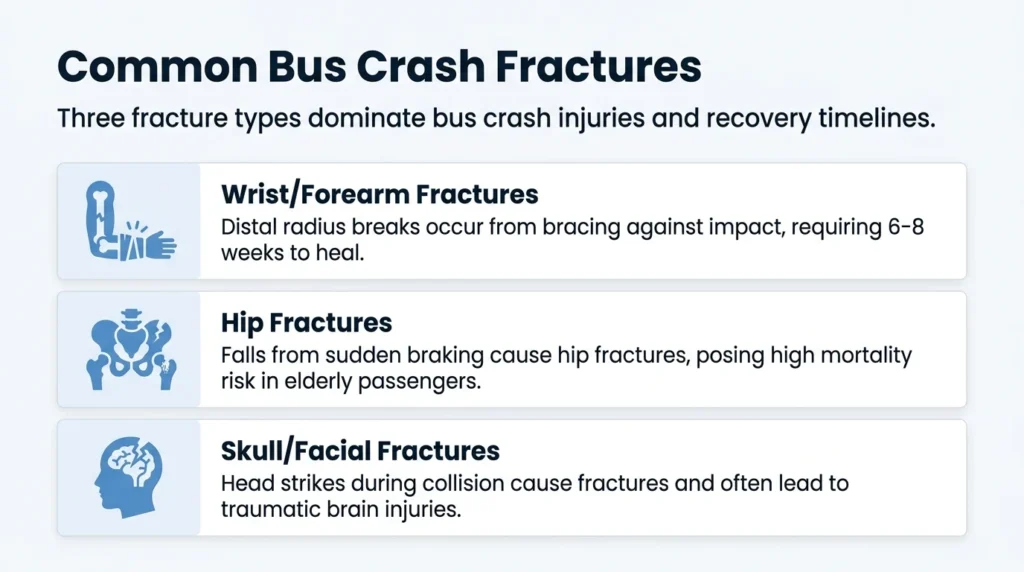
- Wrist and forearm fractures usually come from bracing when passengers grab seat backs or overhead rails, loading full body weight onto the wrist joint, and commonly breaking the distal radius. While a non-displaced fracture often heals with a cast in 6 to 8 weeks, a displaced or shattered break may need open reduction and internal fixation surgery, stretching recovery to 3 to 12 months, and leaving permanent hardware in place.
- Hip fractures come from falls and direct impact when sudden braking or a rollover throws passengers to the floor, hitting riders aged 65 and older hardest. Treatment almost always means surgical fixation or a total hip replacement, then months of rehabilitation; notably, CDC data shows one-year mortality after a hip fracture runs from 17% to 25% among elderly patients, making these injuries a real wrongful death concern.
- Skull and facial fractures come from head strikes against windows, overhead compartments, or from ejection, which can break the skull, orbital bones, or the jaw. These breaks often pair with traumatic brain injury, which raises the value of the claim.
How Fracture Severity Drives Claim Value
Fracture severity is the main factor that sets your settlement range. The more treatment and lasting impairment involved, the higher the recoverable damages.
Settlement values for fracture claims vary widely based on treatment costs, lost wages, and lasting impairment. A non-surgical fracture with full recovery typically yields a lower award than one requiring surgery, inpatient rehabilitation, or implanted hardware, which can result in significantly higher recoveries once future costs and lost earning capacity are counted. You can read more in our guide to the average bus accident settlement in Texas.
Permanent impairment pushes value higher still. When a fracture leaves malunion, arthritis, chronic pain, or limited motion, Texas law allows recovery for future medical costs, future lost earning capacity, and permanent disfigurement.
These future-damages pieces can dwarf your first hospital bill. Proving them usually takes expert testimony from treating orthopedists and vocational specialists.
Economic Damages to Track
Keep records of every cost tied to the injury. A complete list strengthens your claim and protects what you can recover.
- Medical treatment: Emergency transport, orthopedic surgery, anesthesia, inpatient rehabilitation, physical therapy, and follow-up imaging.
- Assistive devices: Walkers, wheelchairs, and other equipment you need during recovery.
- Lost income: Wages missed during recovery and any diminished earning capacity going forward.
- Non-economic harm: Pain and suffering, loss of enjoyment of life, and loss of consortium for hip or skull fractures with lasting effects.
One more rule shapes the final number: Texas follows a modified comparative fault rule for bus accident claims. If you are found partly at fault, say for standing while the bus was moving, your recovery drops by that percentage. If your share of fault is 51% or more, you recover nothing.
Public Bus vs. Private Bus: Different Rules Apply
The type of bus that injured you will change the rules. Public and private operators fall under separate legal systems with different caps and deadlines.
Claims Against Public Transit Buses (TTCA Rules)
Texas government buses fall under the Texas Tort Claims Act (TTCA), which waives sovereign immunity only in narrow cases and adds strict caps and notice rules. This covers city transit authorities, county districts, and state agencies.
The Act waives immunity for injuries caused by a government employee operating a motor vehicle within the scope of their job. That waiver appears in the Texas Civil Practice and Remedies Code (CPRC) § 101.021.
Recovery is capped tightly, and our breakdown of the Texas Tort Claims Act bus accident limits explains how these caps apply.
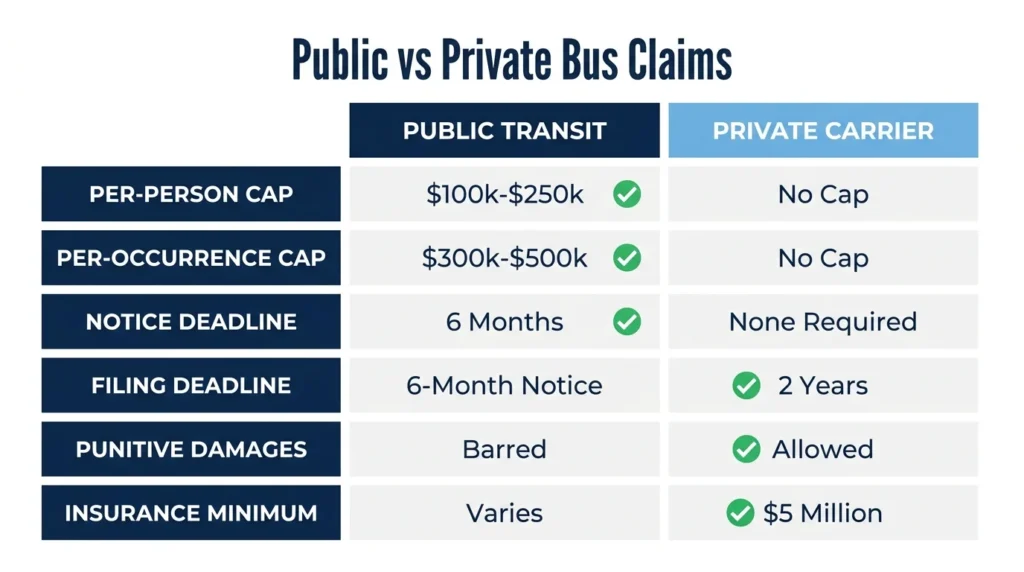
- Under CPRC § 101.023, claims against the state or a municipality are capped at $250,000 per person and $500,000 per occurrence.
- Claims against transit authorities and other units of local government are capped at $100,000 per person and $300,000 per occurrence.
- School districts are also capped at $100,000 per person, and punitive damages are barred.
The notice rule is the trap that ends most public bus claims, and under CPRC § 101.101, written notice must reach the government unit within six months of the crash. It must state the date, time, place, and nature of the injury, and missing this window bars the claim for good. If a public bus injured you, contact an attorney right away to protect that six-month window; you can also learn whether you can sue public transportation in Texas.
Claims Against Private & Charter Bus Operators
The TTCA does not cover private operators, so they get no immunity and no damages caps. This group includes charter companies, tour buses, school contract carriers, and intercity motorcoach lines.
Texas courts hold these operators to a heightened duty of care as common carriers. An operator who breaches that duty faces full compensatory damages with no statutory cap. Punitive damages may also apply for gross negligence or reckless conduct.
Federal rules add another layer. Private interstate operators must follow hours-of-service limits under 49 C.F.R. Part 395, and any violation of those limits can be offered as evidence of negligence per se in Texas litigation.
General driver conduct requirements fall under 49 C.F.R. Part 392. The Federal Motor Carrier Safety Administration’s (FMCSA) bus operator safety resources set out the full compliance standard for commercial carriers.
Coverage tends to be deep. The FMCSA requires for-hire passenger carriers running vehicles that seat 16 or more passengers in interstate commerce to carry at least $5 million in liability insurance.
Deadlines & Steps After a Bus Fracture
Move quickly after a bus crash fracture, because several deadlines are fixed by statute and cannot be waived. The right early steps protect both your health and your claim.
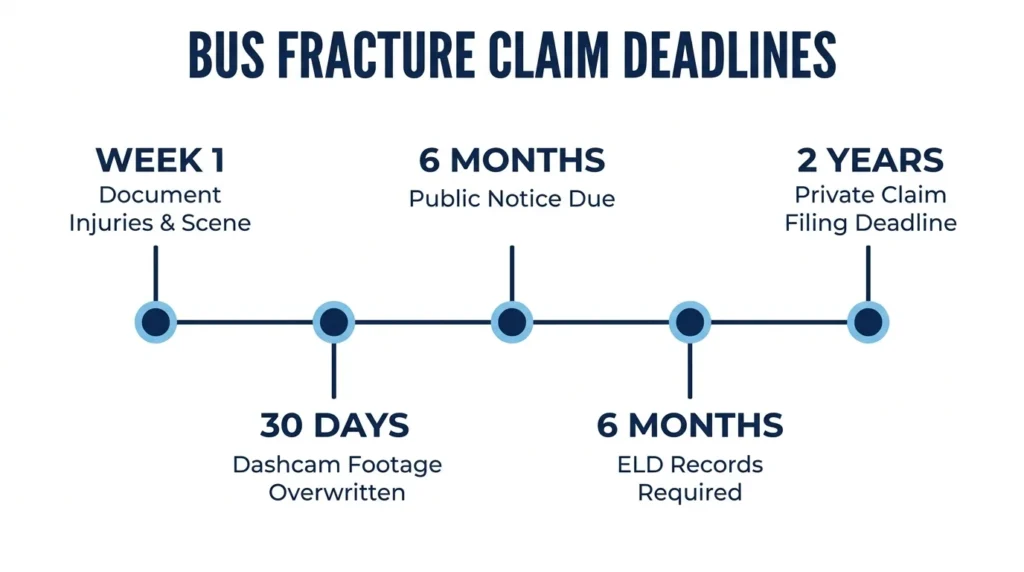
In the first week, get emergency care and make sure every injury is in the medical record, even before surgery is scheduled. Photograph your injuries, the scene, and any bus damage, and keep all paperwork from the operator, transit authority, or police. Our guide on how to file a bus accident claim in Texas walks through each step.
If a government entity runs the bus, written notice is mandatory within six months under CPRC § 101.101. It must name the claimant and state the date, time, place, and nature of the injury. A police report or a phone call does not count, and missing the deadline ends the claim.
Claims against private carriers must be filed in court within two years of the injury under CPRC § 16.003. Minor claimants have until two years after turning 18 under CPRC § 16.001.
Evidence also disappears fast. Electronic logging device data and hours-of-service records must be kept for at least six months under federal law, but dashcam footage has no federal retention floor and is often overwritten in 30 days. An attorney can send a litigation hold letter that forces the bus company to preserve those records before they vanish, and clients describe that kind of fast action in our client reviews and testimonials.
Talk to a Texas Bus Accident Attorney
The clock is already running on your claim. If a public bus injured you, the six-month notice deadline can end your case before you even realize it exists, and key evidence can be erased in weeks. Angel Reyes & Associates handles bus accident fracture claims across the entire state of Texas, with more than 20 offices statewide, and we move fast to preserve your notice rights and the records that prove your case.
With over 30 years of experience and more than $1 billion recovered for clients, we know how to take on transit authorities and private carriers alike. We offer free consultations, we speak Spanish, and you pay no fee unless we win. Reach out today for a free consultation and let us protect your claim.
Past results do not guarantee future outcomes.
Broken Bones & Bus Accidents FAQs
Does a pre-existing condition like osteoporosis reduce what I can recover for a fracture?
Texas follows the eggshell plaintiff rule, which means a negligent party is responsible for all the harm they caused, even if a condition like osteoporosis made your bones more fragile. You can recover damages for how the crash worsened your condition, though you cannot recover for any impairment that existed before the accident.
If I were riding the bus on the way to work and got hurt, can I file a workers' compensation claim?
Ordinary commutes are excluded from workers’ compensation coverage under Texas’s going-and-coming rule, so a standard bus ride to work is not covered. The exception is when your employer directly furnished or paid for the transportation as part of your job duties, in which case the injury may fall within the course and scope of employment.
Can the six-month notice deadline for a public bus claim ever be excused?
Texas courts recognize an actual-notice exception under CPRC § 101.101(c) when the government unit had direct knowledge of the incident, the injury, and its own possible role in causing the harm before the deadline passed. Courts apply this exception narrowly, and the burden falls on the injured person to prove the agency actually had that knowledge, so relying on a police report or an incident form filled out at the scene is rarely enough.
If many passengers were all injured in the same bus crash, does that affect how much I can collect?
Each injured passenger files a separate claim, but when the operator is a government entity, the $500,000 per-occurrence cap under CPRC § 101.023 is shared across all claimants. If total injuries across the crash exceed that ceiling, every passenger’s individual recovery may be reduced proportionally.
Do federal safety rules apply to a bus company that only runs routes inside Texas?
Texas-only bus operators are not subject to direct Federal Motor Carrier Safety Administration enforcement, but the Texas Department of Public Safety has adopted the federal motor carrier safety regulations for intrastate commercial vehicles with only limited exceptions. Violations of those adopted rules can still be used as evidence of negligence in a Texas lawsuit, much the same as violations of the federal regulations themselves.
About the Authors

Angel Reyes
Writer
Angel L. Reyes, III is the Founder and Managing Partner of Angel Reyes & Associates. A nationally recognized trial attorney and business leader, Angel has helped over 70,000 injury victims recover more than $1 billion since founding the firm in 1993. Named to the Texas Super Lawyers list annually since 2008, Angel brings Wall Street experience, Ivy League education, and a deep commitment to client advocacy. He is a frequent legal commentator and published author with extensive contributions to legal scholarship, trial strategy, and consumer protection.

Graham Griffin
Editor
Graham Griffin is the Web & Content Manager at Angel Reyes & Associates, where he oversees content strategy, AI-powered workflows, a...

Angel Reyes
Reviewer
Angel L. Reyes, III is the Founder and Managing Partner of Angel Reyes & Associates. A nationally recognized trial attorney and business...