Bus Accident Whiplash and Soft Tissue Injuries in Texas


Every article on this site is researched by our internal team, reviewed for legal accuracy against current Texas law, and held to State Bar of Texas advertising standards before publication. We do not publish content that overstates outcomes or makes promises about results.
Learn more about our
editorial standards .
Key Takeaways
- Whiplash and soft tissue injuries are real, even when X-rays and MRIs show nothing.
- Soft tissue symptoms often peak 24 to 72 hours after a bus crash, not right away.
- Government bus claims need written notice within six months and cap damages at $250,000.

You were riding the DART bus home through downtown Dallas when the driver hit the brakes to avoid a stalled car. Your head snapped forward, then back, and you walked away thinking you were lucky. Two days later, your neck is stiff, your shoulders ache, and you cannot turn your head without pain. Now you are wondering whether those delayed symptoms point to whiplash and what you should do next.
Whiplash vs. Soft Tissue Injuries Explained
Whiplash and soft tissue injuries are among the most common injuries after a bus accident. They can be painful, disruptive, and surprisingly difficult to prove because they often do not appear on a standard X-ray.
Whiplash (Cervical Strain)
Whiplash happens when your neck is forced rapidly forward and backward during a crash. That sudden movement can stretch or tear the muscles, ligaments, and tendons in your neck before your body has time to brace for the impact.
Standard X-rays often look normal because they cannot show injuries to muscles, ligaments, and tendons the way they show broken bones. Depending on your symptoms, your doctor may order an MRI or other imaging to look more closely at the soft tissues in your neck.
Doctors often rely on your symptoms, physical examination, and medical history to diagnose whiplash. Most people with a bus accident whiplash injury feel neck pain, stiffness, headaches, a deep shoulder ache, and a limited range of motion when they try to turn or tilt their head.
Early medical records are often some of the most important evidence in a whiplash claim. A doctor who documents your whiplash and neck injury symptoms soon after the crash creates a record that supports your injury, even when an X-ray appears normal.
Other Soft Tissue Injuries
A bus crash can also strain muscles, ligaments, and tendons throughout your back, shoulders, and knees. Sprains, strains, contusions, and torn ligaments also rarely appear on a standard X-ray.
Where you were sitting changes your risk. Passengers seated without a seatbelt, or standing when the crash happens, get thrown harder and farther, which raises the odds of a serious soft tissue injury that victims often underestimate.
Why Symptoms Often Appear Days Later
Soft tissue symptoms often peak 24 to 72 hours after the crash, not the moment it happens. So feeling fine when you step off the bus does not mean you walked away uninjured.
Delayed symptoms after a crash are often caused by the adrenaline that floods your body during a crash and masks pain, while inflammation in the strained tissue takes time to build. By the time the swelling sets in, you may be a day or two removed from the accident.
For some people, the pain emerges slowly and then worsens over several days or even weeks. A stiff neck on Monday can become a debilitating headache by Thursday.
This delay can create issues with your bus accident claim. Wait to see a doctor, and an insurer can argue your injury came from something other than the crash, since the records do not start until days later.
Get a medical evaluation right after any bus accident, even if nothing hurts yet, and keep notes as new symptoms appear. If you are already experiencing neck or back pain days after a bus accident, a quick evaluation can create a documented record linking your symptoms to the crash.
How Insurers Challenge Soft Tissue Claims
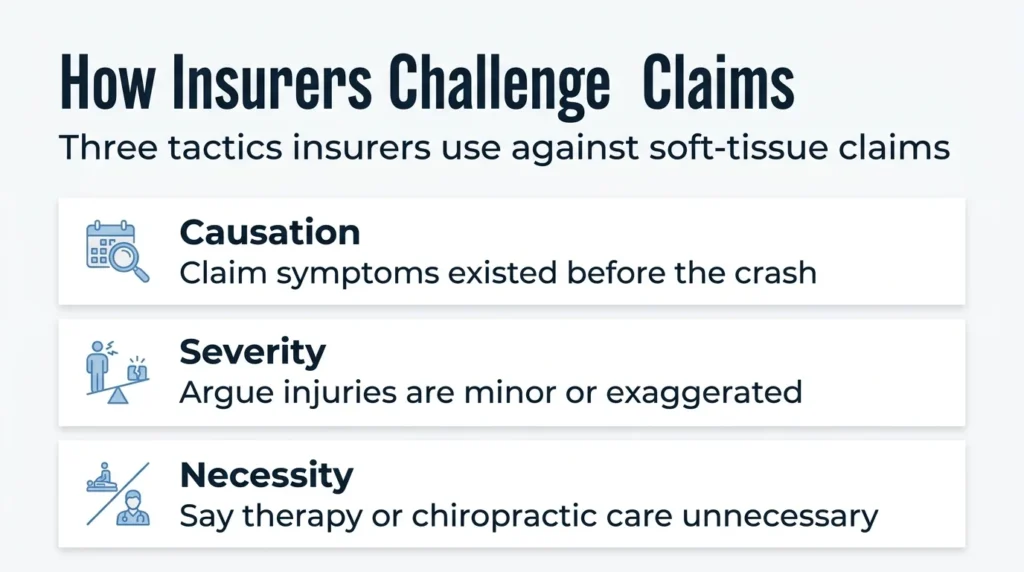
Insurance companies tend to challenge soft tissue claims in three main ways: they question what caused the injury, how serious it really is, and whether the treatment was necessary. They may argue your symptoms existed before the crash, that your injuries are minor or exaggerated, or that physical therapy and chiropractic care were unnecessary.
When a government entity operates the bus, the claim can become even more complicated. The transit agency or its insurer may raise sovereign immunity defenses and statutory liability caps early in the process, hoping that the added legal complexity will encourage a quick, low settlement.
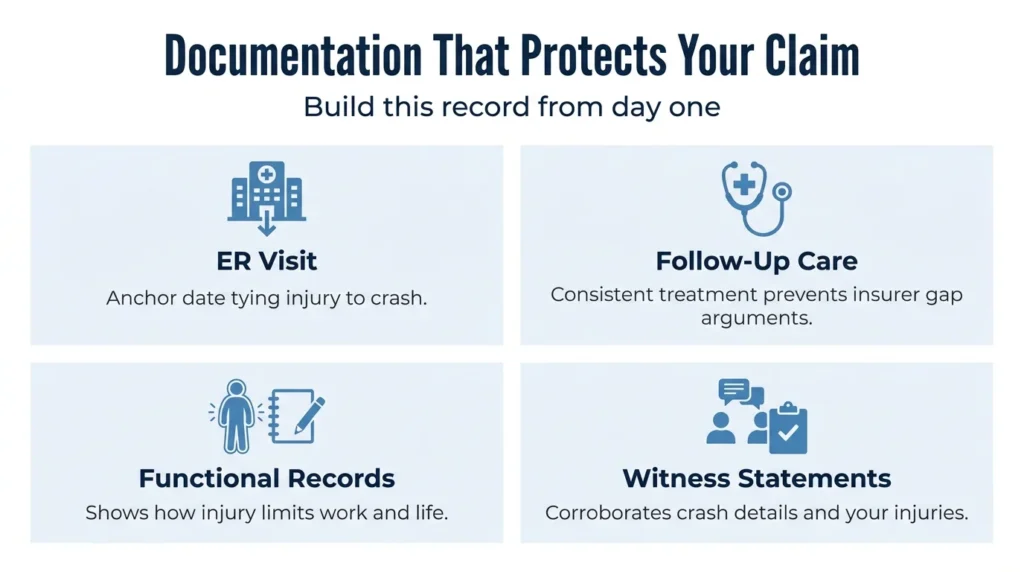
If you’re seeking whiplash injury compensation, the strongest response is thorough documentation. Build the following documentation from day one to protect your claim.
Emergency room or urgent care visit on the day of or after the crash. This is the anchor date that ties your injury to the accident and undercuts the causation argument.
Consistent follow-up care with a treating physician, orthopedist, or neurologist. Gaps in treatment let an insurer claim you healed or were never hurt.
Functional capacity records showing how the injury limits your work and daily life. These connect invisible pain to real, measurable loss.
Witness statements from passengers or bystanders on the bus. Independent accounts corroborate what happened and how you were affected.
Keeping records can also help you reach a better settlement. The type and severity of your injury play a major role in determining compensation, which is one reason average bus accident settlements can differ so much from one claim to another.
Texas Legal Deadlines & Limits for Bus Claims
Your deadline depends entirely on who operated the bus. A government-run bus and a private bus follow completely different rules, and confusing the two can cost you the claim.

Claims Against Government-Operated Buses
Government entities operate city buses, public school district buses, and transit authority vehicles, so your claim falls under the Texas Tort Claims Act. That law sets a strict notice deadline and caps what you can recover.
You must give the government entity formal written notice of your claim within six months of the incident under the Texas Civil Practice and Remedies Code (CPRC) Chapter 101. Miss that window and your claim can be barred entirely, no matter how serious your injury.
The Act also caps damages, though the ceiling depends on which type of government entity ran the bus. For the state or a municipality, the cap is $250,000 per person. For other local government units (such as county transit authorities or regional transit districts), the limit drops to $100,000 per person. That ceiling makes documenting the full extent of your injury even more important, since you cannot afford to leave provable losses unclaimed.
Claims Against Private Bus Operators
Charter buses, intercity coaches, and contracted school bus operators are private companies held to the common carrier standard, not government caps. Your deadline here is longer, and the available coverage is usually higher.
Texas gives you two years from the date of injury to file a personal injury lawsuit under CPRC § 16.003. That is a hard deadline, and missing it almost always ends the case before it starts.
Federal rules raise the stakes on coverage. Interstate operators running vehicles that seat 16 or more passengers must carry at least $5 million in liability coverage under FMCSA financial responsibility rules. Texas adds its own financial responsibility requirements for commercial operators under the Transportation Code Chapter 601.
Whether a government agency or a private company ran your bus, the rules that govern your claim diverge sharply, and an attorney can pin down exactly which deadlines and caps apply to your situation.
Talk to an Attorney About Your Case
A whiplash or soft tissue injury from a bus crash is harder to prove than a broken bone, but it is no less real, and you should not face an insurer alone. Angel Reyes & Associates has represented injured Texans for over 30 years, handling the medical documentation, insurer negotiations, and government notice filings these claims demand.
We offer free initial consultations and work on a contingency basis, meaning no fee unless we win your case. We have more than $1 billion recovered for clients across Texas, and our client reviews and testimonials reflect how we have handled injury claims like yours.
To talk with an attorney about your bus accident injury, reach out to us for a free consultation.
Past results do not guarantee future outcomes.
Whiplash and Soft Tissue FAQs
How long does whiplash last after a bus accident?
Mild whiplash often resolves within a few weeks with consistent treatment, while moderate to severe cases can last several months or longer. Recovery depends on the extent of the cervical strain, how quickly treatment begins, and individual factors such as age and prior injury history.
Can you file a claim for whiplash if you were a passenger on the bus?
Yes. Passengers injured on a bus can file a personal injury claim against the bus operator because bus companies owe riders a heightened duty of care as common carriers. Which deadlines and liability limits apply depends on whether the bus was run by a government agency or a private company.
Can I still file an injury claim if I did not go to the hospital on the day of the crash?
You can still file, but a gap between the accident and your first medical visit gives the insurer an opening to argue that something else caused your pain. Seeking care as soon as possible after symptoms appear strengthens the connection between your injury and the crash.
Does it matter if I was partly at fault for the bus accident?
Texas follows a modified comparative fault rule, so you can still recover damages if your share of fault is 50 percent or less. Your total recovery is reduced by your percentage of fault under Texas Civil Practice and Remedies Code Section 33.001.
What types of damages can I recover for a soft tissue injury from a bus accident?
A soft tissue injury claim can cover medical bills, future treatment costs, lost wages, and pain and suffering. Future medical expenses are part of the calculation too, so it is worth waiting until your doctor has a clear picture of your long-term needs before settling.
About the Authors

Angel Reyes
Writer
Angel L. Reyes, III is the Founder and Managing Partner of Angel Reyes & Associates. A nationally recognized trial attorney and business leader, Angel has helped over 70,000 injury victims recover more than $1 billion since founding the firm in 1993. Named to the Texas Super Lawyers list annually since 2008, Angel brings Wall Street experience, Ivy League education, and a deep commitment to client advocacy. He is a frequent legal commentator and published author with extensive contributions to legal scholarship, trial strategy, and consumer protection.

Graham Griffin
Editor
Graham Griffin is the Web & Content Manager at Angel Reyes & Associates, where he oversees content strategy, AI-powered workflows, a...

Angel Reyes
Reviewer
Angel L. Reyes, III is the Founder and Managing Partner of Angel Reyes & Associates. A nationally recognized trial attorney and business...